
Friend and brother-in-law of George Morland, James Ward (1769–1859) was six years younger, and just as successful, becoming one of the major British artists, alongside the younger John Constable (1776-1837) and JMW Turner (1775-1851). Yet Ward has been forgotten since. In this and the following two articles, I try to do him and his art a little justice.
Like Turner, James Ward was born into a relatively poor family in London. His father was a cider and fruit merchant, who unfortunately fell victim to excessive cider consumption, leaving his mother destitute. His older brother managed a good education and became a leading engraver, but James was put to work filling bottles of cider, then washing bottles, rather than being sent to school. He started his apprenticeship with the leading engraver of the day, John Raphael Smith, in 1781 or 1782, just as his brother William was completing his own.
His talent for drawing became apparent during that apprenticeship, and James was producing plates in his own name from 1784. At around that time, he first came into contact with George Morland, who was then at the height of success and relatively free of debts and drink. Morland married Anne Ward (James’s sister) in July 1786, and a month later William Ward married Maria, Morland’s sister.
Although the joint household of the Morlands and Wards lasted only three months, William and James Ward remained good friends with George Morland, and this enabled James Ward to start learning to paint in oils. In 1791, when he completed his apprenticeship as an engraver, Ward wanted to become Morland’s pupil, but the irascible Morland refused. Ward continued to teach himself, largely by copying Morland’s paintings and other works that came in for him to engrave, and by 1793, he had sold some of his more original paintings of rustic scenes, and made and published engravings from them.
In about 1793, he had his first four paintings accepted for exhibition at the Royal Academy, and his work was bringing him a good income. Soon after that, Morland fell out with him, something Ward came to value as Morland’s debts and problems mounted. Ward himself had periods when the stress of life seemed to overcome him: in 1794, with the outbreak of war with France, he lost a lucrative market for his prints. However, he fell in love with the unrelated Emma (or possibly Mary Ann!) Ward, and married her in early December.
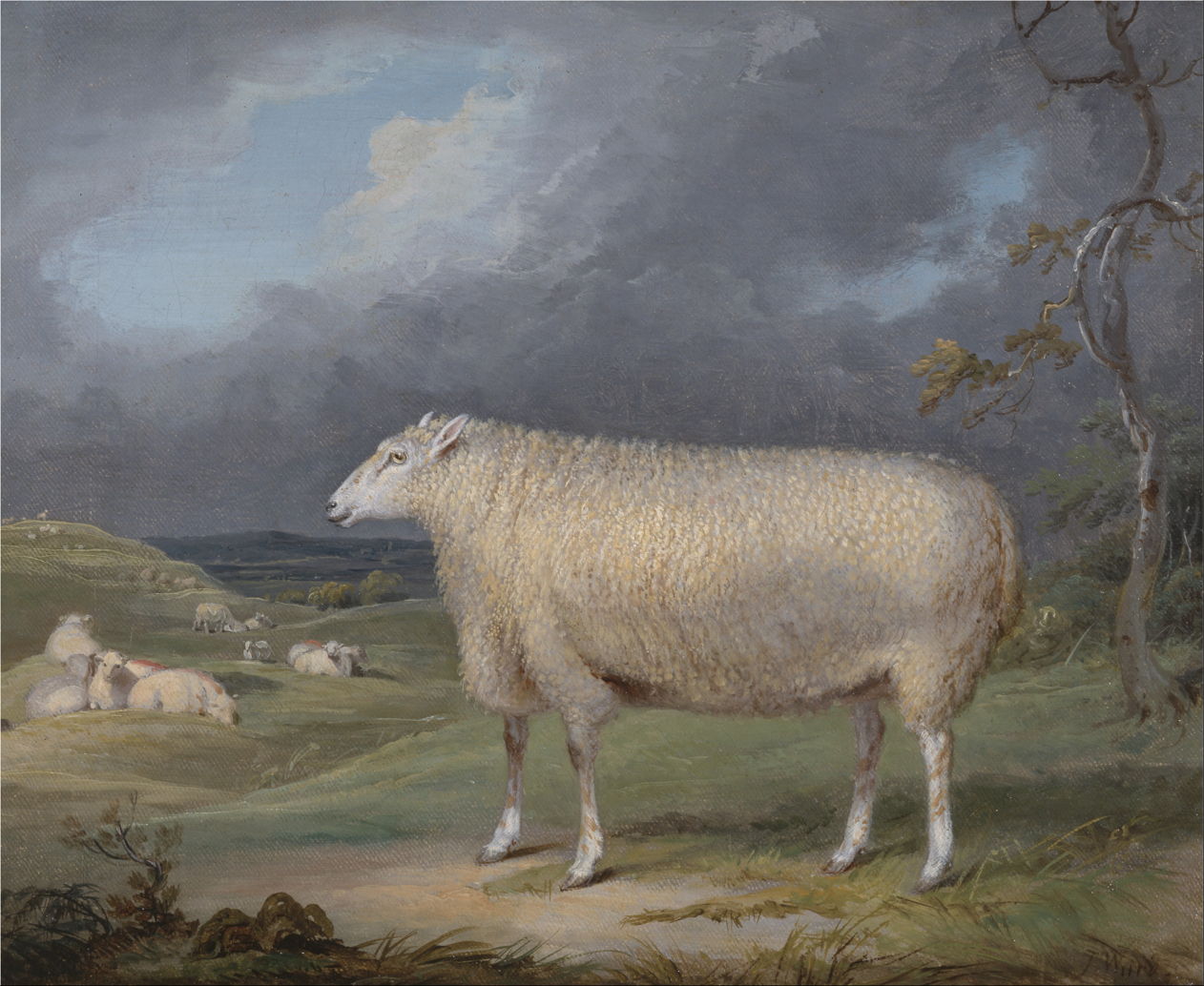
Ward’s early paintings were influenced by Morland, and showed farm animals, such as his A Border Leicester Ewe (1795-1800), and rustic scenes. This particular breed, which today at least has larger ears, was developed in Northumberland, England, in 1767, so was a recent introduction. This was probably part of an uncompleted commission to travel around the whole of Britain documenting its farm breeds for the Agricultural Society, which he undertook from 1800. His paintings were to be engraved and published by Josiah Boydell, but that project foundered in 1805-7.
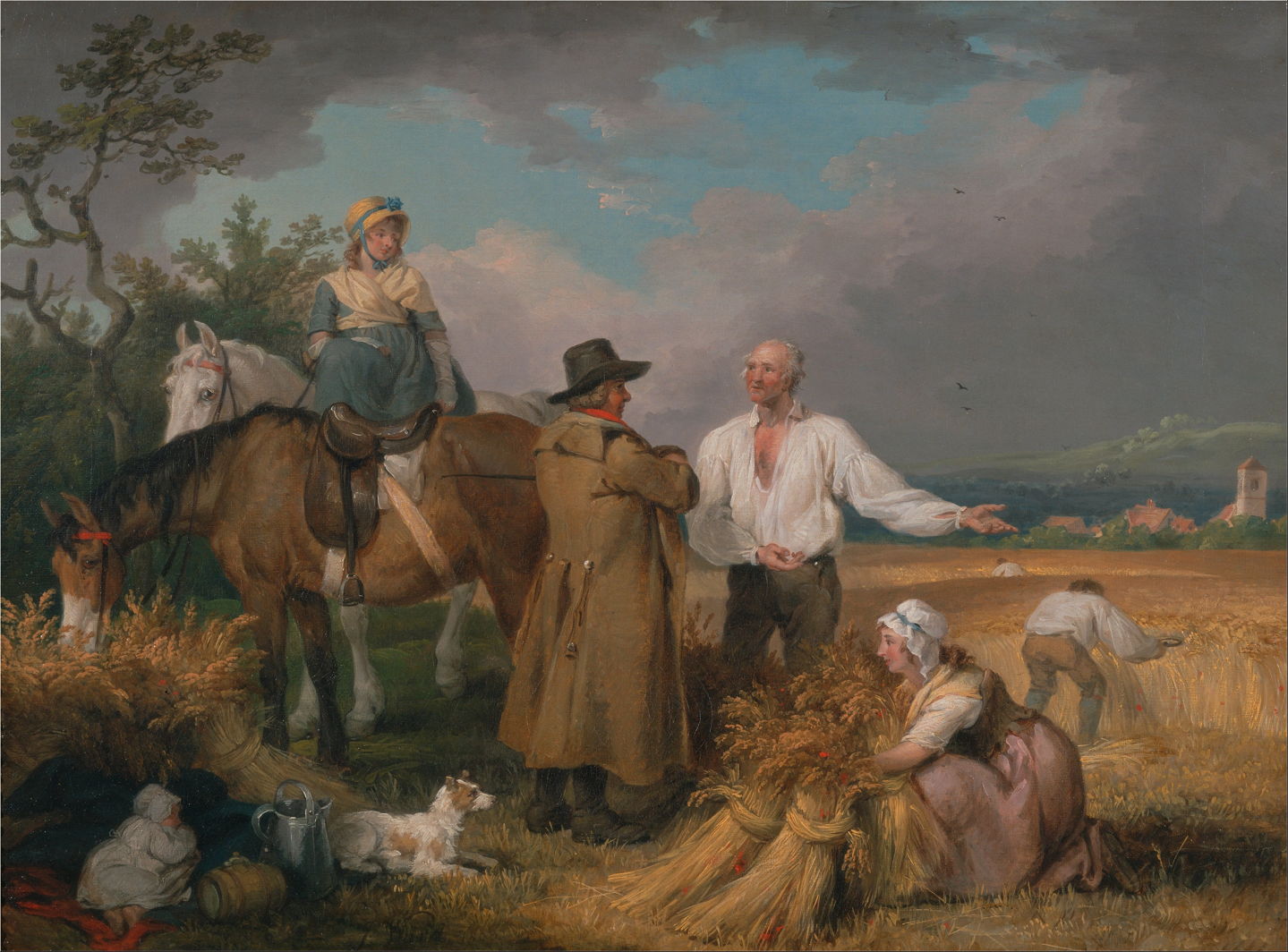
The Reapers (1800) has similar influences, showing the landowner and his wife, who have ridden out to inspect progress with the harvest. Behind them, Ward’s landscapes are becoming more than mere backdrops, with careful play of the light from his subtle sky, on the fields, hills, and distant village.

Though his early finished paintings may have lacked originality, he produced some superb oil sketches from early on, which bear comparison with those of Constable. A Harvest Scene with Workers Loading Hay on to a Farm Wagon (c 1800) was painted on a small panel, using high chroma colours, particularly in the foreground.
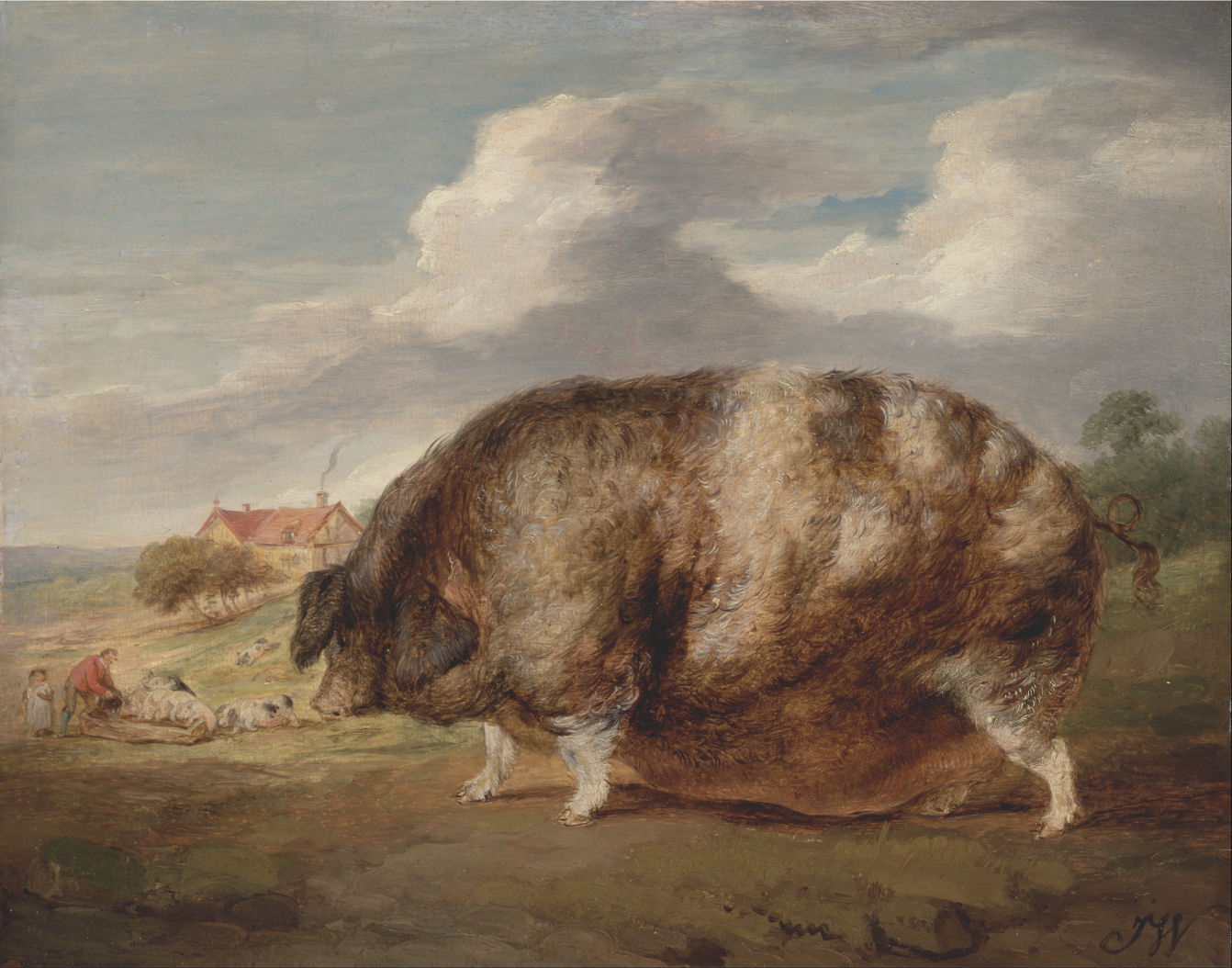
Gloucestershire Old Spot (1800-1805) takes one of Morland’s favourite farm animal subjects, this ancient but now threatened breed, and plants its enormous bulk into another of Ward’s delightful rustic landscapes.
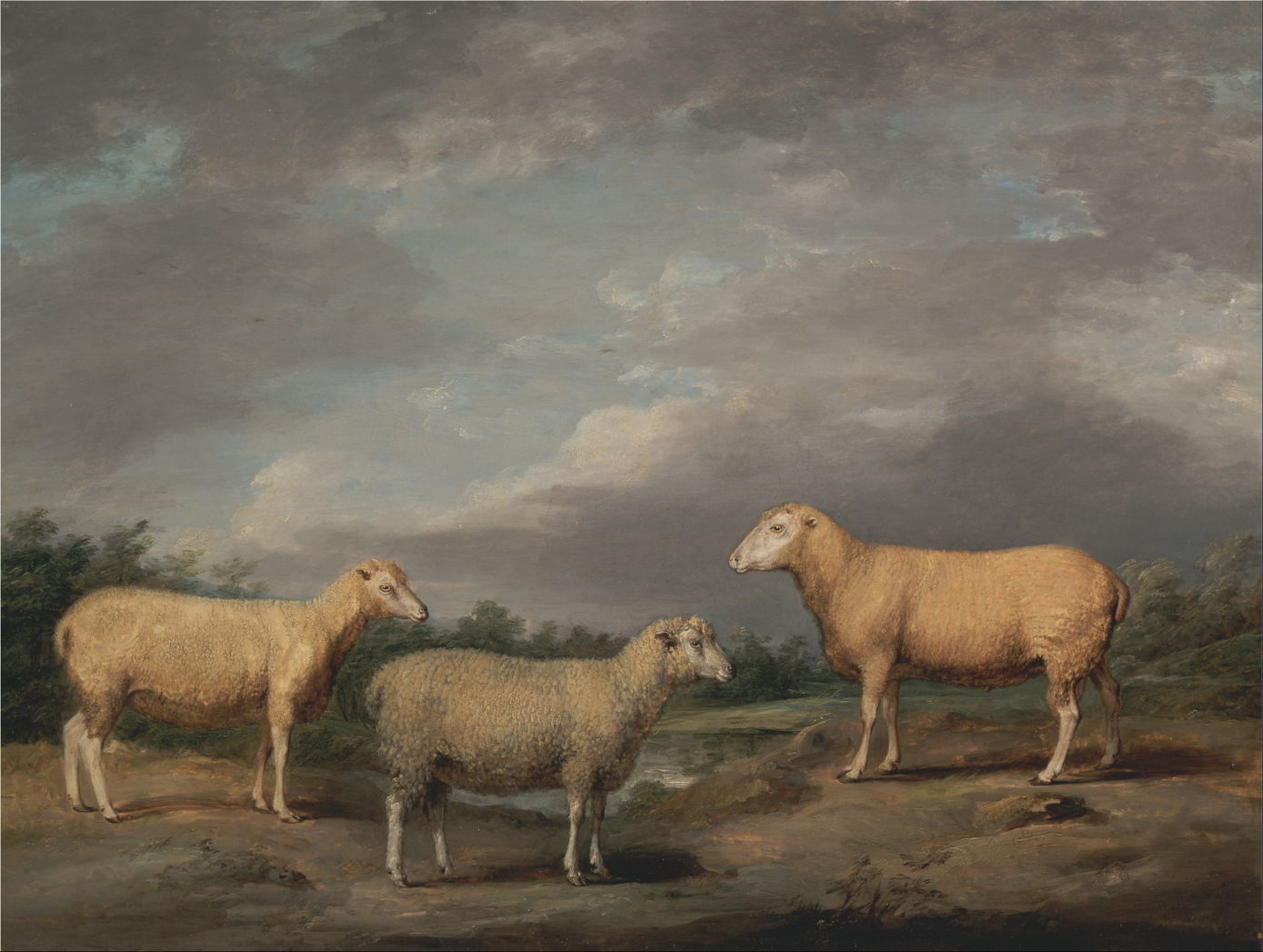
Ryelands Sheep, the King’s Ram, the King’s Ewe and Lord Somerville’s Wether (1801-1807) shows faithfully one of the oldest breeds of British sheep, originating with the monks of Leominster, Herefordshire, in the 1300s. Their name is derived from their being grazed on rye pastures. Although Ward returned to farm animals as his subjects, this marks the end of his early period of painting influenced by Morland.

Ward’s outstanding Man Struggling with a Boa Constrictor (c 1803) was a relatively large and late oil study for a painting that was apparently rejected by the Royal Academy in 1803, Liboya Serpent Seizing its Prey, which has been lost. It’s probably his best figurative painting, showing careful study of anatomy. Although Ward never attended the Royal Academy Schools, unlike Turner, in 1801 he enrolled in an anatomy course by dissection in London. Ward had applied to the Royal Academy Schools in 1797, but was unsuccessful; Turner had started his studies there in 1789.
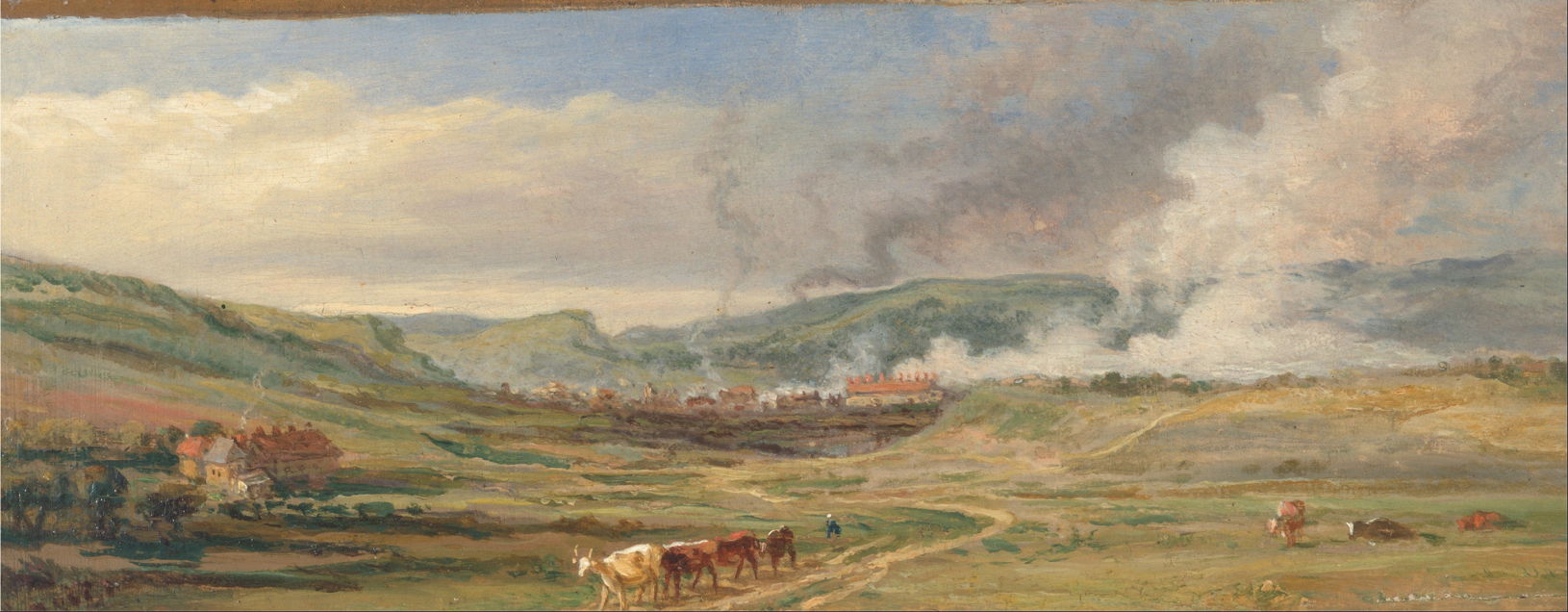
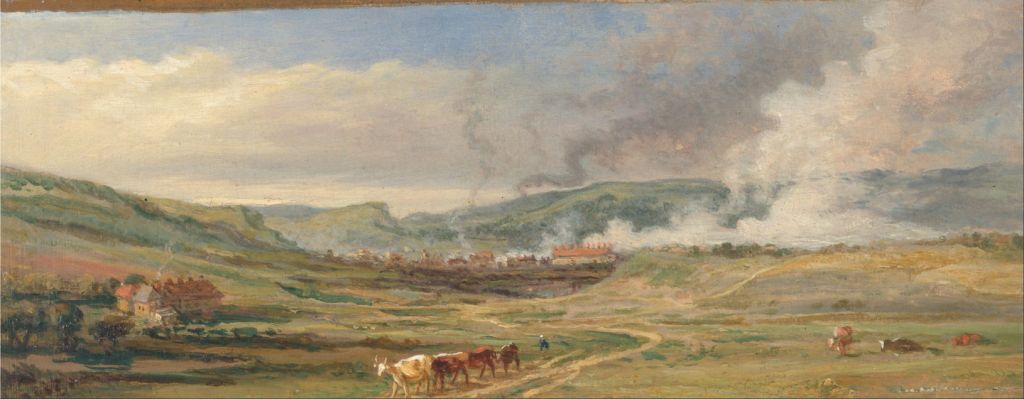
He continued to sketch landscape views in oils, including this outstanding panoramic Landscape near Swansea, South Wales (c 1805), squeezed onto a small panel. The extensive smoke rising from the distant valley was from the heavy industries based on coal and iron which had been spreading through the previously rural areas of South Wales.

Unlike Constable’s paintings of affluent Suffolk, Ward wasn’t shy of showing the increasing dereliction in the troubled countryside at the time. An Overshot Mill (1802-1807) shows a watermill using the combination of water and gravity to power the grinding of corn. Its fabric is in dire need of repairs, and the thatchers have already made a start on its roof.
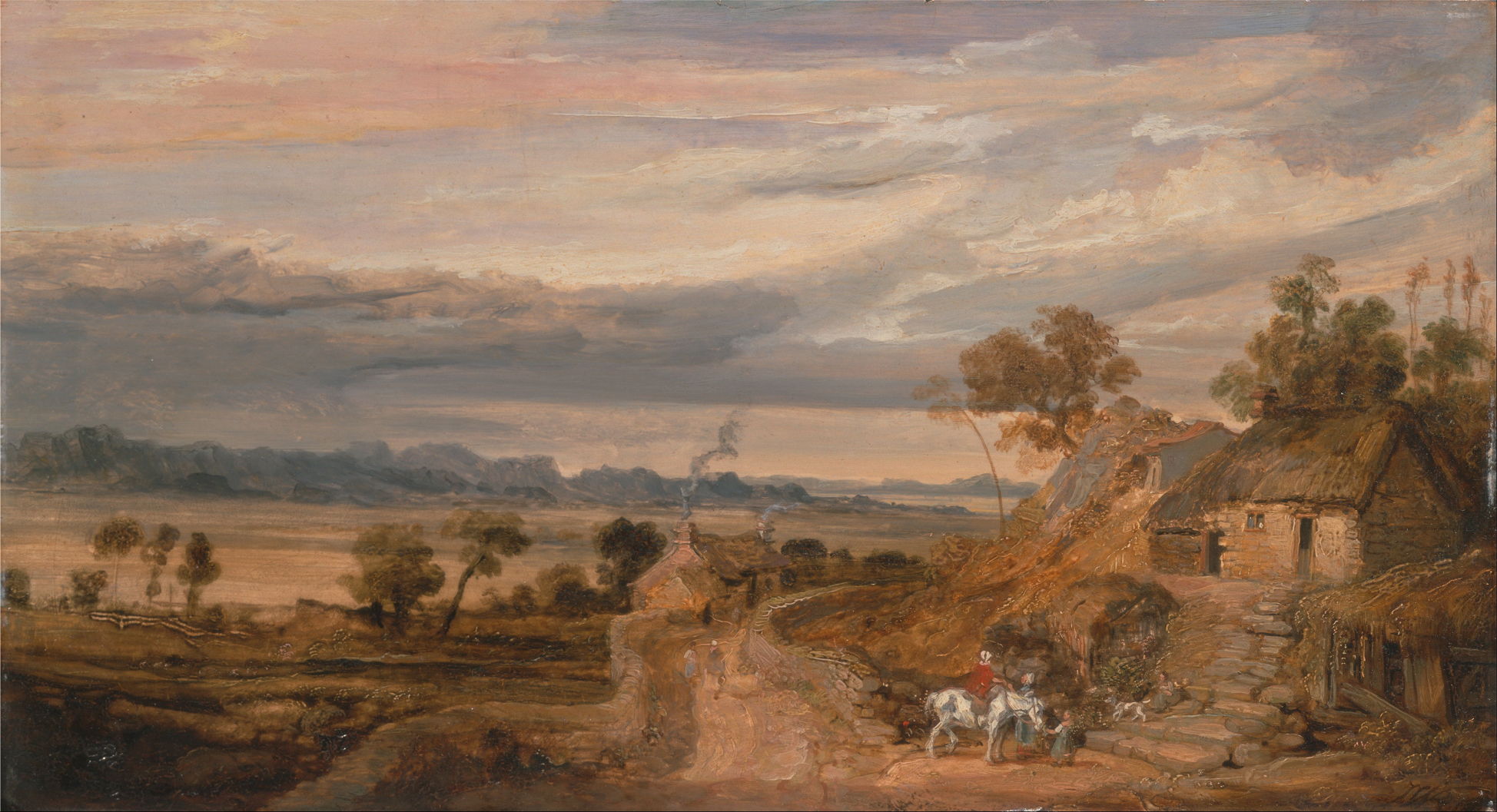
Landscape with Cottages (1802-1827) is more idyllic under its richly coloured sky, but still has the frankness of an oil sketch.
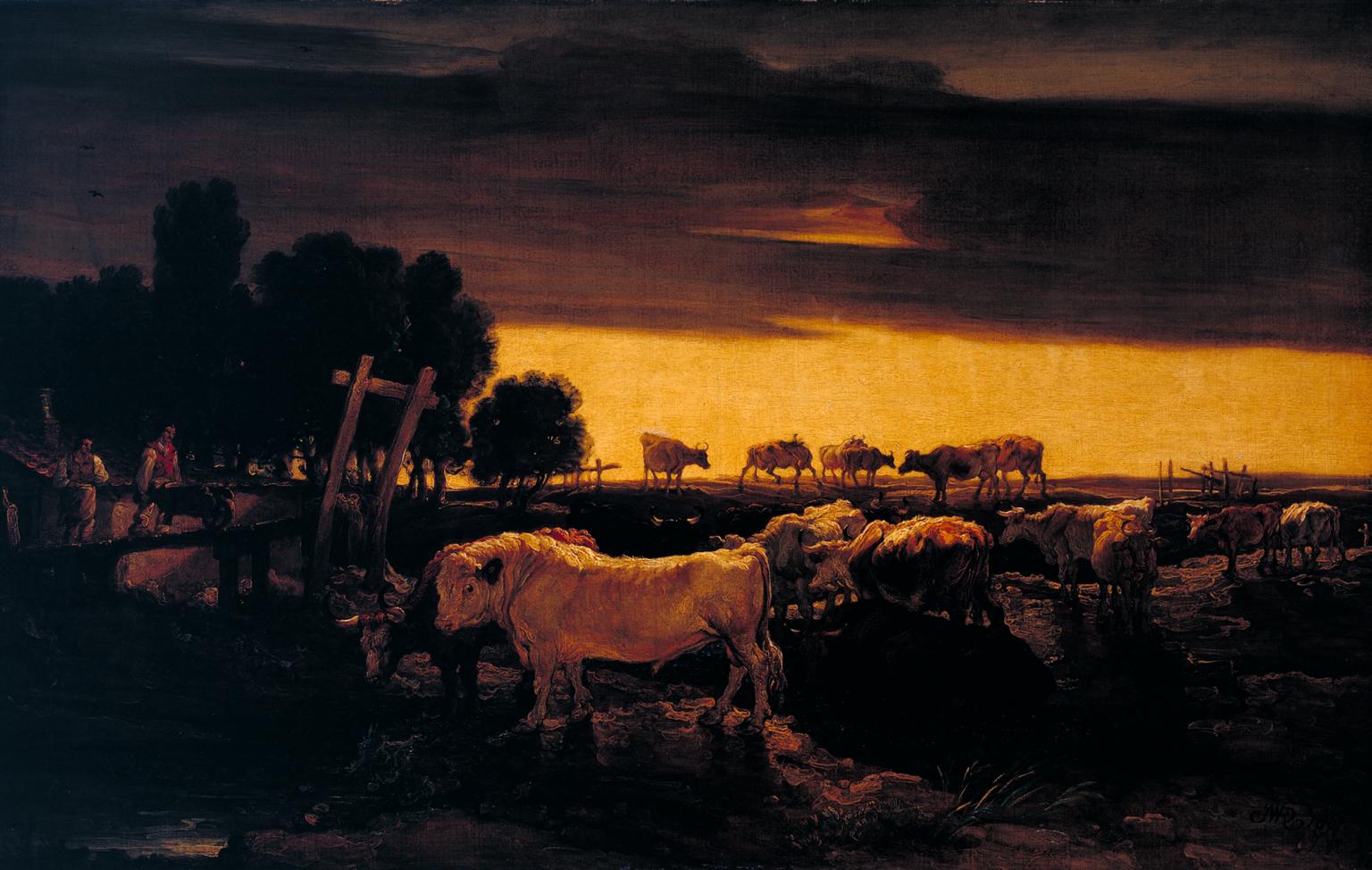
At a time when Turner’s oils were still conventional, Ward experimented more with light, as in his unusual Cattle-Piece, ? Marylebone Park (1807). This is also of interest in that it’s believed to be set in what was then a large hunting park on the northern edge of London, whose modern relic is Regent’s Park.
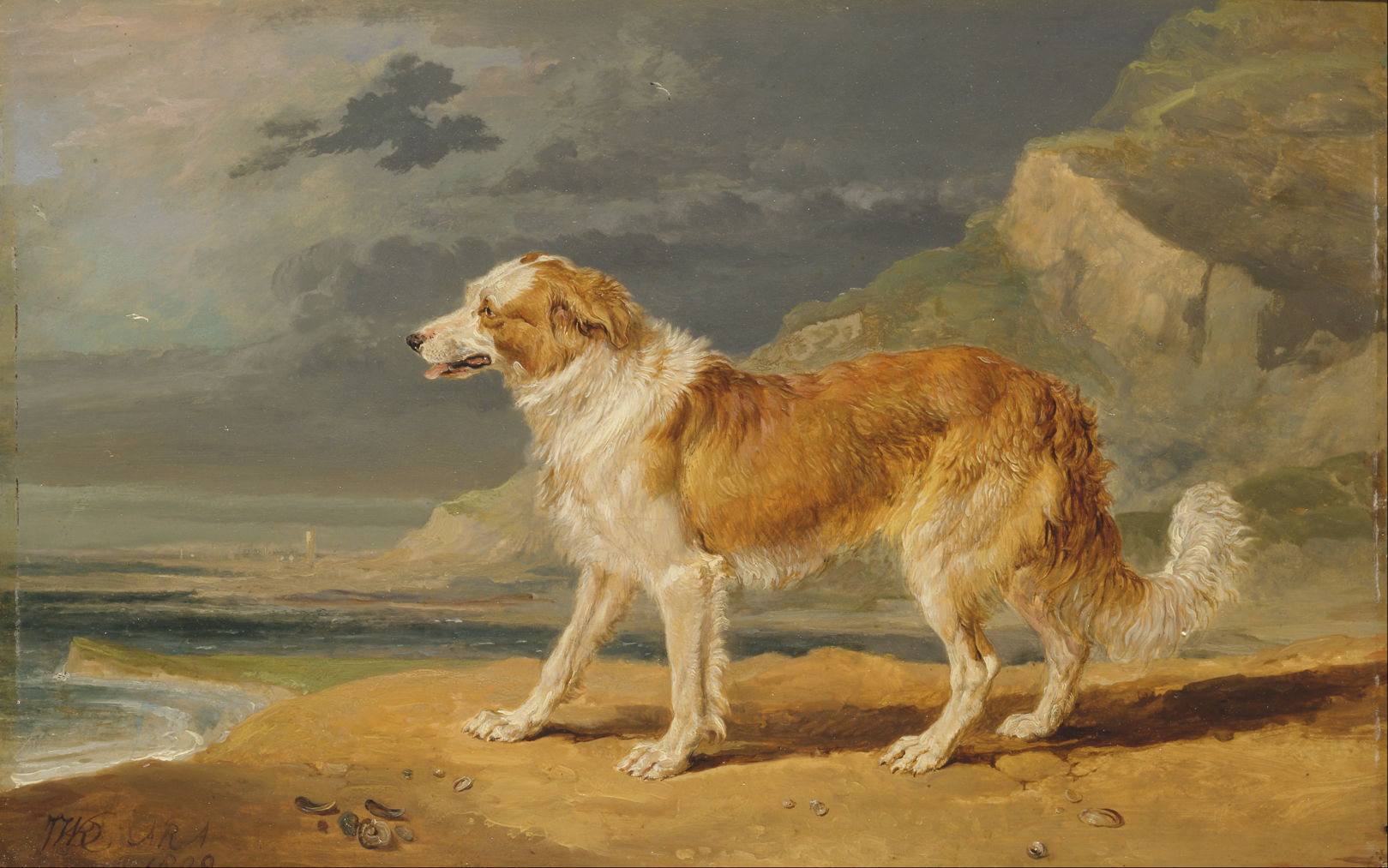
Even when he was painting portraits of dogs, Ward could not resist setting them in fine landscapes complete with brilliant seagulls, as shown in his Rough-Coated Collie from 1809. This dog appears to be a shorter-haired precursor to the modern Rough Collie, which originated in the 1800s, perhaps in a cross with a Borzoi or Russian Wolfhound.
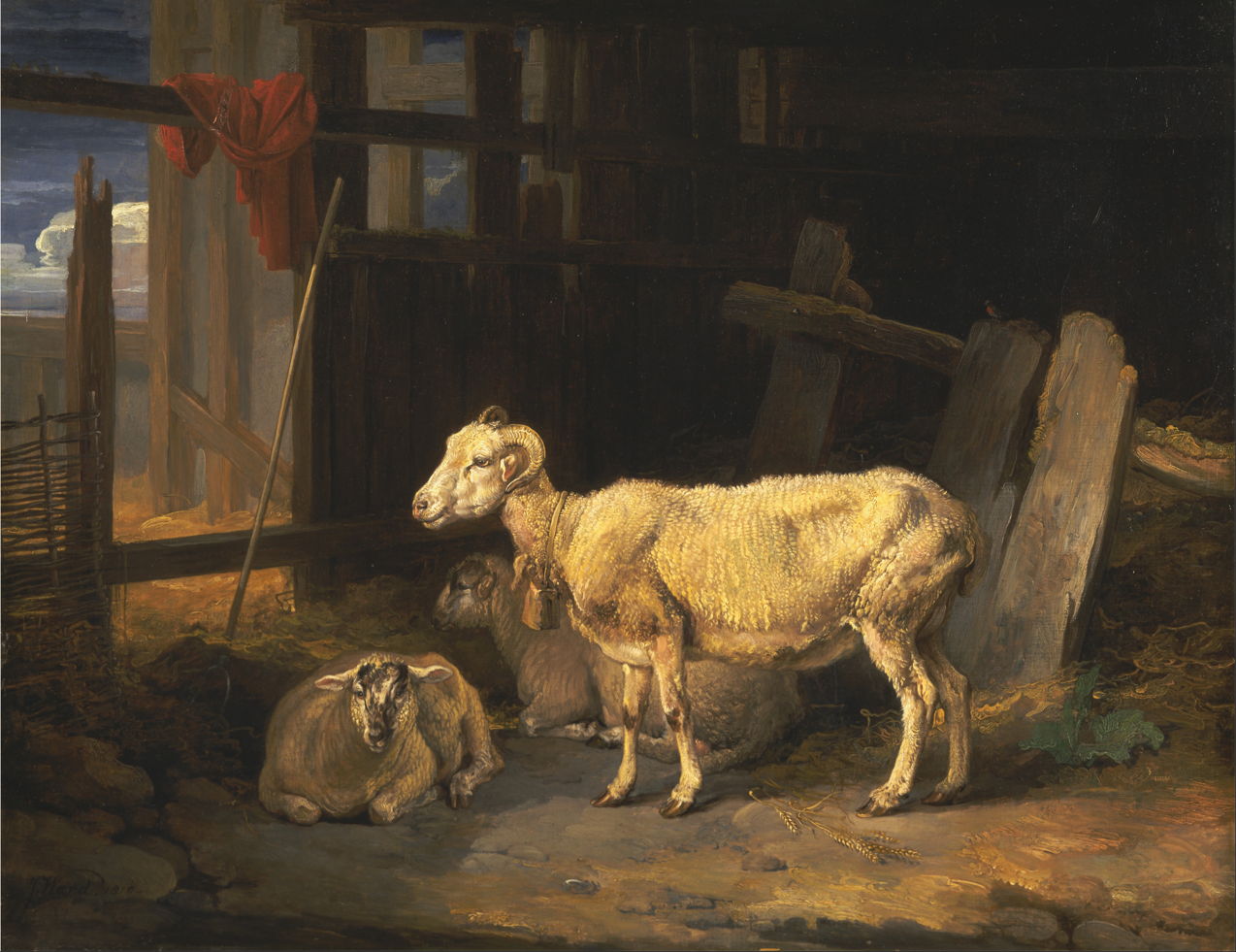
Ward’s Heath Ewe and Lambs (1810) is unusual for its indoor setting, and the difficulty in recognising the breed, which appears to be a horned heath variety, which were probably confined to Germany at the time. It’s also hard to know whether to read anything into the red cloak wrapped around the wooden beam at the top left.

The Straw Yard (1810) is a wonderfully loose sketch in which Ward brings together the dereliction in the countryside, and a menagerie of farm animals, including horses, two donkeys, chickens, and many pigs and piglets.
By 1810, although his career had had its ups and downs, he was an Associate of the Royal Academy (elected in 1807 or 1808), and was cultivating a group of patrons. Next week I will show examples of his mature commissions, including his most famous painting of Gordale Scar.
References
Beckett O (1995) The Life and Work of James Ward, the Forgotten Genius, Book Guild. ISBN 978 0 8633 2948 7.

