
Paintings of trees identified as chestnuts became not uncommon during the nineteenth century, although the English name refers to two completely different species found throughout Europe: the ‘true’ sweet chestnut, Castanea sativa, with its edible fruit, and the horse chestnut, Aesculus hippocastanum, with its inedible fruit known to many children as conkers.
Edible chestnuts are a delicacy, usually eaten roasted in the autumn and before Christmas, and an ingredient for stuffing poultry. Conkers are used in a British children’s game, in which a string is attached and opponents strike your conker with theirs, aiming to shatter it. It had earlier been played using hazelnuts, and the first record of horse chestnuts being used is from 1848, on the Isle of Wight.

The London-based Irish painter Daniel Maclise painted Robin Hood and His Merry Men Entertaining Richard the Lionheart in Sherwood Forest in 1839. ‘Good’ King Richard, to whom the legendary Robin Hood was loyal, sits drinking under an oak tree at the right, still wearing his armour from the Crusades, the only link between the legends of Robin Hood and the ‘Saracens’ of the Middle East. Various of the ‘Merry Men’ and Maid Marian can be spotted in the crowd: at the left, with a deer over his shoulder is Little John, sat under the same horse chestnut tree is Friar Tuck, and Robin Hood stands in the centre, in red, with Maid Marian to the right. That tree’s leaves clearly have the compound form of the horse chestnut.

Alfred Sisley painted this Avenue of Chestnut Trees in La Celle-Saint-Cloud to the west of the Fontainebleau Forest in 1865, in Barbizon style. It was refused when he submitted it to the Salon in 1867, then remained unsold for ten years before being bought by Sisley’s patron Jean-Baptiste Faure, a celebrated opera singer. Although it’s not possible to identify the trees clearly, its title uses the French word châtaigniers, to refer to sweet chestnuts.

Pissarro must have taken delight in the weird forms of the trees in this Chestnut Grove at Louveciennes, painted in 1872. In the far distance is the massive warm cream stone of Marly Aqueduct. Their trunks resemble those of sweet chestnuts, and again are referred to as châtaigniers.

Chestnut Trees at Osny from about 1873 was one of Pissarro’s paintings exhibited at the First Impressionist Exhibition, where it gained praise from the critic writing for L’Artiste. It was exhibited in 1883 at the Durand-Ruel Gallery, where it was even better appreciated, but remained in the artist’s own collection until his death. These are also sweet chestnuts.
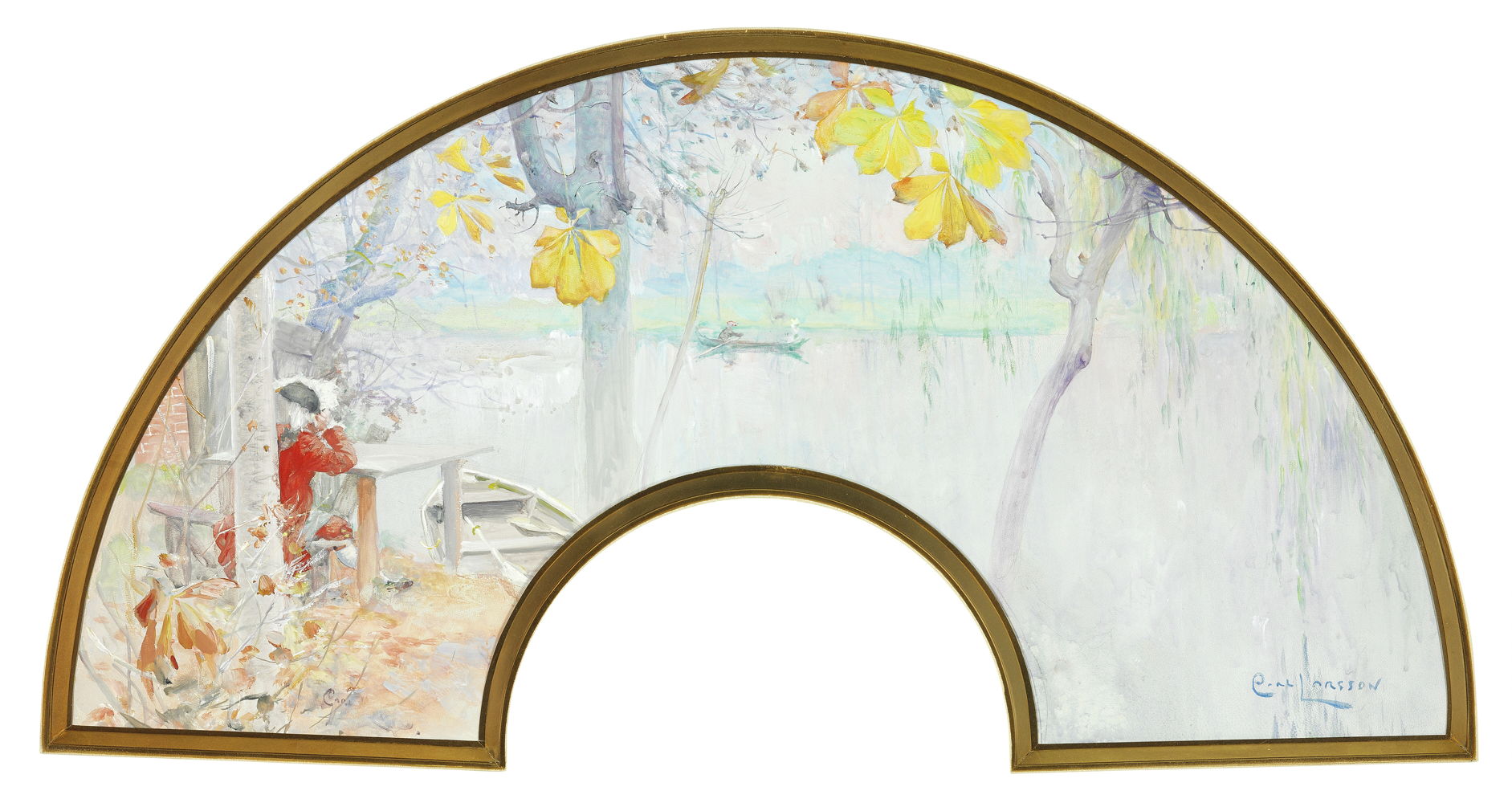
When the Swedish artist Carl Larsson was in Paris in 1884, he must have seen some of Pissarro’s painted fans, and as he was switching to his mature medium of watercolour, he painted this superb Rococo Idyll. At the left, an elegant Rococo gentleman, a recurrent figure in Larson’s paintings at that time, is sat at a table under a horse chestnut tree by a lake. It’s autumn and the leaves, typical of that species, have already changed colour.

Two of Cézanne’s favourite themes in his later landscape paintings were the family mansion at Jas de Bouffan and the view from there of Mont Sainte-Victoire. He combines them in his Chestnut Trees at the Jas de Bouffan in Winter from 1885-86. Although difficult to tell from their appearance, its original French title uses the word marronniers to refer to horse chestnuts.

Vincent van Gogh’s Blossoming Chestnut Tree from 1887 shows a horse chestnut in full leaf and flower with a solid canopy built from visible and organised brushstrokes. These marks are starting to form whorls and swirls in places, including the background vegetation. The tree is only demarcated from that background, the grass below, and trees behind, by discontinuity in the structure and orientation of the marks. Its flowers are typical of a horse chestnut, and some have already turned red following their pollination.
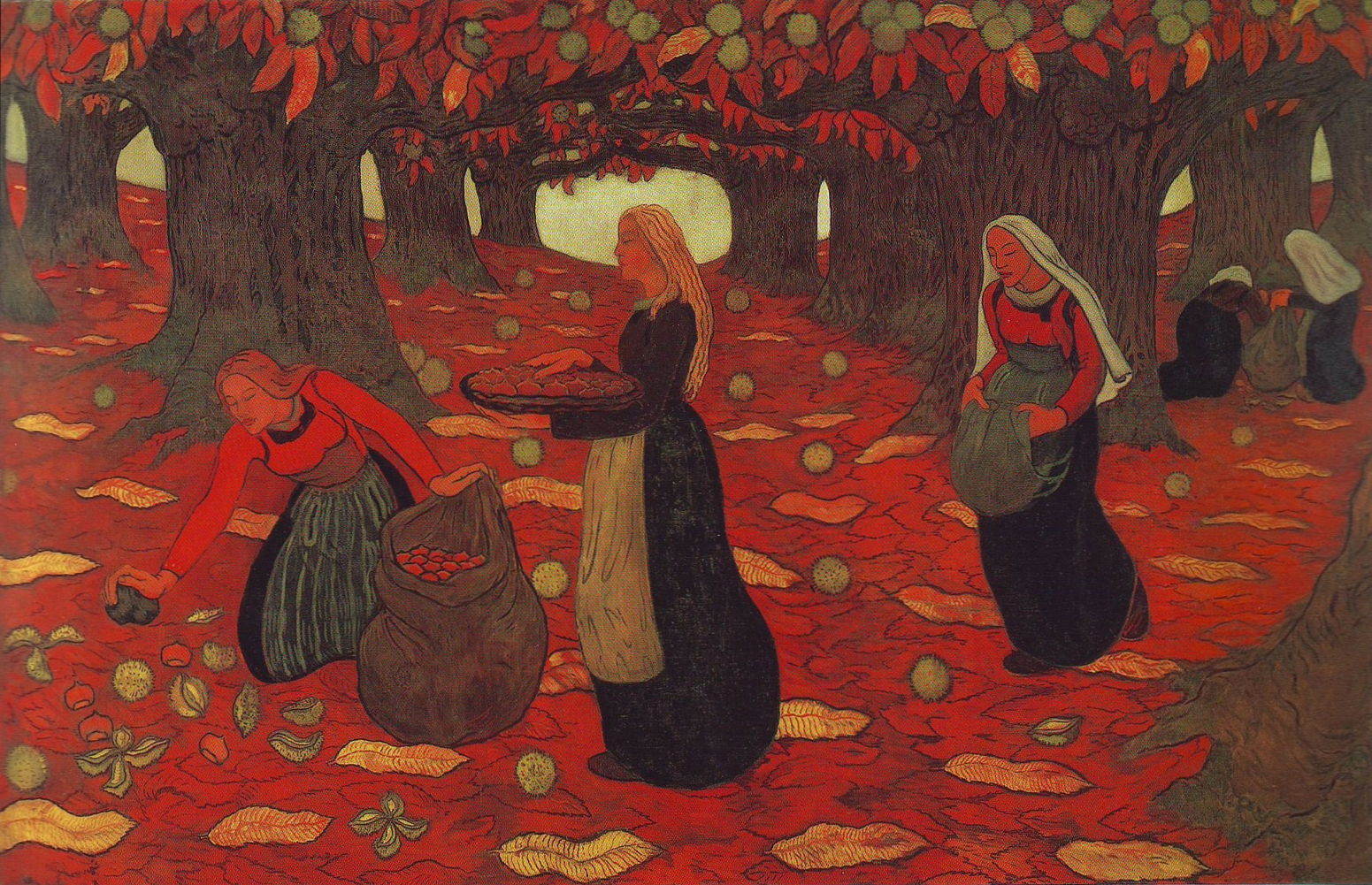
The Nabi artist Georges Lacombe was fascinated by goings-on in the woods in Brittany. This painting of Chestnut Gatherers from 1893-94 combines the Nabi flattened decorative look with a rich red more typical of the early twentieth century. The leaves and fruit shown are typical of sweet chestnuts, here being gathered for eating.

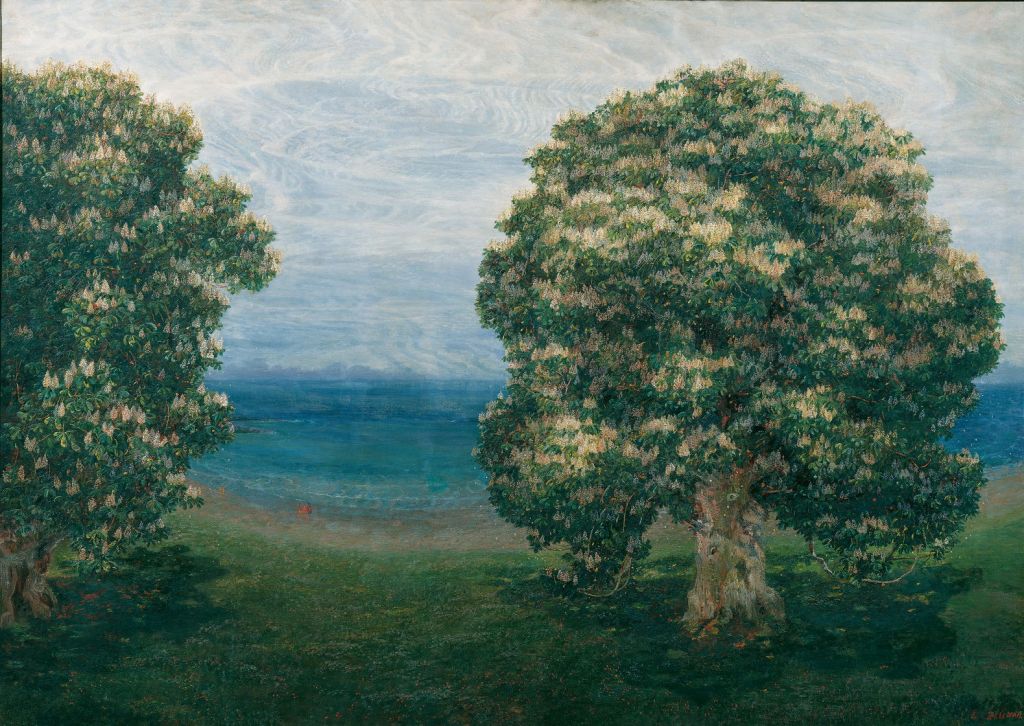
Flowering Chestnuts from 1900 is now perhaps Emilie Mediz-Pelikan’s best-known, or least-forgotten, painting, with its contrasting rhythm in the flowers and the fine whorls of the clouds. Two small groups of people at the water’s edge provide subtle colour contrast. Their leaf structure and flowers are typical of horse chestnuts, and a few of the flowers have started turning red.
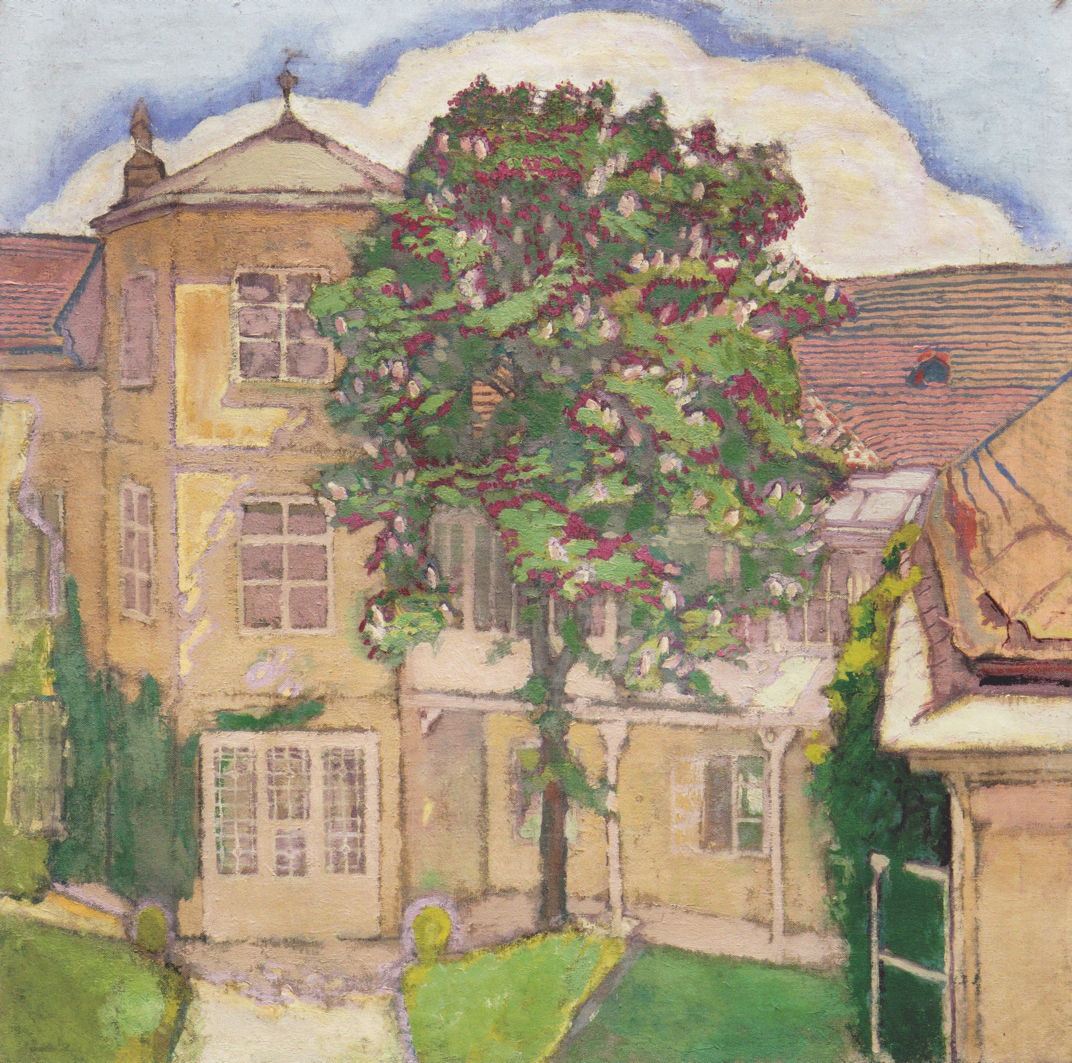
Best known now for his design rather than paintings, Koloman Moser’s Chestnut Tree in Blossom from about 1912 tackles a demanding motif, its building deeply foreshortened at the right and with a complex projection in 3D. The roof behind the horse chestnut flows into an unseen dormer, and the tree itself is finely crafted and rich in blossom, some of it already turned red.
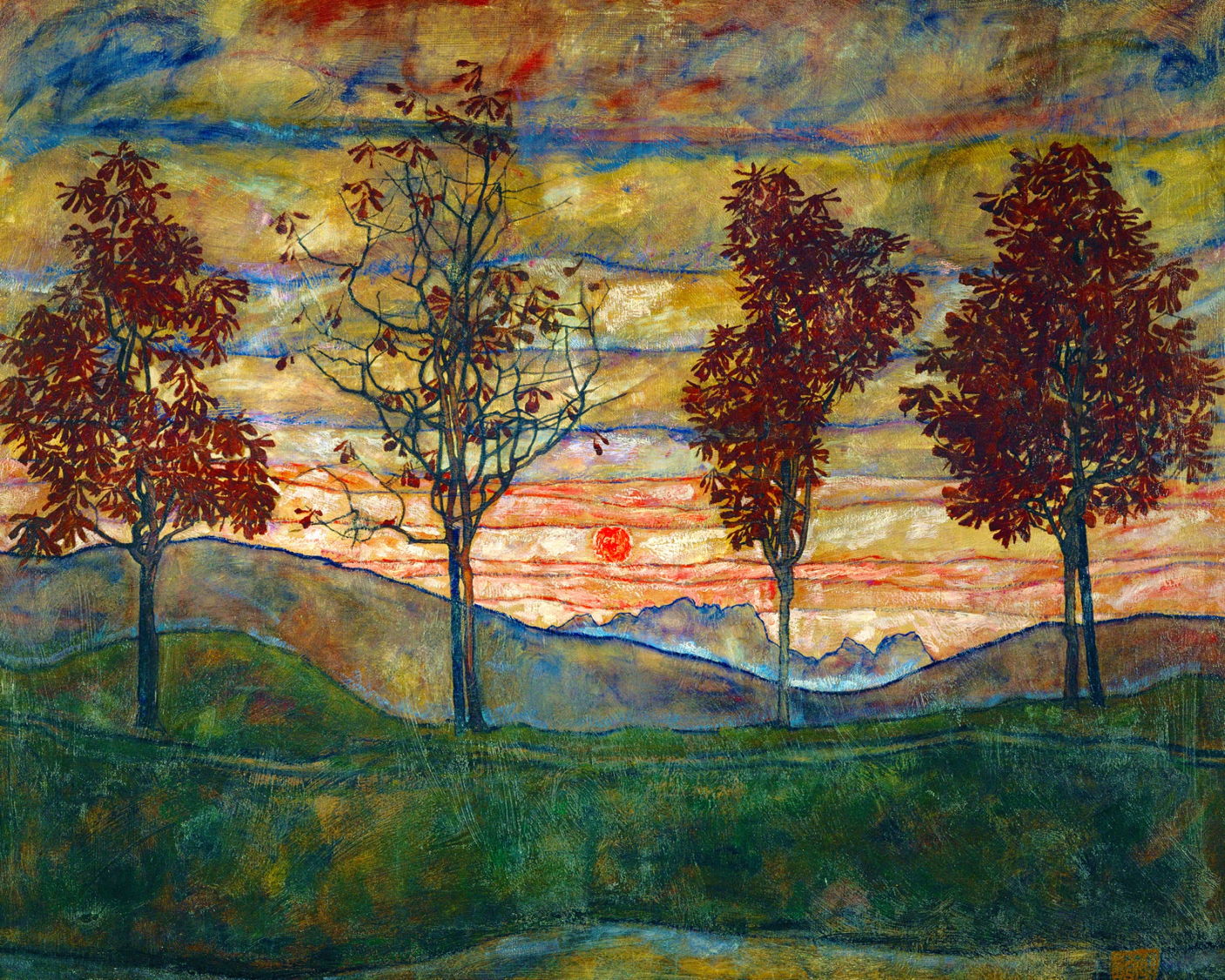
Finally, Egon Schiele’s Four Trees is an Expressionist work based on views in Austria, showing four stark horse chestnut trees in the setting sun of the autumn. The compound leaves shown are typical of horse chestnuts.

