

The history of Impressionism has been written and rewritten many times, but one great landscape painter who is often omitted is Charles-François Daubigny (1817–1878), whose landscapes were so admired by Paul Cézanne and Vincent van Gogh. This weekend I show a small selection of his paintings that anticipated what was to come.
His father was also a landscape painter. Daubigny seems to have been a sickly child, and to promote his health was sent for several years to stay in the village of Valmondois, to the north of Paris, on the river Oise, in the care of a nurse/nanny. To set his age in context, he was a schoolboy of 13 when the oldest of the mainstream Impressionists, Pissarro, was born, and had started work at the age of 15 at the time of Édouard Manet’s birth.
By 1834, Daubigny was helping to restore paintings in the Louvre, although he still enjoyed returning to the countryside on the banks of the Oise. The following year, he started as a student in the studio of Pierre-Asthasie-Théodore Sentiès. In 1836, he had earned enough money to pay for himself to travel to Rome and southern Italy, with a colleague from the studio. On his return the following year, he entered the Prix de Rome, but was unsuccessful.
Daubigny continued to develop his paintings, and in 1838 had his first landscape accepted by the Salon. This was followed by two more in 1840, when he had started in Paul Delaroche’s studio. Unfortunately there was a misunderstanding over the rules of the Prix de Rome in 1841, and his submission was eliminated; he abandoned further attempts.
He continued to exhibit at the Salon through the 1840s, and married at the end of 1842. The following year he started painting in the Forest of Fontainebleau, then the focal point of the Barbizon School, with which he is now often associated. At some stage during the 1840s, he met and befriended Camille Corot, a friendship that was to last until Corot’s death in 1875.
With the liberalisation of the Salon under the Republic in 1848, Daubigny exhibited six paintings, and won a second class medal.

The Harvest (1851) above and a View from the Banks of the Seine at Bezons (1851, not shown here) were great successes at the Salon the following year, and were bought by the Nation, despite being criticised for their sketchy finish. Daubigny’s use of colour in this painting heralded the changes that came with the main Impressionist movement.

Daubigny painted with Corot in Switzerland, and in The Hamlet of Optevoz, in about 1852.

The Pond at Gylieu (1853) was his great success of the Salon of 1853: it won a gold medal, and was purchased by Emperor Napoleon III. It must rank among the finest realist landscape paintings of this period, as shown in the detail below.


In the mid 1850s, he started painting extensively on the coast of Normandy and Brittany. He returned to Optevoz to paint Sluice in the Optevoz Valley (1854), which won him a third class medal at the Exposition Universelle in Paris in 1855 and was purchased by the State.

Banks of the Seine (1855) marked the start of a long campaign painting the banks of rivers in northern France. To facilitate that, in 1857 he launched a specially-built studio boat, anticipating Claude Monet’s later use of a similar floating studio.
He also turned to fruit trees in blossom in the spring, and his first major painting of them, Spring (1857), was acclaimed for its originality. He was made a Chevalier of the Legion of Honour in 1859, the same year that Monet discovered his work, and Camille Pissarro first exhibited in the Salon. In 1860 and 1861, Daubigny visited Gustave Courbet in his home town of Ornans.

This later painting of blossom, Spring Landscape was made in 1862, the same year that he moved into a new purpose-built house and studio in Auvers-sur-Oise. This marked the start of the artists’ colony there, where Vincent van Gogh was later to spend his final two months of painting.

On the Oise (1863) is a fine example of the paintings that Daubigny made of riverbanks at this time, and shows the influence they had on mainstream Impressionists over the following decades. In 1863 he entertained Berthe Morisot and her family, and he continued to have social contact and to encourage her painting.
In 1865, Daubigny visited London, where he had lunch with Whistler. Back in France, he continued painting his innovative river landscapes in the Île de France, the countryside around Paris, which he knew from his childhood.

Working on the bank or in his floating studio, paintings such as his Boats on the Oise from 1865 were generally well-received, although there were still critics who complained about their lack of Salon finish.
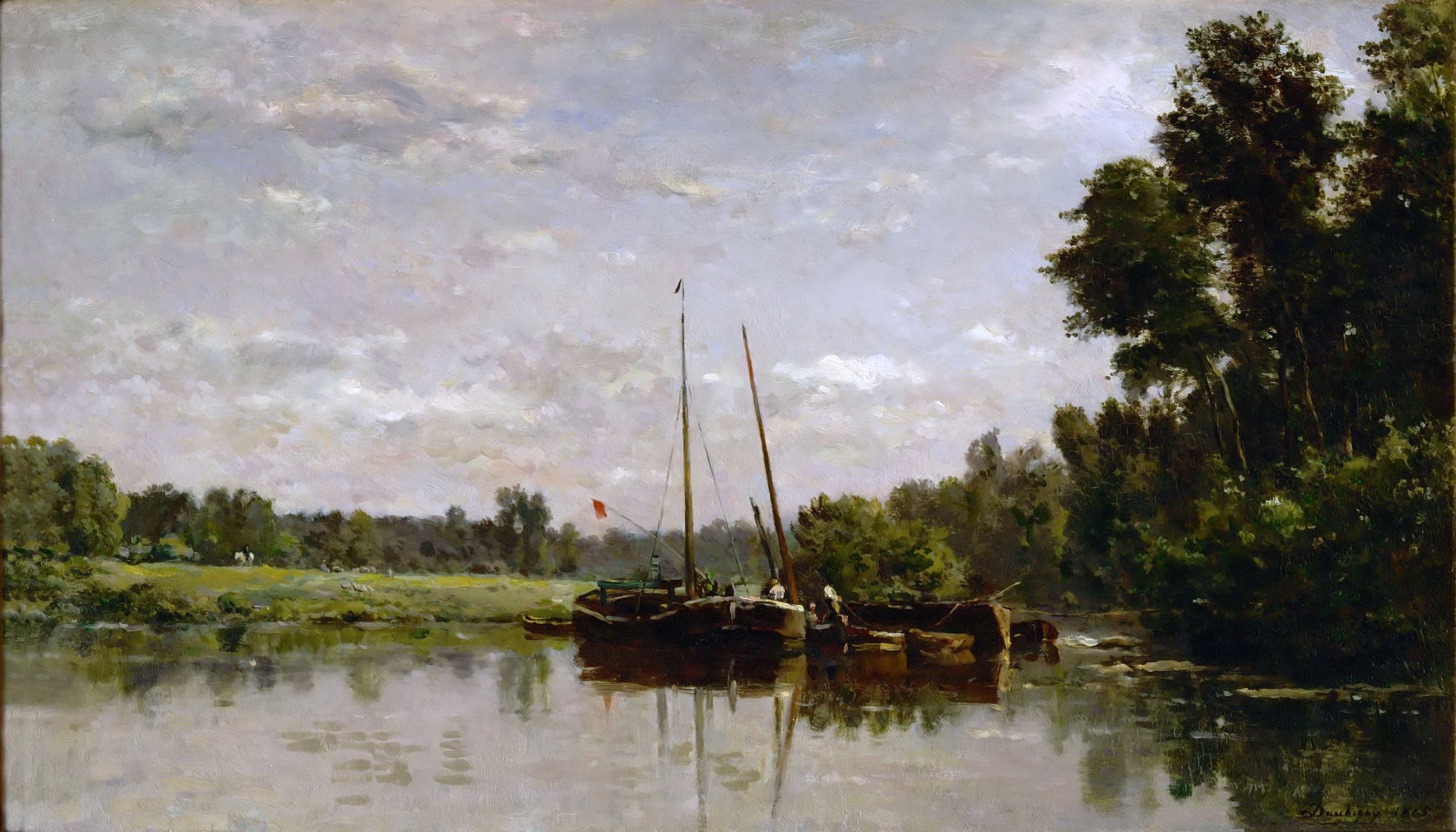
Barges (1865) is another of these, that proved so influential on the mainstream Impressionists, who were only just starting their careers.
Reference
Ambrosini, Lynne et al. (2016) Inspiring Impressionism: Daubigny, Monet, van Gogh, National Galleries of Scotland. ISBN 978 1 906270 86 5.

