

By the end of the nineteenth century, training aspiring painters was flourishing in the USA, although most still travelled to Europe to complete their education and gain experience in world-renowned academies. Among the major painters who taught in the USA at that time were Thomas Eakins, John Ferguson Weir, Robert Henri, Frank Duveneck, and William Merritt Chase, and this second article concludes my short survey of those who were taught by Chase.
John Marin (1870-1953)
He attended the Pennsylvania Academy of the Fine Arts in 1899-1901, where he studied under Thomas Pollock Anschutz and Chase, and at the Art Students League in New York. For six years before the First World War he travelled through Europe as his paintings became progressively more modernist, then returned to paint in New Jersey and Maine. He was one of the first American artists to create abstract paintings, and remains greatly respected for his leading role in the development of modern art.
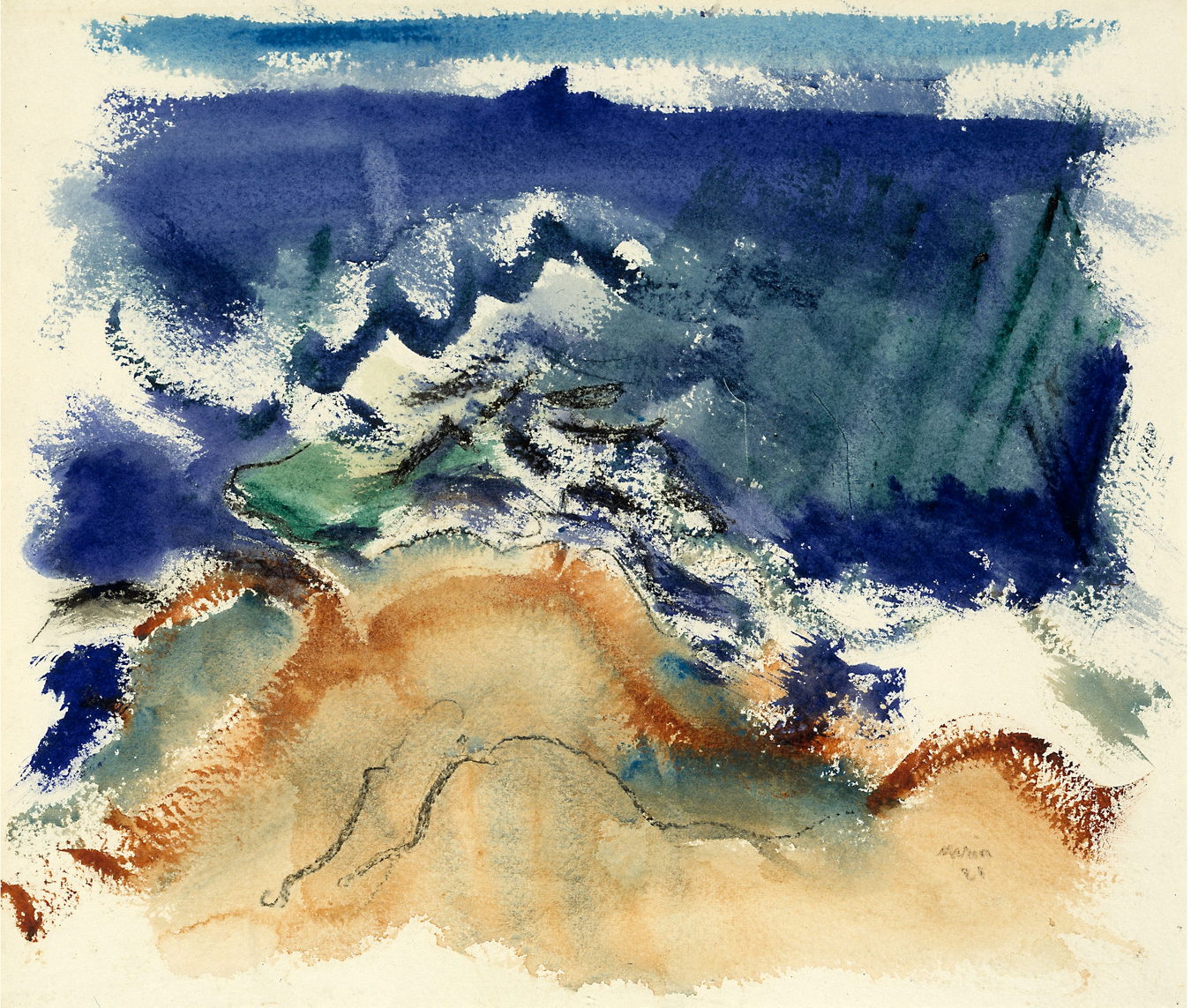
He spent his first summer on the coast of Maine in 1914, and painted it frequently, as seen in The Sea, Maine from 1921.
Edward Charles Volkert (1871-1935)
After studying at the Cincinnati Art Academy under Frank Duveneck, he was a student at the Art Students League in New York under Chase. He doesn’t appear to have painted outside the USA.

Volkert went on to establish himself as an Impressionist, specialising in grazing cattle, as seen in these Cows in a Sunlit Pasture.
Ella Sophonisba Hergesheimer (1873-1943)
Descended from Charles Willson Peale, she attended the Pennsylvania Academy of Fine Arts, where she was taught by Cecilia Beaux and William Merritt Chase. In the summer of 1900, she attended Chase’s summer school in the Shinnecock Hills. As the best in her class at the Academy, she won the Cresson Travelling Scholarship, and studied at the Académie Colarossi in Paris for three years. She went on to become a successful portraitist in Nashville, Tennessee, where she also illustrated local society.

Her Portrait of Madeline McDowell Breckinridge shows one of the leaders of the women’s suffrage and rights movement in 1920.
Susan Watkins (1875–1913)
Susan Watkins was born in California, but her family moved to New York, where her father was an editor for the New York Sun newspaper. She started her training at the Art Students League in 1890, at the age of only fifteen, where she probably first met Chase. Her father died in 1896, so she and her mother moved to Paris, where she resumed her training under Raphaël Collin (1850-1916) in an academic style.
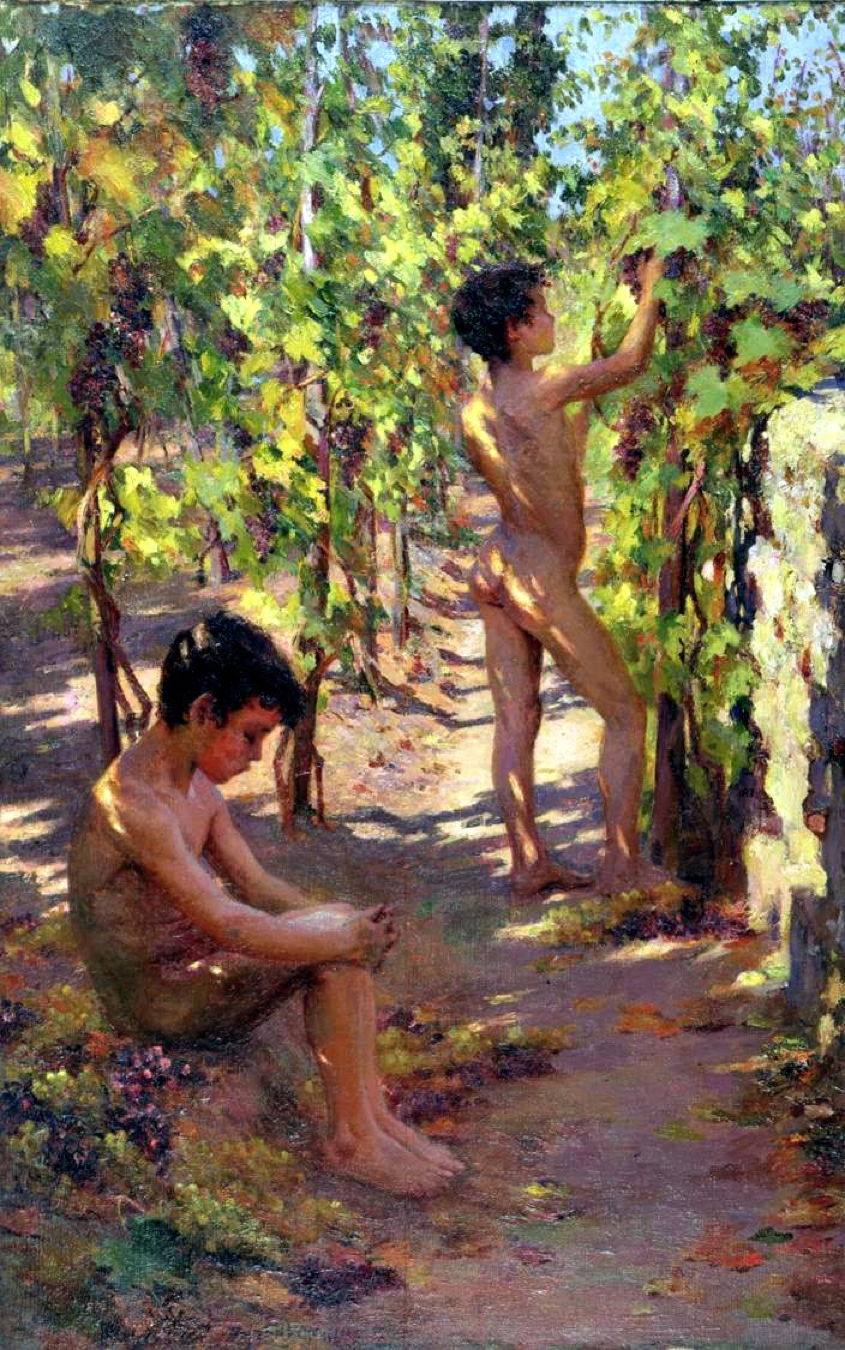
Her painting of Boys Picking Grapes at Capri from about 1906 was made when she was visiting Italy. She became ill when in Europe in 1910, and returned to the USA, where she died three years later, at the age of only 38.
Kate Freeman Clark (1875-1957)
She was introduced to Chase when at the Art Students League in New York City, after 1895. Chase taught her still life painting, and remained her mentor for the rest of his life. She doesn’t appear to have traveled outside the USA. Chase particularly respected her work, and had two of her paintings in his personal collection. Her work remains in copyright, and can be seen here (HTTP only).
Marsden Hartley (1877–1943)
He studied painting at the New York School of Art from about 1898, under Chase, then went on to the National Academy of Design. He didn’t travel to Europe until 1912, but returned to the US in 1916 after the start of the First World War. He was influenced by Cubist art he saw when in Paris and Berlin, and was another of the early American Modernists.

Hartley became ‘the painter of Maine’ in 1937, and this view of Mount Katahdin, Maine, First Snow, No. 1 painted in 1939-40 is typical of his later work.
Joseph Stella (1877-1946)
Having started studying medicine, he turned to art, at the Art Students League in 1897 and the New York School of Art from 1898 under Chase. He also attended a Shinnecock Summer School in 1901, taught by Chase. Although Stella returned to his native Italy, and to live in Paris, between 1909-13, he didn’t train there.
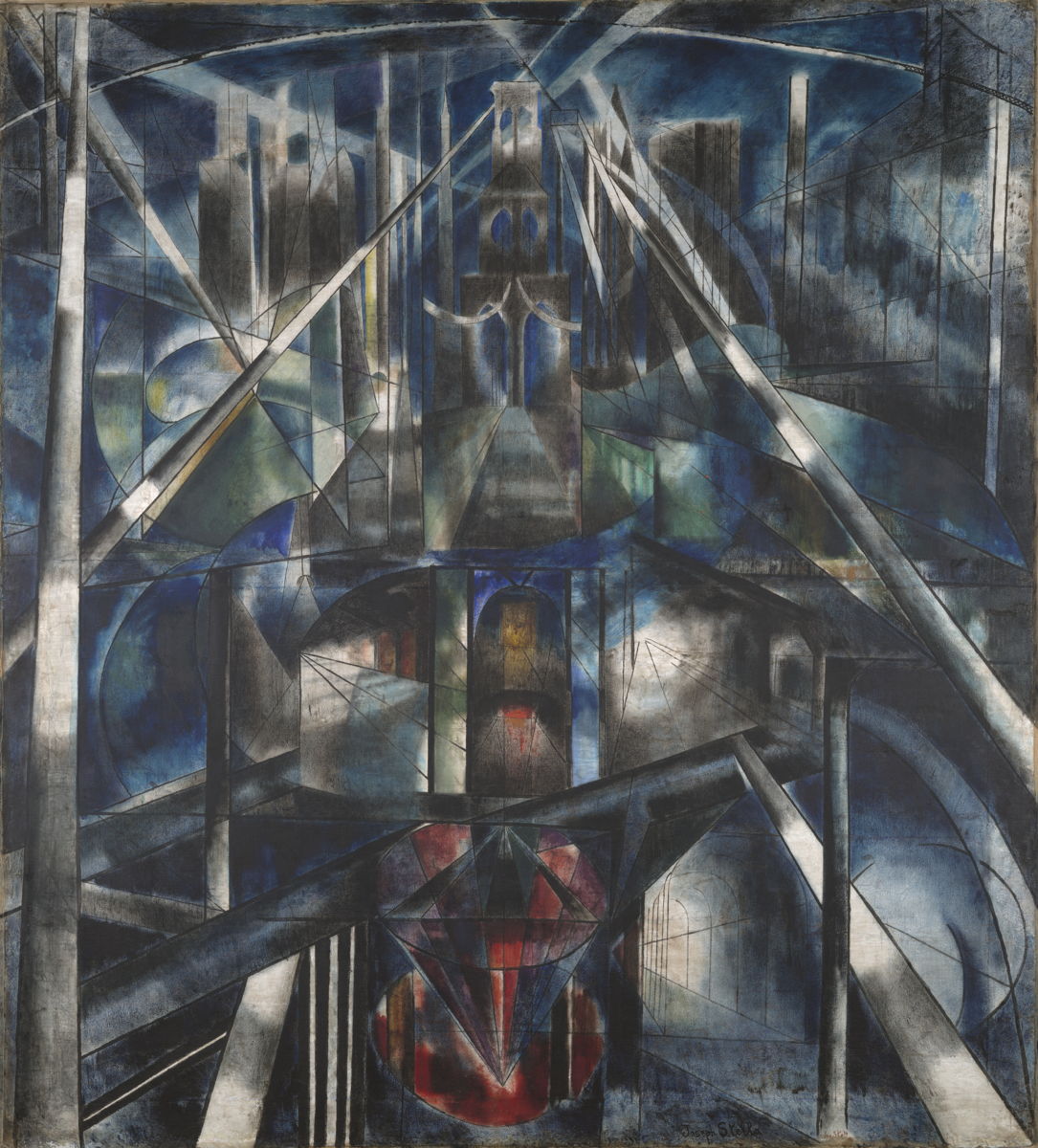
His best-known work is this Cubist geometric analysis of Brooklyn Bridge from 1919-20.
M Jean McLane (1878-1964)
She studied in Cincinnati under Frank Duveneck, then in New York under Chase. She is also known to have continued her training in Italy, Spain and France. An accomplished portraitist, her work remains in copyright.
Edward Hopper (1882-1967)
He studied under Chase and Robert Henri at the New York School of Art from around 1900-1906, and his mature style was strongly influenced by Chase, Manet, and Degas. Although he did visit Europe, he doesn’t appear to have trained outside the USA. A major painter by any standard, his work remains in copyright.
Rockwell Kent (1882-1971)
After studying composition and design at the Art Students League in 1900, he learned to paint at the Shinnecock Summer Schools in 1900-1902, then in 1902 was a student of Robert Henri at the New York School of Art. He doesn’t appear to have studied outside the USA. Another major painter by any standard, his work also remains in copyright.
George Wesley Bellows (1882–1925)
He attended the New York School of Art from about 1904, mainly studying with Robert Henri, and didn’t study outside the USA. He has become one of the school’s most distinguished alumni.
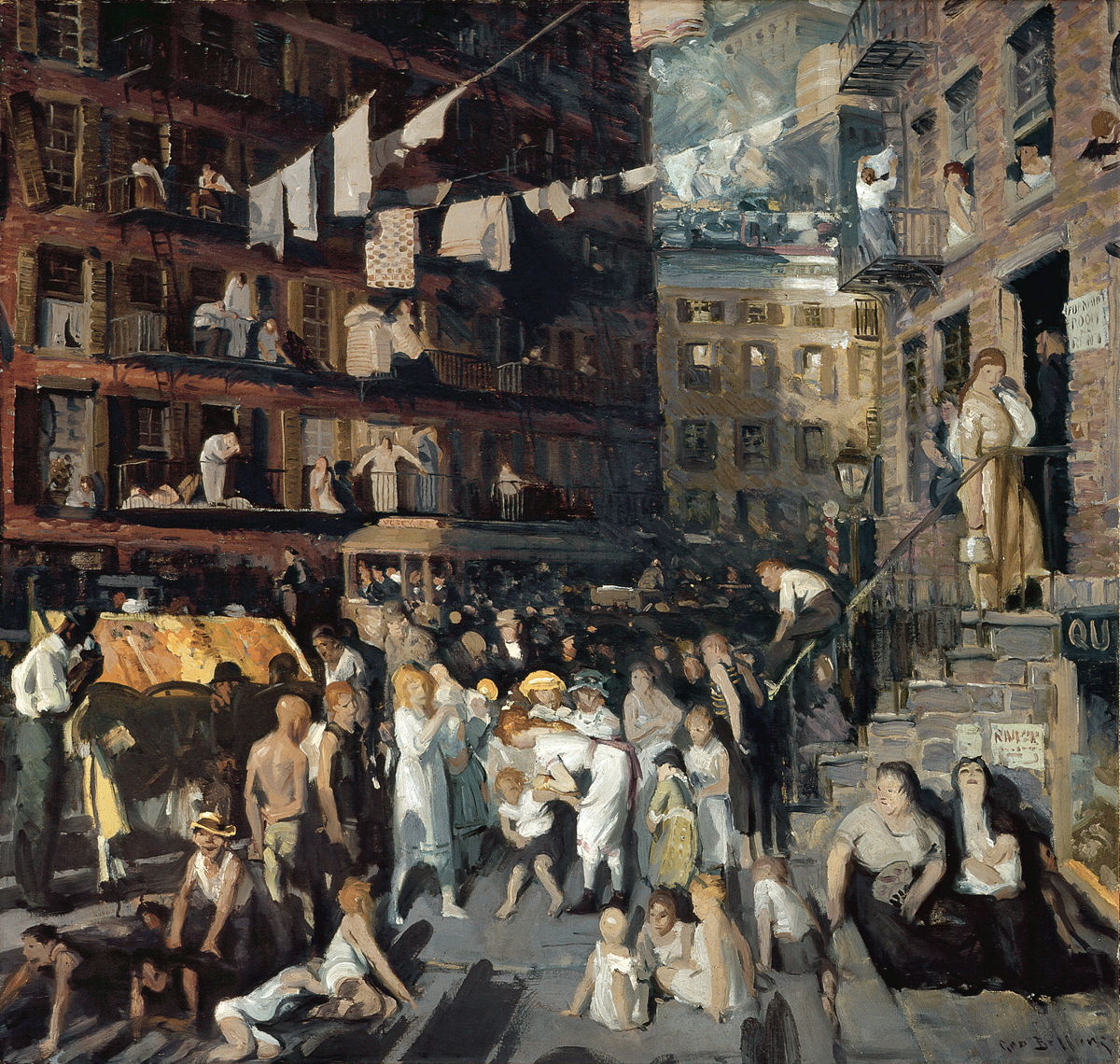
As one of the Ashcan School he painted many gritty views of urban life in New York City, including his most famous Cliff Dwellers from 1913.
Julian Onderdonk (1882–1922)

He studied with Chase from 1901, initially at a Shinnecock Summer School, and for a further two years after that, but never trained outside the USA. His father, Robert Jenkins Onderdonk (1852–1917) had earlier studied with Chase, and with James Carroll Beckwith.
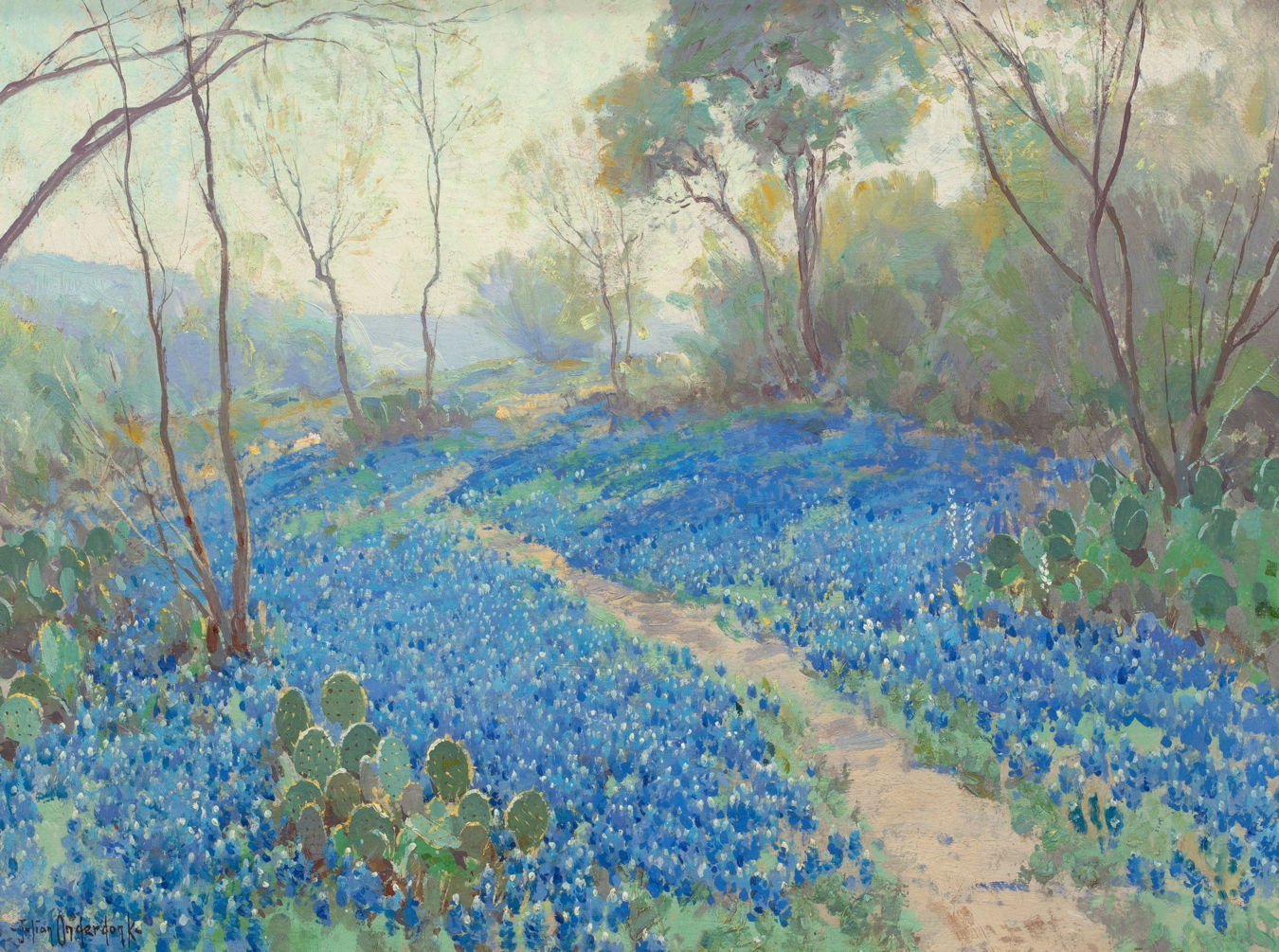
Following his training with Chase he returned to his native Texas, where he painting many landscapes, often featuring blue bonnet flowers, until his untimely death in 1922 at the age of only 40. This is his Hillside of Blue Bonnets – Early Morning, Near San Antonio Texas from 1916.
Charles Henry Buckius Demuth (1883–1935)
From Drexel University, he went on to study at the Pennsylvania Academy of the Fine Arts, under William Merritt Chase. He travelled to Europe in 1907, studying at the Académies Colarossi and Julian in Paris. He was one of the founders of Precisionism when it started to develop in 1915, in the USA.

Chimney and Water Tower from 1931 is an example of his Precisionist views.
Elizabeth Sparhawk-Jones (1885-1968)
She attended the Pennsylvania Academy of the Fine Arts from about 1901, where Chase was one of her teachers. He became her mentor, until his death in 1916, which affected her deeply. Although she visited Paris while still a student, her training was almost entirely in the USA. Her paintings remain in copyright.
Georgia Totto O’Keeffe (1887-1986)
Probably Chase’s most eminent and popular former student, she studied under him at the Art Students League in New York City in 1907. The following year she won the League’s William Merritt Chase prize for still life, and didn’t study outside the USA. Her work remains in copyright. The Georgia O’Keeffe Museum holds more than a thousand of her works, and has a good online collection.
Leopold Gould Seyffert (1887-1956)
He studied at the Pennsylvania Academy of the Fine Arts in 1906-1913, where his teachers included Chase, Thomas Pollock Anschutz, and Cecilia Beaux. He visited Europe in 1910, 1912 and 1914, and became a leading portraitist. His work remains in copyright until next year.
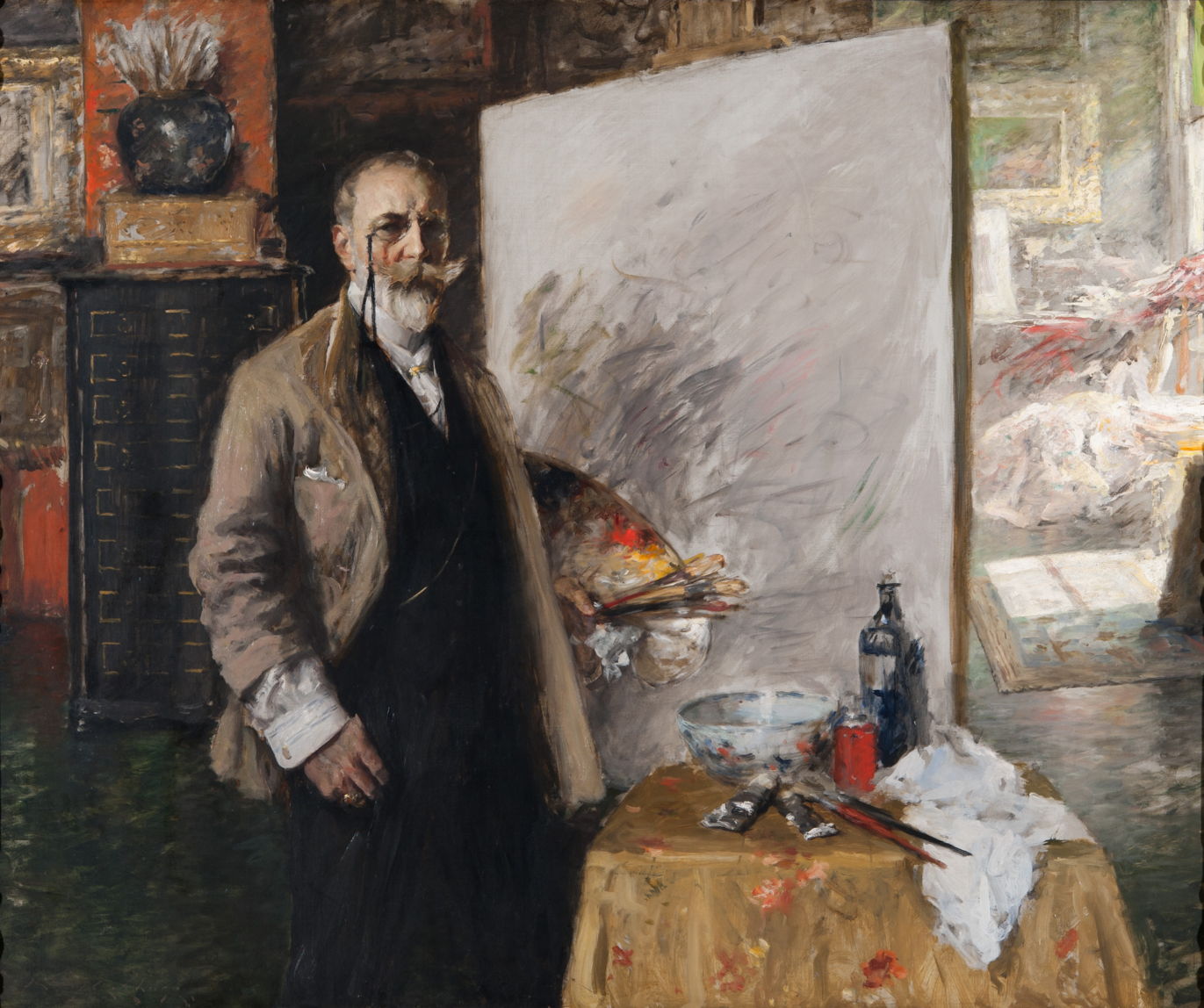
The USA owes much to its great teachers of art including Thomas Eakins, John Ferguson Weir, Robert Henri, Frank Duveneck, and above all William Merritt Chase, seen above in his 4th Avenue Studio shortly before his death. For they brought a cultural revolution, and independence from the academies of Europe.

