

At the same time that Constable and Turner were transforming landscape painting on the northern side of the Channel, Eugène Delacroix was laying the foundations for the change in style that was to take effect on the southern side.
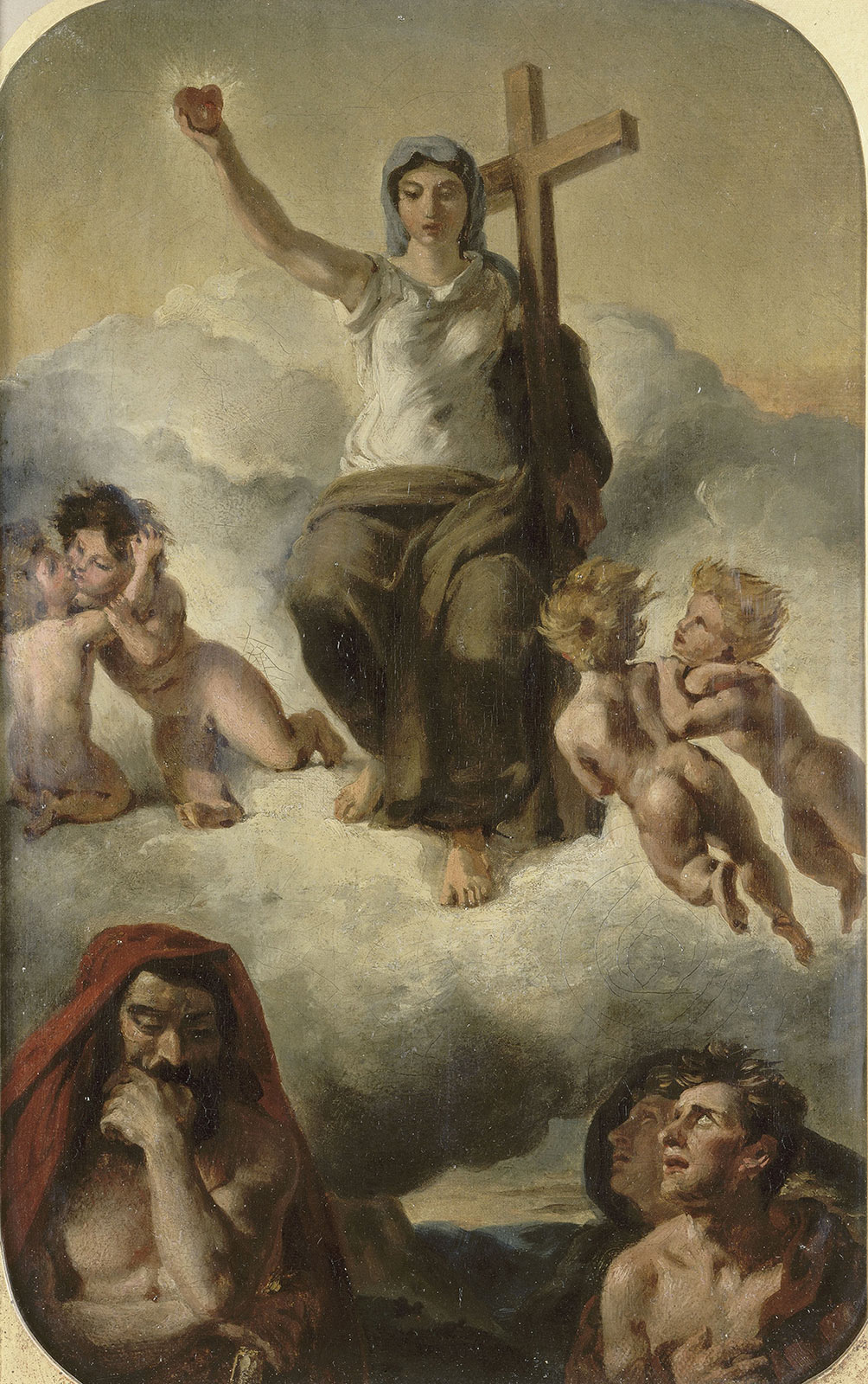
At first Delacroix followed the tradition of painting studies loosely, but retaining a tight academic style in his finished works. This is shown in his painterly study of the Virgin of the Sacred Heart from 1821, shown above, and the resulting finished painting from the same year, below, commissioned for the cathedral in Nantes.
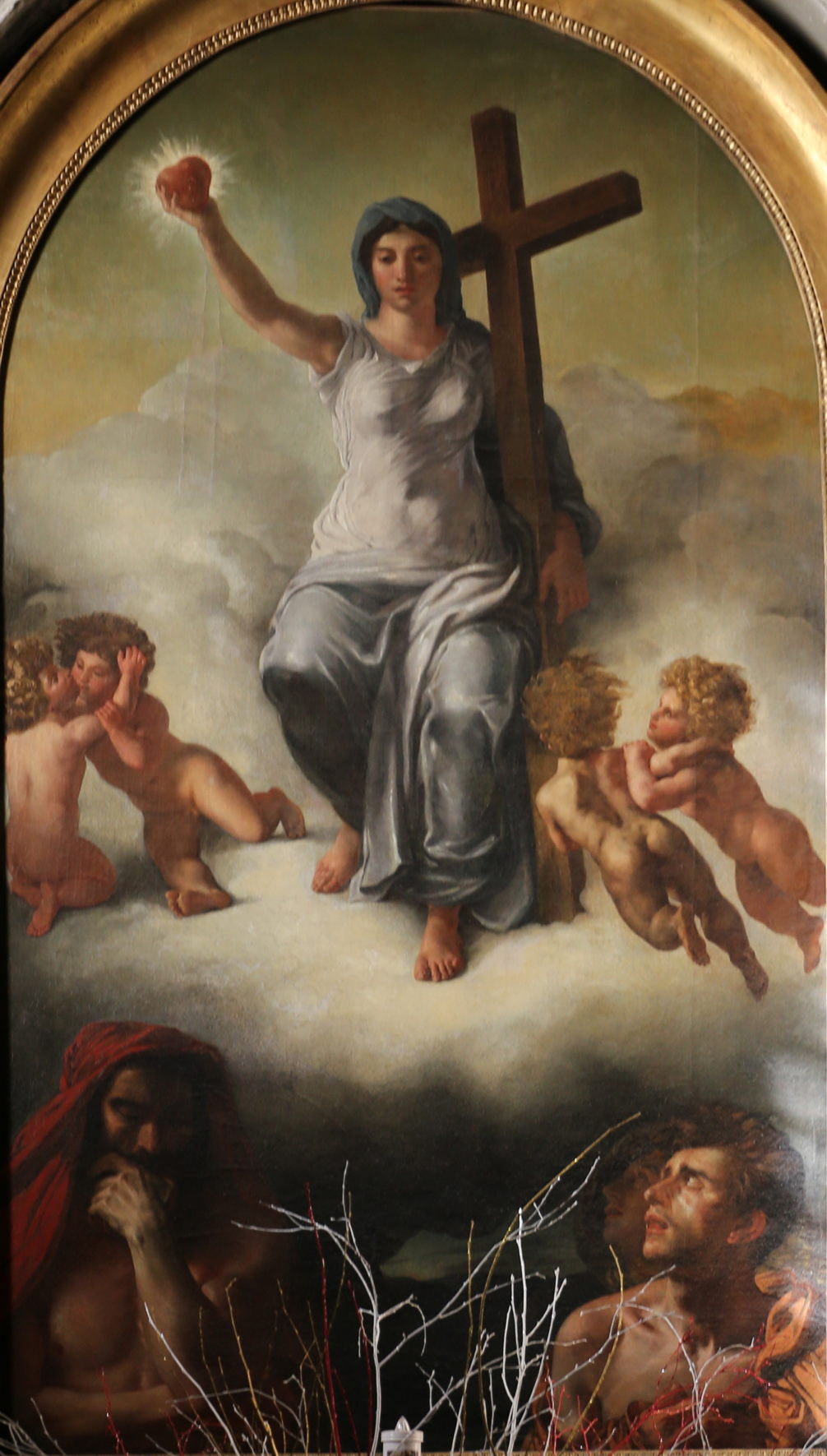
His finished Triumph of Religion, Virgin of the Sacred Heart (1821) is thought to have been refused by the clergy, and in 1827 ended up in the Cathédrale Notre-Dame-de-l’Assomption in Ajaccio, capital of the French island of Corsica, where it wasn’t rediscovered until the 1930s.
Just four years later, what appeared to have been a sketchy study became his finished painting.

He painted A Mortally Wounded Brigand Quenches His Thirst in about 1825, but it wasn’t shown until the Salon of 1827-28. Set in a bleak landscape, this brigand with roughly sketched hair is bleeding into the water he’s trying to drink. This seems to have marked a change in Delacroix’s practice, perhaps best illustrated in his two versions of The Death of Sardanapalus.

In his original version, painted and exhibited at the Salon in 1827, his brushwork is tight and the huge canvas intricately detailed. Seventeen years later, in 1844, he painted a smaller replica, shown below.

This wasn’t intended to please the Salon, and he was far more painterly in its facture. The series of details below show how radical that had become.
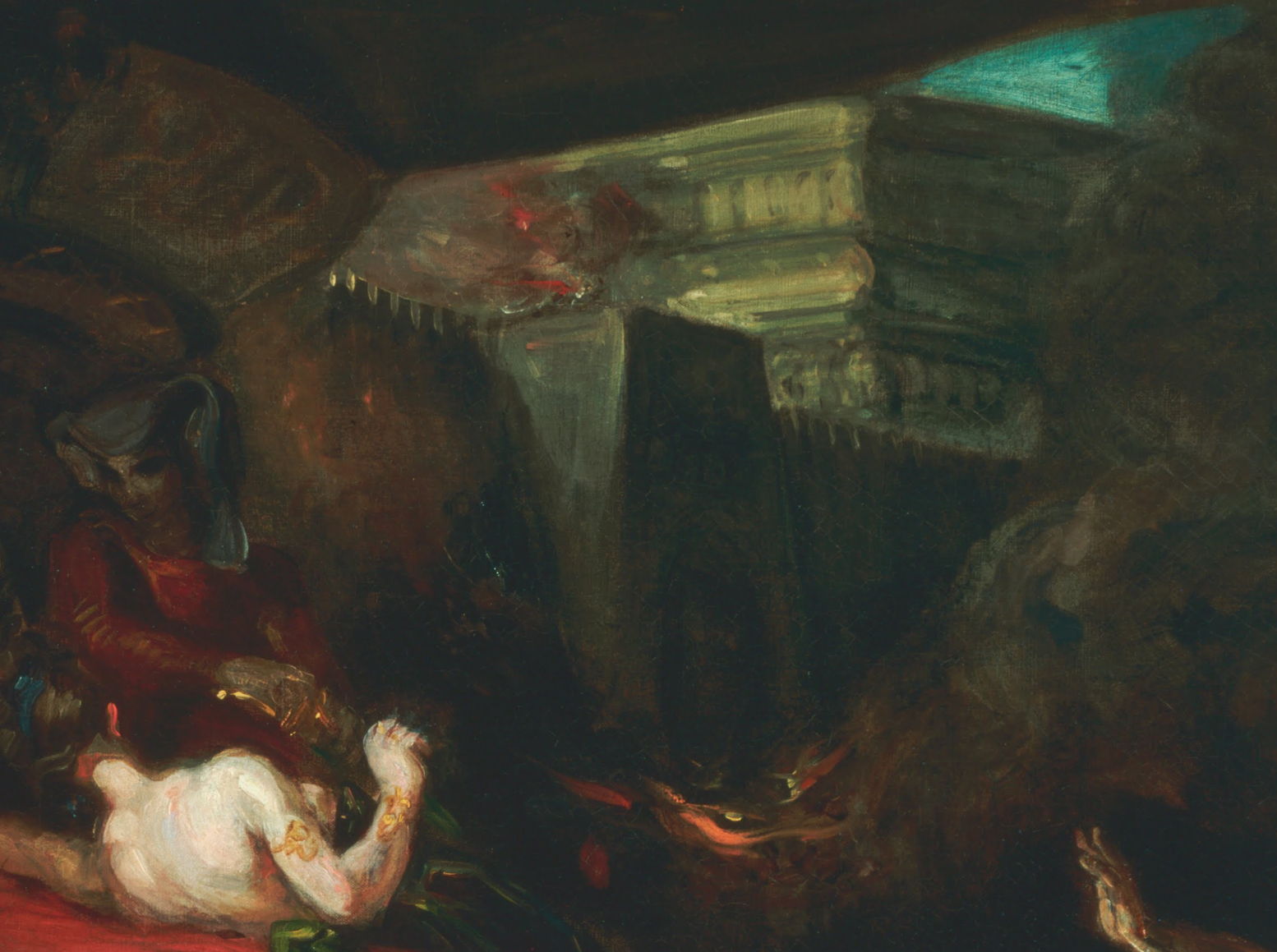
At the upper right, everything is sketched in roughly, with marks evident on both the figures seen at the left.

Halfway down the left of the canvas, the horse’s head and golden bridle are assembled from many short brushstrokes.

Similar marks are evident throughout the two figures in the right foreground.

Sardanapalus himself is another assembly of coarse marks.

Delacroix’s Abduction of Rebecca was shown at the Salon of 1846 under the extended title of Rebecca Abducted at the Order of the Templar Bois-Guilbert during the Sack of the Castle of Front-de-Boeuf, but only achieved a lukewarm reception. This too has extensive displays of his brushstrokes and other marks, most obviously in the mane of the horse at the left edge.
These became even bolder in two of his later narrative works.

In 1852, he tackled one of the most entertaining scenes from Ariosto’s epic poem Orlando Furioso, of Marfisa and Pinabello’s Lady. The knight Pinabello’s lady had mocked the companion of the woman warrior Marfisa, an old woman named Gabrina. For that, Marfisa knocks Pinabello from his horse, which promptly gallops off into the distance, as seen at the right, where he paints the only fine detail. Pinabello’s lady is forced to undress and hand over her clothing for Gabrina to wear, as shown in its gestural foreground.

Painted in about 1860, Angelica and the Wounded Medoro tells another of the stories from Orlando Furioso. One of its leading characters is the beautiful but pagan princess Angelica, who is frequently the target of the leading males’ amorous intentions. Eventually she falls in love with a very ordinary Moorish soldier, Medoro, and runs away with him to Cathay, leaving lovesick knights behind.
At one stage Medoro is badly wounded, and Angelica expresses her love by rescuing and caring for him, nursing him back to health. Medoro is still wearing his armour and riding his horse with his right arm in a sling. Angelica stays alongside, holding his left hand. His attendants, accompanied by a dog (foreground), lead the horse through a narrow mountain pass, heading for safety, and his eventual recovery.
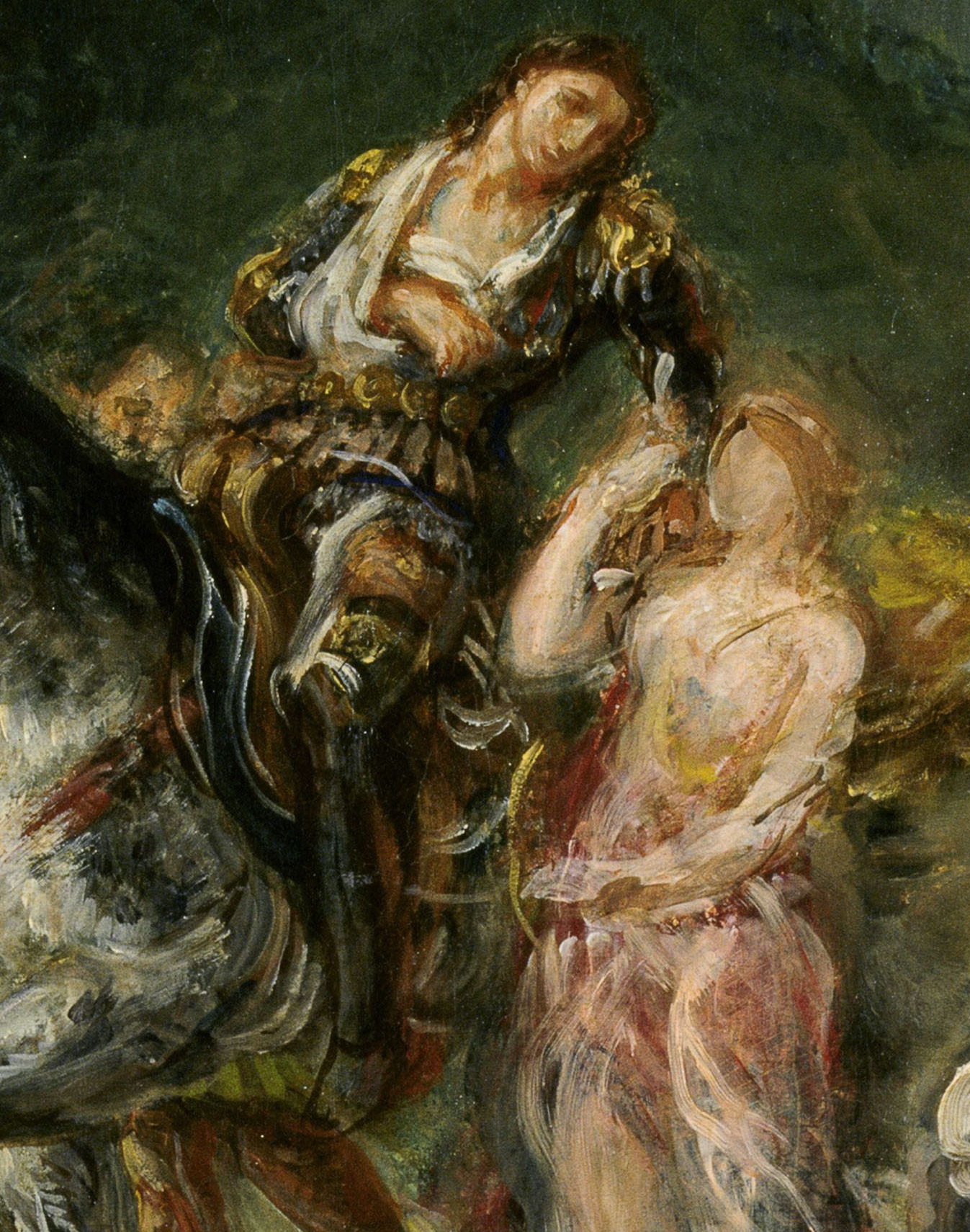
Of the four faces seen in the painting, only Medoro’s has any features at all, and appears strangely expressionless. Angelica’s face is a formless blur of flesh colour, and the rest of this detail is a series of virtuoso brushstrokes.
Delacroix’s figurative painting was far in advance of his time, and in these late works anticipated Expressionism, which didn’t arrive until the following century.

