
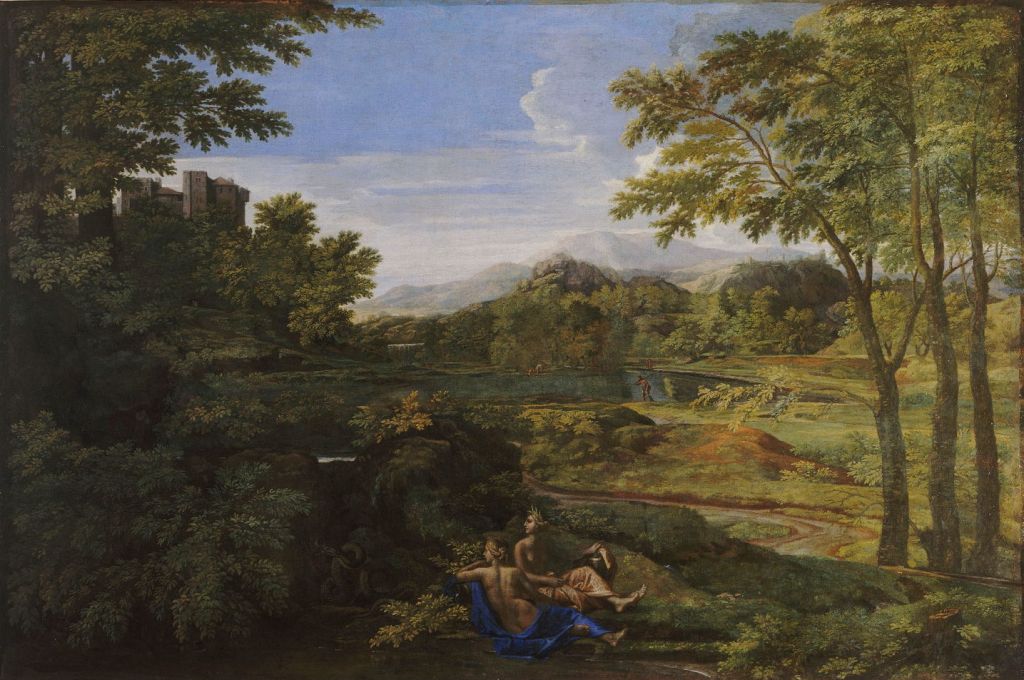
As one of the founding fathers of the genre, Poussin’s landscapes are among the most influential, and his approach to the depiction of trees set the standard.
Nicolas Poussin (1594-1665) was born near Les Andelys, a village on the River Seine in Normandy, where he was initially apprenticed to Quentin Varin. He ran away to Paris at the age of eighteen, where he continued his apprenticeship under minor masters. Becoming impressed by Italian paintings, he attempted to travel to Rome, but was forced to return to Paris. He eventually moved to Rome in 1624, and remained there painting for much of the rest of his life.
A good friend of the other major French landscape painter of the day, Claude Lorrain, he relied mainly on private patronage and completed many major paintings with religious and historic themes. He returned to France between 1640 and 1642 to work as court painter to Louis XIII, but went back to Rome as a result of intrigues in the French court. His marriage was childless, but he adopted his wife’s brother, Gaspard Dughet, who also painted fine landscapes and assumed the name of Poussin; distinguishing their work remains difficult and controversial.

In Landscape with a Man Scooping Water from a Stream (c 1637) he comes closest to a view dominated by trees, most probably his lifelong favourite, oaks, in this case the holm oak, Quercus ilex. Each is carefully constructed from the trunk and branch anatomy, and their canopies, although dense, are formed from leaves rather than solid masses. The distant view is that of an idealised Roman campagna.
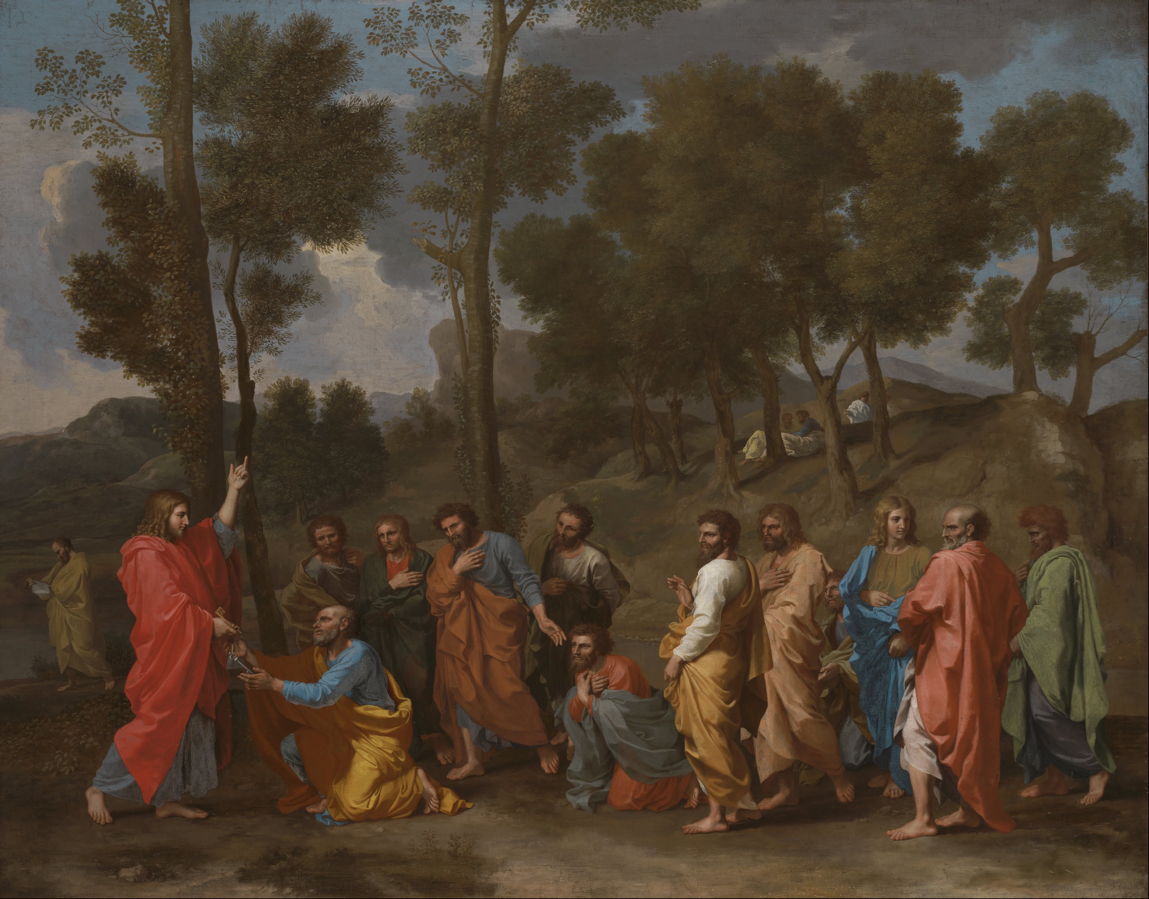
His early works were mostly religious, myth, and history, but he still took the opportunity to enrich landscape backgrounds with carefully painted trees: this, one of his first series of seven paintings showing the sacraments, was completed for Cassiano dal Pozzi, a major patron in Rome. The Sacrament of Ordination (Christ Presenting the Keys to Saint Peter) (c 1636-40) is interesting as its trees, although far less colourful than Christ and his disciples, dominate in size.

Seen close up, Poussin has shown closer foliage in crisp detail, and softened that as it goes deeper towards the background: this mimics the effects of optical depth of focus, something he couldn’t have known about. He also modelled variation in colour and texture of the bark, and other subtle details.

Landscape with Saint John on Patmos (1640) shows another idealised landscape, probably based on the western Italian coast, rather than Patmos in the Dodecanese, in the eastern Aegean. Instead of placing trees at the edges, Poussin sets them further back; these again have the look of oaks. There’s a richer variety in the middle distance, breaking the more regular lines of ancient ruins.

A more detailed view of the tree at the left confirms that it has the leaves typical of an oak, and has bark carefully textured and encrusted with lichen. Poussin was no botanist, and understanding of plant and tree species was limited at that time, but his trees reflect careful observation and field drawings.
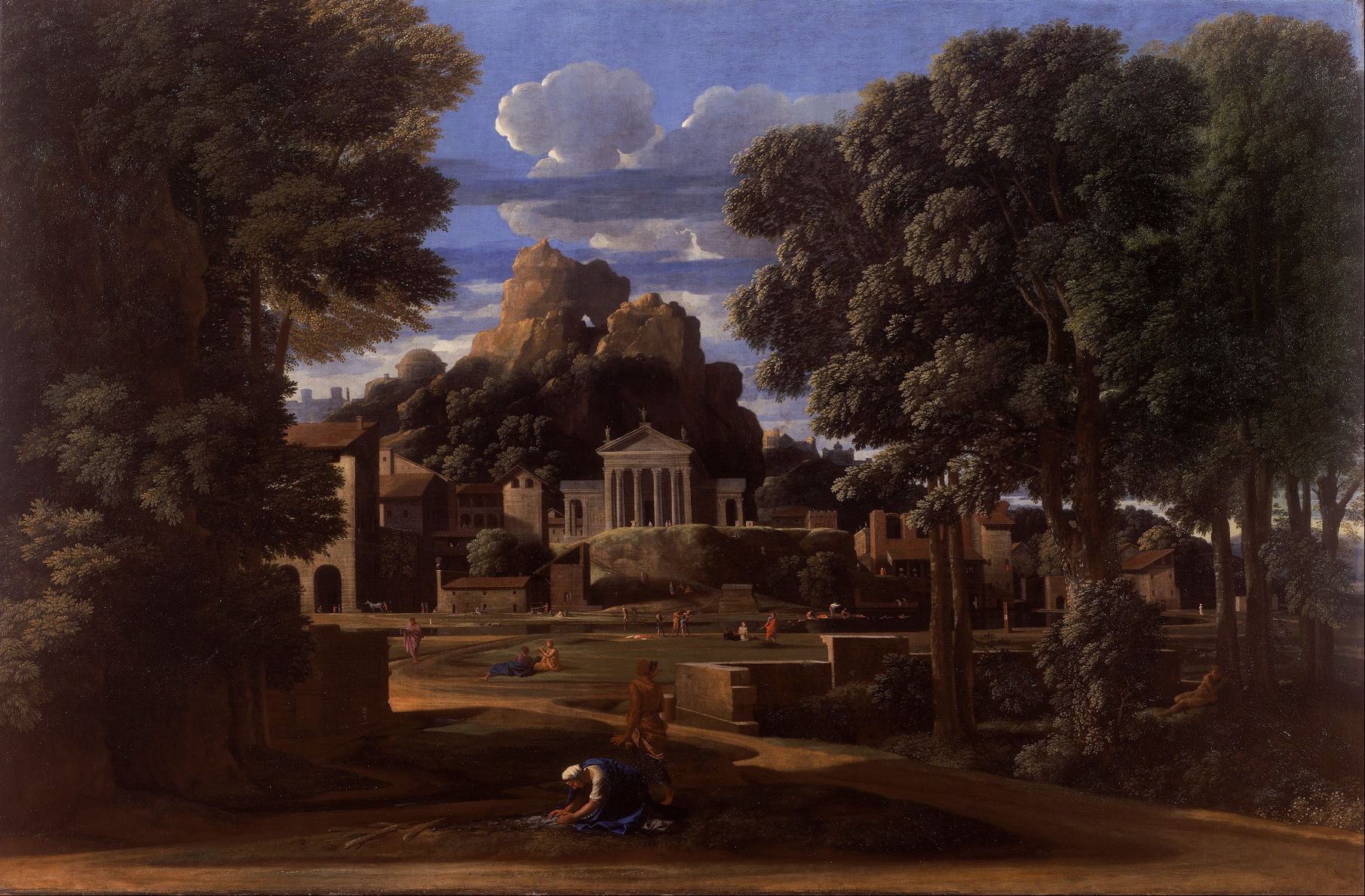
Landscape with the Ashes of Phocion (1648) is dominated by the dense canopies of holm oaks, their leaves painted meticulously. At the far right, there appears to be a close group of poplars, perhaps.

When seen in detail, their anatomical construction is apparent, as are more figures from his staffage, including a person apparently clinging to the base of one of the trunks, at the lower right of this view.

Poussin’s trees were also actors in the narratives in his paintings. Here, in Landscape (during a Thunderstorm) with Pyramus and Thisbe (1651), each canopy is contorted by the wind, and they form the major cue for its strong gusts, the water on the lake remaining unrealistically flat.
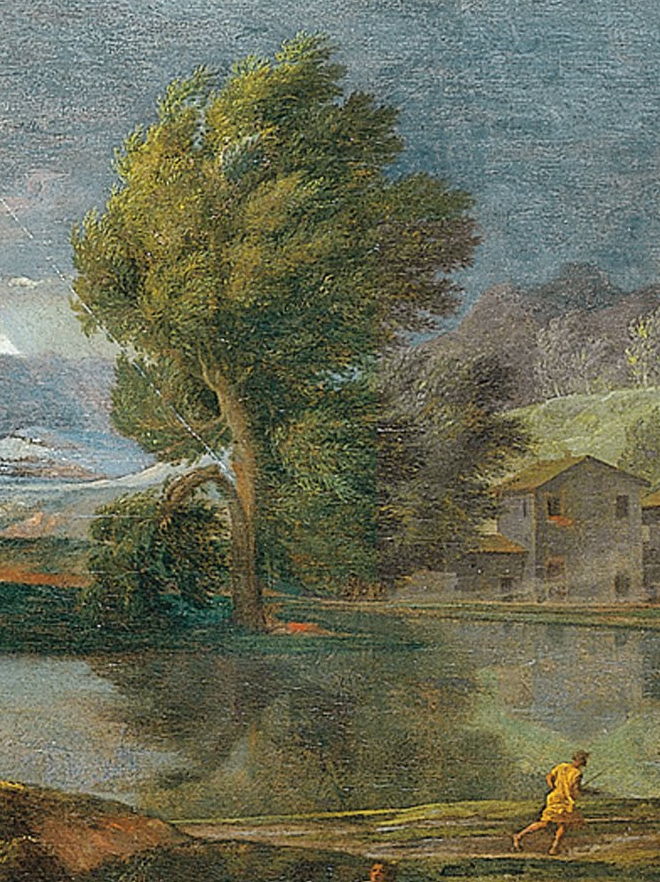
This detail shows the leaves and branches of the tree on the lakeside swept back to their limits, and one of the few branches that appears damaged, to reinforce the impression of the strength of the wind.
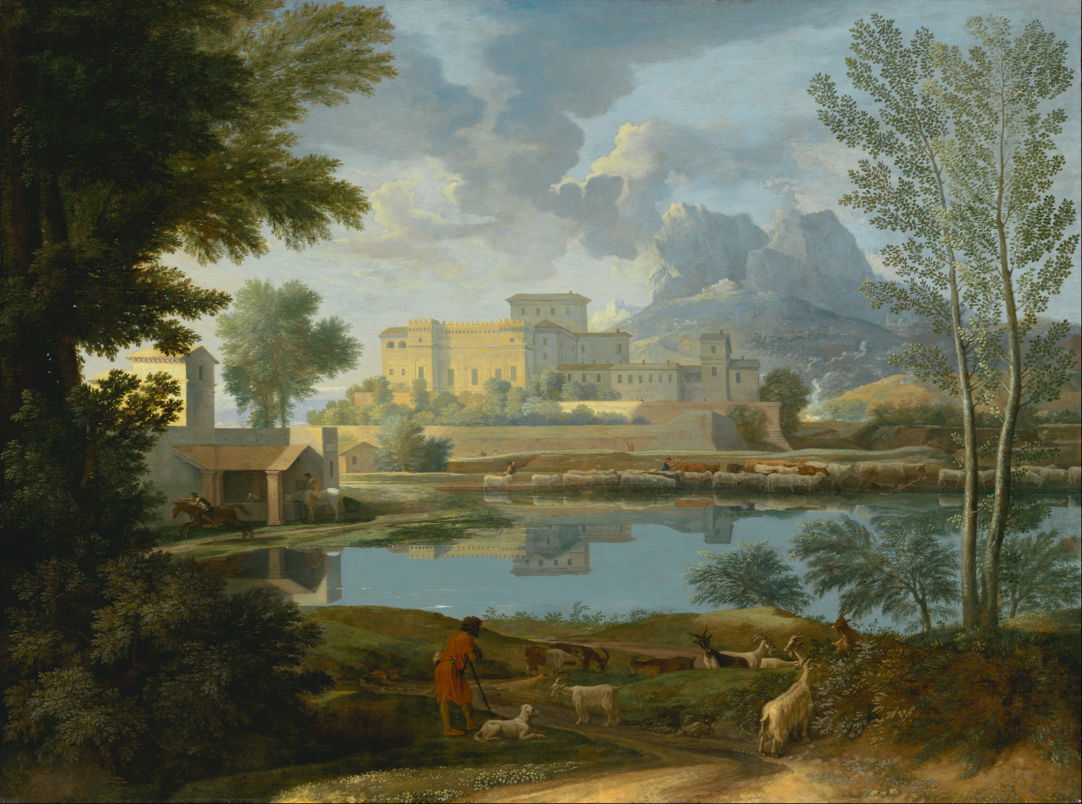
The contrast shown in Landscape with a Calm (c 1651) is achieved largely in the appearance of the foliage and canopies. Here the trees are closer to the edges of the canvas, and form a more classical repoussoir.
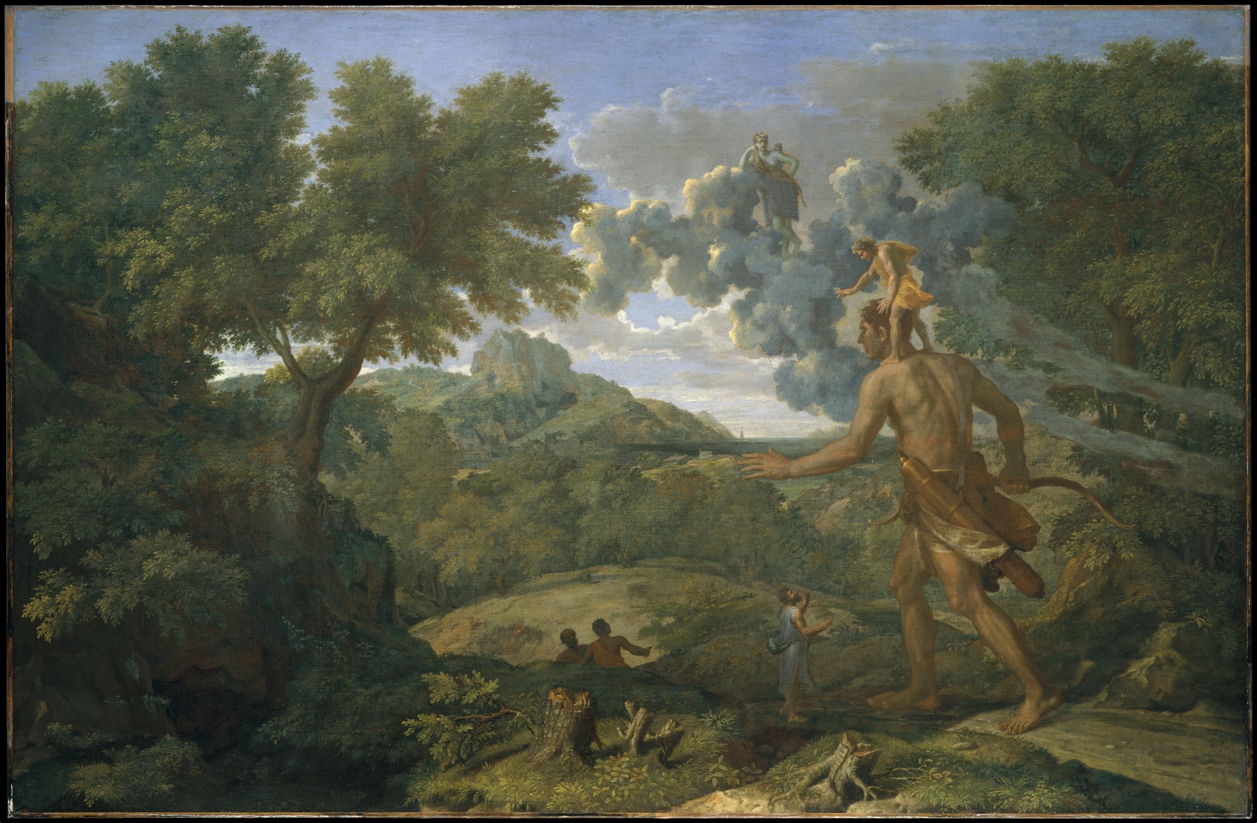
In Blind Orion Searching for the Rising Sun (1658) Poussin’s oaks not only frame the view, but provide scale for the blind giant Orion.

The fused twin trunk is old, its surface gnarled and uneven, and its base clinging to the edge of a small cliff.
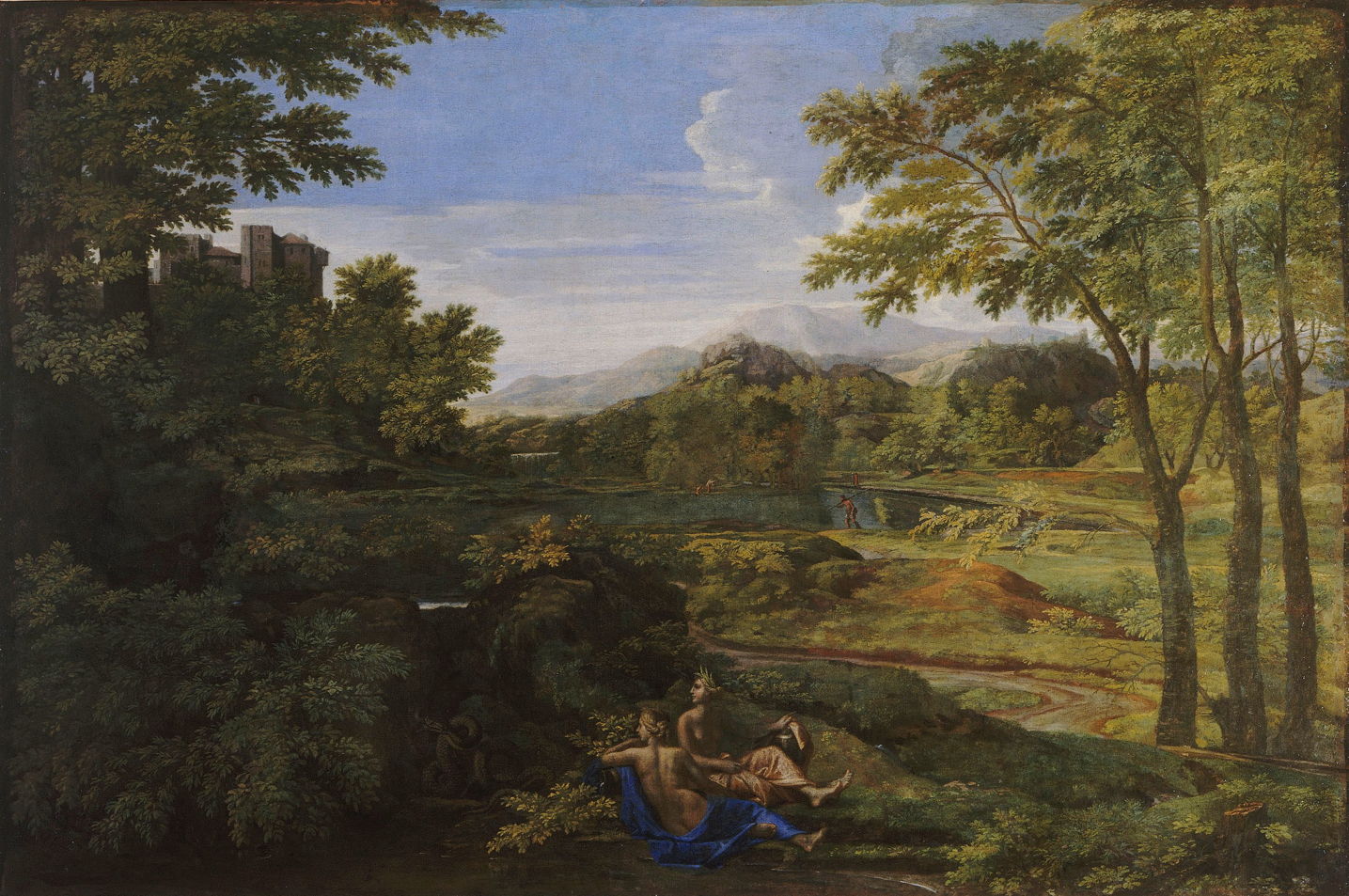
Landscape with Two Nymphs and a Snake (c 1659) uses the trees to the right as more than just a framing device.
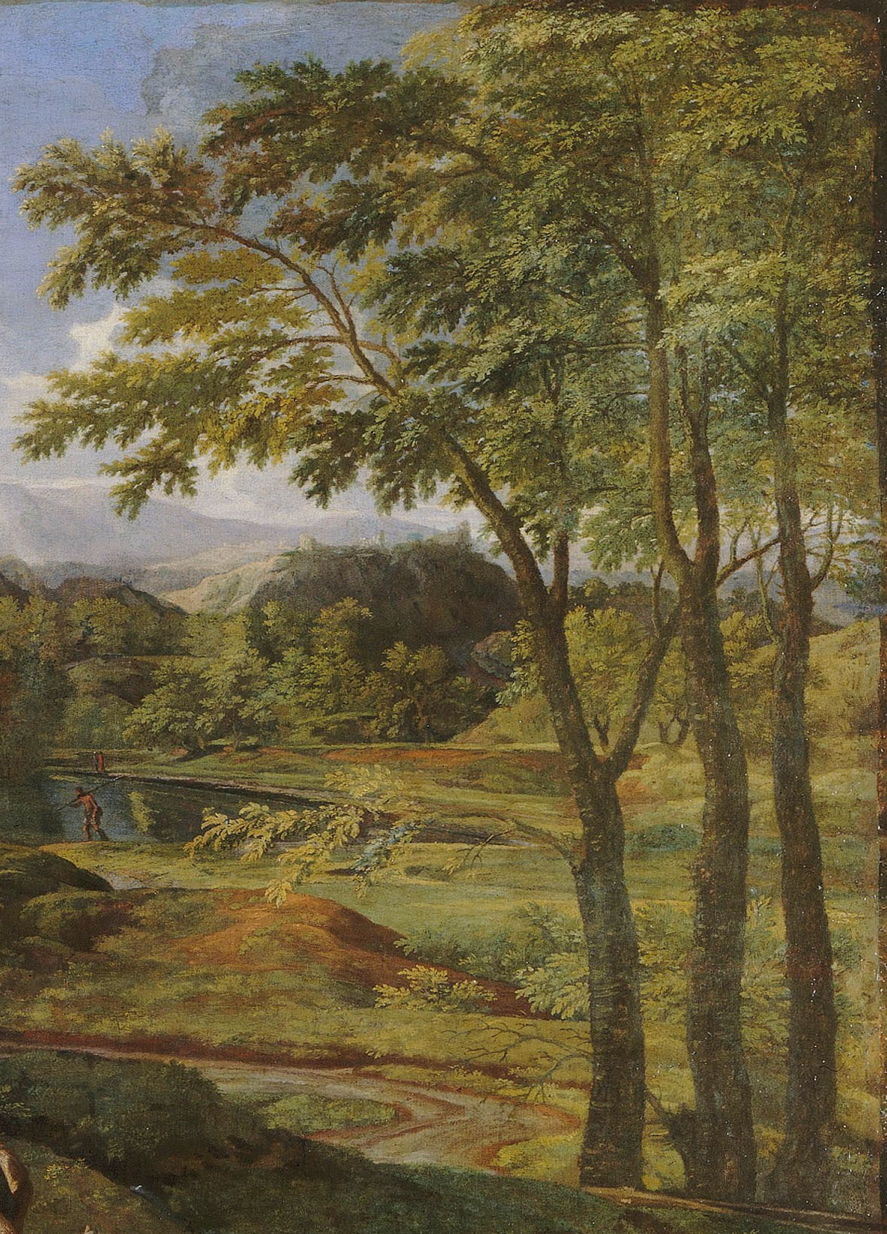
This detail view suggests the trees at the right are likely to be oaks. He again controls level of detail, size of leaves, and ‘focus’ to enhance the sense of depth.
References
Clark TJ (2006) The Sight of Death, an Experiment in Art Writing, Yale UP. ISBN 0 300 11726 4.
Milovanovic N and Szanto M (eds) (2015) Poussin et Dieu (in French), Hazan. ISBN 978 2 7541 0826 3.
Rosenberg P & Christiansen K (2008) Poussin and Nature. Arcadian Visions, Yale UP. ISBN 978 0 300 13668 5.
Thuillier J (1994) Nicolas Poussin, Flammarion, Paris. ISBN 978 2 08 012440 4.

