

Two centuries ago today, on 4 May 1826, Frederic Edwin Church was born in Hartford, CT. As one of the founding American masters, he has a pivotal place in the history of painting in North America, and is one of the great nineteenth century landscape painters. Inspired by Alexander von Humboldt’s account of central America, Church travelled to Colombia and Ecuador in 1853, and returned to depict their ‘physiognomy’ in grand landscape paintings. He went back to central America in 1857 to build on his earlier success.
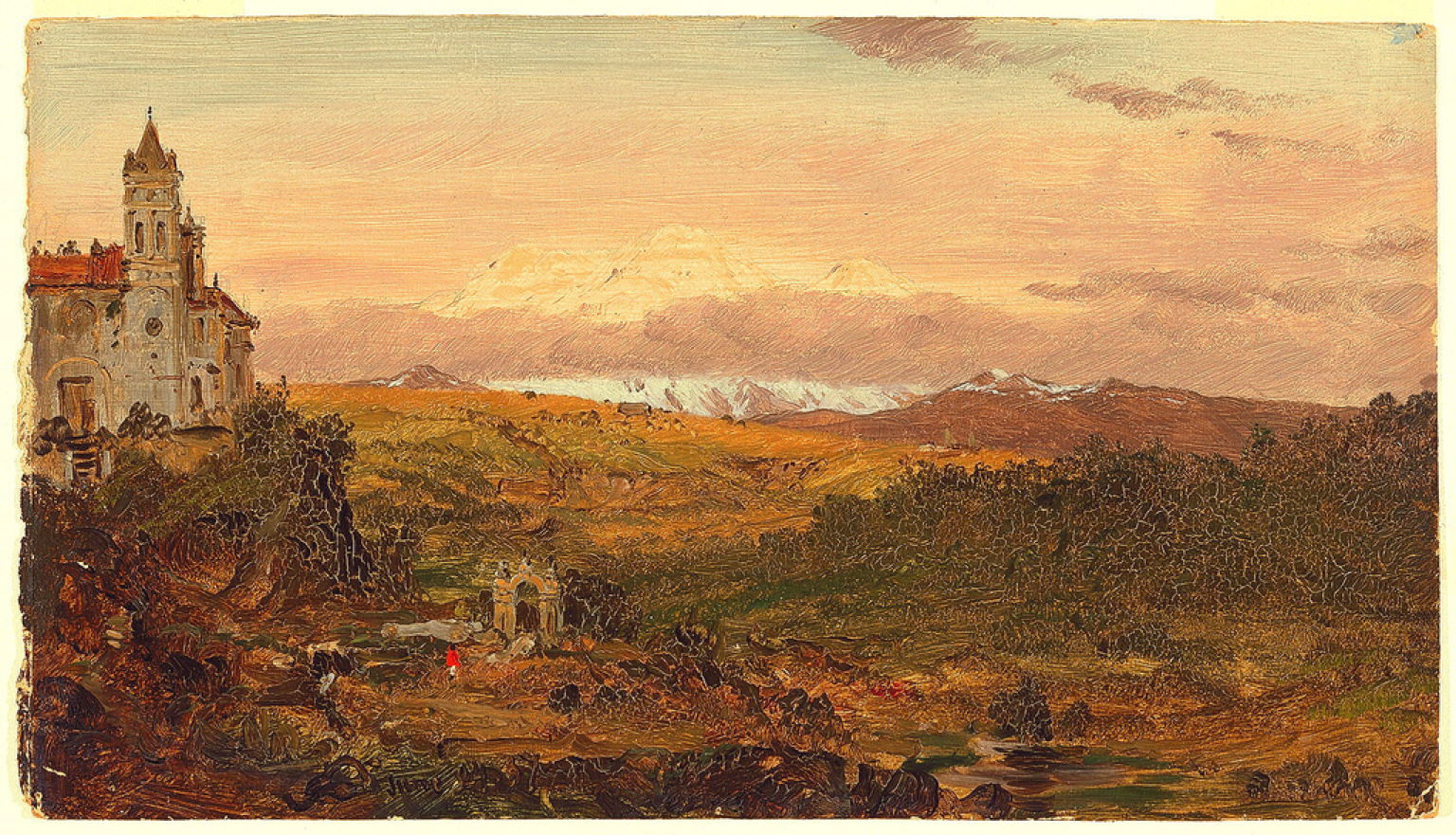
Church painted this oil sketch of the cathedral in Chillo, Ecuador, on 24 June 1857. As with most of his oil sketches, it’s small and made on cardboard, which was cheap and portable but not intended to last the years.
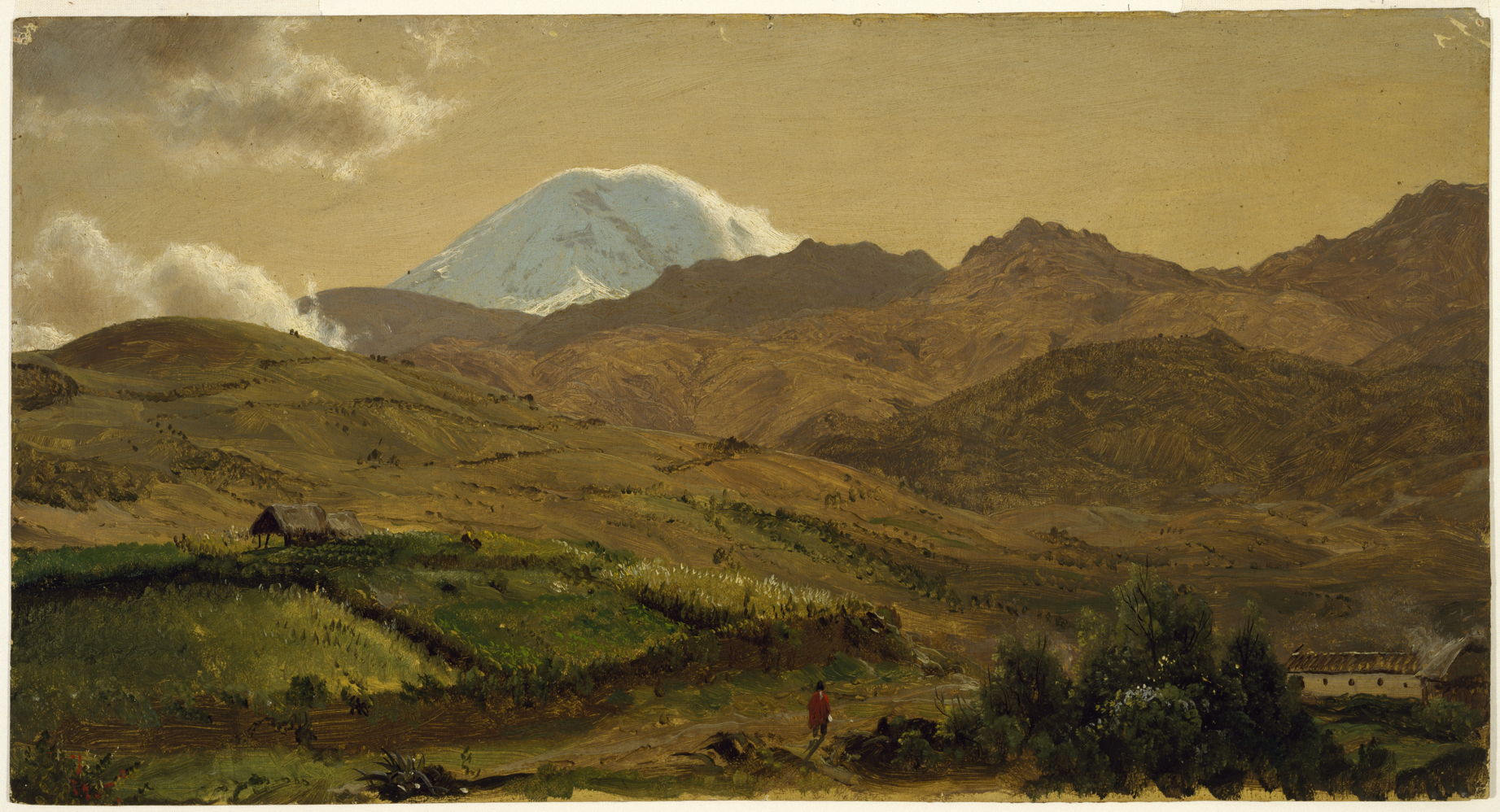
His larger oil sketch of Mount Chimborazo in Ecuador is rich in painstaking detail for a study never intended to be viewed by others. In comparison to his studio works, though, it’s full of fine gestural marks with some quite painterly passages.
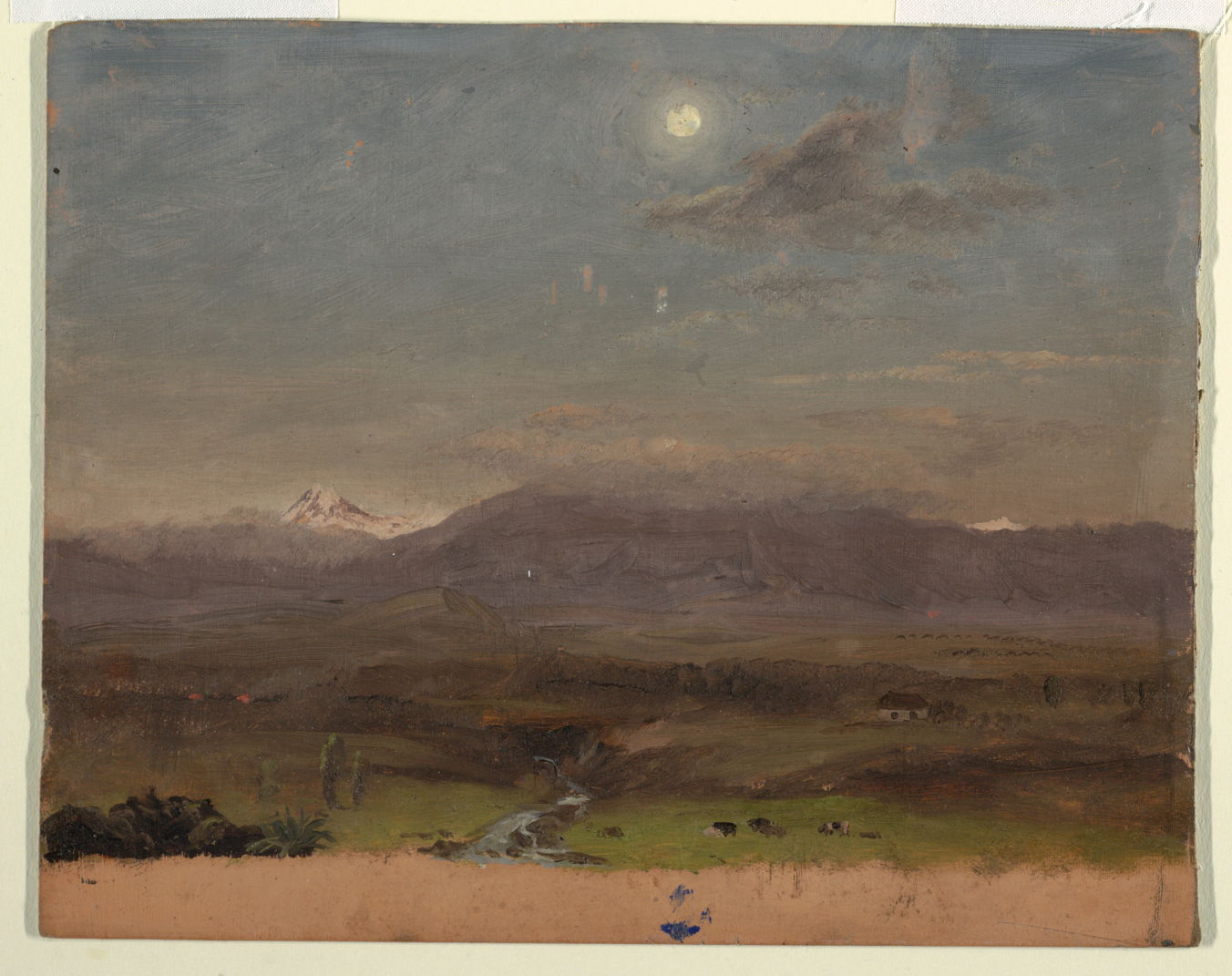
He may have painted this atmospheric view of mountains in the moonlight during either of his visits to Colombia and Ecuador.
On 29 April 1859, the first of more than twelve thousand people walked into the Studio Building on West 10th Street in New York City, to stand in awe and amazement in front of Church’s huge Heart of the Andes (1859). For many, its dramatic view of a densely-vegetated plain with its backdrop of snow-capped mountains wasn’t its most impressive feature: it was the painting’s meticulous, almost overwhelming detail.
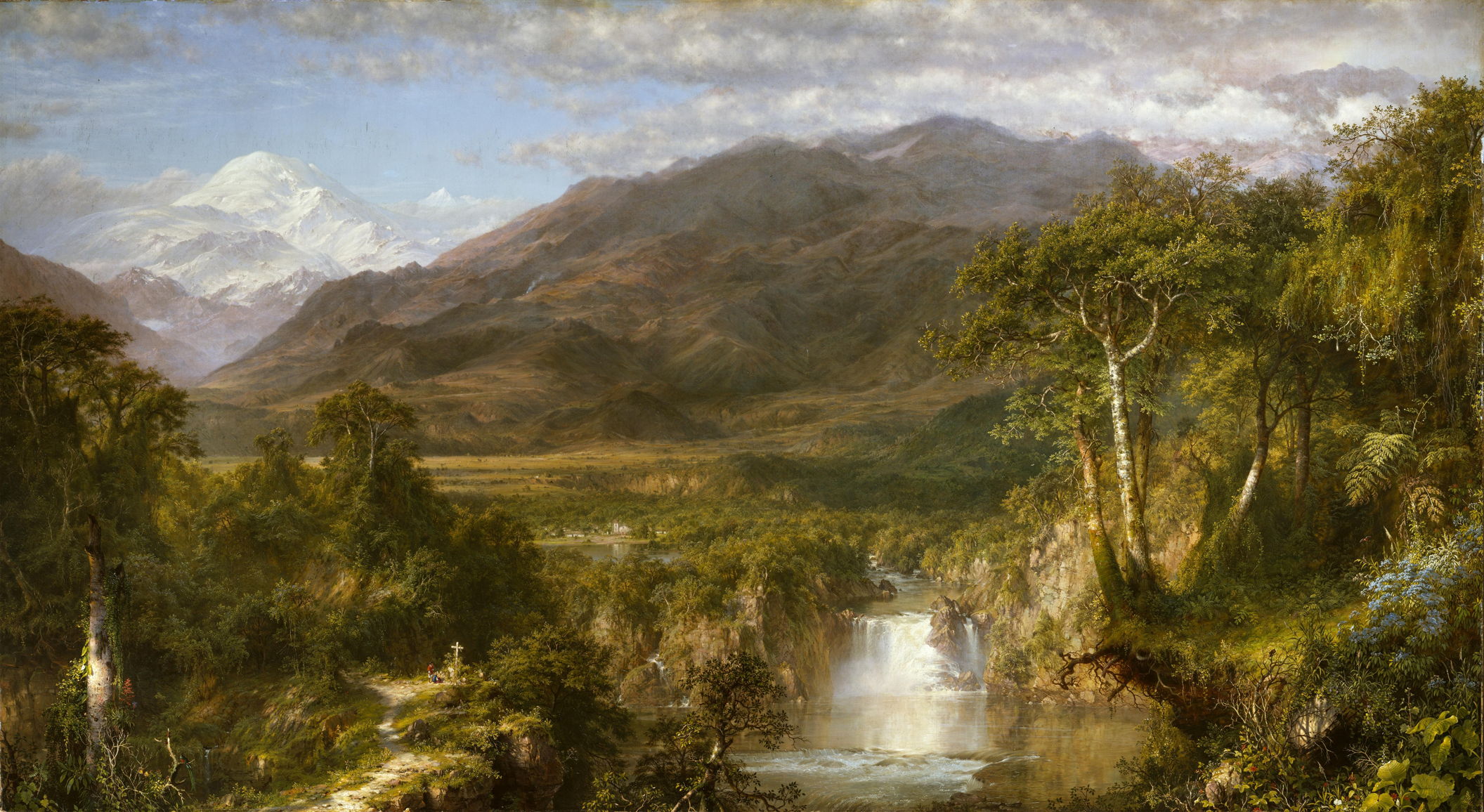
Tucked away among the brightly-coloured birds and rich plant life, at the very heart of The Heart of the Andes, is a cross, with two figures by it. Dressed as locals, one sits, facing the cross, while the other stands just behind the seated figure and looking in the same direction. The cross is made simply of wood, and appears to have been decorated with a floral garland. It’s partly obscured by the luxuriant wayside plants.

Over its five square metres of canvas, these are the only visible humans.
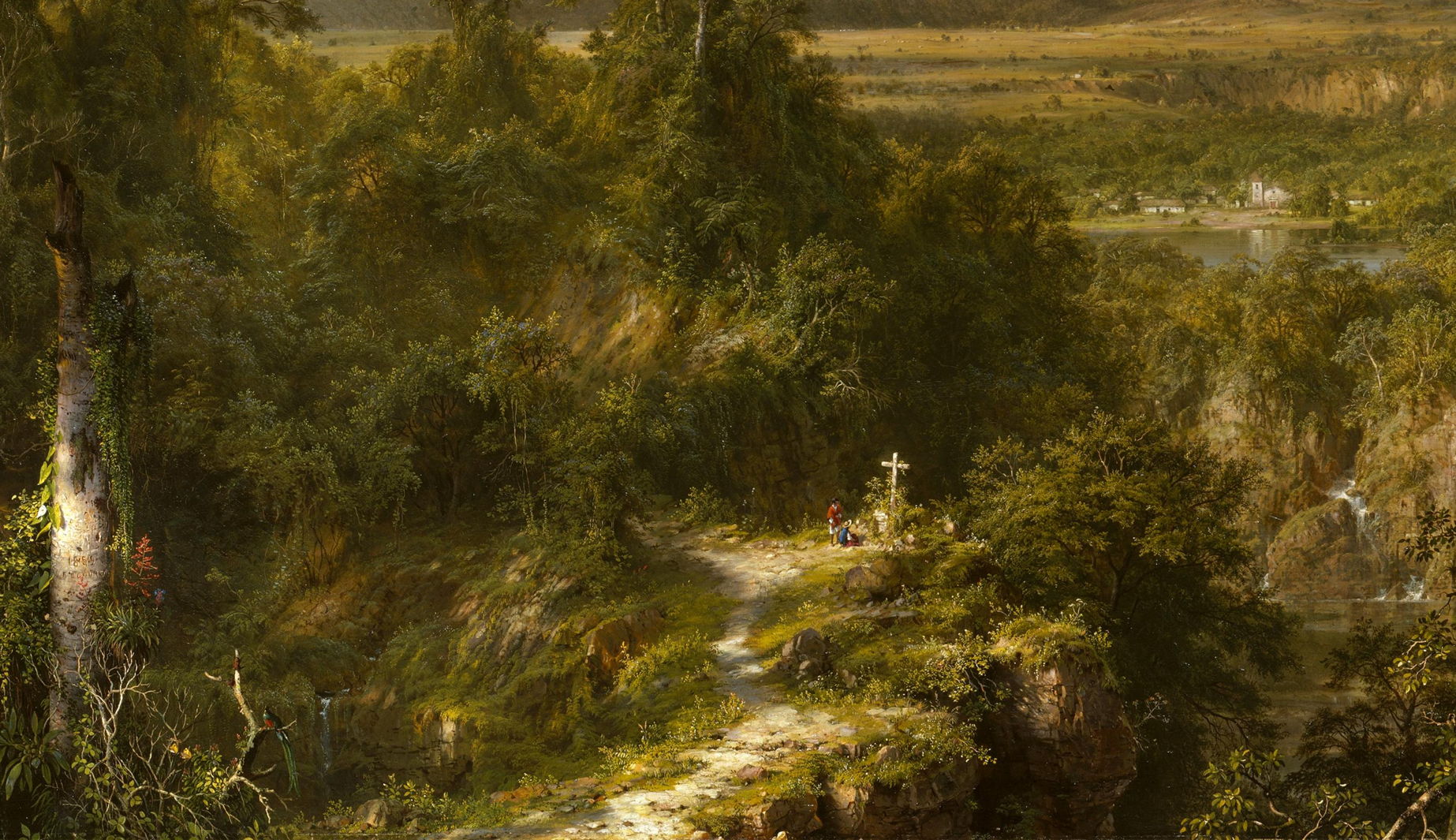
They’re part of a complex passage. The cross stands just off a path winding its way past a dead tree-trunk, seen at the left here, on which the artist has ‘carved’ the year and his name. The path then curves to the left, along the bottom of a small gully, where it disappears into the trees and undergrowth.
On the other side of the river, to the right, is a small mission-like settlement. Facing the viewer is the tower and broad frontage of a church, with its large double wooden doors. Beyond and around is the enormity of nature: open plain with scattered trees, then rising ground to the first hills, and many miles distant the soaring white peaks of the Andes proper.
Viewers were recommended to bring opera glasses in order to see these details through the crowd. Jennifer Raab argues this is a different way of seeing, as demanded by the painting, and it evoked literary responses from the likes of Mark Twain and critics.
Church was friends with Isaac Israel Hayes, a noted Arctic explorer, and once the artist had enjoyed the success of The Heart of the Andes he travelled with another friend, Louis Legrand Noble, to Newfoundland and Labrador to build himself a library of drawings and sketches for his next spectacular painting.
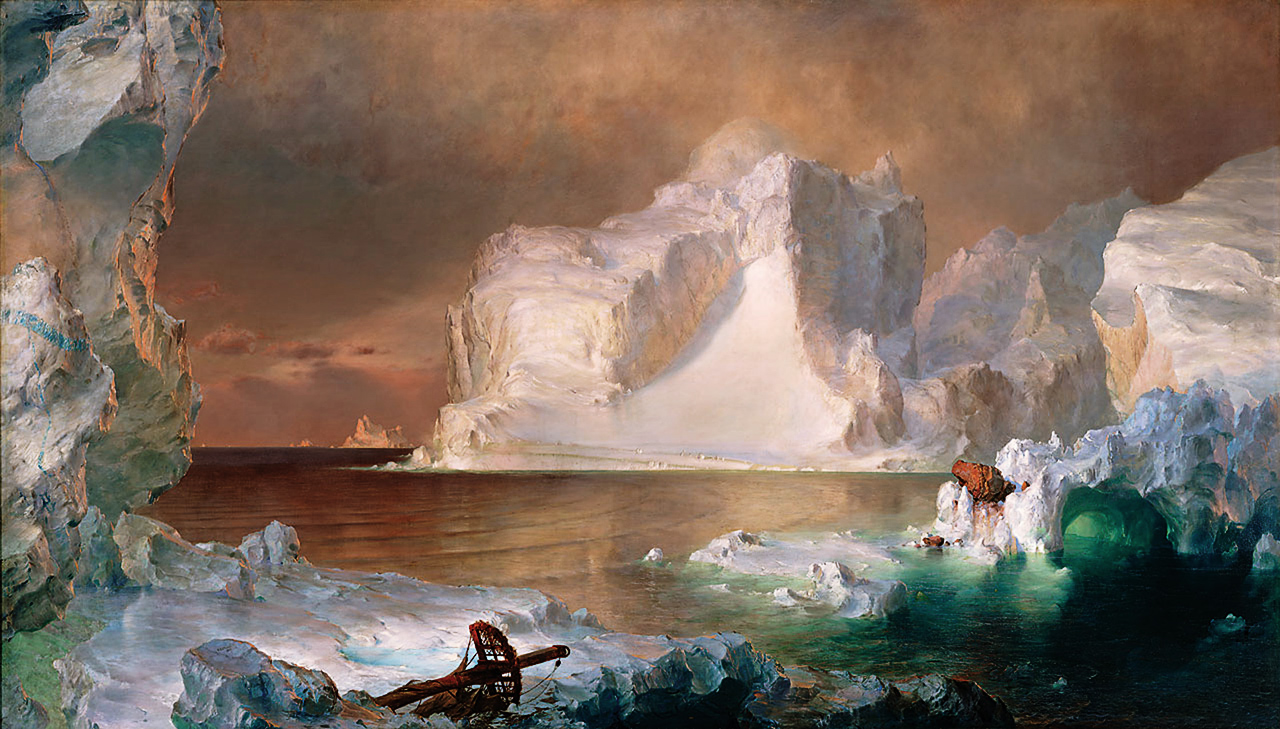
Church’s The Icebergs (1861) was ill-fated, though. Its solo exhibition opened just twelve days after the start of the Civil War. Then titled The North, it lacks the human glimpses and intricate details of nature that made The Heart of the Andes such a success. The broken mast now seen in the foreground was a later addition made by Church in an attempt to improve its popular appeal.
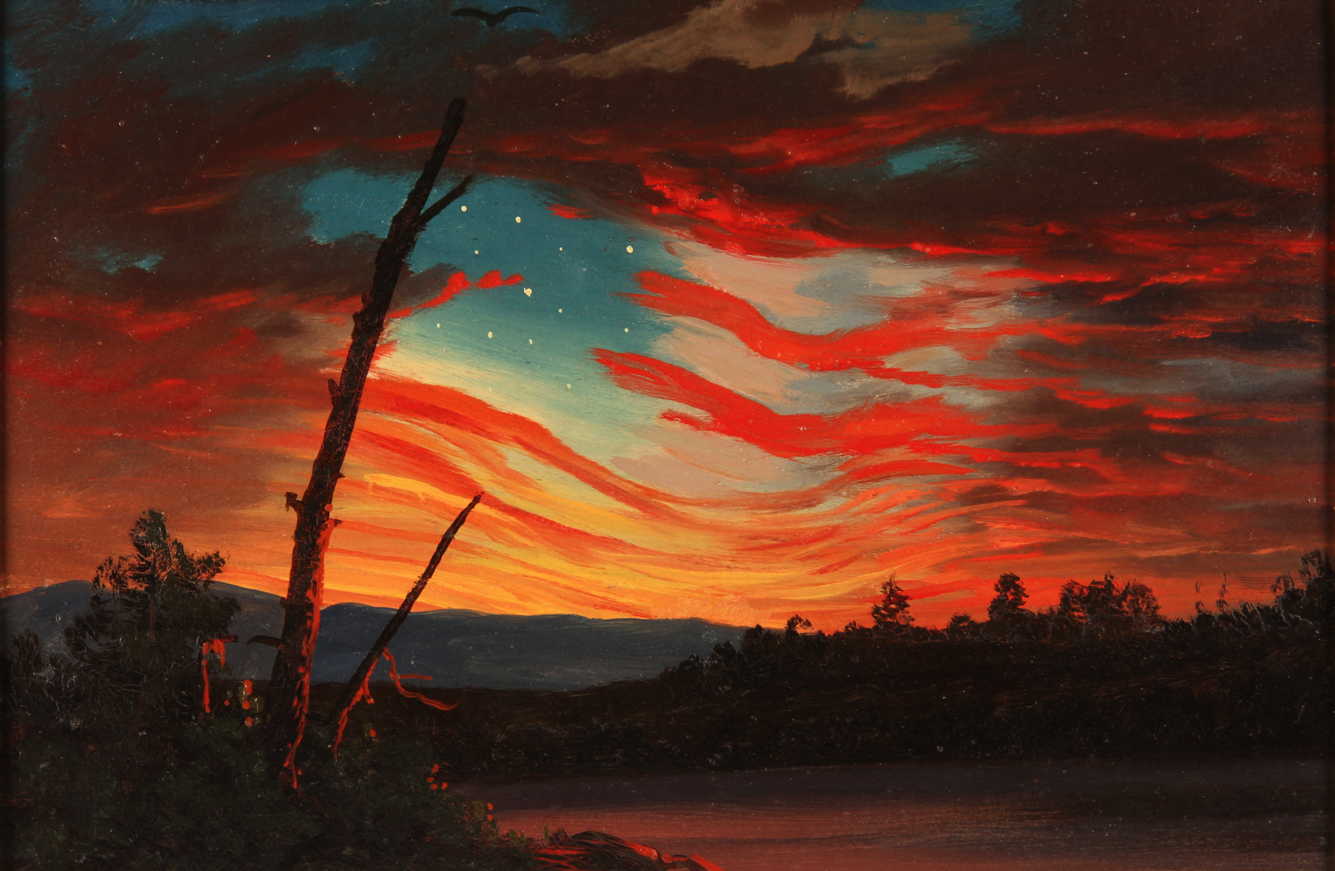
With the Civil War in progress, Church’s more successful response was Our Banner in the Sky (1861), which was turned into a lithograph, with prints being sold to benefit the families of Union soldiers.
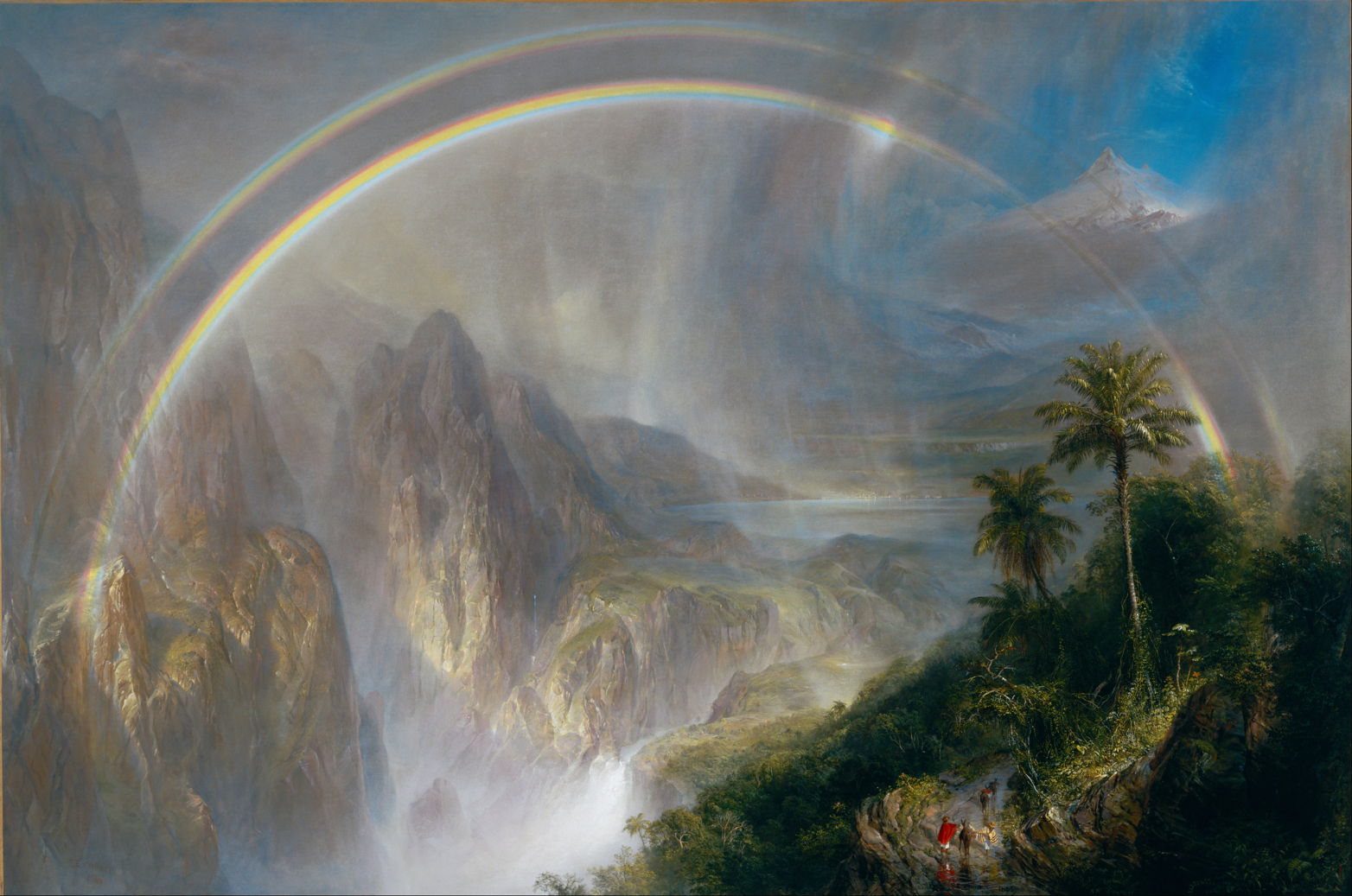
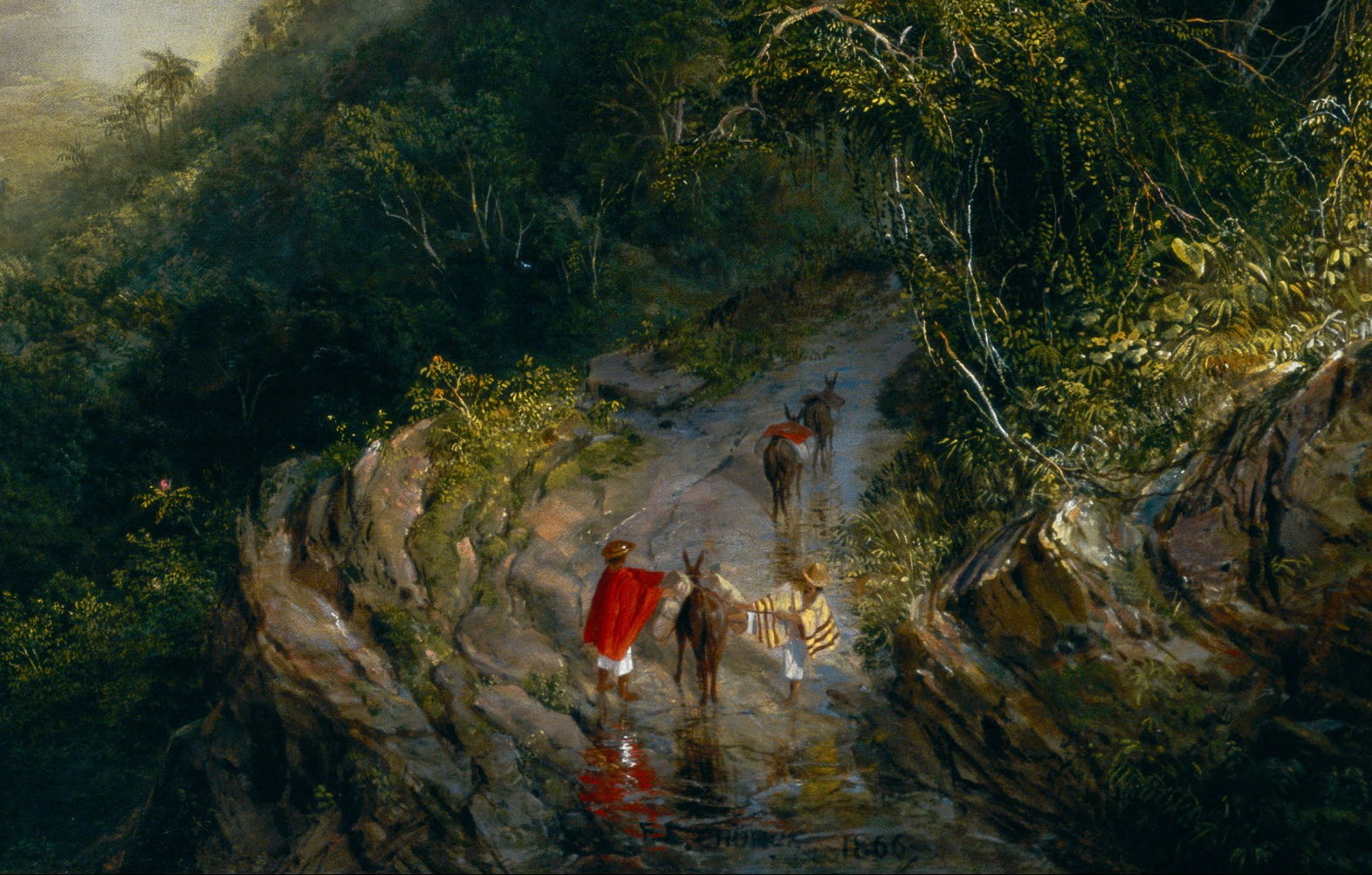
Church continued to paint finished works based on his earlier studies in front of the motif. Rainy Season in the Tropics from 1866 features a faithful depiction of a double rainbow, and again added human interest. Splashing through a rocky stream is a small train of pack animals with two drivers, who have paused for a moment to adjust a load, as shown in the detail below.

Spanning much of the foreground of Church’s Pichincha (1867) is a suspended bridge, one end glowing in the early morning light. Just over half way across, a woman wearing a brilliant red blouse is riding side-saddle on a mule, which is picking its way slowly across the thin logs forming the walkway. At the left end is another mounted figure, who has just completed that terrifying crossing.

Late that year, Church and his family set off on his longest journey, although much of it was undertaken in less arduous conditions than he had experienced in Ecuador. They travelled to Europe, then on to Egypt, Jaffa and to stay in Beirut. In February 1868, Church visited Jerusalem and from there travelled to the city of Petra by camel. In the Spring they returned across the Aegean Sea, and spent the remainder of the year in Rome. They finally returned across the Atlantic in June 1869.

In Church’s studio painting of Jerusalem from the Mount of Olives (1870), the Holy City is reminiscent of John Brett’s Florence from Bellosguardo (1863) in its projection and detail. But Church’s lower vantage point allowed him ample foreground, where there are four people and two camels making their way along the dry, stony track skirting the ancient olive trees and crossing the valley to the city. Although not as brightly lit by the late afternoon sun as the Dome of the Rock in the distance, Church draws attention to the figures in the foreground by silhouetting them against the light on the track.
Church provided a detailed key to the salient features, which was engraved and printed for the edification of the viewer. It was hailed a triumph when first displayed to the public in Goupil’s New York gallery in 1871, and at the end of the century Peter Bergheim made a photo-montage showing the same view.
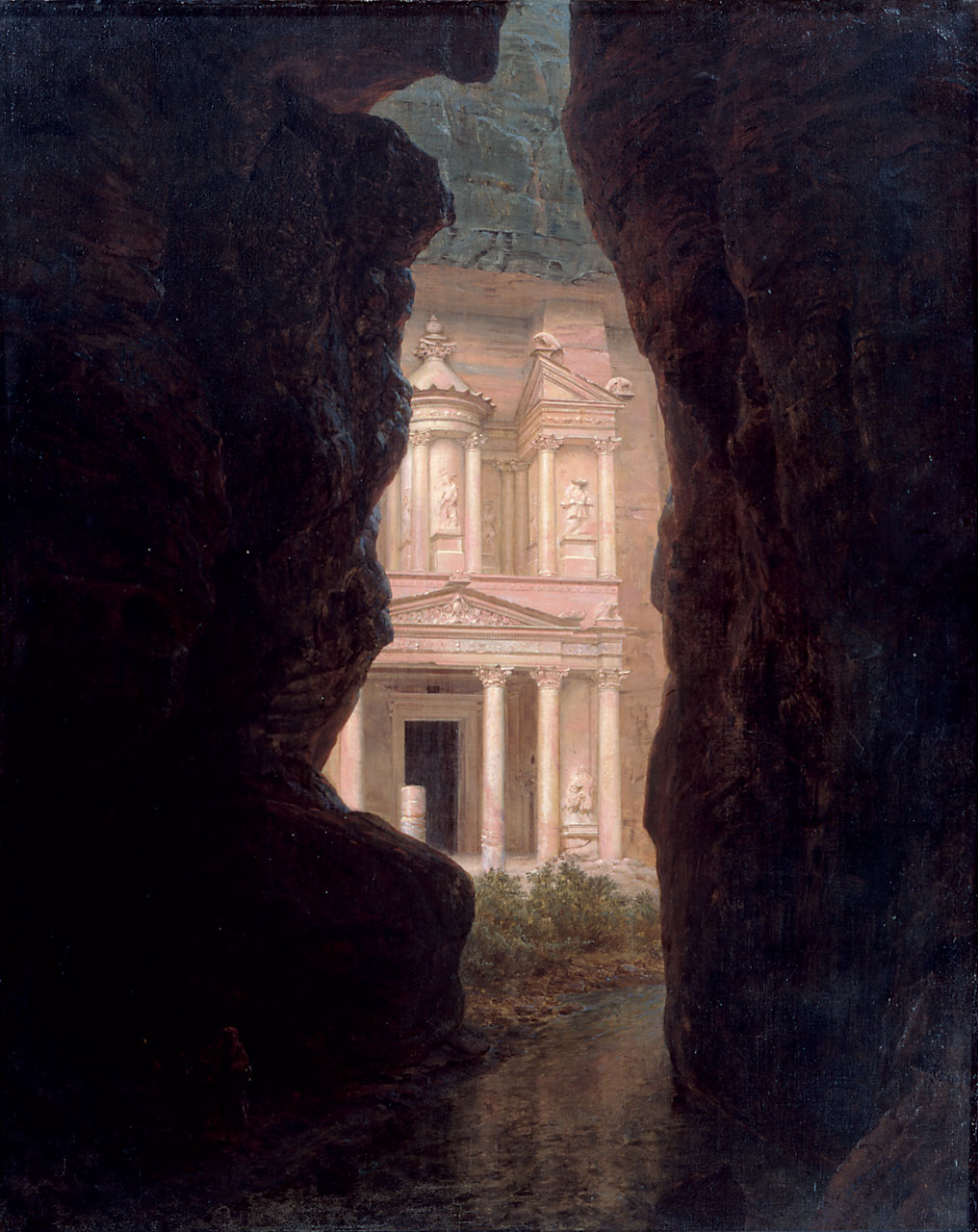
Church’s most famous studio painting of Petra, El Khasné, Petra from 1874, is an oddity in showing an unusual view lacking sky, and frames its strongly vertical format. It’s also short on detail, and what can be discerned from the murky depths of its framing appears mysterious and unresolved.
This painting was featured as the centrepiece of the Church family sitting room in his self-designed estate at Olana. He had started work on the design of his mansion there in 1870, engaging Calvert Vaux, co-designer of New York’s Central Park, to assist. They assembled a pastiche of forms and styles into what Church termed a “Feudal Castle”.
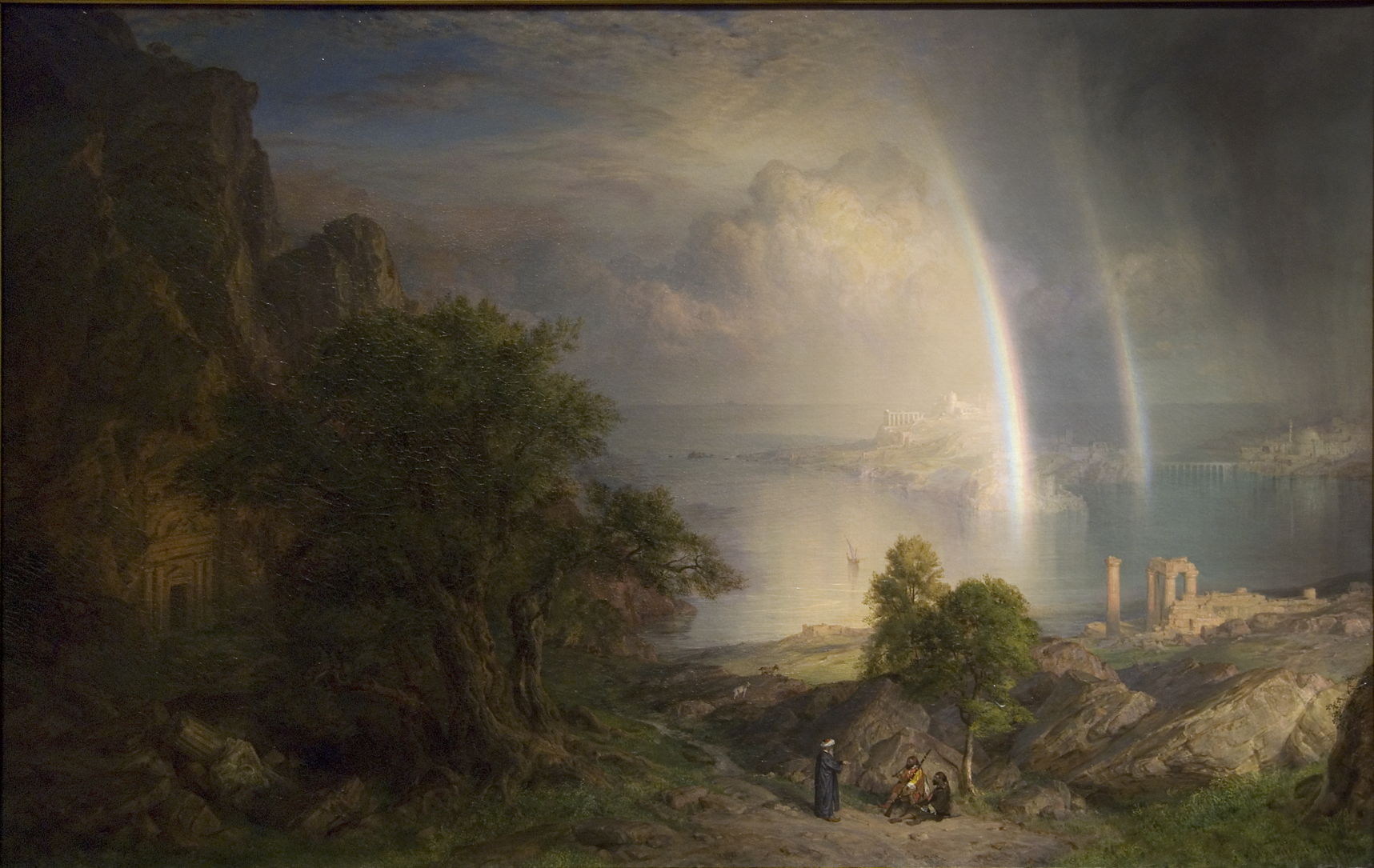
By 1876, Church was finding painting increasingly difficult due to his advancing rheumatoid arthritis. This late studio work showing The Aegean Sea was completed in about 1877, following which he became almost unable to paint. He wintered in Mexico to alleviate his problems, and died in 1900, at the age of 73. By that time, Church’s finely detailed realist paintings had become reviled, and it wasn’t until the 1960s before his art was taken seriously again.
You can see more about exhibitions and publications to celebrate Church’s bicentenary on Olana’s site.
Reference
Raab, Jennifer (2015) Frederic Church, The Art and Science of Detail, Yale UP. ISBN 978 0 300 20837 5.

