

Few accounts of painting in the last decades of the nineteenth century consider the importance of photography at the time. Yet photography was enjoying remarkable technical advances: in 1884, George Eastman started replacing glass plates with light-sensitive film, and four years later he launched the first Kodak camera, the predecessor of the Kodak Brownie that was to follow in 1901. As Naturalist painting was taking the Salon by storm, its rival was becoming more widely available, and no longer required a private chemistry lab.
First responses to photography by painters were often hostile.

Philipp Sporrer’s The Photo (1870) is probably the most pointed painted propaganda. The young photographer is not the sort of man you would leave your wife or daughter with. He’s down at heel, unkempt, and his straw hat is abominably tatty. His studio is poorly-lit, probably an old shed, its floor littered with rubbish, and its window broken. His subject is manifestly poor and uncouth, sitting in ill-fitting clothes and picking his nose as he waits for the photographer to fiddle with his equipment.
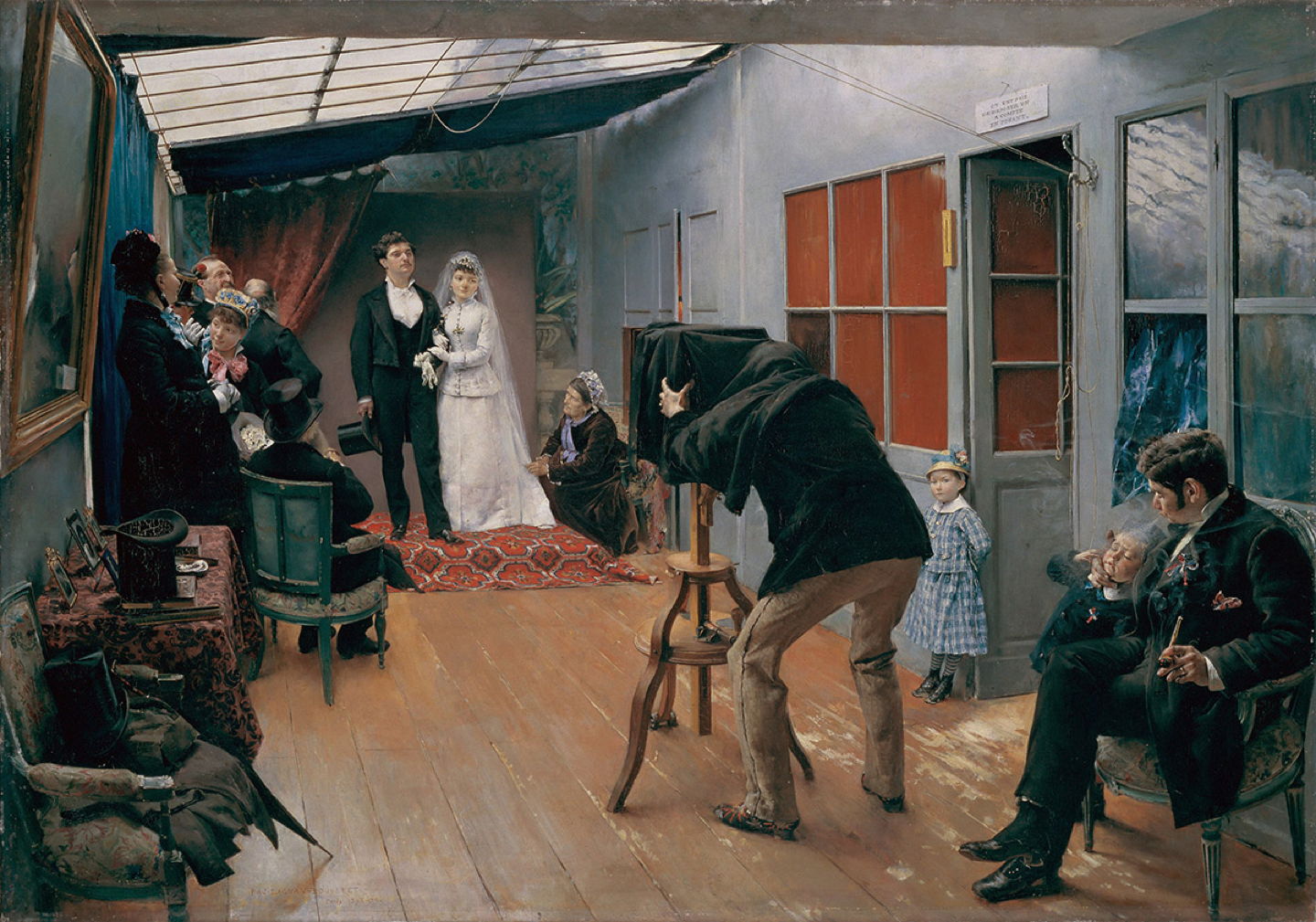
Pascal Dagnan-Bouveret’s A Wedding at the Photographer’s (1879) seems more calculated. Hugely successful at the Salon, this artist saw no threat from wedding photography, a market in which there was no competition between painting and photography. But he still takes the opportunity to show the photographer and his studio as being tatty and tawdry.
Gradually, painting started to become influenced by the nascent art of photography, most obviously in the use of views through the lens of a camera.

Gustave Caillebotte’s major painting of 1875 shows three workmen preparing a wooden floor in the artist’s studio at 77 rue de Miromesnil. It’s thoroughly detailed, Realist, and despite its innovative view and unusual subject, it conformed to the highest standards of the Salon at the time.
Caillebotte was hurt and angry when he was informed that this painting had been rejected by the Salon jury. The grounds given seem extraordinary now: apparently the jury was shocked at this depiction of the working class at work, and not even fully-clothed. It was deemed to have a ‘vulgar subject matter’ unsuitable for the public to view. Or was it really because of his wide-angle photographic effect?

Caillebotte was one of the first established painters to experiment with photography, as demonstrated in another wide-angle view of Paris Street, Rainy Day from 1877.

During his development of Naturalism, Jules Bastien-Lepage arrived at a compositional formula that achieved similar effects, as seen in his Haymakers or Hay making in the same year, with its high horizon and fine detail in the foreground. Together these also give the visual impression that the whole canvas is meticulously realist, although in fact much of its surface consists of visible brushstrokes and other more painterly forms.
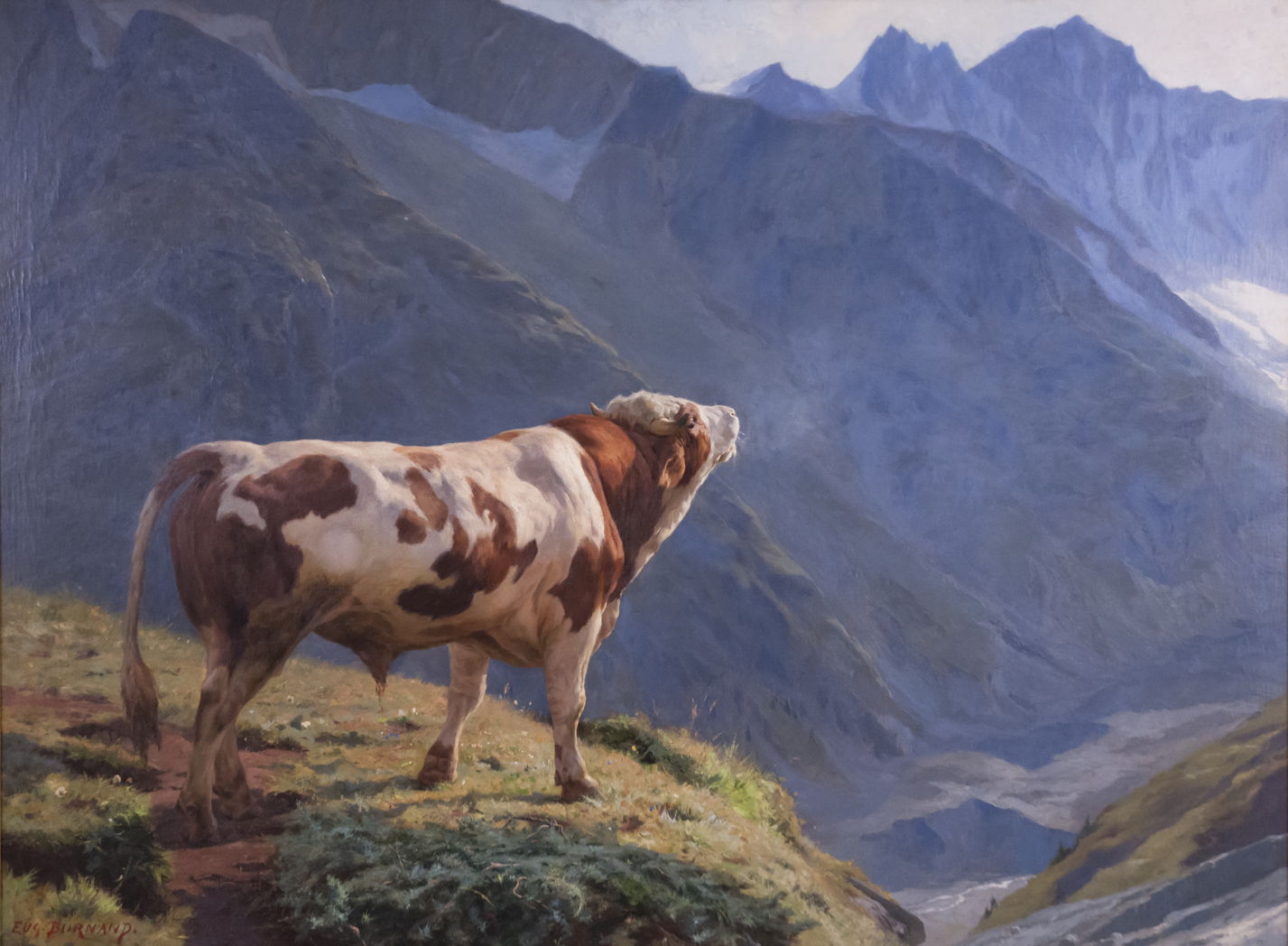
Eugène Burnand’s magnificent painting of Bull in the Alps from 1884 is fascinating for his use of both optical effects and extreme aerial perspective. Not only are there marked contrasts between the foreground and background in terms of chroma, hue and lightness, but Burnand has used defocussing in a photographic manner. The crisp edges of the bull stand proud of the softer edges and forms in the mountains behind. It’s worth noting that Burnand had been a pupil of Jean-Léon Gérôme.

Paul Louis Martin des Amoignes’ painted his wonderful In the Classroom two years later, in 1886. It bears unmistakeable evidence that it was either painted from photographs or strongly influenced by them. One boy, staring intently at the teacher in front of the class, is caught crisply, pencil poised in his hand. Beyond him the crowd of heads becomes more blurred.
By the 1890s, more painters were experimenting with photography.

Among them was Edgar Degas. This is an albumen print of patron and amateur painter Henry Lerolle with two of his daughters, Yvonne and Christine, taken by Degas in 1895-96.
The realist painter Jean-Léon Gérôme not only experimented with photography for many years, but was an enthusiastic advocate for its recognition as an art in its own right.

Gérôme’s Truth Coming out of her Well to Shame Mankind (1896) is based on a quotation attributed to Democritus, “Of a truth we know nothing, for truth is in a well” (or, more literally, ‘in an abyss’). Gérôme used the same allusion in his preface to Émile Bayard’s posthumous collection of collotype plates of photographs of nudes, Le Nu esthétique. L’Homme, la Femme, L’Enfant. Album de documents artistiques inédits d’après Nature, published in 1902, where he wrote:
Photography is an art. It forces artists to discard their old routine and forget their old formulas. It has opened our eyes and forced us to see that which previously we have not seen; a great and inexpressible service for Art. It is thanks to photography that Truth has finally come out of her well. She will never go back.
The Naturalist painter Jules-Alexis Muenier became a photographer by the time he travelled to North Africa with Pascal Dagnan-Bouveret in 1888, armed with cameras.

Although I have been unable to find a suitable image of the painting, this photograph shows Muenier with his painting of The Harpsichord Lesson in about 1911, which became his most famous work during his lifetime. Muenier, Gérôme and Dagnan-Bouveret weren’t just happy snapper photographers, but believed in photography as fine art. All three were early members of local photographic clubs, and Muenier and Dagnan-Bouveret exhibited their photographs as seriously as their paintings.
 The Eclectic Light Company