
Critics and the public got their first taste of Naturalist painting in the Salons in the early 1880s, led by the success of Jules Bastien-Lepage. As Paris was the focal point of western painting at that time, this rapidly spread internationally, and ranged wider in its themes.
Literary Naturalism had spread with the translation of the writings of Hippolyte Taine (1828-1893) the critic and historian, Claude Bernard (1813-1878) the physiologist, and the Rougon-Macquart novels of Émile Zola (1840-1902), published between 1871-93. Those became accessible in all the major European languages by 1880, and attracted an intellectual following throughout Europe and North America.
At the time there was a strong Nordic school of painting in France, including Christian Skredsvig (friend of Edvard Munch), Nicolai Ulfsten, Carl Larsson, Karl Nordstrôm, Hans Heyerdahl, Erik Werenskiold, and Christian Krohg.

Krohg’s Port Side! (1879) is his only painting to be exhibited at the Salon. He started this when he was in Berlin, and completed it when at Skagen in Denmark in the summer of 1879. It didn’t set the Salon of 1882 alight, but was favourably received by some critics.

Hans Heyerdahl’s The Dying Child (1881) was so lauded it was bought from the Salon for the French nation, but has since returned to Norway. Although executed in an older, darker style this motif became popular with Nordic painters including Edvard Munch, and is typical of Naturalism.
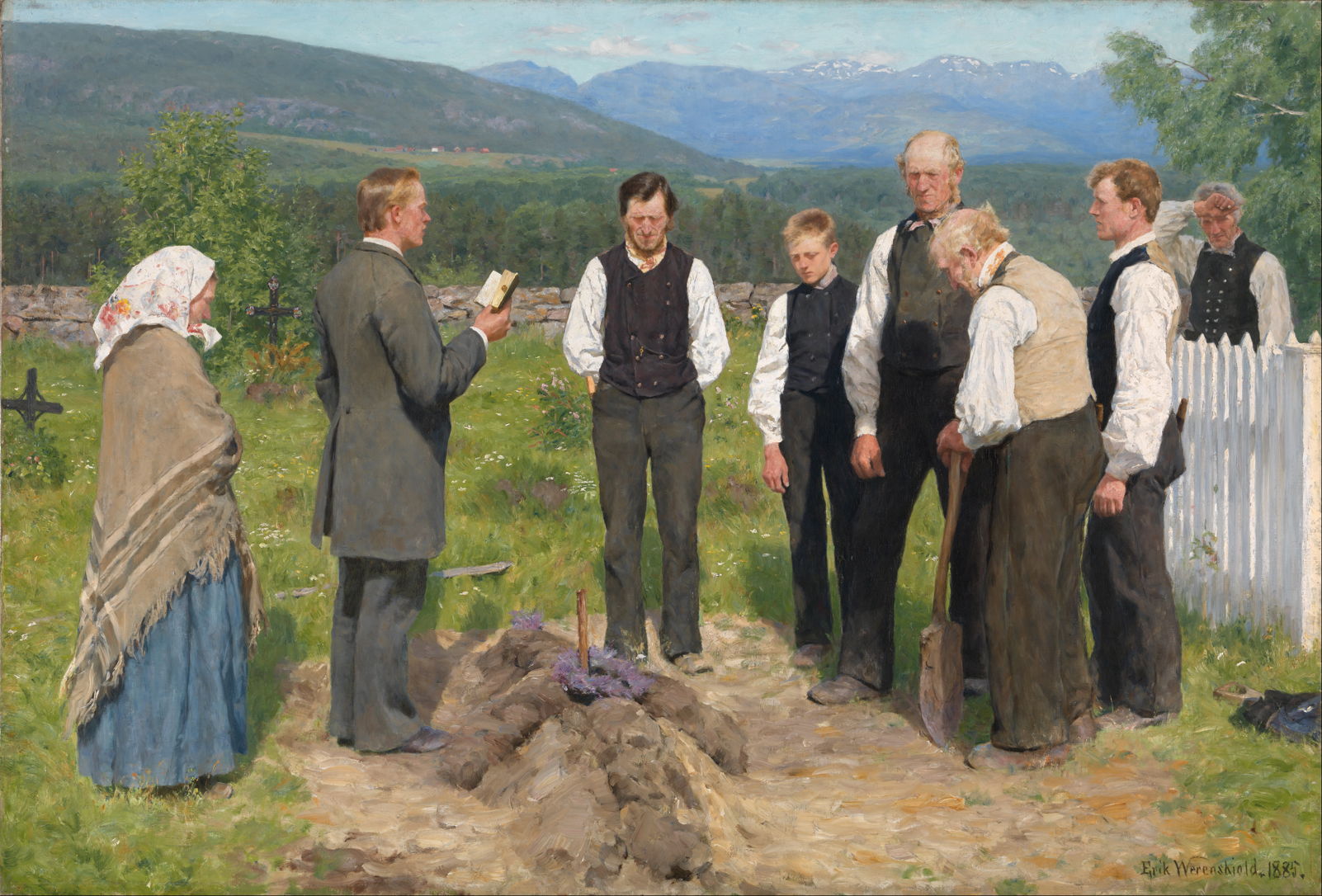
A little later, Erik Werenskiold painted his rural Norwegian response to Courbet’s Burial at Ornans, in his Peasant Burial of 1885.

Charles Frederic Ulrich was born in New York City in 1858, and had travelled to Europe to attend the Royal Academy in Munich, Germany, as did so many other American painters, including William Merritt Chase. Many of his surviving works show different workplaces across Europe: in The Glass Blowers (1883) the work is delicate, in blowing and preparing glass domes, perhaps for use as covers of watches and clocks.

Joan Planella was a Catalan painter who studied in Italy rather than France. The Little Weaver (1882-89) shown here is a replica of the original completed in 1882. It shows a young girl working at a large and complex loom in Catalonia, as a man lurks in the background, keeping a watch over her.

Following the formative social realism of Jean-François Millet, Léon Lhermitte’s masterpiece The Harvesters’ Pay (1882) takes a more objective look at the realities of rural farmworkers. This evolved rapidly through Bastien-Lepage’s paintings of poor waifs and strays, to the grim battle for survival shown below in Fernand Pelez’s Homeless (1883).

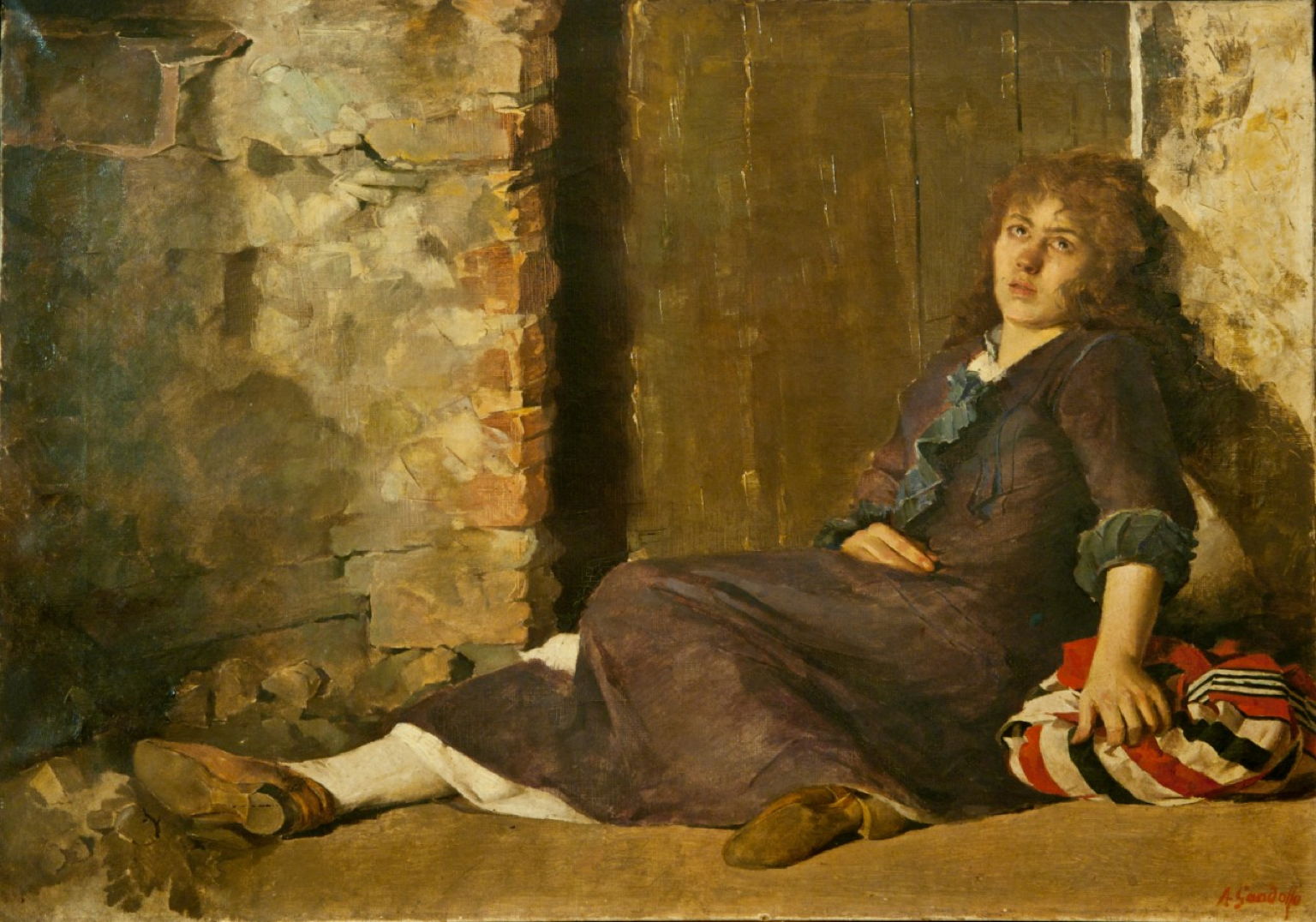
These were by no means confined to France. The Sicilian Antonino Gandolfo’s Evicted from 1880 raised similar concerns under a very different political regime.
Even more uncomfortable for the French Third Republic and other states was the depiction of industrial unrest as it swept across Europe in the late nineteenth century.

A good example is Alfred Roll’s painting of a Miners’ Strike in 1880. This was probably made from life when he visited the strike at Denain in the Nord-Pas de Calais coalfield that year. His large original painting seems to have been exhibited at the Salon in Paris, from where it was purchased by the State. However, the artist had to sell at ‘cost price’ on the understanding that it would be hung in the capital, in the Ministry of Commerce, where it would have substantial impact.
Once the State got its hands on Roll’s painting, it was despatched to a local museum in Valenciennes, where it seems to have been largely forgotten. The original is now badly damaged, and the image shown above is reproduced from Le Petit Journal, where it didn’t appear until 1 October 1892.
By early 1884, Émile Zola had decided to write a novel in his Rougon-Macquart series about a miners’ strike, and in February 1884 the author visited a strike near Valenciennes, where Roll’s painting was on display, for his research. He started writing Germinal on 2 April 1884, and the book was published in serial form from November of that year. Its story centres on a miners’ strike in the Nord-Pas de Calais coalfield very similar to that painted by Roll, and it remains Zola’s most successful work.
The State may have successfully suppressed the immediate impact of Roll’s painting by hiding it away in the provinces, but in this case it had not anticipated its influence on Zola.
Industrial unrest in Belgium came to a head in 1886, with a succession of strikes across the country. These started in Liège as a commemoration of the fifteenth anniversary of the Paris Commune, but spread through industrialised zones to the region around Charleroi and Hainault.

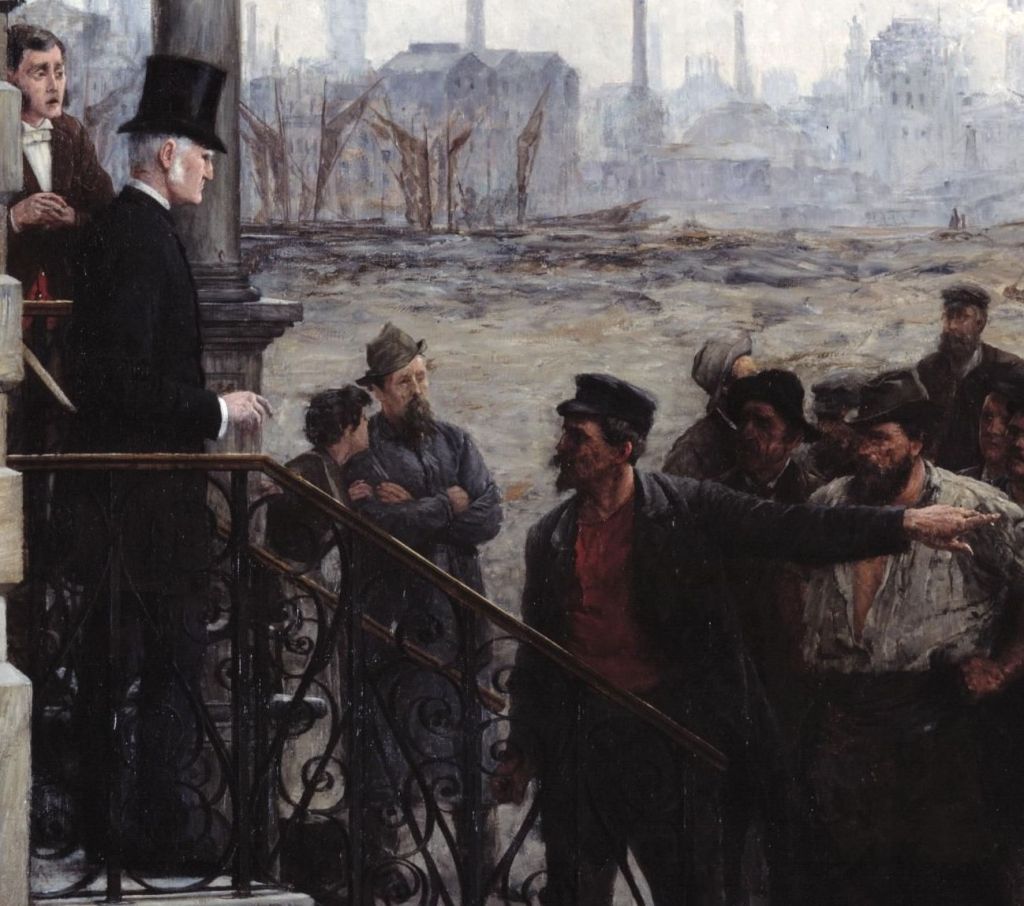
Robert Koehler painted his masterpiece of The Strike in the Region of Charleroi that year, with a group of workers standing outside the smart entrance to offices. The top-hatted owner stands on the top step, one of his managers looking anxious beside him. The leader of the workers is at the foot of the steps telling the industrialist of the workers’ demands. The situation is looking increasingly nasty, although there are no signs yet of police or troops, or of violent confrontation.

Politics and art were mixing freely in the Nordic countries too. The Norwegian Christian Krohg explored the theme of fatigue and sleep, particularly among mothers. In Tired from 1885, the young woman seen here is no mother, but a seamstress, one of the many thousands who worked at home at that time, toiling for long hours by lamplight for a pittance.
Home work as a seamstress was seen as the beginning of the descent into prostitution, a major theme in Krohg’s painting and writing. The paltry income generated by sewing quickly proved insufficient, and women sought alternatives, which all too often led to them taking to the street.

Just before Christmas 1886, Krohg’s first novel Albertine was published by a left-wing publisher. Its central theme is prostitution in Norway at the time, and the police quickly seized all the copies they could find, banning it on the grounds of violating the good morals of the people. Krohg was found guilty of the offence the following March and fined, although the police were only able to seize 439 of the first 1600 copies to go into circulation.
At the same time as he was writing that novel, Krohg had been working on his largest and most complex painting: Albertine in the Police Doctor’s Waiting Room (1885-87). He also painted several other scenes from the book. Curiously, Krohg’s campaigning writing and painting didn’t want prostitution made legal: quite the opposite, he and others wanted it banned.
Naturalist painting also helped promote advances being made by the state in healthcare and education.

The depiction of modern hospitals, medical teaching and research is a feature of Naturalism. Henri Gervex, who rose to fame with a ‘shocking’ painting of a nude courtesan on the morning after, found a little flesh at the Hôpital Saint-Louis, where an eminent doctor is teaching Before the Operation in 1887.

Jean Geoffroy’s Primary School Class from 1889 shows one of the Third Republic’s new lay teachers working diligently in the classroom with her pupils. This was deemed sufficiently positive to the State as to be purchased by the French National Ministry of Education, where it still hangs.
 The Eclectic Light Company