

In post-classical European art the great majority of paintings are close to being square, with an aspect ratio (given as width to height) of between 0.75:1 and 1.5:1. Although there’s no generally agreed cut-off for what constitutes a panorama, those with an aspect ratio of 2:1 or greater should qualify.

Ancient and classical paintings are different, though, and what’s probably the oldest landscape painting (excluding those in caves) is far broader than it is high. This Flotilla Fresco painted at Thera on the island of Santorini in Greece must have been completed before a catastrophic volcanic explosion in about 1627 BCE destroyed the local civilisation.

Paul Bril was exceptional in this panoramic View of Bracciano painted in about 1622 with an aspect ratio of 2.2:1. Although strongly Italianate, it’s a painting ahead of its time in other respects, as a fairly accurate depiction of a real place, with all sorts of fascinating little scenes within it, like the young boy doffing his hat to the passing dignitary in his coach with armed guard.

Just over twenty-five years later, the Dutch painters Bartholomeus van der Helst and Jan Vos used a panoramic canvas to accommodate all those in The Celebration of the Peace of Münster, 18 June 1648, in the Headquarters of the Crossbowmen’s Civic Guard (St George Guard), Amsterdam. This has an aspect ratio of 2.4:1, even greater than Bril’s.

The Swiss painter Caspar Wolf was another early exponent in his Panorama of Grindelwald with the Wetterhorn, Mettenberg and Eiger painted in 1774, although this couldn’t have been called a panorama at the time. This shows the distortion needed to include the whole of this view on a single canvas, with its remarkably high aspect ratio of 2.75:1. Today we’d envisage this as being painted through a wide-angle lens, although it was a century before such camera lenses came into use.
It’s generally accepted that the idea of a panorama was first formalised in British patent number 1612 of 1787 awarded to Robert Barker, where he coined the word, and the word’s first appearance in print occurred four years later.

A little later, Giovanni Battista Lusieri attained high aspect ratios of around 2.7:1 by assembling multiple supports, in his case sheets of paper, as he worked in watercolour on this View of the Bay of Naples, Looking Southwest from the Pizzofalcone Toward Capo di Posilippo in 1791.
Robert Barker’s panorama wasn’t artistic in the slightest, but pure spectacle and entertainment. His original painting of Edinburgh was on a large roll of paper, and first exhibited in Leicester Square, London, an area now known for its leading movie theatres. Baker either stuck the painted roll on the inside of a large cylinder for rotation about the viewer (also known as a cyclorama), or later he scrolled the roll past the viewers’ eyes.

Many paintings in JMW Turner’s huge output are panoramic in nature if not in form. This example, Petworth Park: Tillington Church in the Distance (c 1828), is viewed from a higher level even though its content has little vertical extent, to emphasise its long cast shadows. It has a high aspect ratio of 2.4:1, and the odd arc of the path in the foreground enhances its wide-angle effect.

In about 1830, Théodore Rousseau’s Panoramic View of the Ile-de-France attained the highest aspect ratio yet, of just over 3.7:1, which may have been driven by the growing popularity of panoramas as entertainment. He’s also more conventional in placing the viewer at the level of the rooftops, looking over foreground buildings. The angles of lines of trees and other objects in the foreground appear to show wide-angle lens distortion, although the earliest known photograph wasn’t made until 1838. One possible explanation is that Rousseau used a camera obscura to draw in the view, although I’m not aware of any evidence of that.

Just a few years later, Jean-Baptiste-Camille Corot painted panoramic views en plein air and in his studio. This example of Avignon from the West (1836) shows how well he transferred the skills that he had learned when in the Roman Campagna to the French countryside. Its aspect ratio is more modest at 2.2:1, similar to that of Paul Bril two centuries earlier.

Many of Frederic Edwin Church’s epic landscapes were painted far south beyond the US border, but this early panoramic view of Niagara made in 1857 remains one of his most important works, with its aspect ratio of 2.3:1.

I don’t have a date for Henri Harpignies’ magnificent watercolour panorama of View of the Seine at Rouen, which I believe shows the view from Bonsecours, to the south-east of the city, looking north-west into the summer sunset, with an aspect ratio of 2.2:1.
By the end of the nineteenth century panoramas were attaining aspect ratios over 4:1, requiring custom supports, either being painted on the interior walls of a cylindrical building or rotunda, or on rolls like Robert Barker’s.

Hendrik Willem Mesdag’s staggering Panorama Mesdag from 1880-81 was commissioned as a view of the village of Scheveningen, the Netherlands, from its coastal dunes. It’s 14 metres high and 120 metres long, giving it an aspect ratio of 6.8:1. When tastes changed towards the end of the nineteenth century, the company exhibiting the panorama as an entertainment went bankrupt; Mesdag bought it back, and it remains housed in its dedicated building, an appropriately extreme memorial to this long-lasting fascination.
Over the following decades other huge panoramas were painted to commemorate wars and national history. I show here just two examples.

Paul Dominique Philippoteaux’s vast Gettysburg Cyclorama opened to public acclaim just twenty years after the battle, in 1883, and continues to draw attention at the battlefield’s visitor centre. It was commissioned by a group of Chicago investors, rather than anyone interested in its art, and has the highest aspect ratio of 13.3:1.
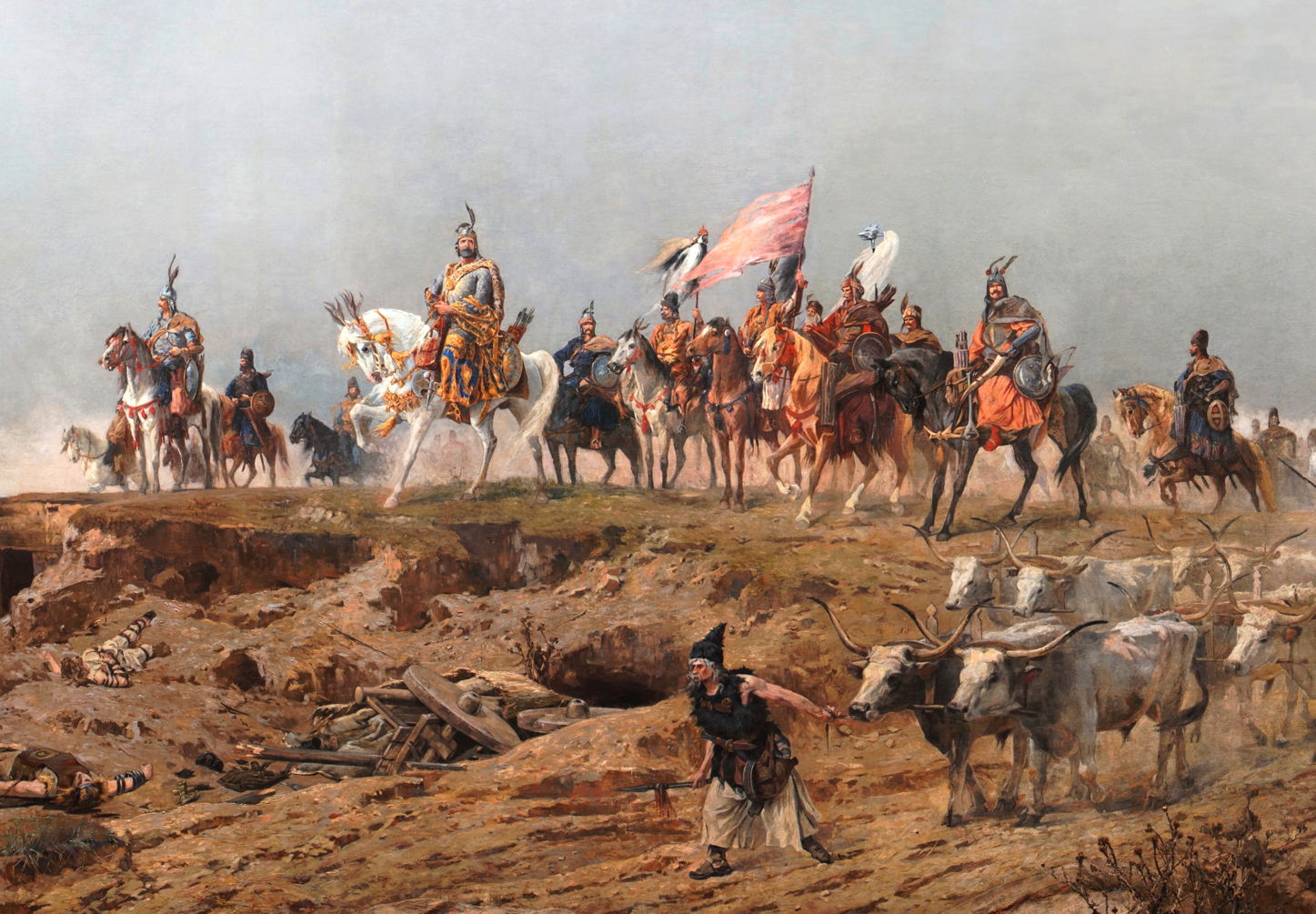
As their popularity was waning at the end of the century, Árpád Feszty and a hoard of assistants depicted the narrative scenes they imagined of a millennium earlier, as the first Hungarians arrived to settle their country. Their whole panorama has an aspect ratio of 8:1.

