
The Golden Age of the Dutch Republic developed as a result of a combination of circumstances, some of which are made clear in previous articles in this series. This summary brings those together with a small selection of works to illustrate them.
The Northern Renaissance, that had started in the Flemish countries to the south in the 1420s, had flourished in centres such as Antwerp and Brussels during the sixteenth century. As it matured into the Baroque during the early decades of the Golden Age, it was led by Peter Paul Rubens. This gained from the early adoption and development of oil painting on canvas using realist techniques to depict increasingly secular themes, which became centred in the workshops of Antwerp.
Flanders and Brabant in the south remained part of the Habsburg empire ruled from Spain, with intolerance towards Protestant movements leading to religious conflict. Some artists who trained in those countries migrated to the north, where they accelerated the growth of Dutch Golden Age painting.

Among them was Clara Peeters, who seems to have trained in Antwerp before painting innovative still lifes in the Dutch Republic. By about 1611, when she painted Mesa (Table) above, she was selling her paintings to the Spanish royal family. Some of her works ended up in the Spanish Royal Collection, and today remain in the Prado in Madrid as a result. Dutch painters developed her themes, and settings for meals, particularly that of breakfast, later became a sub-genre.
As a secular confederation of provinces, art in the republic wasn’t dominated by religious themes or the patronage of a royal dynasty. Commissions seldom came from religious organisations, but from guilds and other non-religious groups that were flourishing in the growing cities. Most popular among those were group portraits of occupational guilds.

Although guilds had been an important part of Renaissance society, few if any appear to have commissioned group portraits, which were largely confined to noble families. In 1617, Michiel van Mierevelt and his son Pieter, specialists in portraiture, painted The Anatomy Lesson of Dr. Willem van der Meer, one of the earliest portraits of a social group from the Dutch Golden Age. These are thought to be members of the Surgeons’ Guild of the city of Delft, who commissioned this work.

Among the groups responsible for many of these portrait commissions was the civil militia. Frans Hals’ Militia Company of District XI under the Command of Captain Reynier Reael (1633-37) shows a group known as the Meagre Company. He was commissioned to paint this in 1633, but three years later it remained unfinished, and the commission was transferred to Codde to complete the right side of the canvas and many of the hands and faces a year later.
Migration and international trade transformed cities like Amsterdam, which rapidly became multicultural at a time when much of Europe was still oppressing minority groups such as Jews.

Meindert Hobbema’s view of The Haarlem Lock, Amsterdam from 1663-65 shows one of the city’s working locks with a raising bridge, with the masts of many ships in the harbour beyond.

Avercamp’s Winter Landscape with Skaters from 1608 shows the many who have spilled out from the warmth of buildings to take to the ice.
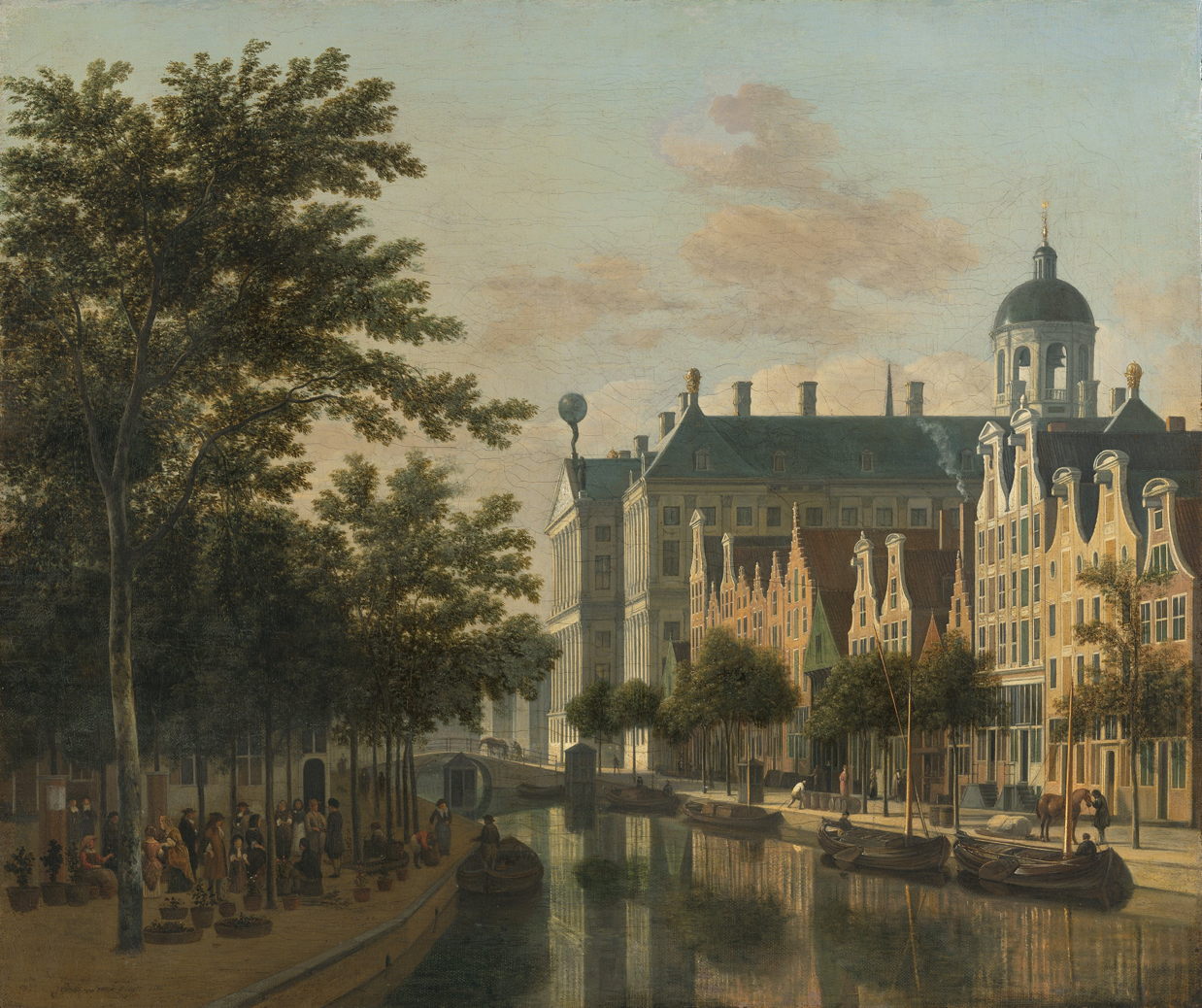
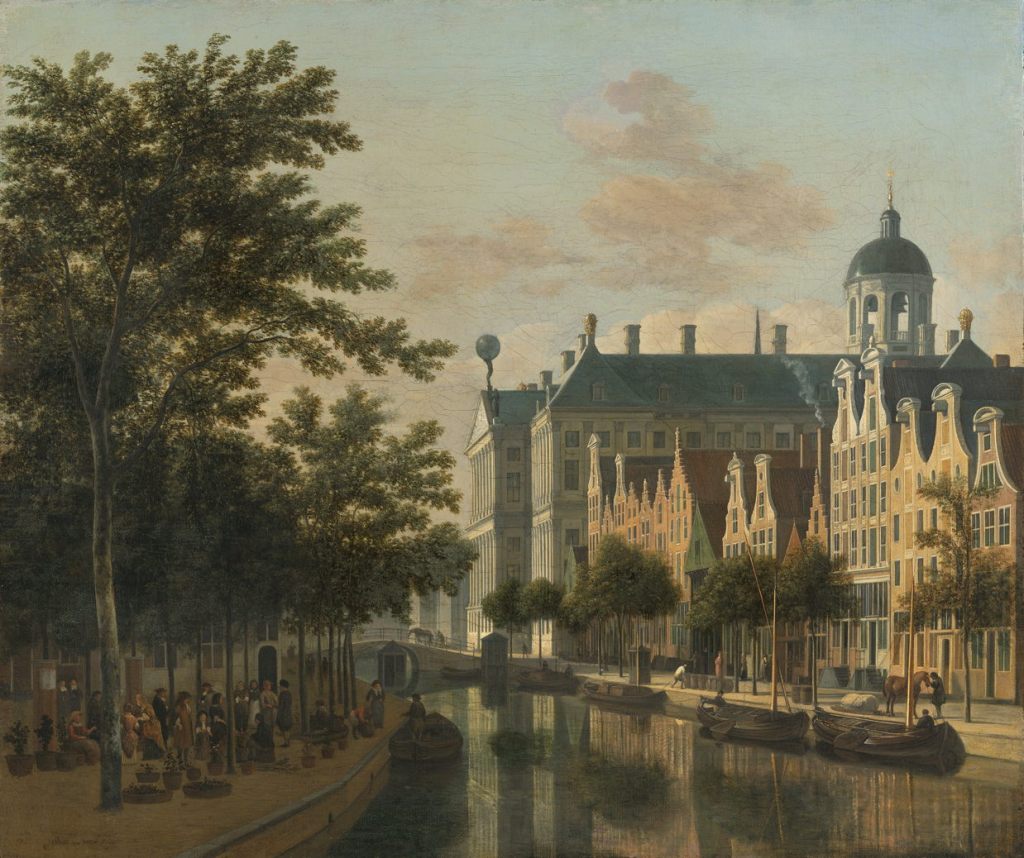
Berckheyde’s The Nieuwezijds Voorburgswal, Amsterdam from 1686 shows the canal running at the rear of Amsterdam’s City Hall, built between 1648-65, and featuring the octagonal tower seen at the right. By this time the population of Amsterdam had risen to more than 220,000, many of them immigrants.
With the growth of trade came increasing prosperity, and urban populations who became avid collectors. For some it was household linen or clothing, for others Delft tiles, and for the many who wanted to decorate the walls of their houses, paintings were ideal. Those artists who had achieved recognition could sell through art dealers, some of whom were painters themselves. For smaller and more everyday works, art fairs were held, and collectors flocked to attend them in search of bargains.

A Senior Merchant of the Dutch East India Company, painted during 1650-59, is thought to show Jacob Mathieusen and his wife, against a background of the company fleet in Batavia roads. This city in what was then the Dutch East Indies is now the site of Jakarta in Indonesia.
As more secular genres became popular, painters specialised in sub-genres in an effort to appeal to new markets.

In mid 1652, Jan Abrahamsz Beerstraaten seems to have witnessed the destruction by fire of part of the centre of Amsterdam, shown in his studio painting of The Old Town Hall of Amsterdam on Fire, 7 July 1652 (1652-55).

The sense of Smell, from 1637, is the best of Jan Miense Molenaer visual jokes, a thoroughly secular if not irreverent scene from everyday life.

The theme of witchcraft was explored in Domenicus van Wijnen’s Witches’ Sabbath by Moonlight, set in a moonlit Italian landscape. This combines many of the now-classical symbols associated with the Dark Arts, and is taking place at an outdoor altar set up at the foot of the gallows, on which a dead body hangs.
With the driving force in painting being removed from a royal family, and professional power resting with local guilds of Saint Luke, the republic avoided adopting a privileged academy system. Painters trained first as apprentices before demonstrating the skills expected of a master, so gaining admission to the guild. These too had originated in Flanders, with the foundation of Antwerp’s by 1382. Amsterdam led in 1579, and several other cities in the Dutch Republic followed from 1609.
Taken together, the main driving forces of Dutch Golden Age painting were a rich diversity in both society and painted themes, and the popularity of paintings among the republic’s citizens. As a result, visual art thrived.

