
One hundred years ago today, on 22 January 1925, Carlos Schwabe (1866–1926) died in the town of Avon, in Fontainebleau Forest, France, at the age of only 59. In last week’s article, I outlined his career and showed examples of his art up to 1896, when he completed a set of illustrations for an edition of Baudelaire’s poems Les Fleurs du Mal (Flowers of Evil) published in 1900.
In February 1896, Schwabe was among those who exhibited with les artistes de l’âme (Artists of the Soul) in the lobby of Théâtre de la Bodinière in Paris. Other noted Symbolists who had formed this breakaway movement included Edmond Aman-Jean, Alphonse Osbert and Lucien Lévy-Dhurmer. Although it attracted the attention of the critics of the day, its impact was less than that of the earlier Salon de la Rose+Croix.

In 1898, Schwabe designed and painted this poster for the French première performance of his friend Vincent d’Indy’s opera Fervaal, staged on 10 May 1898 at the Théâtre de l’Opéra-Comique, Paris. Based in part on an obscure Swedish poem, it centres on Celtic battles with Saracens, with a good deal of Norse mythology and sorcery added. This painting shows the closing moments, when the Gaulish hero of the title carries the lifeless body of his lover, daughter of the Saracen emir and a sorceress, up a mountain just as the reign of a ‘new God’ is about to start. Sadly, the opera wasn’t a success, and has seldom been performed since.
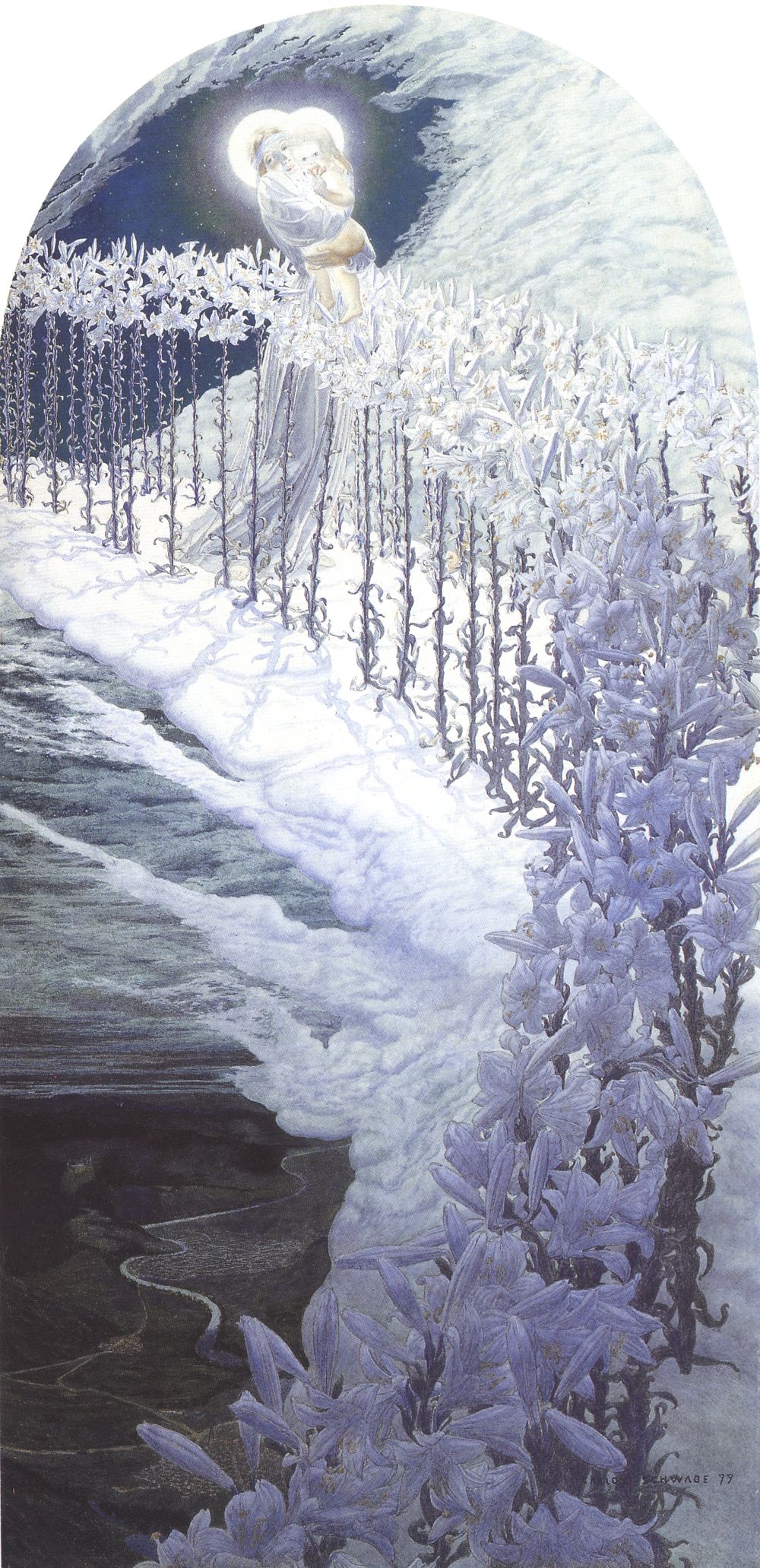
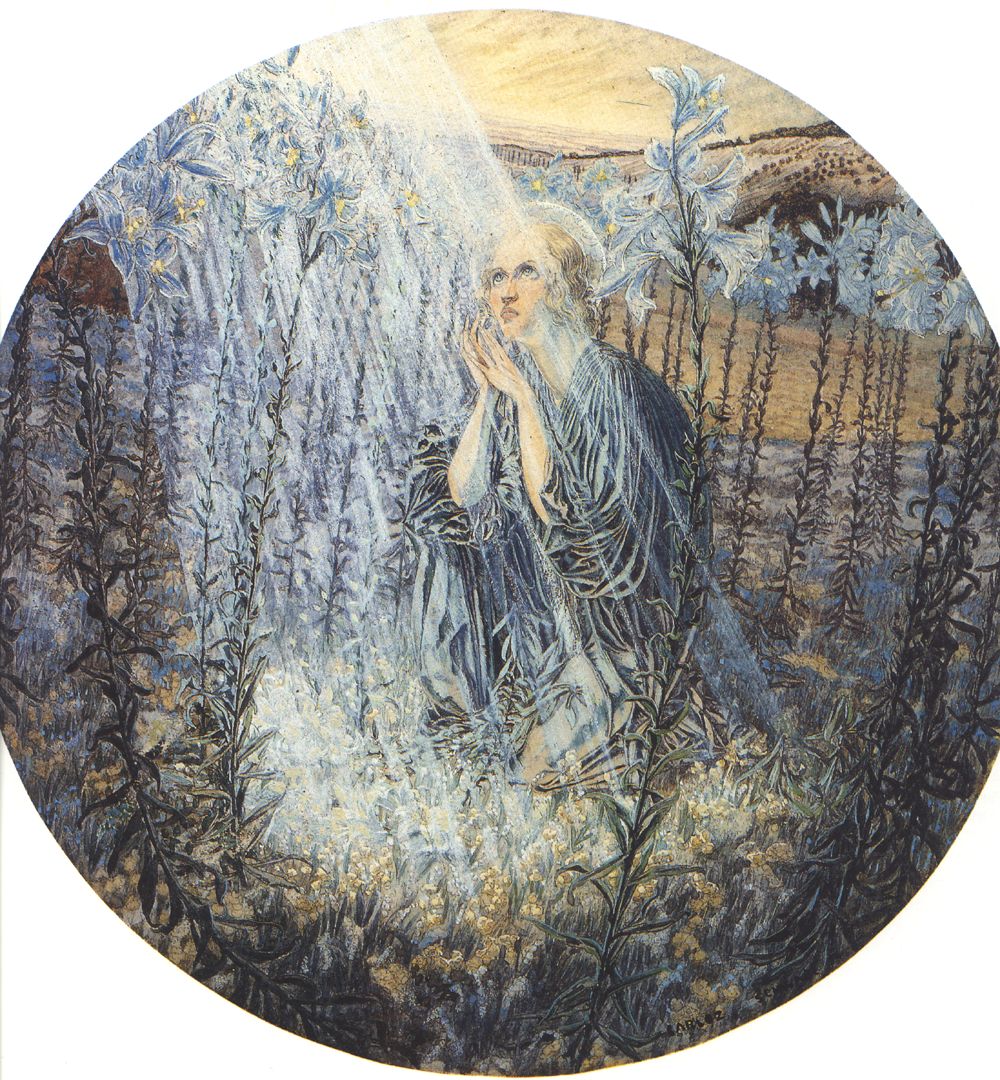
The following year, Schwabe painted one of at least two versions of a more conventional Christian motif, The Virgin with Lilies (1899) (above), dominated by the sweeping curve of its rhythmic flowers. Below is another version with the same title, but no date, on a tondo. This lacks the same rhythm, instead emphasising the rays of heavenly light.

Schwabe developed the theme of the Grim Reaper further in his watercolour of Death of the Gravedigger from 1900. An old gravedigger is seen deep in his own work on a snowy winter’s day. Squatting beside that grave is the female figure of Death, holding in her right hand a small oil lamp emitting an unnatural green light. She looks languidly down at the gravedigger, and he looks up at her in fear. The long barren twigs of a weeping willow form a curtain that echoes the curves of her wings.
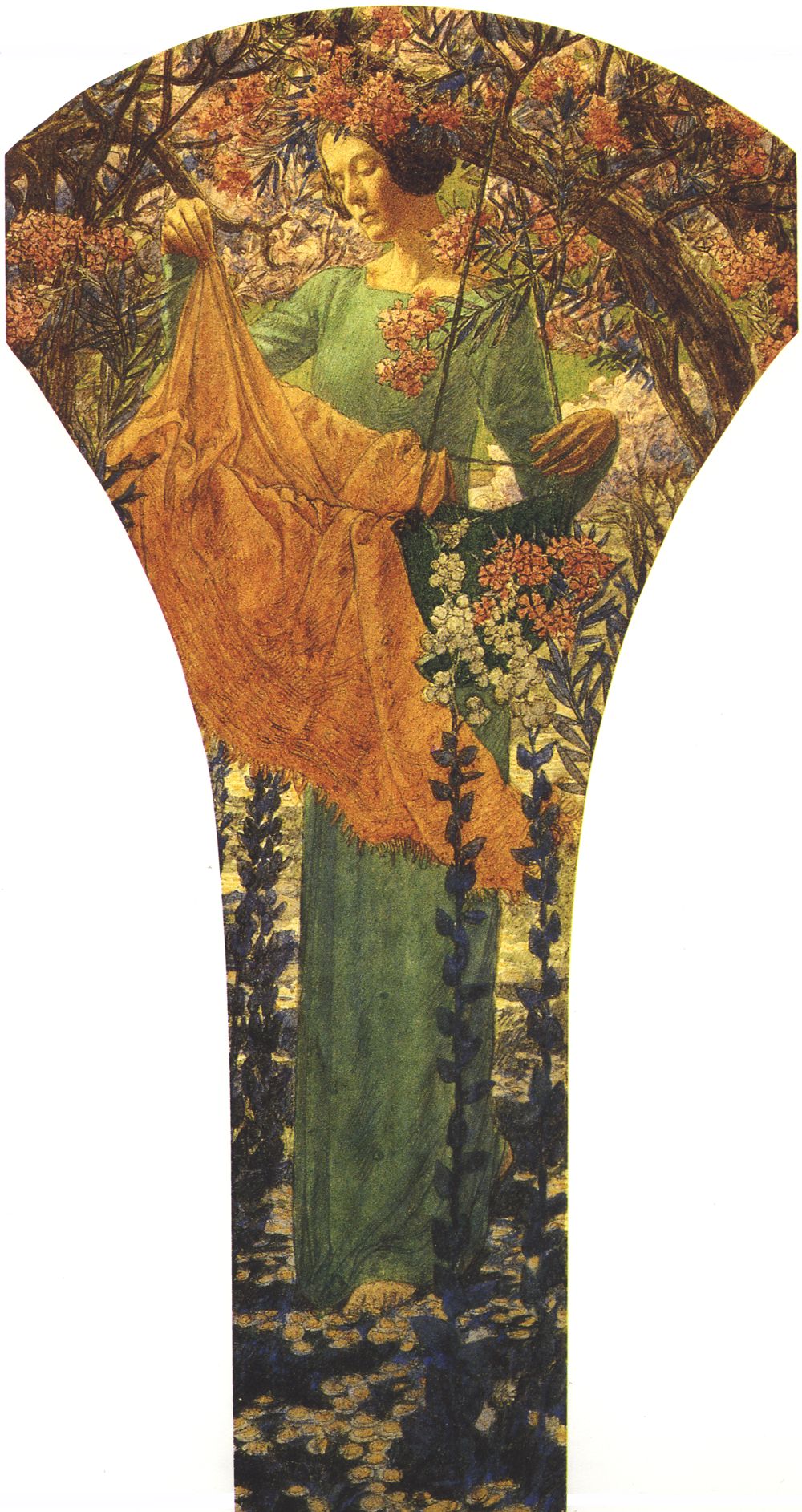
Woman with a Cradle Among Flowers, or Fate, from 1900 appears to be a decorative work, showing a mother tending to an infant’s cradle suspended among rich blossom. She looks down at the baby, but exceptionally it’s not revealed to the viewer. This is also one of Schwabe’s few works that may depict a real-life motif.
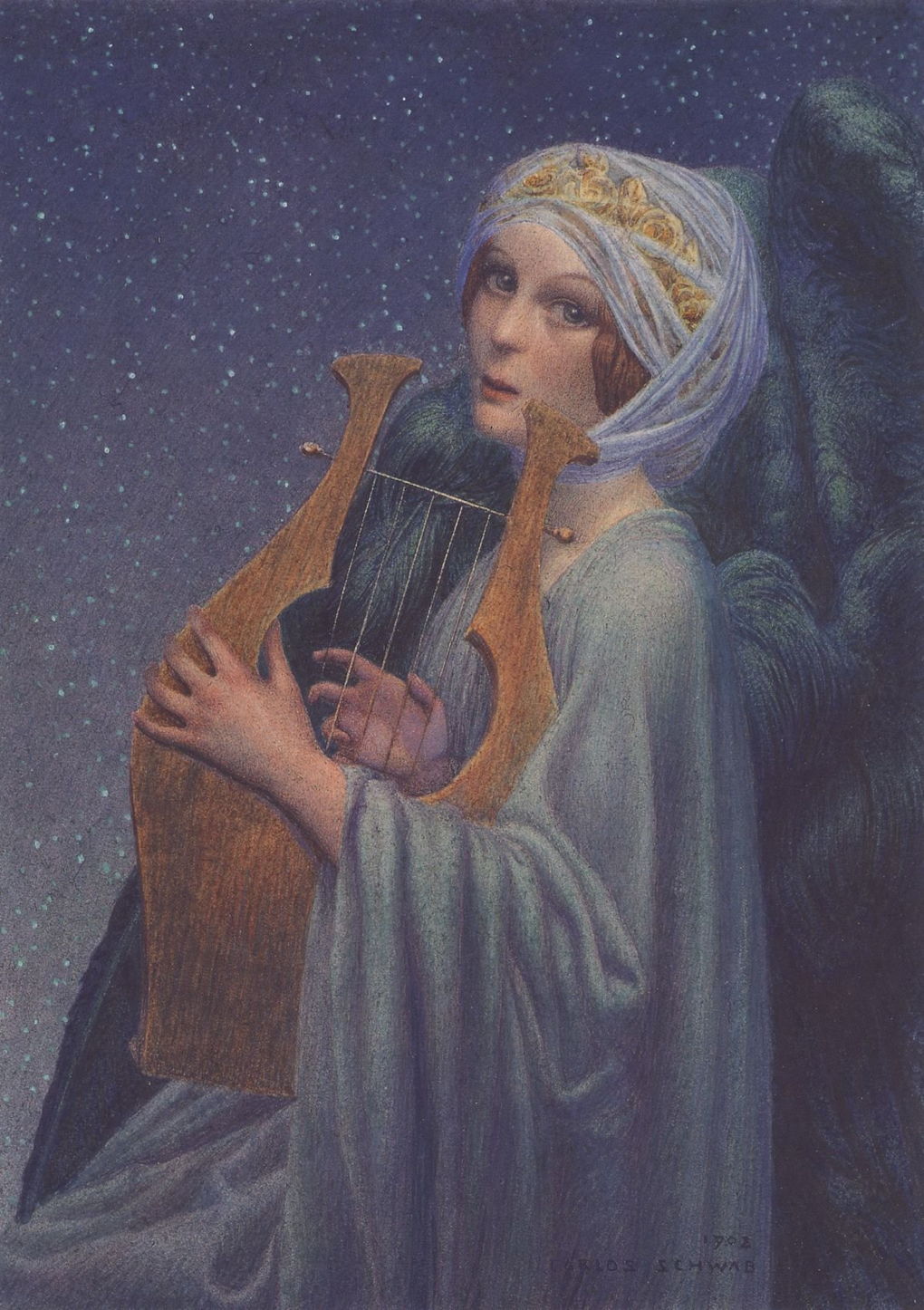
Schwabe painted this romantic portrait of a Woman with a Lyre in 1902. She has the dark wings typical of so many of his angels, but is more wide-eyed as she sings against the backdrop of a starry night.
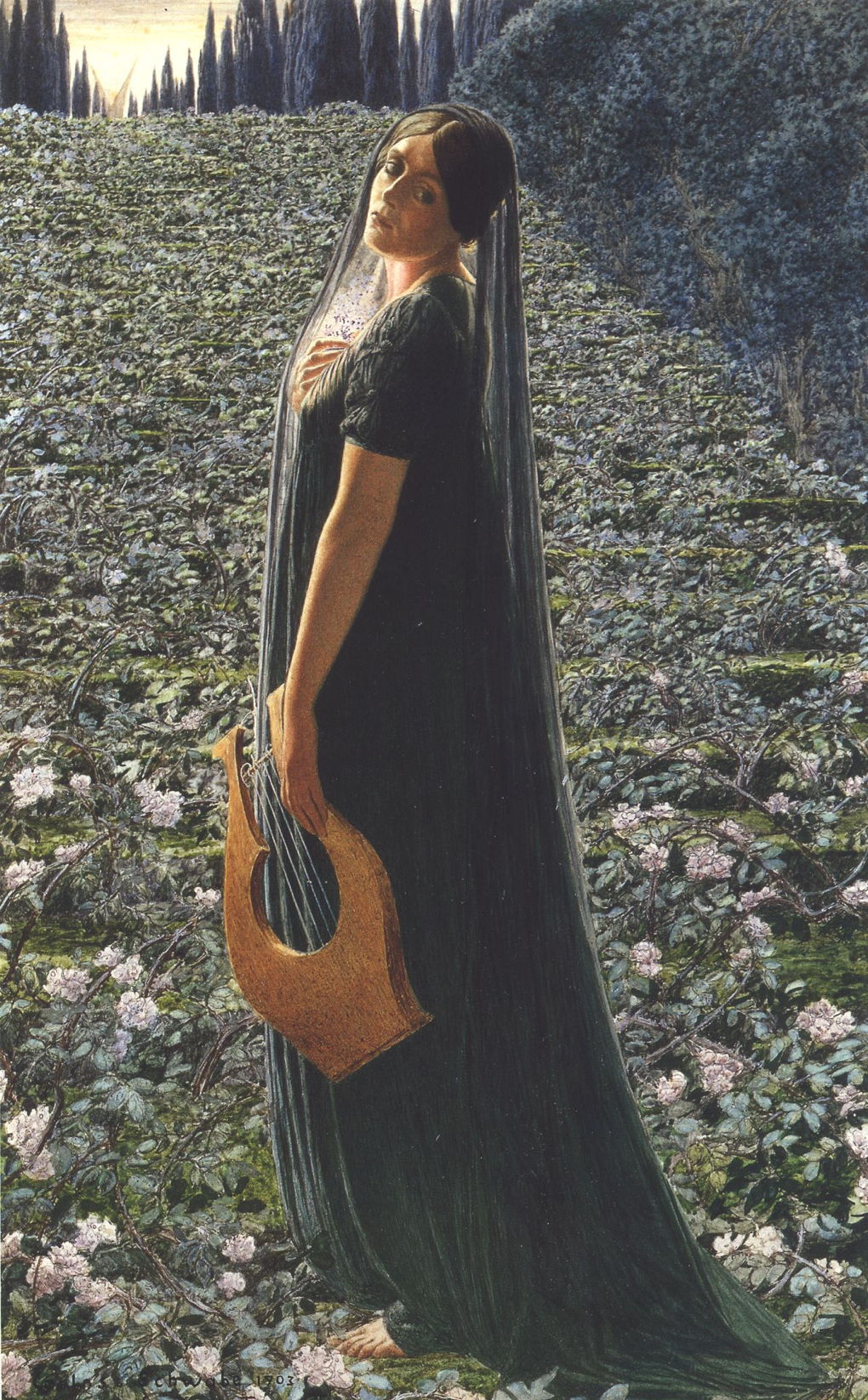
His watercolour of Elysian Fields from 1903 is ambiguously titled, as it could refer to the famous avenue of the Champs Élysées in Paris. A woman looks languidly at the viewer as she strolls over a floral carpet on overgrown steps, leading up to an avenue of cypress trees, long associated with graveyards and death. She is dressed in black, with a long black mantilla, and carries a classical lyre in her left hand, indicating she is a poet. In classical Greek mythology, the Elysian Fields were the final resting place of the souls of heroes.
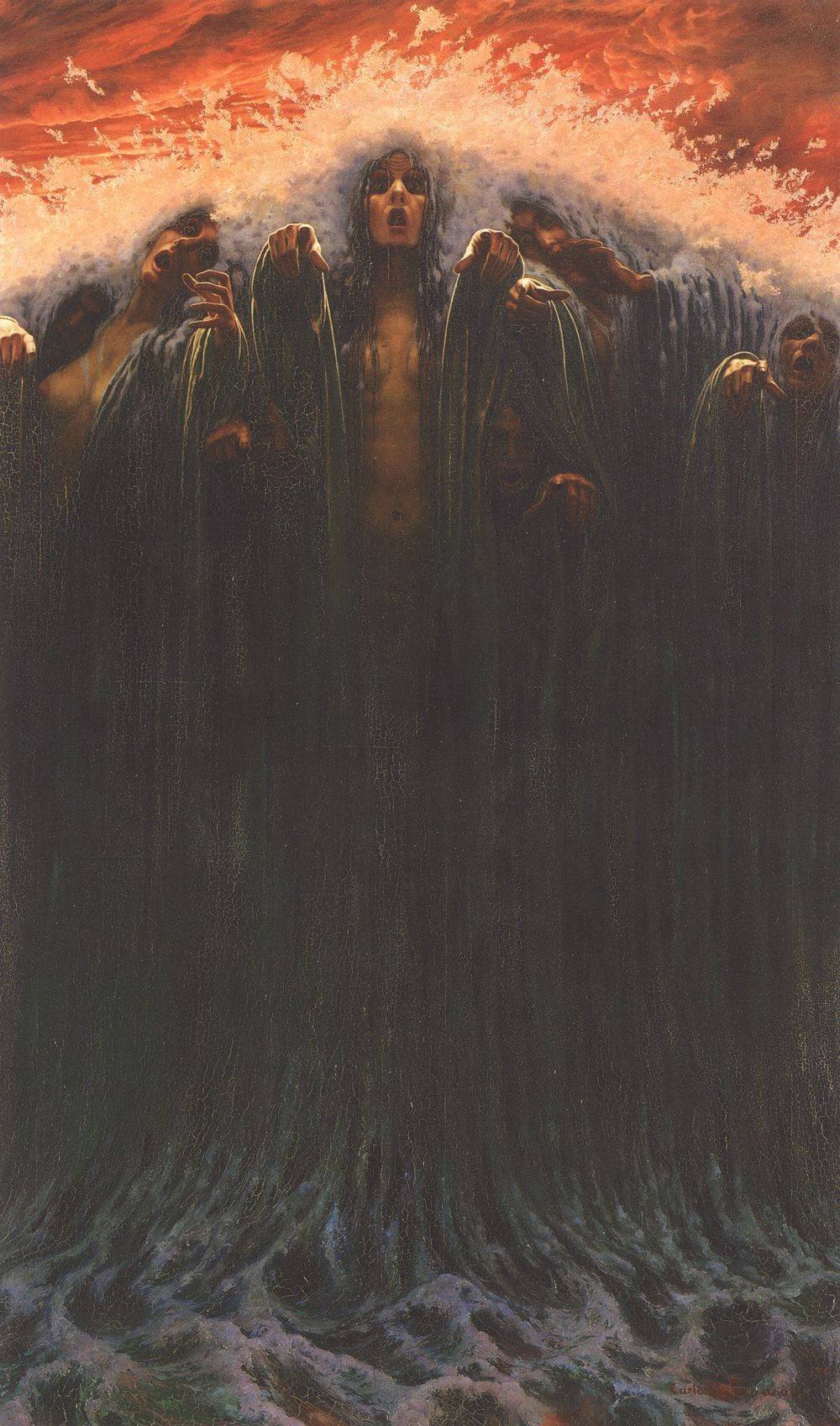
Schwabe appears to have painted mainly in watercolour during much of his career, but a few of his accessible works used oils. One of these is this dramatic Wave from 1907, in which the bodies of angry accusative women, possibly the Furies, are embedded in the wall of a wave as it rushes towards the viewer.
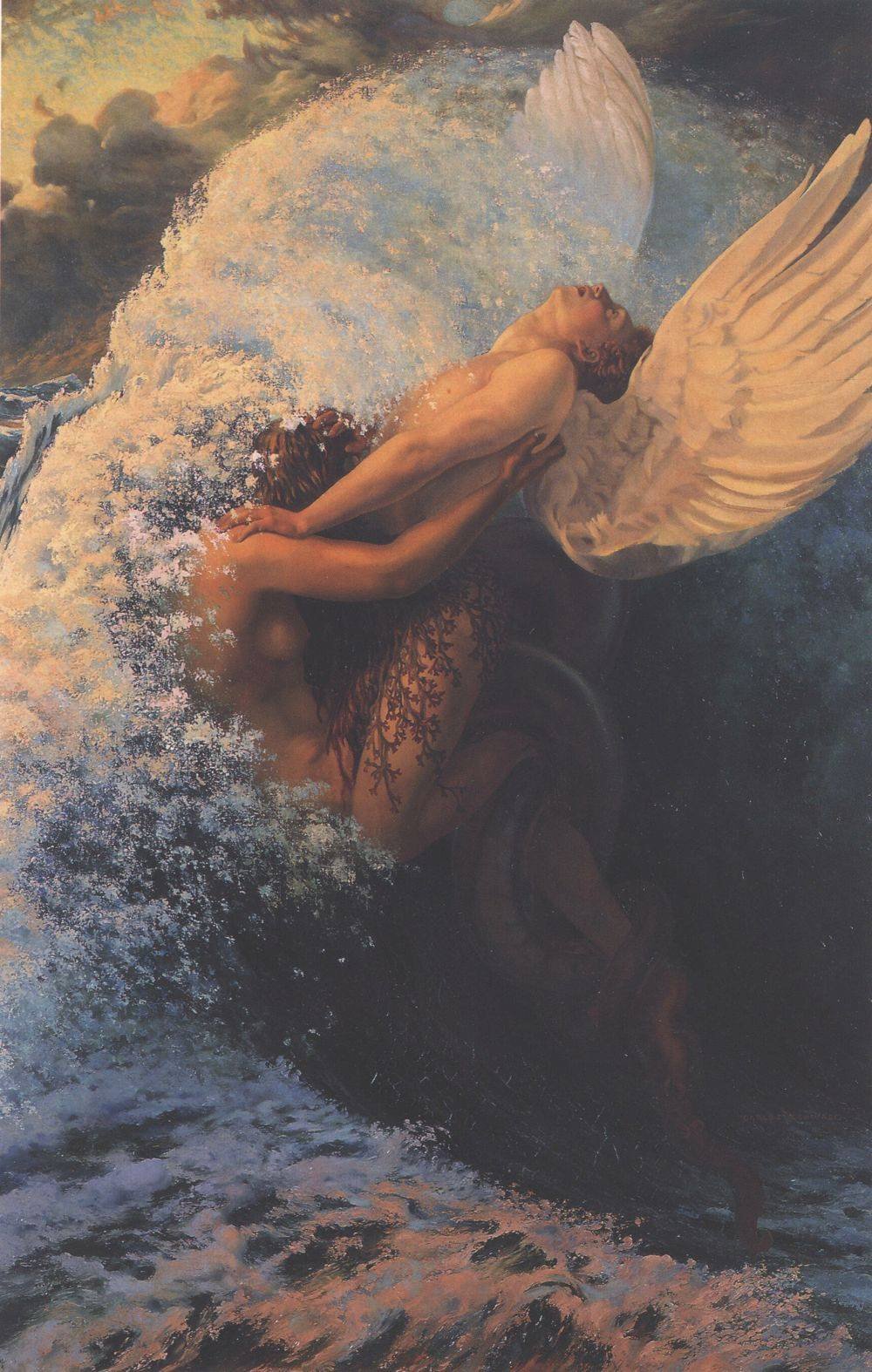
He also revisited some of the paintings he had made to illustrate Les Fleurs du Mal a decade earlier. Schwabe’s oil painting of Spleen and Ideal from 1907 is a fairly explicit depiction of two figures making love in a breaking wave, presumably indicating the moment of climax. The figure ‘on top’ is an angel with white wings, and appears to be male, while that ‘below’ has the breasts of a woman, although her face is obscured by her long hair. Writhing in among their interlocked bodies are the coils of a serpent, adding a dark twist to the composition.
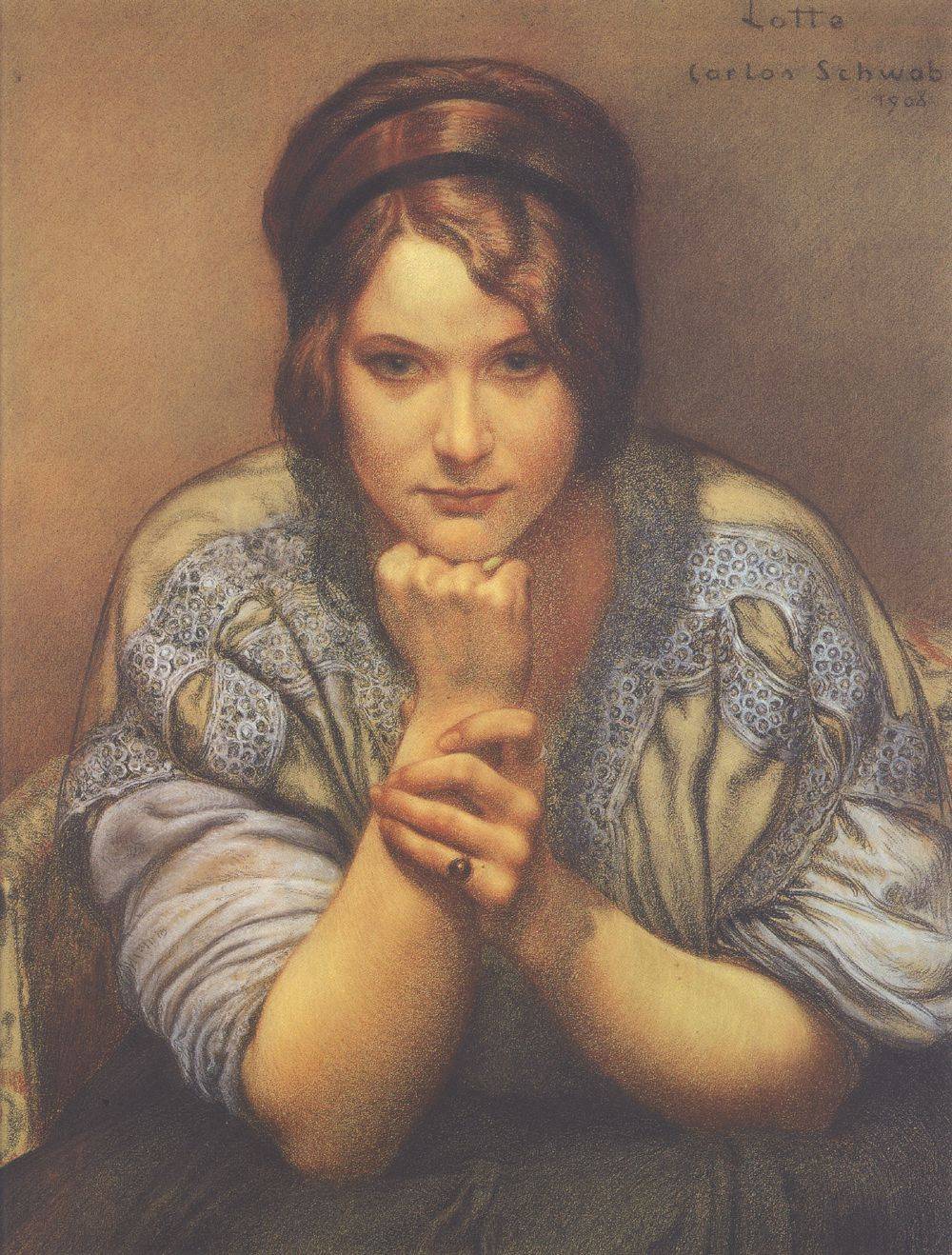
The last dated painting I have been able to find is this superb portrait of his daughter Lotte, painted in chalk in 1908. She comes across as a resolute young woman with a distinct air of mystery.
Although Schwabe didn’t die until 1926, I have been unable to locate any usable images of his paintings during the final eighteen years of his life, from the age of only forty-two. He seems to have retired to live in the small town of Avon in the Fontainebleau Forest, and the few paintings of his dated after 1910 appear to be more conventional depictions of classical myths.
 The Eclectic Light Company