
The Golden Age of the Dutch Republic was a period of war and turmoil. It started in the latter half of the Eighty Years War, thrived when that came to an end in 1648, and collapsed following the Disaster Year (Rampjaar) of 1672. That year brought both the Franco-Dutch and Third Anglo-Dutch Wars, invasion, rebellion, economic crisis, and collapse of the art market.

When he was just twenty, the French artist Antoine Coypel painted this Glory of Louis XIV after the Peace of Nijmegen (1681), which gained him admission as a full member to the Académie Royale.
The Treaty of Nijmegen brought an end to the Franco-Dutch War of 1672-78, and was one of a series France signed between August 1678 and September of the following year. These were acclaimed a great success for Louis XIV and France, which gained extensive territory in the north and east as a result. Louis was henceforth known as the Sun King. In this elaborate allegorical flattery, the king is being crowned in the upper left, above a gathering of deities including Minerva, who is wearing her distinctive helmet and golden robes.
Painting didn’t stop, of course, and some artists continued into the following century, but the number of masters declined rapidly.

Domenicus van Wijnen continued to paint, for example his radical interpretation of The Temptation of Saint Anthony in about 1685. Although this may have appeared an outlier at the time, its symbols and composition may have inspired the ‘faerie’ paintings that became popular in the middle of the nineteenth century.

Other artists like Adriaen van der Werff reverted to more traditional themes and style, in his Judgement of Paris from 1716.

The Golden Age was revisited by artists in the nineteenth century, particularly in the period scenes painted by Herman Frederik Carel ten Kate. His Soldier and Men in an Inn shows a scene from the Eighty Years War, with the walls decorated by blue on white Delft tiles. This must have been painted between 1850-80, over two centuries after the end of that war.

Early in the career of the Dutch artist Jozef Israëls, he painted The Seamstress (1850-88) as a genre interior from the Golden Age. A young Dutchwoman works with her needle and thread in the light of an unseen window at the left. In the background to the right, there’s a group of Delft tiles on the wall, and there’s a single tulip in a glass vase at the left.
The impact of Golden Age paintings on European art history was broad and deep, with secular themes becoming more popular than the religious and mythological works that had dominated the art of the Renaissance. New genres, like still life, may not have been rated as highly as history painting, but became widespread.
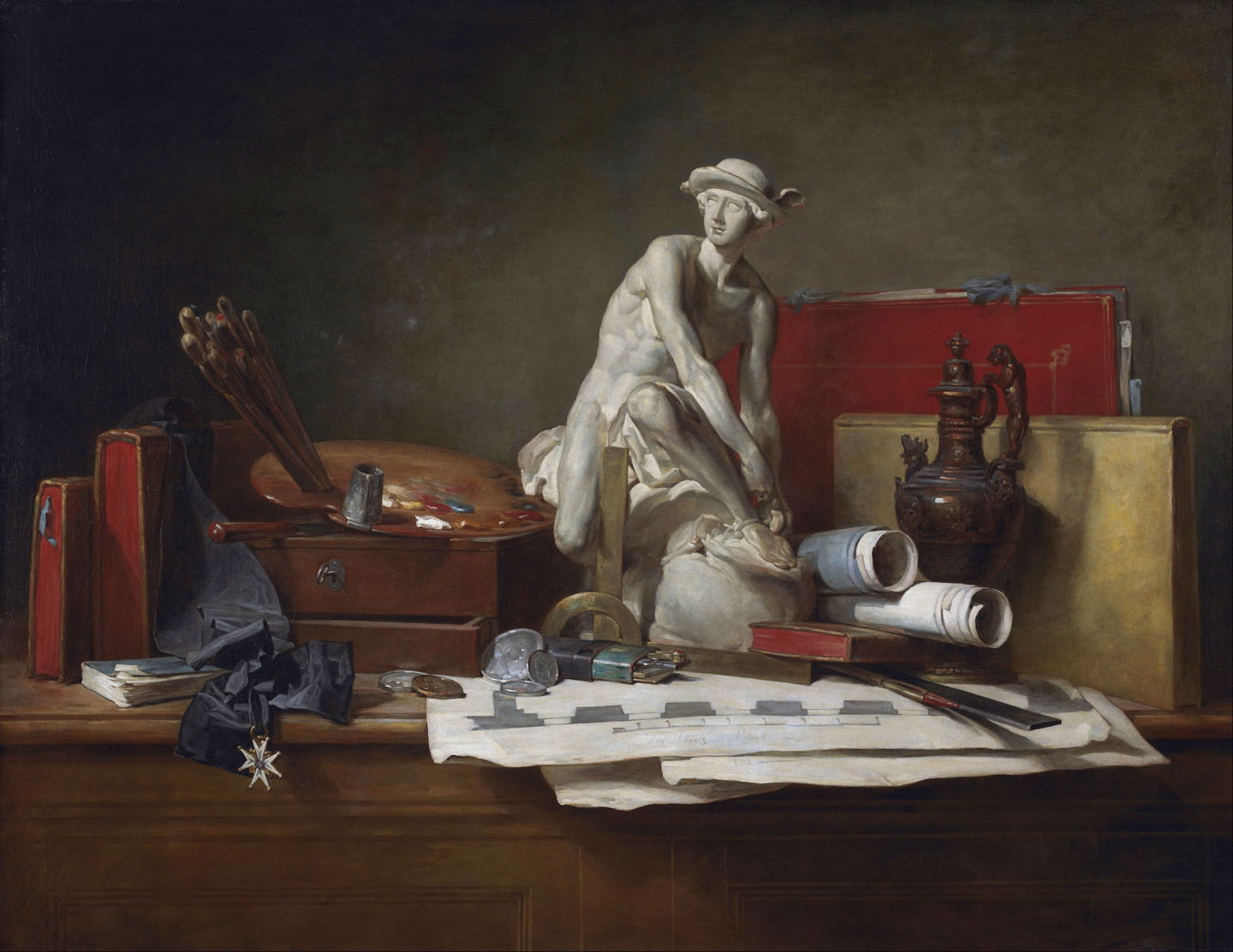
Late in his career, in 1766, Jean-Baptiste-Siméon Chardin painted The Attributes of the Arts and the Rewards Which Are Accorded Them, in which each object has a clear association. Painting is represented by the brushes and palette on top of a paintbox. Architectural drawings and drawing tools represent architecture. The bronze pitcher at the right refers to the work of the goldsmith. The red portfolio tied with ribbons represents drawing. The plaster model of the figure of Mercury in the centre is a copy of a sculpture by J B Pigalle, a friend of Chardin, who was the first sculptor to win the highest French honour for artists, the Order of Saint Michael, whose cross and ribbon are shown at the left.
Greatest impact was in landscape painting. Prior to the Golden Age, landscapes had primarily been used as accessories to other genres. Most were idealised rather than accurate representations of any real location, and many were mere settings for narratives.

The Dutch vogue for expressive skies spread steadily across Europe. This is reflected in Joseph Vernet’s Italianate Harbour Scene from 1749. He still retains formal compositional elements, with figures in the foreground, and scenery behind, but delights in showing us these towering cumulus clouds lit so richly.
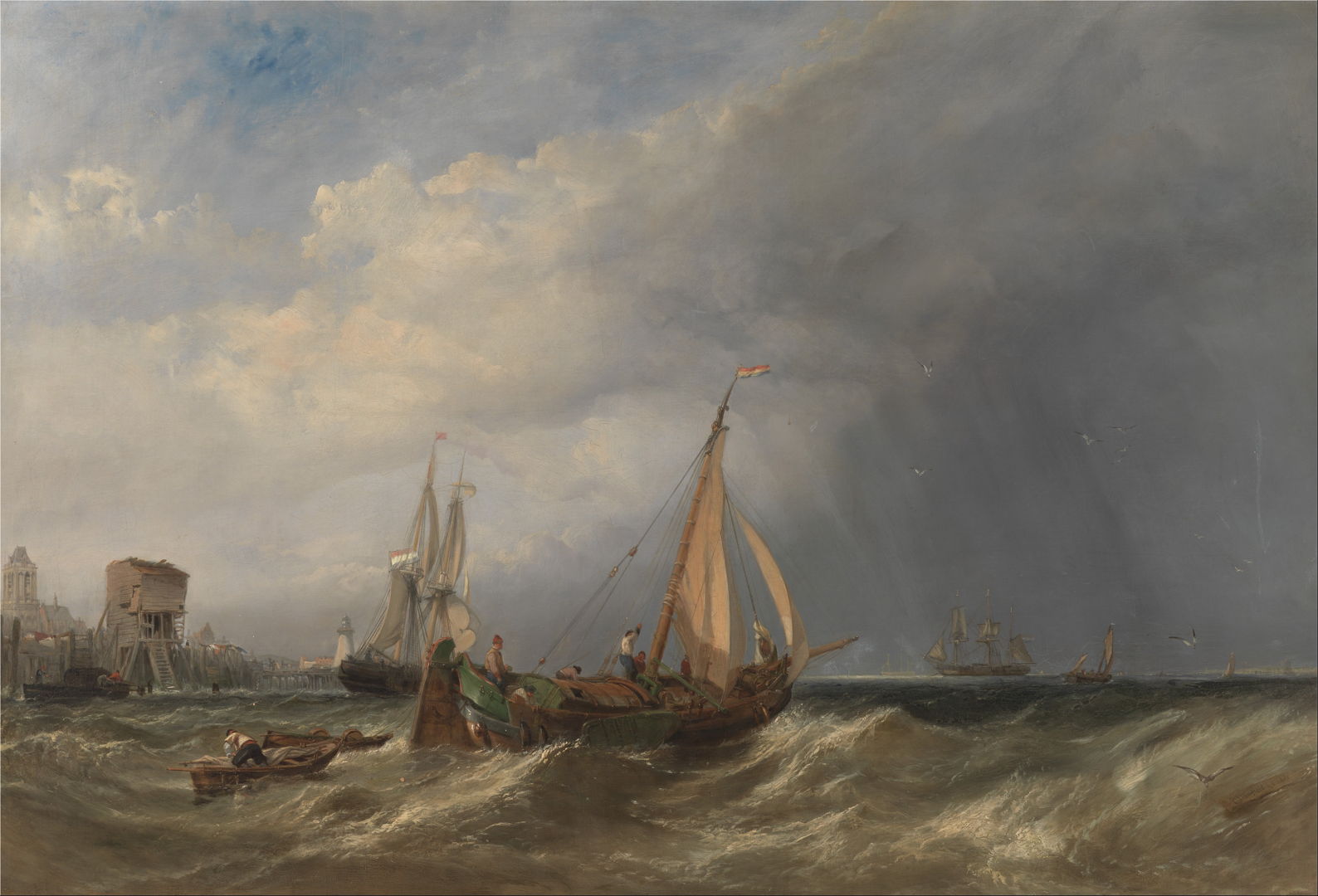
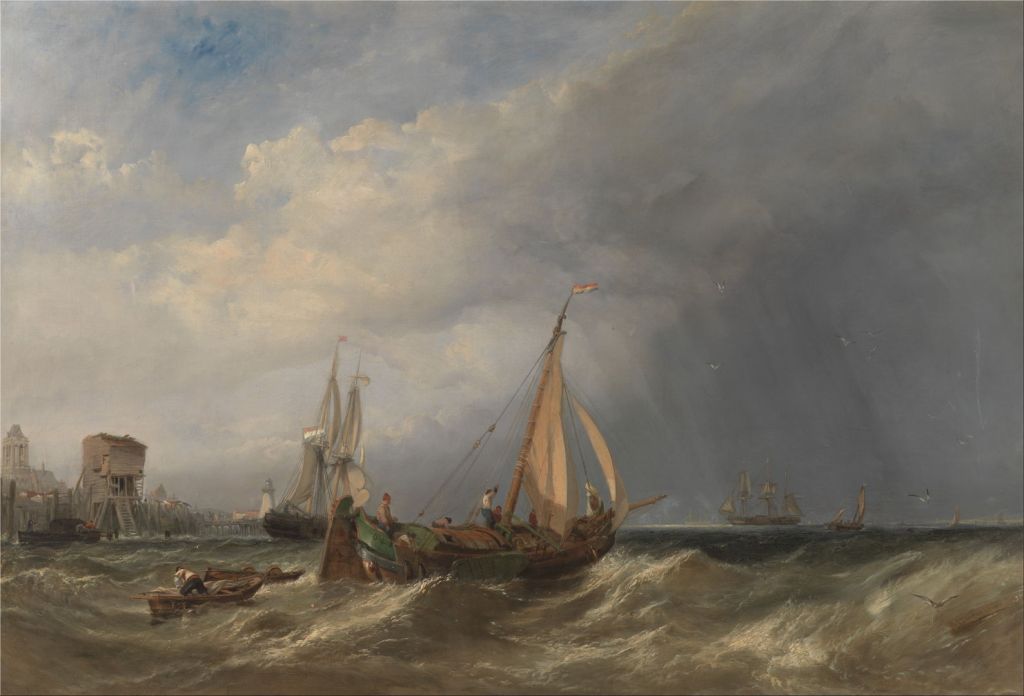
Marine painting became established as a sub-genre, as shown by the British painter Clarkson Stanfield, whose Dutch Barge and Merchantmen Running out of Rotterdam from 1856 includes rich detail, even down to dilapidated buildings on the waterfront.

Many of John Crome’s landscapes feature skies inspired by Dutch painters. His Landscape with Windmills is one of his most remarkable, as a signed painting that appears to have been sketched in front of the motif. Others who skied include John Constable and JMW Turner.
Nocturnes were less reliable, as they underwent phases when they were fashionable, then fell into neglect for a while.

James Abbott McNeill Whistler had a penchant for nocturnes, here his Nocturne: Blue and Gold — Southampton Water from 1872. Its vague blue-greys make the pinpoints of light and the rising sun shine out in contrast, a good reason for limiting his palette, while remaining faithful to nature.
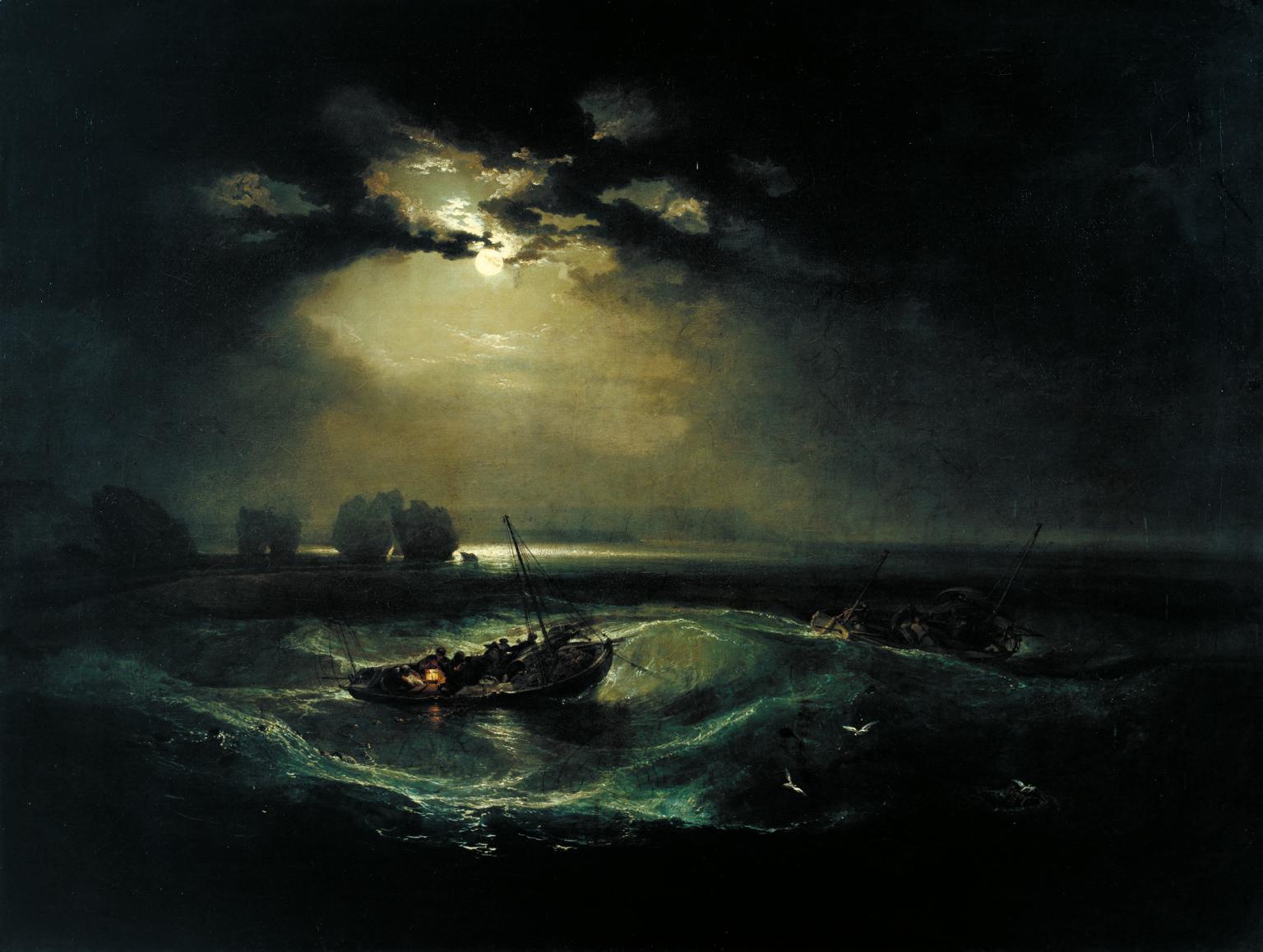
JMW Turner’s Fishermen at Sea from 1796, showing small fishing boats working in heavy swell off The Needles, on the Isle of Wight, is probably the most famous and successful coastal nocturne of all time. This was Turner’s first oil painting to be exhibited at the Royal Academy, when he was just twenty-one.
Paintings by artists of the Dutch Republic had been sold into collections across Europe, where many remain, influencing today’s artists.
 The Eclectic Light Company