
Painting in oils on copper plates had become relatively popular by 1600, and reached its zenith in the work of Adam Elsheimer, who died in 1610. Although it continued through the seventeenth century, it entered a slow decline as stretched canvas became the norm.

Copper remained quite popular in the Netherlands. Some artists, such as Hendrick de Clerck, pushed their technique up to larger sizes too, in The Contest Between Apollo and Pan (c 1620). This is a huge 43 by 62 cm (17 by 24.4 inches), dwarfing its predecessors, and providing exquisite detail in the flowers of its foreground.

To the south, David Teniers the Younger adopted copper for many of his paintings, including Armida before Godfrey of Bouillon (1628-30), significantly smaller than de Clerck’s.

Teniers even used copper for his singerie of A Monkey Encampment from 1633, showing monkeys in human roles in a camp.

One of the grandest paintings made in oils on copper is Gerard ter Borch visual record of The Ratification of the Treaty of Münster, 15 May 1648 made in the same year. This recorded the moment that the Thirty Years War ended, with the ratification of this treaty between the Dutch Republic and Spain. It also marked the birth of the Dutch Republic as an independent country. This is 45.4 x 58.5 cm (17.9 by 23 inches), similar to de Clerck’s giant, but far smaller than its equivalent would have been on canvas.

Teniers appeared to rise to the challenge in The Temptation of Saint Anthony in about 1650: 55 × 69 cm (21.5 by 27 inches).
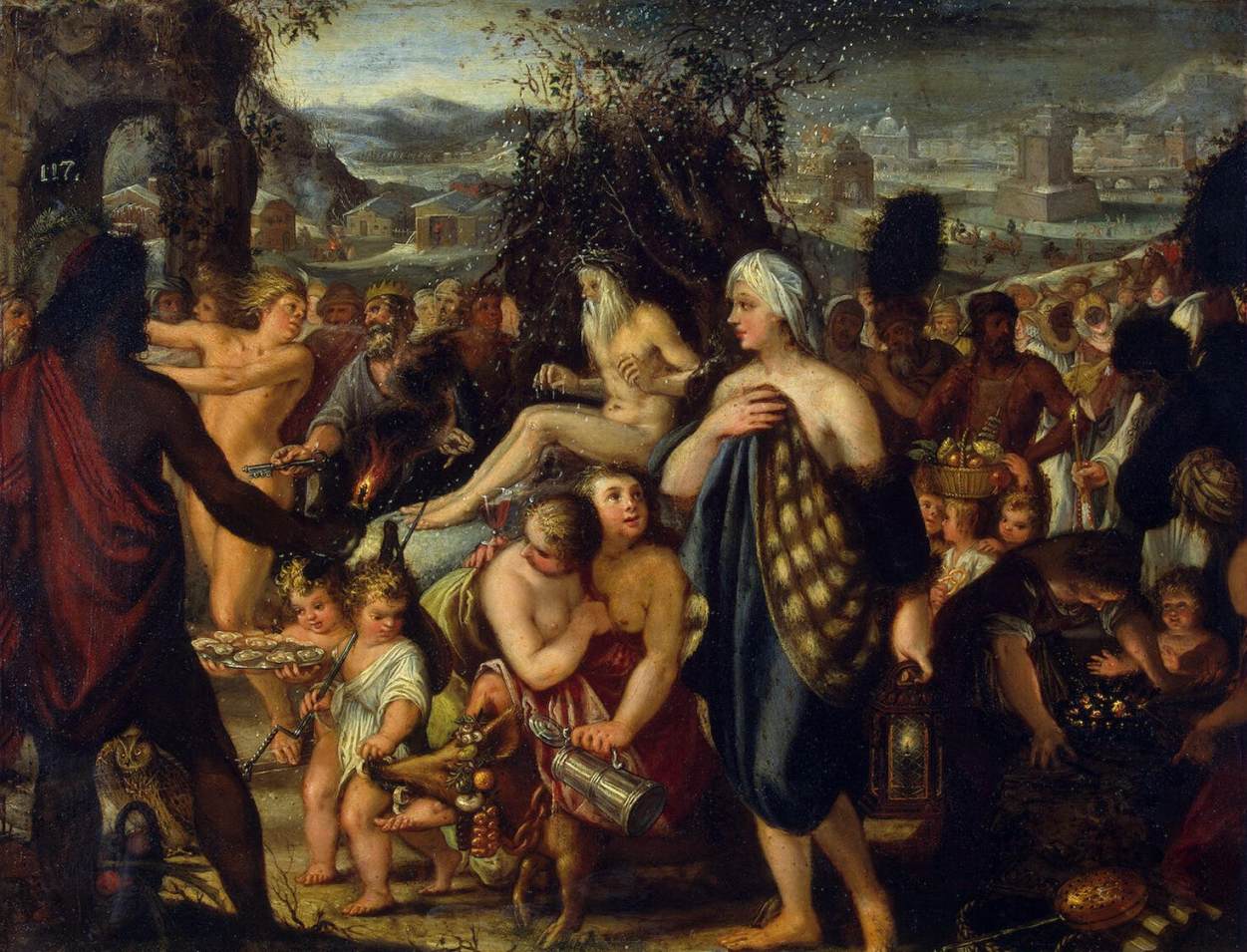
Johann Heiss’s Allegory of Winter (1665) depicts fine snowflakes realistically, thanks to its smooth grain-free surface.
By the eighteenth century, the use of copper as a support had become unusual if not exceptional.
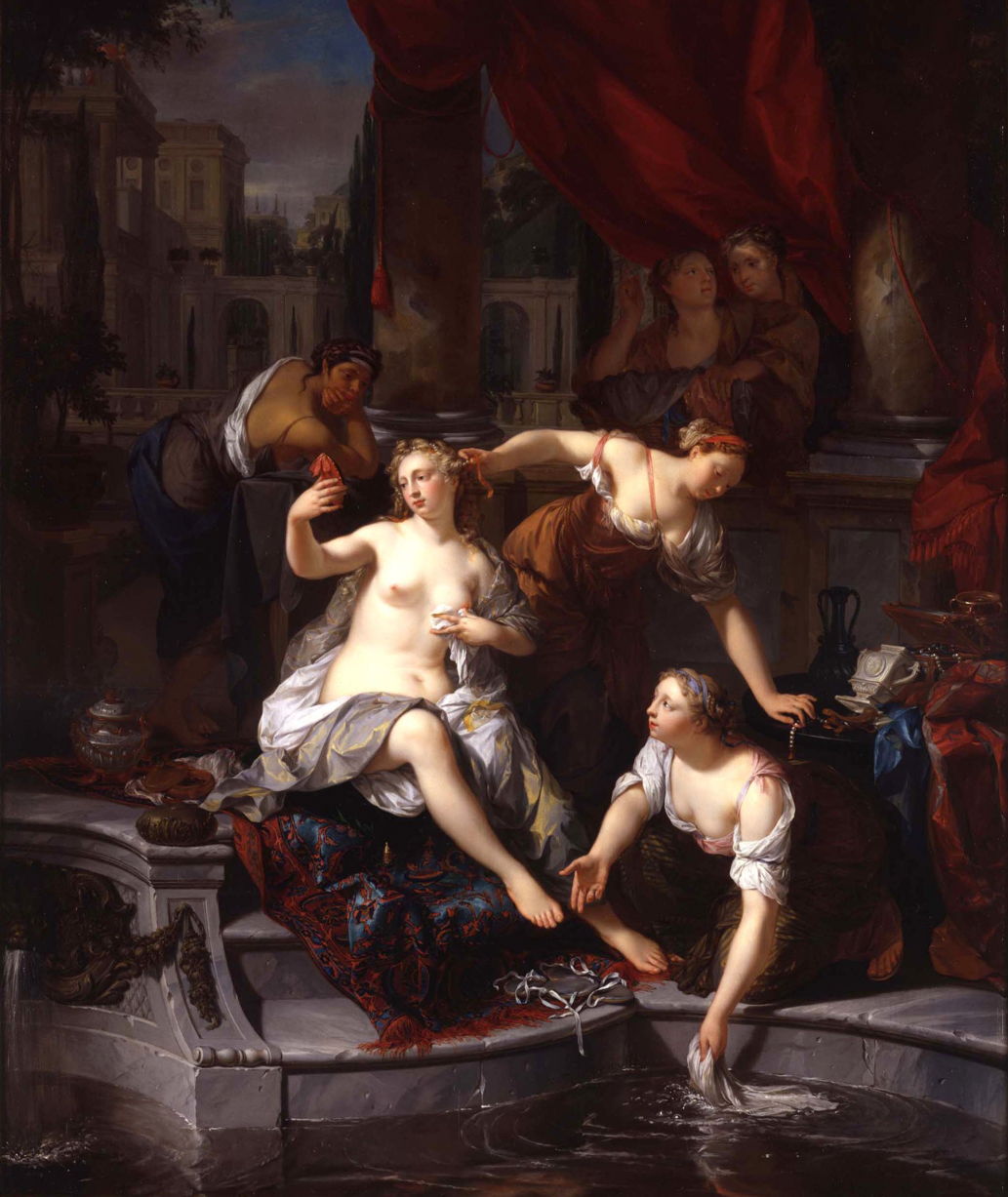
Nikolaas Verkolje’s David Spying on Bathsheba from 1716 uses a relatively large sheet for its conventional account of this popular story.

The use of copper has never ceased altogether since the late sixteenth century, and has been continued by a succession of artists with whom it has found favour, such as Nicolas Lancret above, and Johann Georg Platzer below. The latter appears to have painted many works on larger sheets than those used earlier. There’s a delicate balance to be struck, as thinner sheets are less rigid and warp more readily, but are substantially lighter and cheaper.

Platzer’s The Artist’s Studio (1740-59) shows an assistant using a muller, at the far right, to prepare fresh oil paint for the painters at work in this workshop. Sadly, none of the paintings shown appear to have used copper supports.
Since then, copper has reappeared from time to time, usually where it’s least expected.

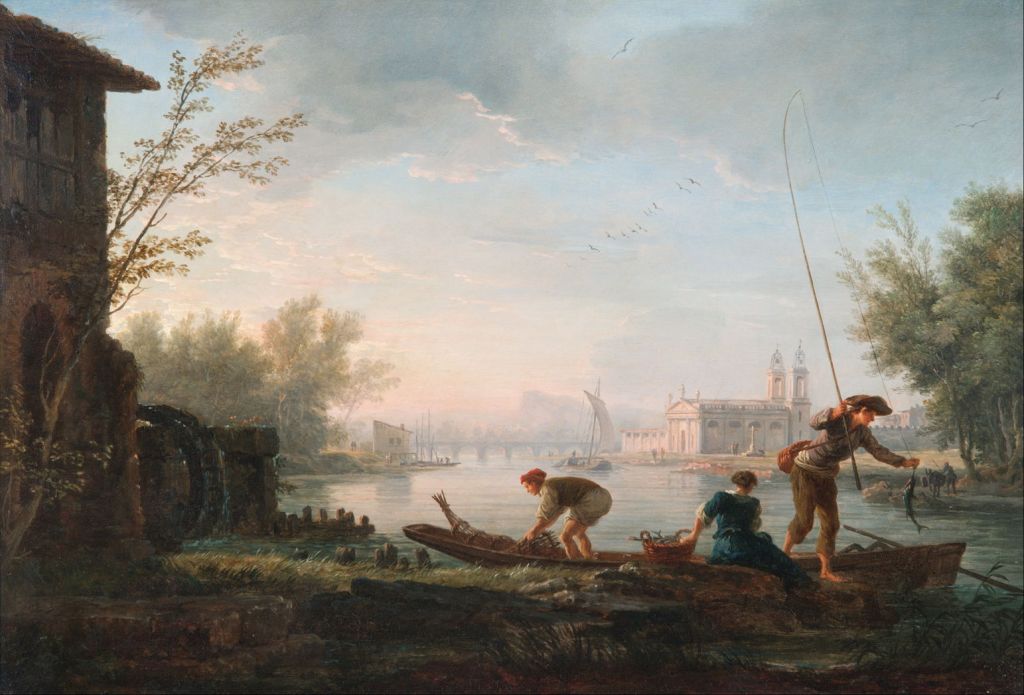
Claude-Joseph Vernet used it for his outstanding series The Four Times of Day in 1757. The first, Morning, shows three people busy fishing at the edge of a substantial river, as the sun rises behind a watermill and trees on the left. Making its way slowly towards the viewer is a barge, its sail lofted out by the gentle breeze. Gulls are on the wing, and the day promises to be fine and sunny. These are painted on silvered copper, presumably to give them a lustrous look. Vernet doesn’t appear to have used copper much later in his career.
My final examples come from the underrated Italian-American artist Joseph Stella, who seems to have experimented with large copper supports in the 1920s.

His Leda and the Swan from 1922 is huge by previous standards, although it’s hard to see any advantage gained from the properties of the support.
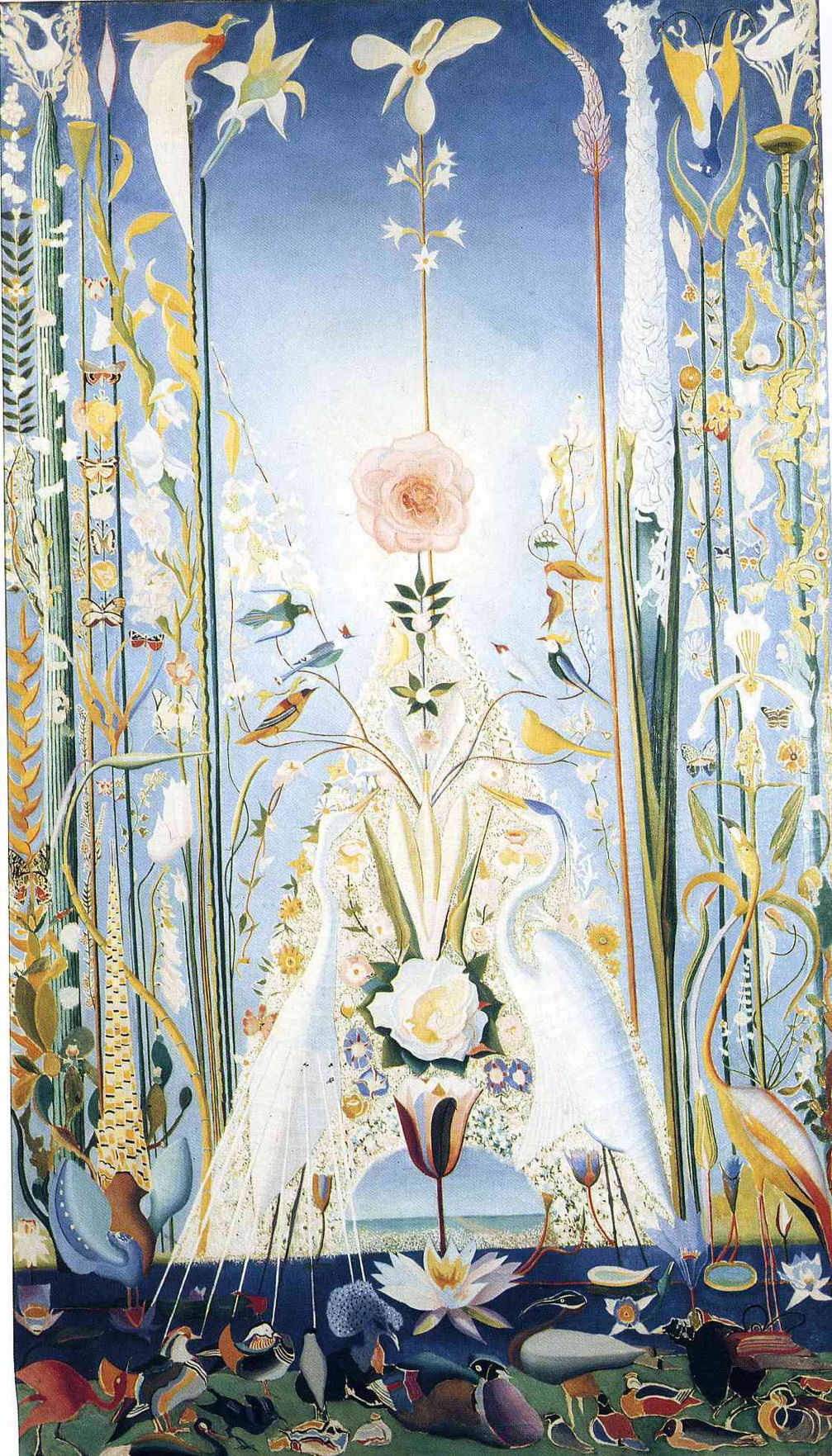
The Apotheosis of the Rose from 1926 is the largest work on copper that I have come across, at 213.4 by 119.4 cm (84 by 47 inches). Its fine detail is overwhelming, making it the perfect end to these examples.
The twenty-first century successor to copper plates must be lightweight ‘honeycomb’ alloy and composite panels that have been adopted by some modern painters.
 The Eclectic Light Company