
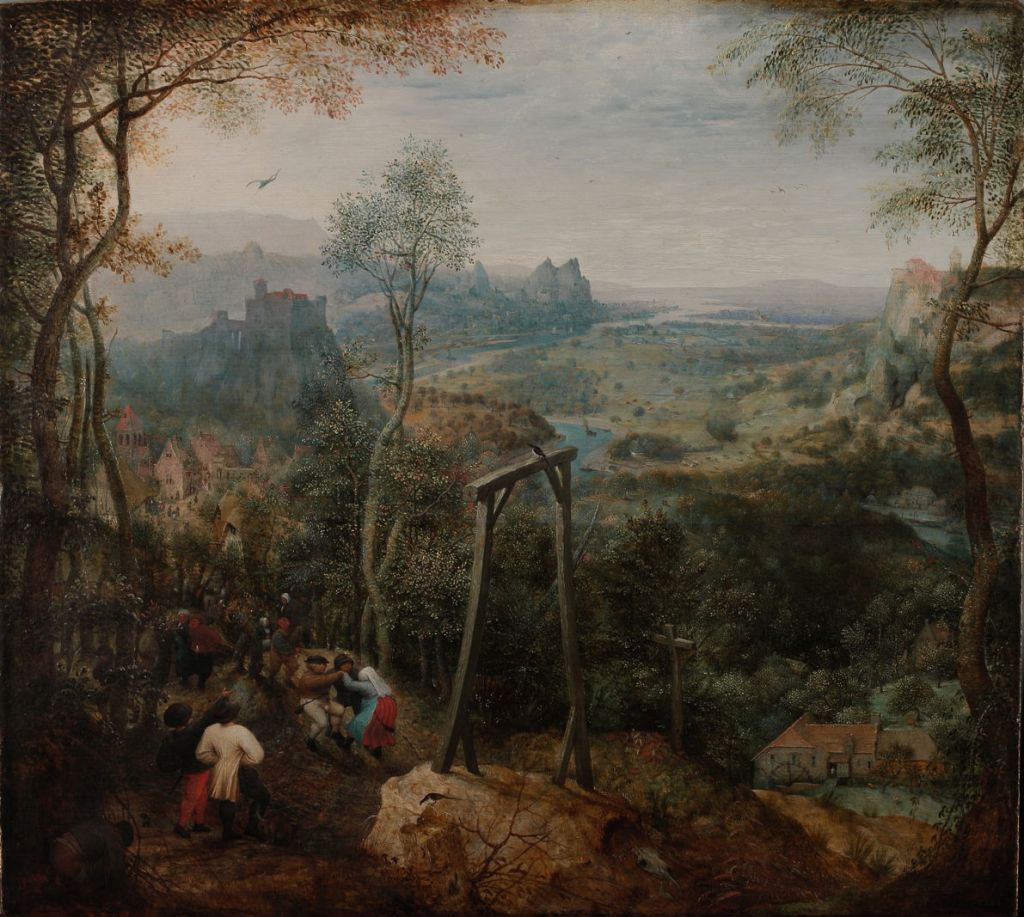
At some stage in the Middle Ages, execution by hanging became the standard method, with beheading reserved for royalty and nobility. For many centuries, the structure used to hang people from, a gallows, became commonplace across much of Europe. Typically situated near a junction of roads just outside towns, gallows became a grim reminder of the brutal consequences of even petty crimes and transgressions. Until the middle of the nineteenth century, hangings normally resulted in slow strangulation, and it was only after 1866 that the victim’s body was dropped far enough to break their neck and cause more rapid death.
Although paintings featuring gallows aren’t common, their presence is always significant to their reading. Distant gallows are ominous hints in several of the paintings of Hieronymus Bosch.
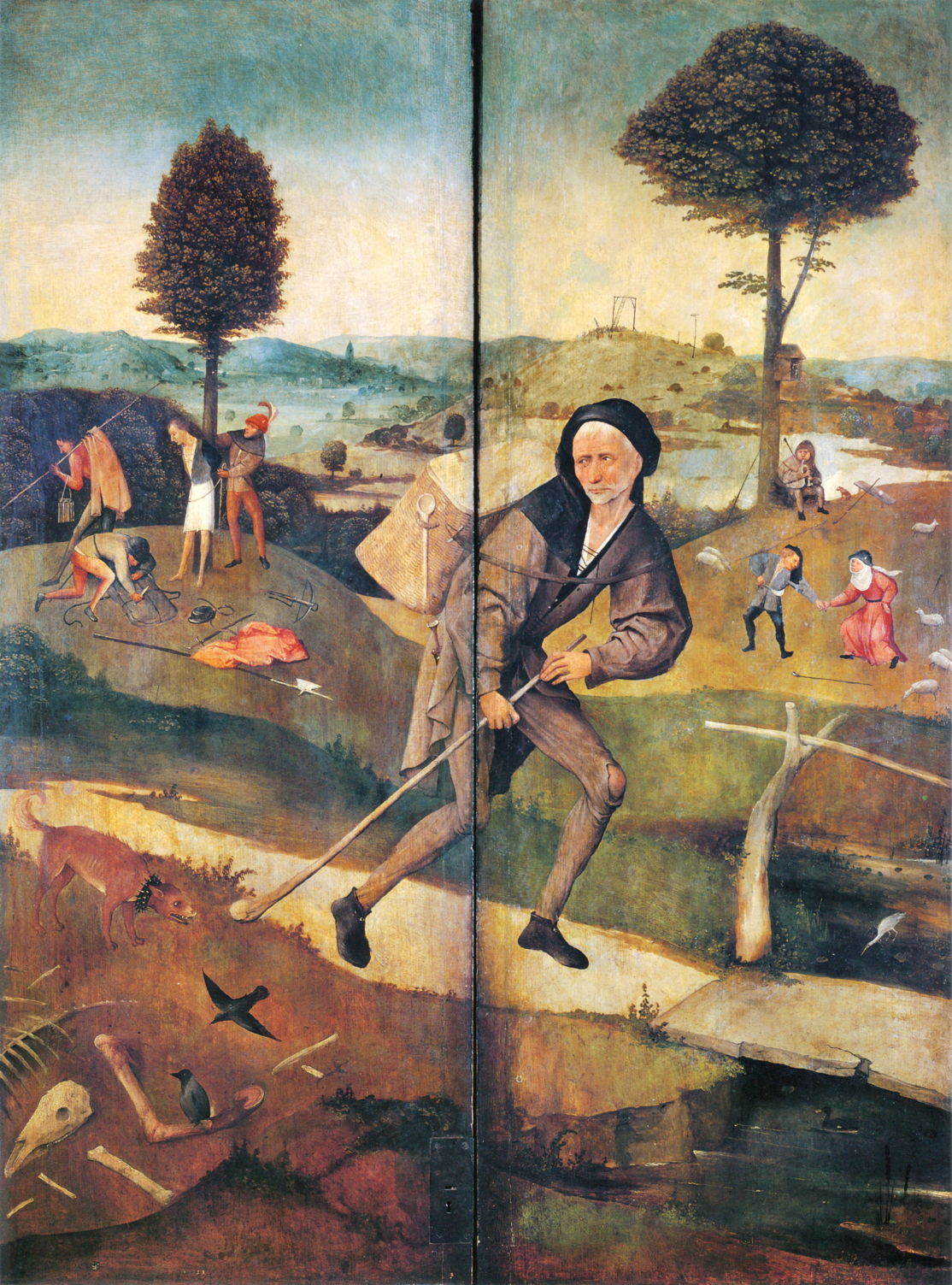
The exterior of his Haywain Triptych shows an older man walking from left to right along a narrow path passing through meadows. Behind him, on the left, three robbers are tying another traveller to a tree, having stolen his outer clothing and his pack. They’re armed with a crossbow and pikes, which rest on the ground by them. On the right, in the distance, a man and a woman are dancing amid their flock of sheep, to the music provided by a bagpiper, who is sat underneath another tree with a large box fixed to its trunk. On a lonely hill in the distance is a gallows, with a ladder propped against it and activity suggesting a hanging is imminent.
Gallows are most frequent in the paintings of Pieter Bruegel the Elder.
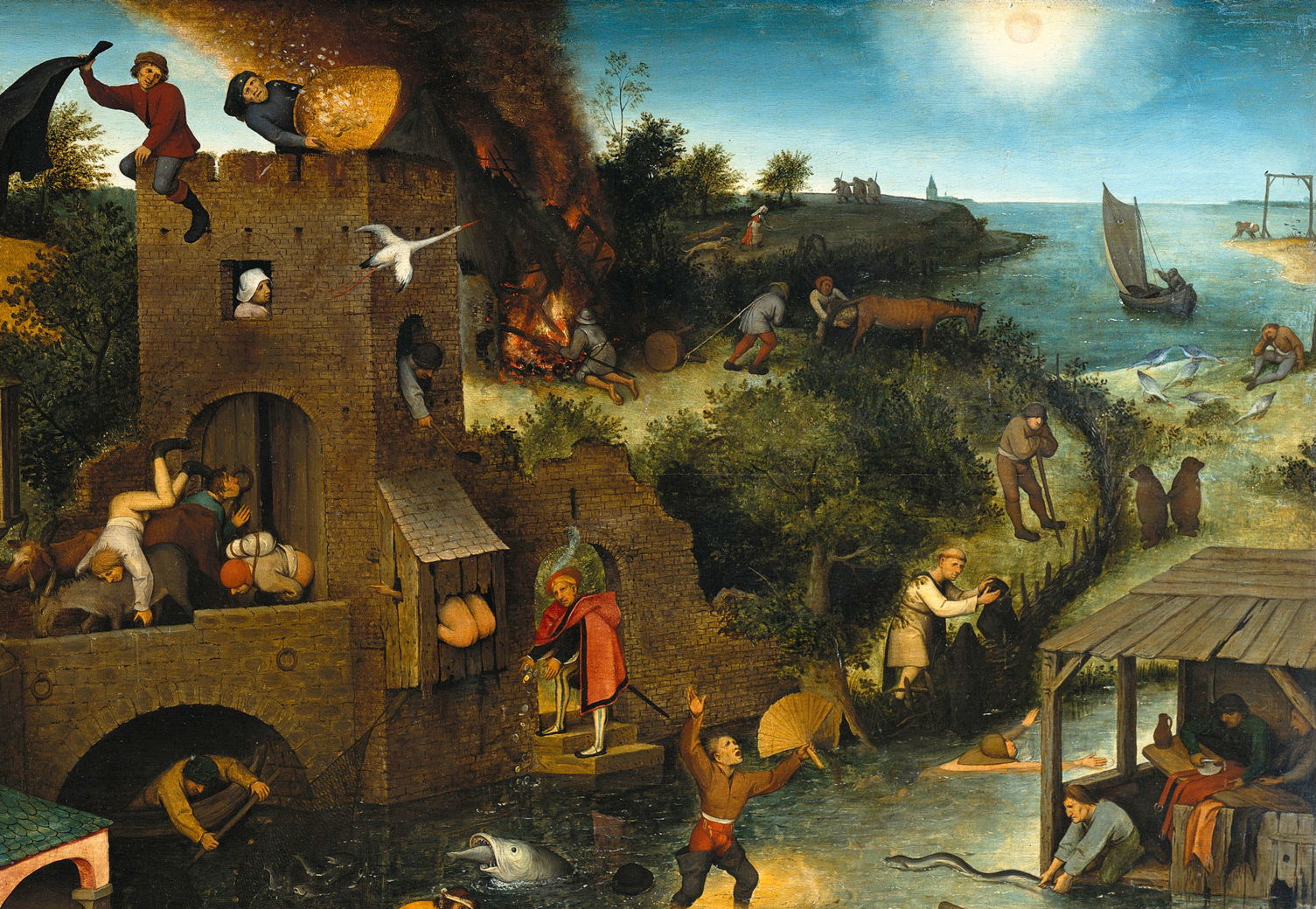
At the top right of this detail from his Netherlandish Proverbs of 1559 is a figure crouching by the gallows, portraying the contemporary Dutch phrase to crap on the gallows, meaning to be undeterred by any penalty.

One longstanding association is that crows or ravens are often seen perching on gallows and at scenes of execution, as in Pieter Bruegel the Elder’s Procession to Calvary from 1564. As the whole of Jerusalem seems to be flocking towards the distant site of execution, a large black bird rests on the empty gibbet at the right edge of the painting, and there are gallows visible in the centre distance.
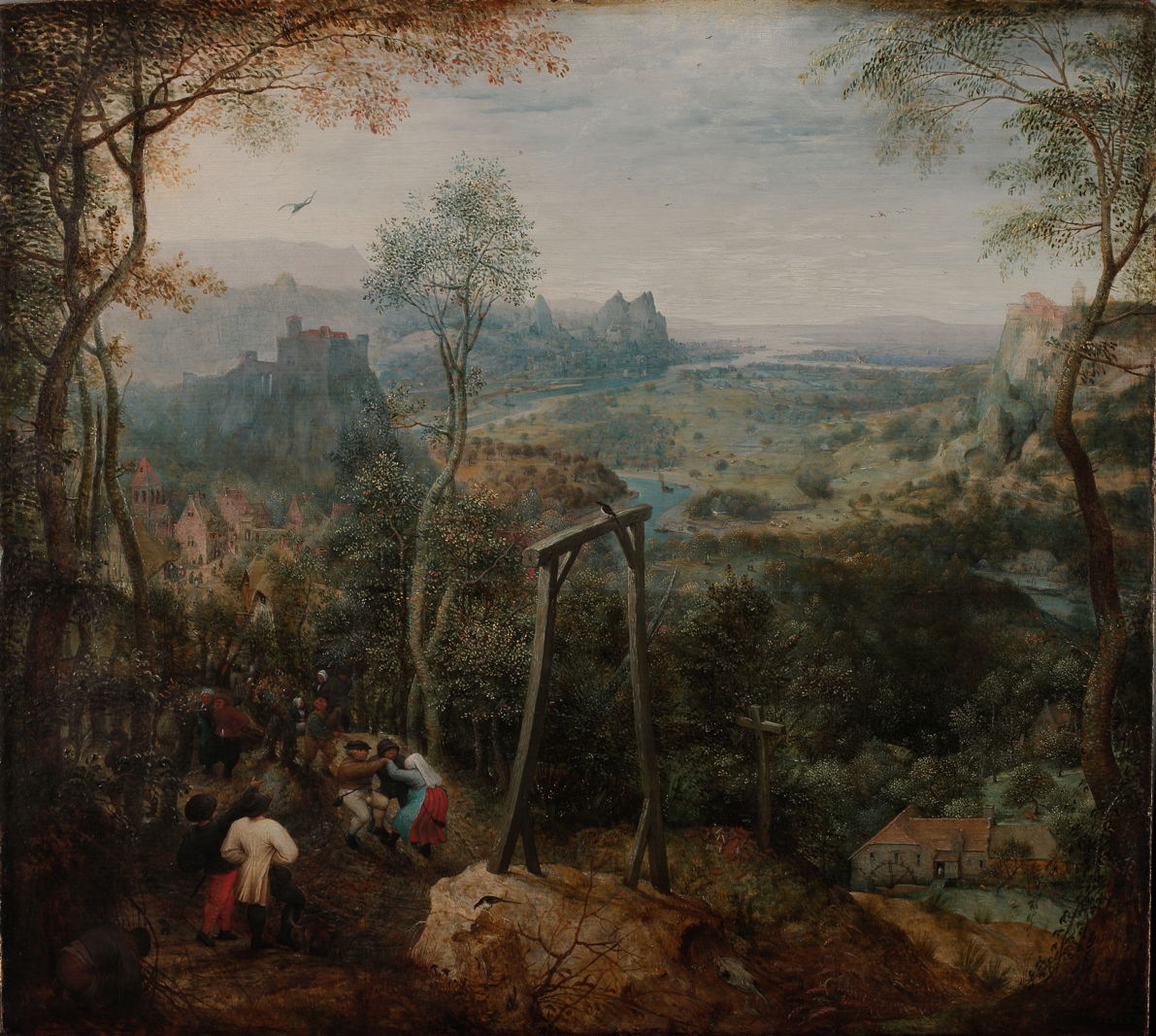
It has been suggested that his Magpie on the Gallows (1568) may be another allusion to a popular proverb, such as ‘dancing on the gallows’ meaning mocking the state, or the folk role of the magpie as a gossip (and Ovid’s story of the Pierides), and gossip as being life-endangering in times of political tension. At least these gallows are currently vacant.

In yesterday’s article about the paintings of Domenicus van Wijnen I showed his undated Witches’ Sabbath by Moonlight, which takes place at an outdoor altar set up at the foot of the gallows, on which a dead body hangs. There are longstanding associations between the Dark Arts, witchcraft in particular, and the gallows as a supplier of corpses.
City gallows were often within its boundary walls, and by the eighteenth century executions had become popular entertainment for all classes. London’s central site was at Tyburn, a distinctive three-legged gallows depicted by many artists and illustrators, including William Hogarth in his moralising series Industry and Idleness in 1747.
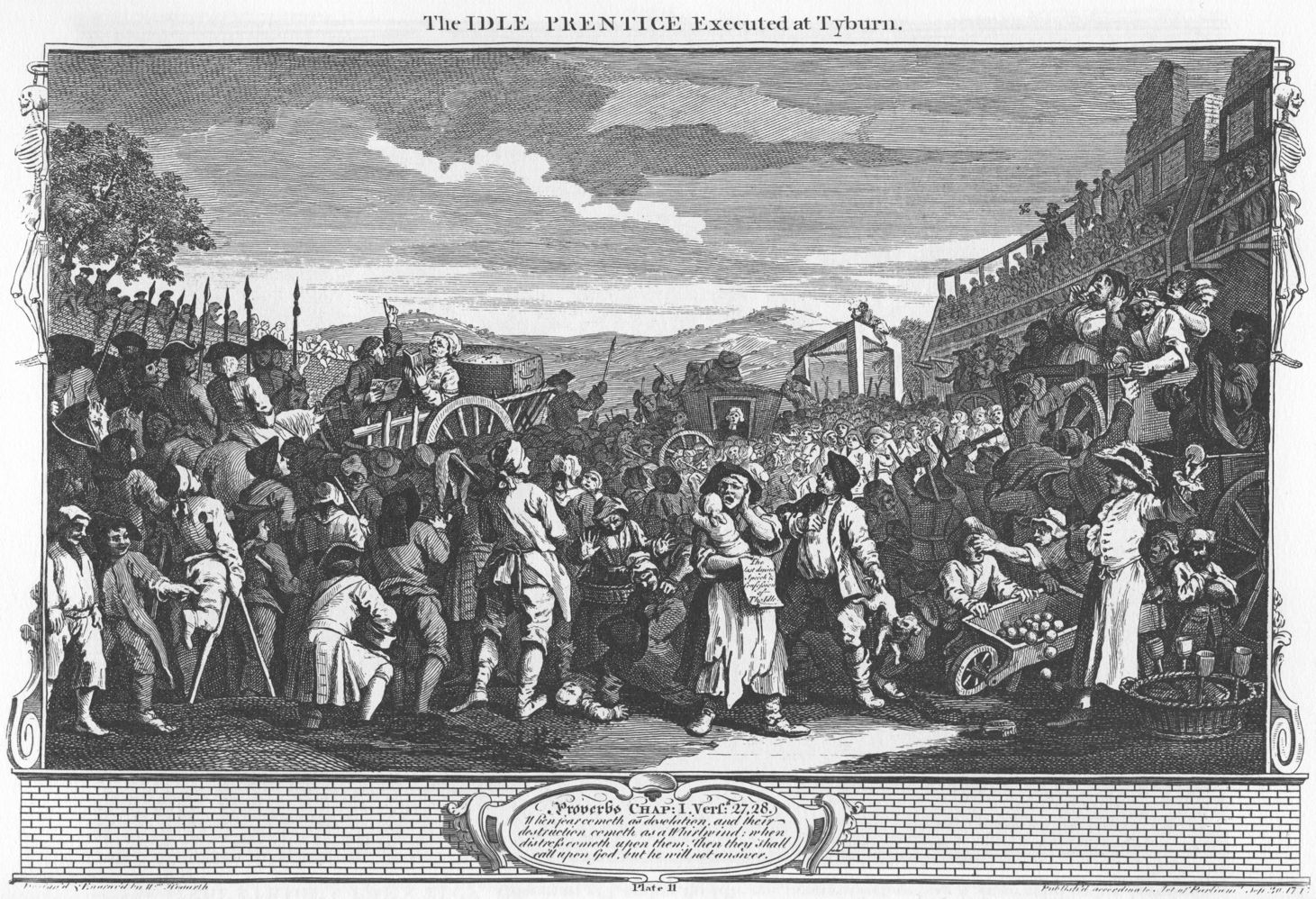
Idle, having been found guilty of murder, has been sentenced to death, and is here shown being taken by cart to the gallows at Tyburn, which are prominent above the crowd in the right middle distance. The hangman is shown below the gallows, adjusting the length of the noose to ensure a swift death. Someone is nonchalantly perched on top of the gallows, smoking a pipe.
Idle is in the back of the cart just to the left of centre, reading, presumably from a prayerbook, accompanied by a Wesleyan minister who appears to be exhorting his repentance, and is stood with his back to his empty coffin. Soldiers follow that cart, and a dense crowd has already gathered to witness the hanging. All manner of minor events are taking place among the crowd. From the window of a coach in the centre, the Ordinary of Newgate is addressing the crowd, in accordance with the will of Robert Dow, a merchant who left money to ensure that spiritual exhortations were provided for those about to die on the gallows. The fields in the distance are those of Notting Hill, long since built over.
By the nineteenth century, some were brave enough to campaign against capital punishment, among them Victor Hugo, who was also an accomplished visual artist.

Hugo fought a lifelong battle against the death penalty, which he first committed to print in his early novel The Last Day of a Condemned Man (1829). The Hanged Man “Ecce” from 1854 shows the remains of a hanged criminal swinging from a gibbet, which remained a common practice.

Carl Blechen’s late oil sketch of A Scaffold in a Storm was painted in about 1835, shortly before he succumbed to severe depression. There can be nowhere more grim, bleak and depressing than the gallows on a remote hill.
 The Eclectic Light Company