
In this alphabetical overview of landscape painting, this week we come to the letter I, for ice and snow. They were among the first themes among early landscape artists in northern Europe, as it flourished in the ‘low countries’.
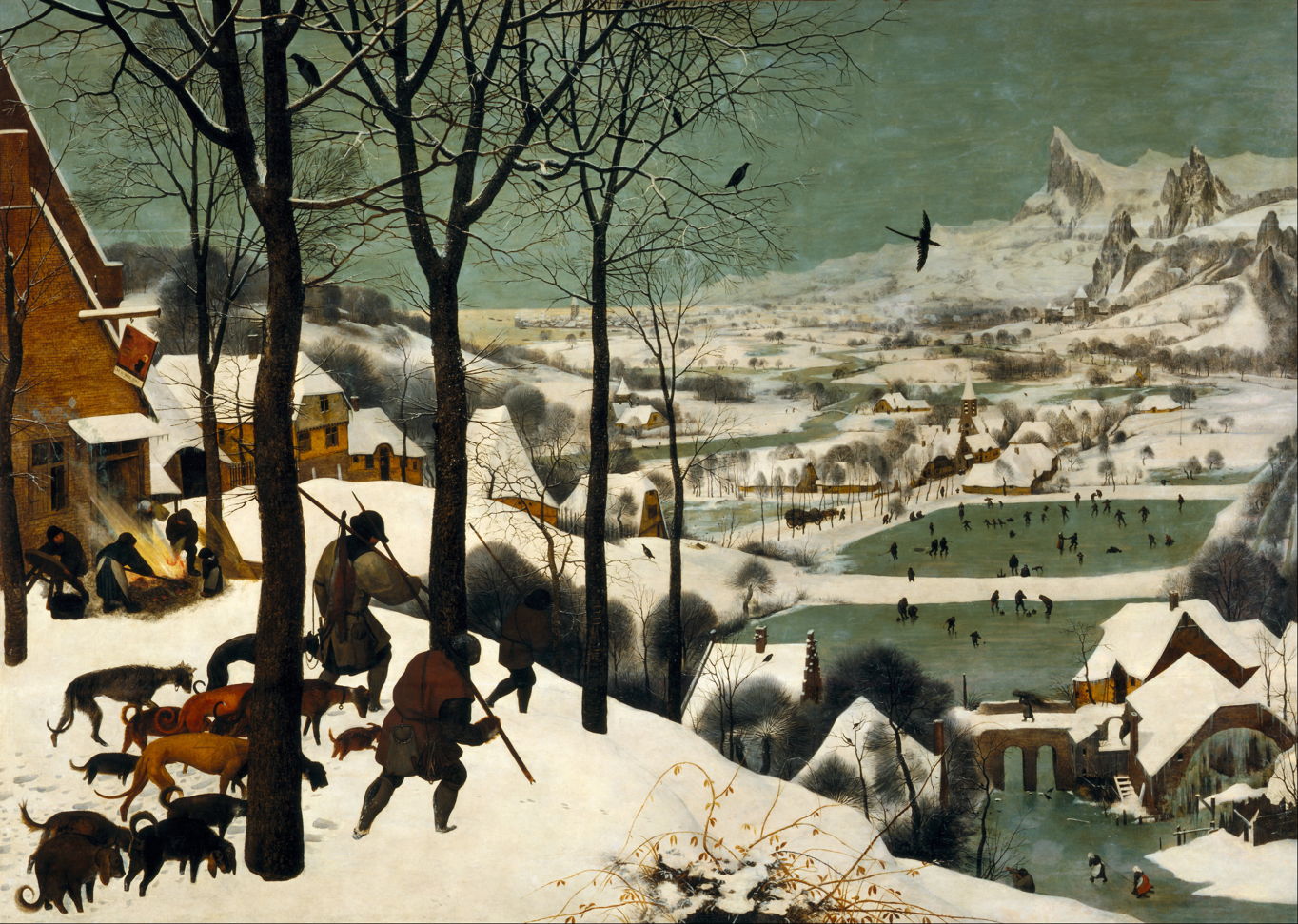
Brueghel’s Hunters in the Snow (Winter) (1565) brings together many of the elements of winter in the flatlands of northern Europe, and is one of his best-known works. It’s unusual for his innovative treatment of the dense branches and twigs in trees, which has seldom been copied by others, but appears very effective.
This was all very well in the days when such paintings were made in the studio, which was quite cold enough in the winter. When more were painted in front of the motif, weather became a limiting factor. Water and watercolour paints freeze at around 0˚C (32˚F), but oils remain usable in even colder temperatures. The biggest limitation is keeping the hands both warm and unencumbered to allow normal use of brushes and palette.

Carl Larsson’s Open-Air Painter. Winter Motif from Åsögatan 145, Stockholm (1886) is an oil painting presumably started en plein air, or composed from sketches made in front of the motif. It shows a painter, presumably a friend, painting in the snow-covered space of a Stockholm suburb. Although his feet are well-protected in thick insulated boots, his hands are bare, and not even protected by fingerless gloves.
Ice and snow scenes became popular among the French Impressionists around 1868-75, when Claude Monet, Auguste Renoir and Camille Pissarro painted some of the finest winter landscapes of the era.

One of Monet’s best-known is paradoxically The Magpie (1868-9), where the bird is probably the smallest and least conspicuous part of the motif.

Armand Guillaumin painted Hollow in the Snow in 1869.

Many of Pissarro’s were made when he was living in Louveciennes, including The Post-House, the Route de Versailles, Louveciennes, Effect of Snow from 1872. This looks from the ‘Royal Gate’ of the Château de Marly towards the post-house, a landmark featured in several of Pissarro’s works from this period.
By a strange coincidence, when Paul Signac was migrating to his mature Divisionist style during the winter of 1885-86, a snow scene was one of the landmarks of his transition.

Much of his view of Snow, Boulevard de Clichy, Paris, from January 1886, is white, but it also features more vivid colours in Divisionist passages such as the wall of a house at the right. Rather than using the established complementary colours of red and green for his spots of paint, he here chooses red and blue, and blue and yellow (which are complementary), signs of his developing insight into colour combinations.
Ice and snow have their own virtues in the landscape.

John Brett’s Glacier of Rosenlaui (1856) is an extraordinarily accomplished first landscape painting following Ruskin’s demanding precepts. Much of it appears to have been painted in front of the motif, and it’s rendered in fine detail. Its combination of heaving ice and barren rock marks the desolation of the high Alps.

In 1892, John Everett Millais painted a desolate British winter landscape in his ‘problem picture’ Blow Blow Thou Winter Wind. Snow is already on the ground with more on its way. An icy wind is blowing, and there’s little shelter. In the foreground, a destitute mother sits, cradling her young baby inside an inadequate shawl, her few worldly possessions in a small bundle beside her. Behind a dog bays into the air, and a man walks into the distance.
In some mountain views, bands of snow and ice give distant peaks depth.

Georg Janny painted this watercolour view of the Dolomites, The Sella Group and Lake Pisciadu, in 1916. Bands of snow and ice give its columns of rock structure and depth.
Snow effects also invited novel themes, including rooftop views over cities such as Paris and Moscow.

Rooftops in the Snow (snow effect), from 1878, is perhaps one of Caillebotte’s closest paintings to core Impressionism, with its atmospheric greyness and sketchy forms, and inspired others to paint similar views in winter conditions.
In a few locations, ice and snow make unusual contrasts with heat.

Edmund Wodick’s Granada from 1886 was probably the last work that he completed; shortly afterwards he developed pneumonia and died at the age of 69. He painted this just outside the city walls, looking across at the Alhambra and its towers, down towards the lush green plain and the snow-capped peaks in the far distance.
Occasionally, the forms made by ice are sufficiently weird to set the whole theme.

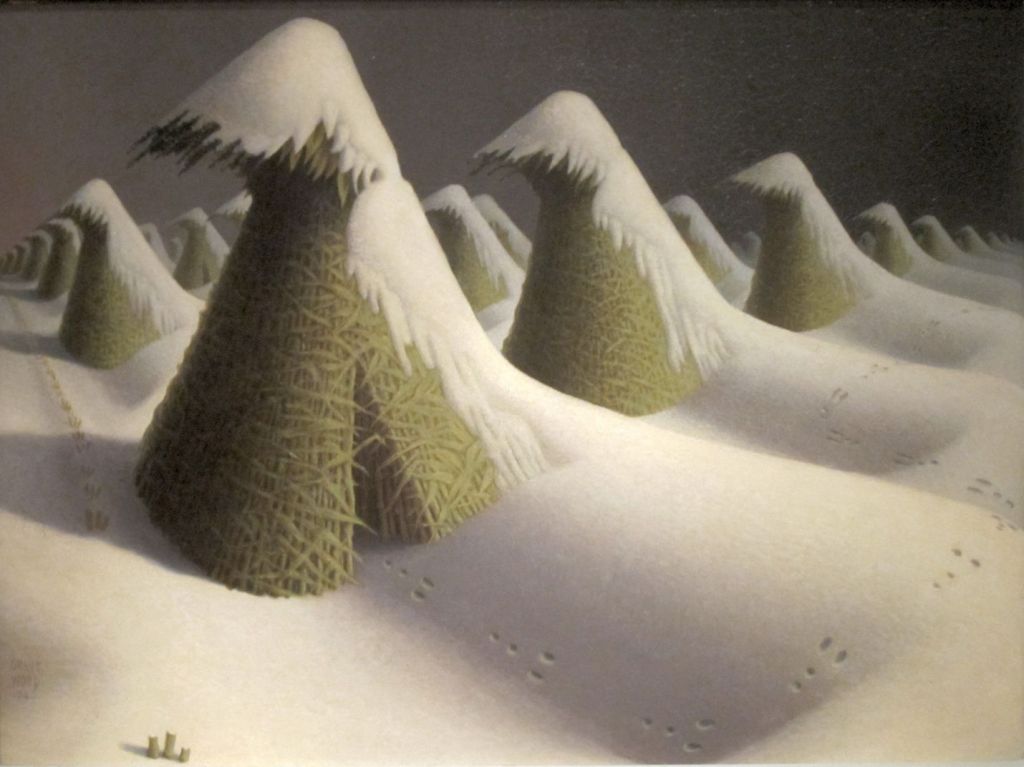
Grant Wood’s January (1940-41) shows a set of hare tracks emerging from a snowed-in stook during harsh winter weather in the Midwest of the USA.
 The Eclectic Light Company