
In September 1818, the young Norwegian landscape painter Johan Christian Claussen (‘JC’) Dahl (1788-1857) arrived in Dresden, capital of Saxony in Germany, with a letter of introduction to Caspar David Friedrich. Six years later, they were both appointed as professors to the Dresden Academy, and together dominated German Romantic painting.
Dahl had been born and brought up in the city of Bergen, on the west coast of Norway, which was then in union with the kingdom of Denmark. His artistic ability was recognised early, and he trained with the leading painter in the city at that time. In 1811, when he was 23, he moved to Copenhagen to study at its Royal Academy, where he established himself a reputation as a prolific and capable realist landscape painter. It was that which brought him to Friedrich in Dresden.

Dahl’s The Coast of Rügen in Evening Light After a Stormy Day from 1818 is one of his earlier mature landscapes, and clearly influenced by Friedrich. Here, though, the artist has opted for a small ship under sail in a choppy sea, rather than Friedrich’s furled sails and flat calm. Friedrich had spent part of his honeymoon on the island of Rügen, and it remained a favourite location for him throughout his career.
Dahl had aroused the interest of Prince Christian Frederik of Denmark, who had become his patron and friend while he was still in Copenhagen. In 1820, the prince invited Dahl to join him in the Gulf of Naples to paint there for him. This enabled Dahl to visit Rome the following year, and enriched by this formative period of ten months, he returned to Dresden.

Dahl’s The Gulf of Naples. Moonlight (1820-21) is more deeply influenced by Friedrich, with its Rückenfigur wearing a top hat looking out to sea, fishing boats and nets, and the bright moonlight.
His visit to the Gulf of Naples coincided with an active phase for the local volcano Vesuvius, during which JMW Turner visited and painted an eruption. Although Dahl was sufficiently enthused to make several oil sketches and take some to completion as finished works, he didn’t become as obsessed as some artists did.

In The Bay of Naples by Moonlight, painted the following year, he has used the warm red light from a more modest eruption to provide colour contrast, and enhance fine details of fishing nets in the foreground.
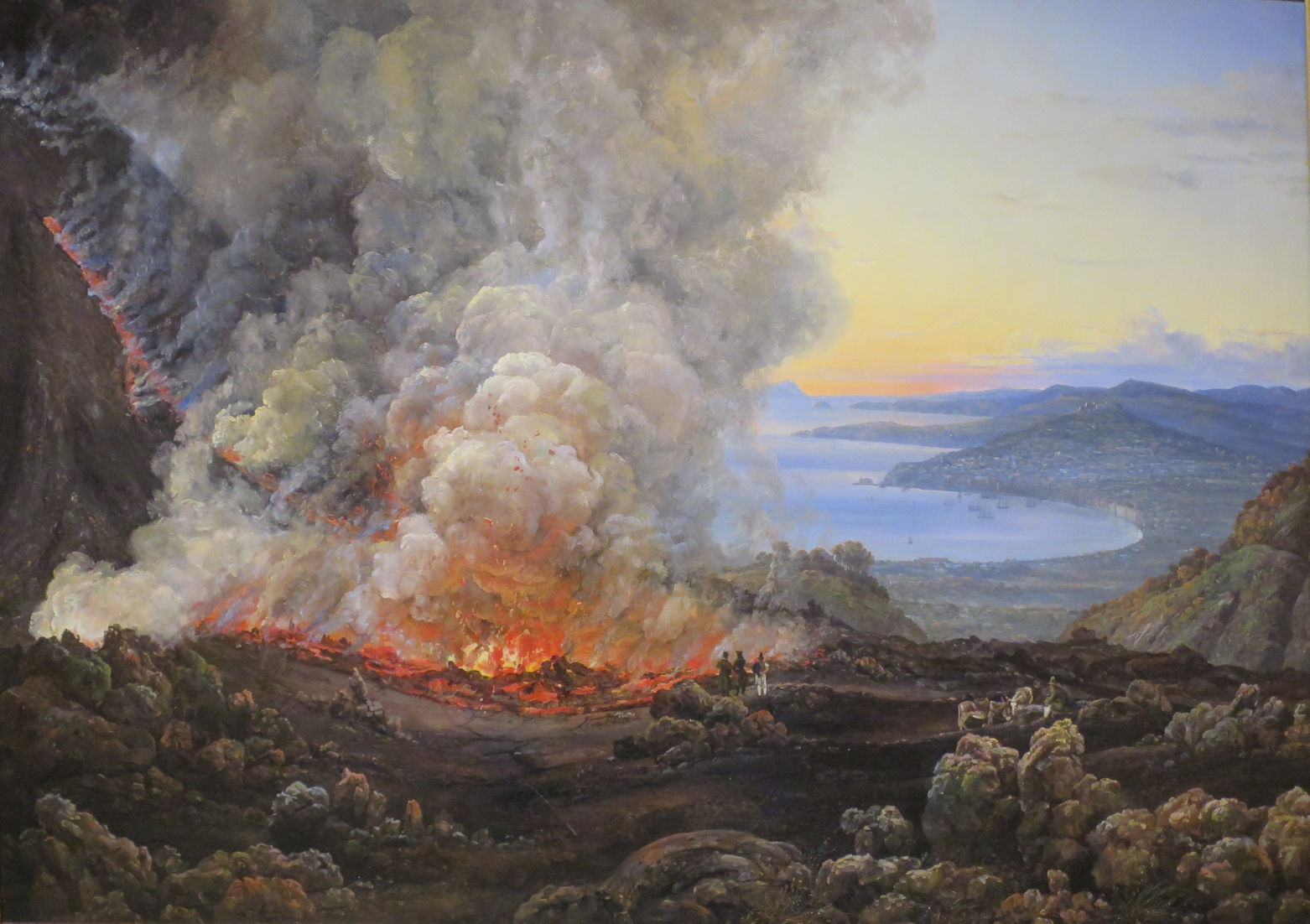
Dahl also travelled up to view lava flows on the slopes of the volcano, where he sketched for his later Vesuvius in Eruption (1821). This reversed view across the Bay of Naples was timed at dusk, with the sky to the west echoing more peacefully the reds and yellows of the molten rock in the foreground.
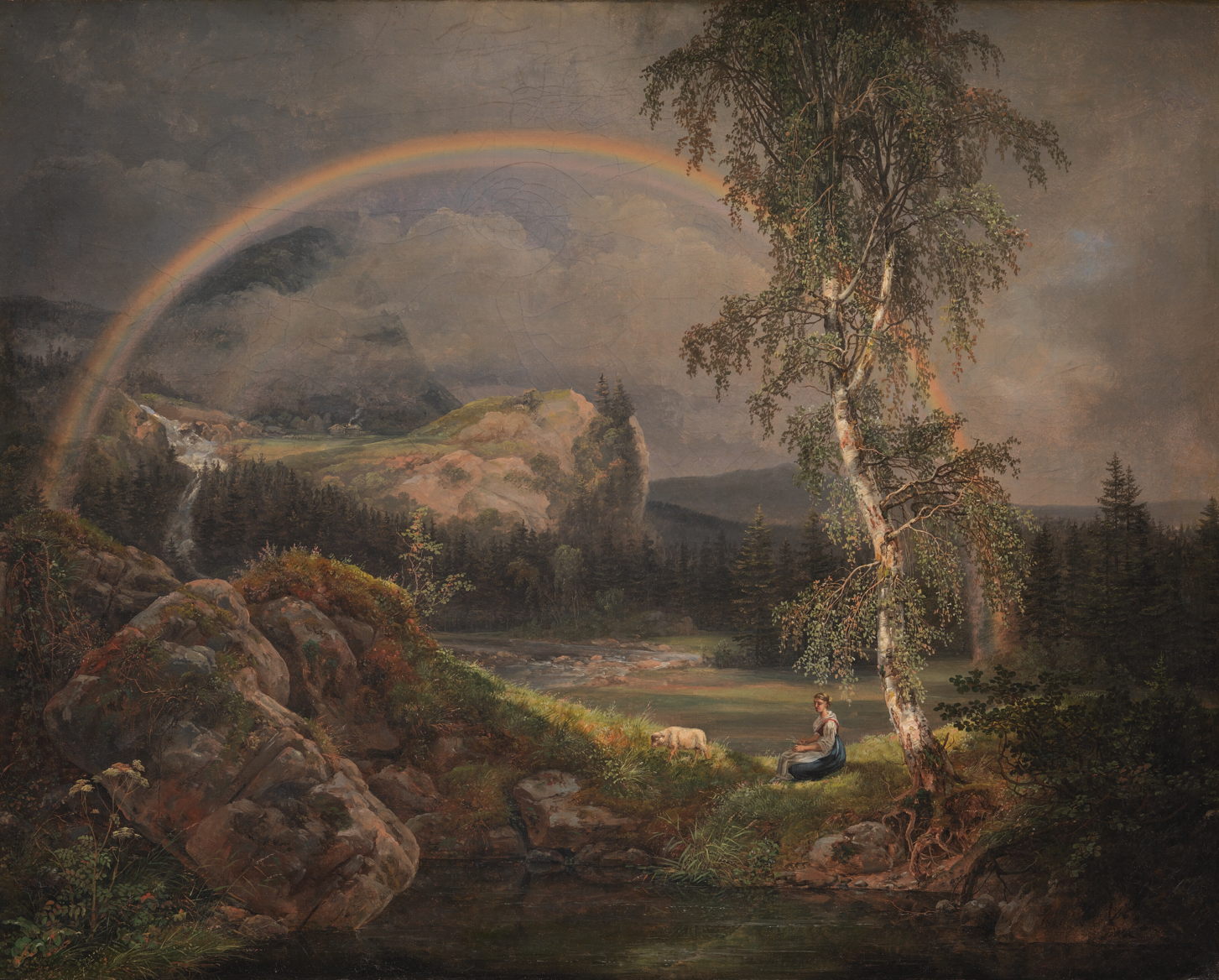
Although he’s not believed to have returned to his native Norway for another five years, in 1821 he painted this Norwegian Landscape with a Rainbow. In the foreground is a lone woman, with a sheep, rather than the customary Rückenfigur.
In 1823, Dahl, his wife and their family moved in with Friedrich and his young family, and their students were able to benefit from both of them. Among them were the Norwegian landscape artists Peder Balke and Thomas Fearnley, both of whom showed their lasting influence, although neither is normally considered to have been a German Romantic.

In 1826, Dahl painted another of Friedrich’s favourite motifs, The Watzmann, this time with a goatherd and his small flock on the foreground mound of rocks. This compares with Friedrich’s deserted and more desolate views of the third highest peak in Germany, south of the village of Berchtesgaden in the Bavarian Alps. Later that year, Dahl visited Norway, and appears to have spent the winter there.

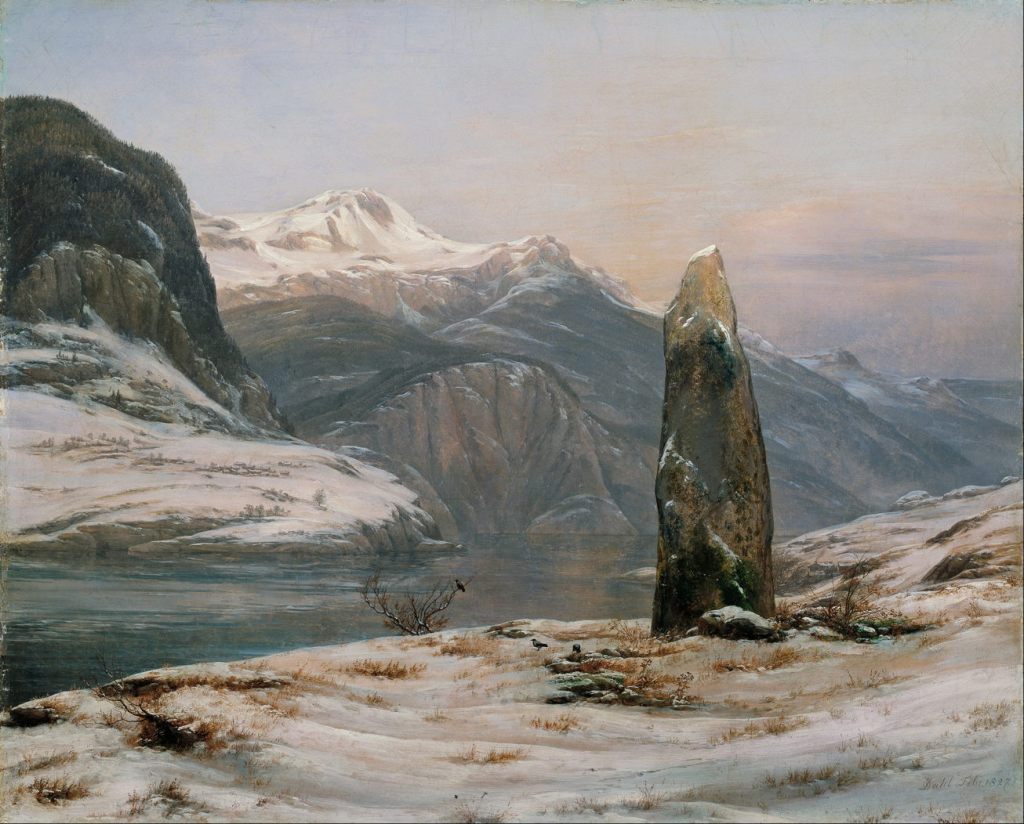
In February 1827, he painted one of the finest winter landscapes of a Norwegian fjord, Winter at Sognefjord. This is the largest and deepest of all the Norwegian fjords, shown deserted apart from a few crows gathered around the base of what appears to be a pinnacle of ice. This might be the famous Balder or Frithjof memorial stone at Leikanger.
In 1828, the year after his wife died in childbirth, Dahl expressed his longing to return to his native Norway, but apart from visits in 1826, 1834, and later, he remained in Dresden.
 The Eclectic Light Company