
Musical instruments appear in many paintings, and during the nineteenth century came into vogue with Aestheticism. Of all the instruments to appear in mythical and narrative paintings, the most significant and popular must be the classical lyre. This consists of a yoke with two arms and a crossbar, across which a variable number of strings are tensioned. In most lyres, those were strummed much like a modern guitar, although they can also be plucked like a harp.
These seem to have originated in the early civilisations of the Fertile Crescent, and spread from there throughout Europe. They were adopted in ancient Greece, where they became strongly associated with both music and poetry, the latter being classed as lyric, as it could be sung to the accompaniment of the lyre. Aetiological myth attributes the origin of the lyre either to Hermes or Apollo, but either way the instrument has become one of the primary attributes of Apollo.
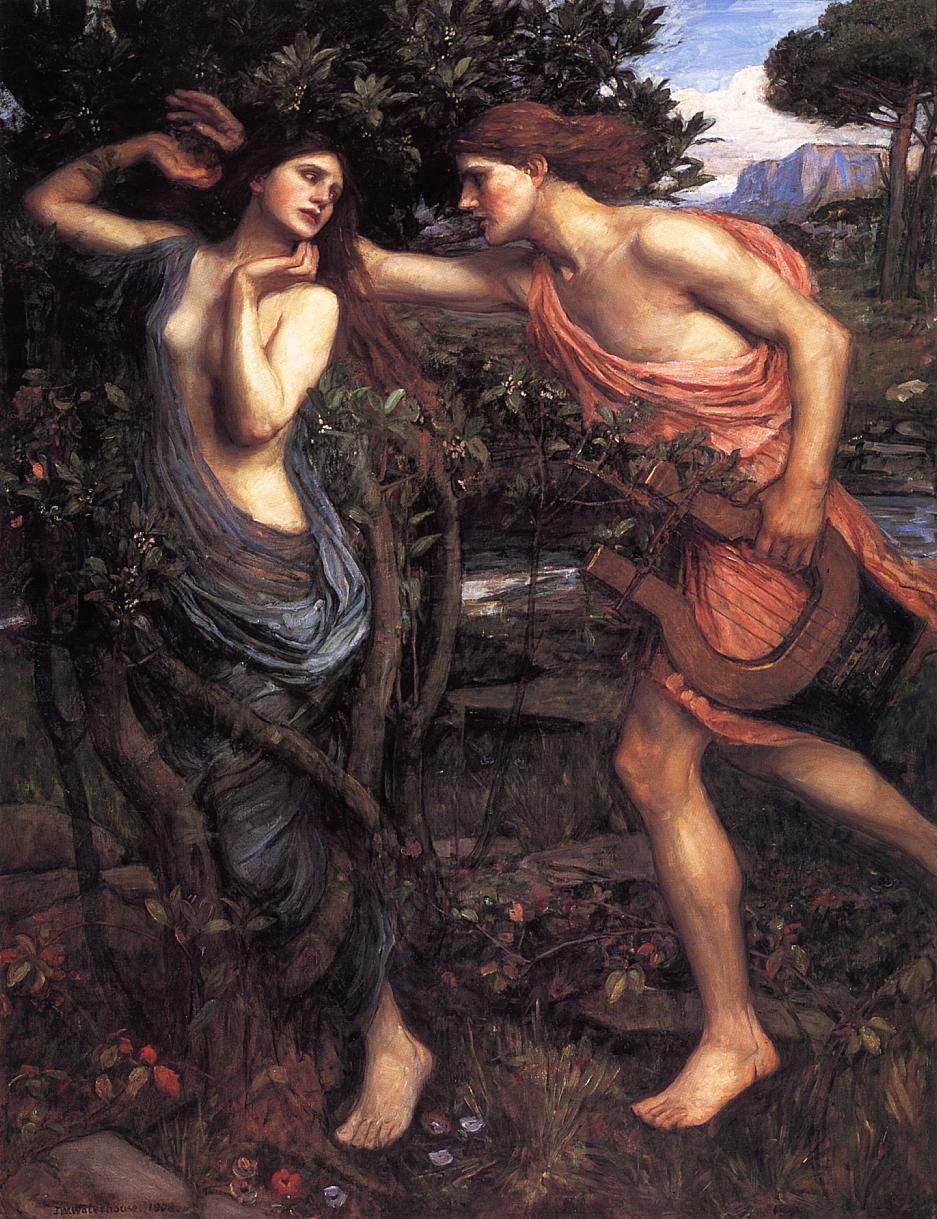
John William Waterhouse’s Apollo and Daphne from 1908 is an unconventional treatment of the myth in which Daphne is transformed when the god tries to rape her. Apollo, holding his lyre with his left hand, has just reached Daphne, who looks justifiably alarmed. The lyre is used purely for identification.

Anton Raphael Mengs’ Parnassus is a fresco he painted in 1761 for a Roman villa. Standing in its centre is Apollo, complete with his lyre and laurel wreaths, used to crown those who became accomplished thanks to the Muses. To the left of Apollo is Mnemosyne, with a dark blue skirt, who is pointing towards a small spring in front of Apollo’s feet. The other women are the Muses, each accompanied by their attribute to aid identification, including Erato at the far left with her lyre for lyric poetry.

In Tiepolo’s painting of Apollo and Marsyas (1720-22) engaging in their musical contest, it would easy to mistake the figure sat on the rock throne as being Apollo. He is actually the youth at the left, bearing his lyre, wearing a wreath of laurel, and given a gentle divine halo. Thus the figure apparently wearing a gold crown sat in a dominant position must be Marsyas, clutching a flute of sorts, not really an aulos, in his right hand. To the right are some of the Muses, one of whom covers her eyes in despair. She knows what Apollo’s pointing arm is about to inflict on the usurper Marsyas.

Even when adventurous artists modernised musical instruments, a substitute for the lyre usually provides an obvious clue. In Raphael’s Parnassus, completed by 1511, Apollo is bowing a string instrument instead of strumming his lyre.
The other mythical figure strongly associated with the lyre is Orpheus, who hung on to his even during his trip to the Underworld, and after death.

Franz von Stuck is one of the few modern painters who followed the ancient Greek tradition of naming his figures, at least in some of his earlier work. Although readily recognisable by the prominence of his lyre, in Orpheus Charming the Savage Beasts with his Lyre (1891) his name is inscribed behind his back.

Peter Paul Rubens’ atmospheric painting of the flight of Orpheus and Eurydice (1636-38) was made during his later years of retirement, not long before his death. Orpheus, still clutching his lyre, is leading Eurydice away from Hades and Persephone, as they start their journey back from the Underworld.

In Edward Poynter’s Orpheus and Eurydice from 1862, Orpheus hangs onto his lyre as he strides past snakes and along a dizzying path on the mountainside.

Émile Lévy’s Death of Orpheus (1866) shows Orpheus knocked to the ground and stunned. Two maenads kneel by his side, one clasping his neck, the other about to bring the vicious blade of her ceremonial sickle down to cleave his neck open. Another wields her thyrsus like a club while pulling at his left hand. His lyre lies on the ground, two of its strings already broken.

Even after death, Gustave Moreau’s Orpheus shows a sombrely-dressed Thracian woman holding Orpheus’ lyre, on which rests his head, blanched in death, as if affixed to the instrument like the head of a hunting trophy.
As the mark of lyric poets, you’ll also see them holding or playing their lyres, as a badge of office.

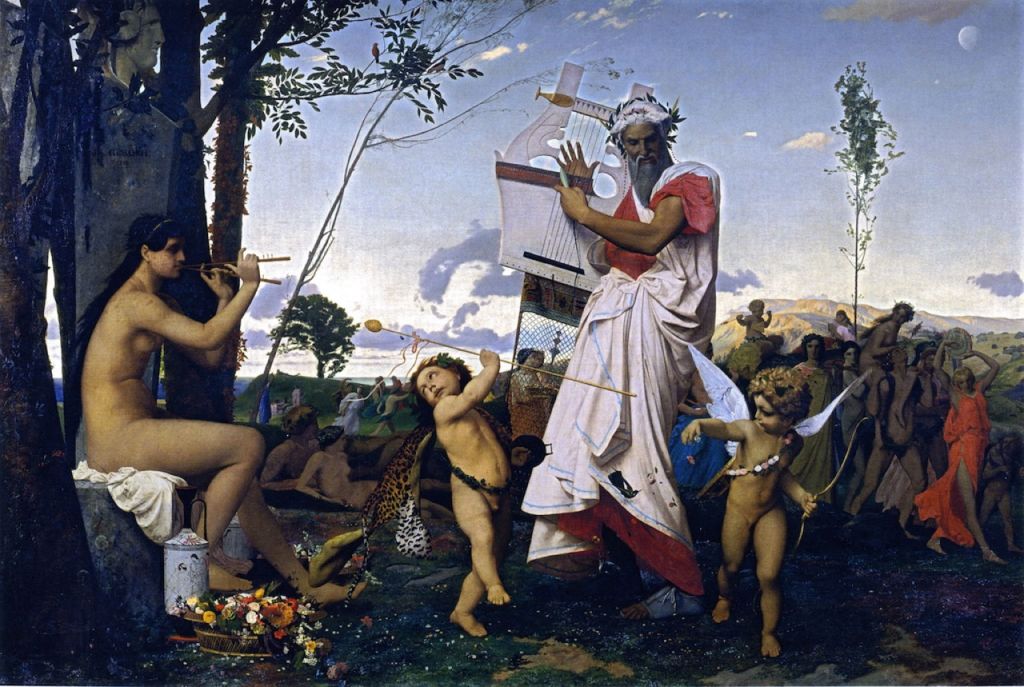
Jean-Léon Gérôme’s early painting of Anacreon, Bacchus, and Amor from 1848 harks back to the secret rites of bacchantes invoking Anacreon, one of the nine canonical Greek lyric poets. The poet takes centre stage with his lyre at his shoulder. Dancing at his feet is the infant Bacchus, who looks to the left at a young woman playing the double pipes. To the right of Anacreon is Cupid (Amor), with his wings, bow, and quiver of arrows.

Lawrence Alma-Tadema’s painting of Sappho and Alcaeus from 1881 shows the poet Sappho resting on a lectern and staring intently at Alcaeus playing a lyre. This contrasts with the more common motifs of Sappho or Hesiod with a lyre, which appear so frequently in the paintings of Gustave Moreau.
 The Eclectic Light Company