
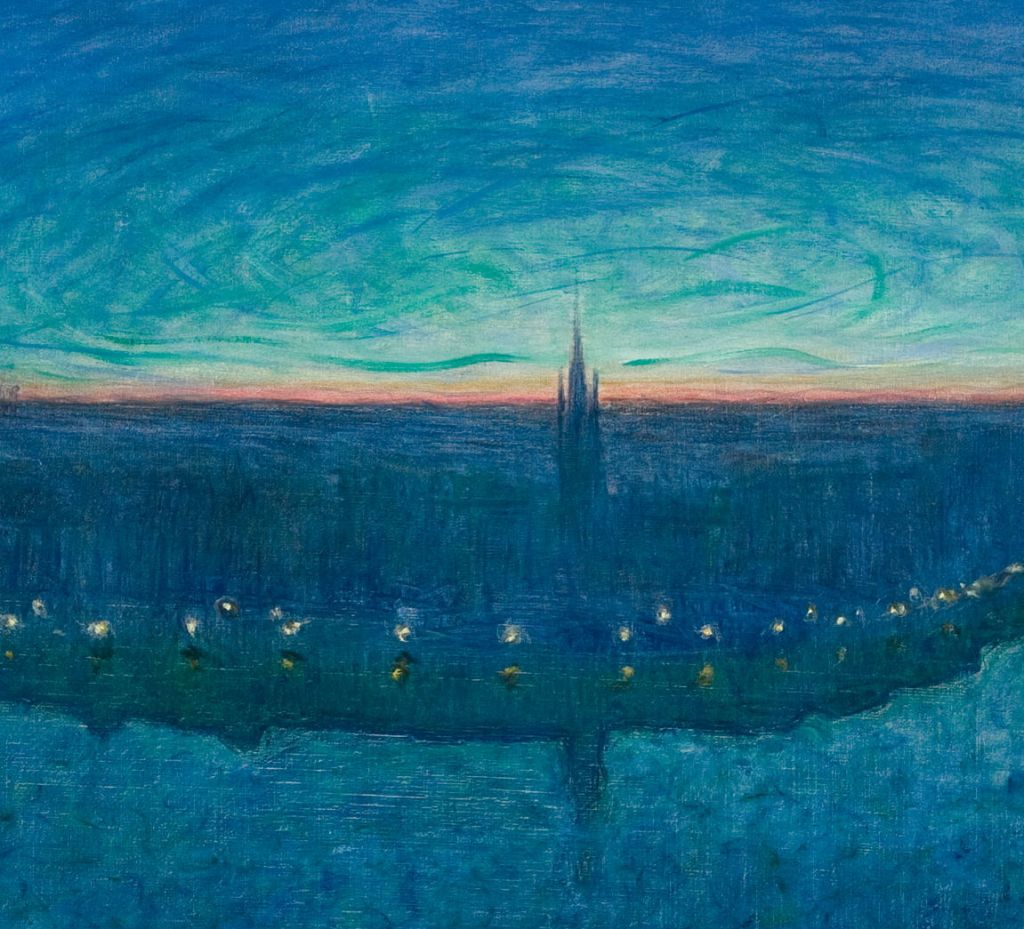
Twilight, technically speaking, is the period between the end of night and the sun’s appearance on the horizon, and that between the disappearance of the sun below the horizon and the onset of the full darkness of night. These are times of day now increasingly familiar to those of us in the northern hemisphere as autumn prepares to make way for winter, and for those in the furthest north form much of the natural light they’ll be seeing by Christmas. Here’s a very small selection of paintings showing this enchanted period of the day.

Rembrandt, who painted few non-narrative landscapes, gave the twilight sky more than half his canvas in his dramatic view of The Mill from 1645-48.
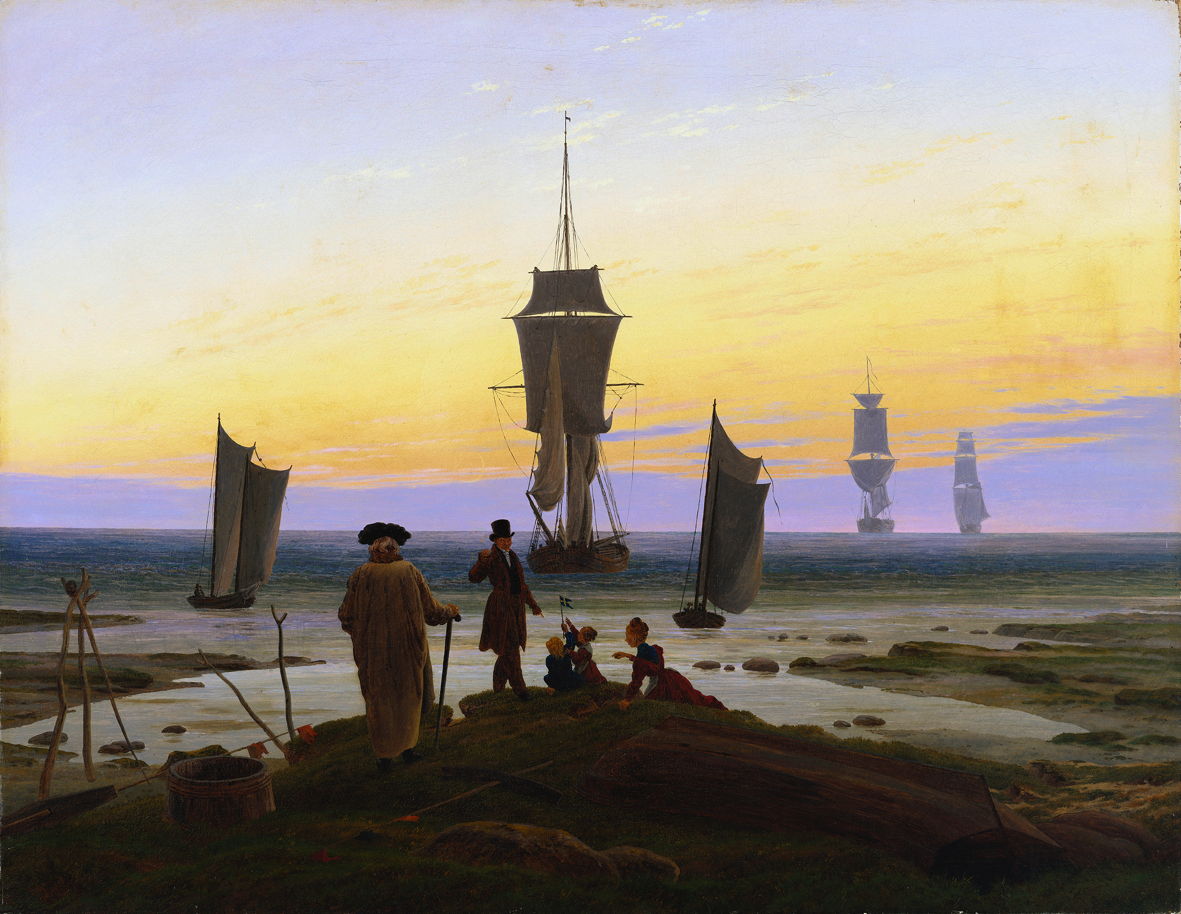
Caspar David Friedrich’s masterpiece The Stages of Life (1834-5) is set at twilight, and shows five figures and assorted fishing equipment at the water’s edge, with five boats sailing in to the shore behind. Two of the figures are children, who raise a small Swedish flag between them. To their right is a young woman, pointing and looking towards the children. To their left is a mature man, wearing a top hat, who is turned towards an elderly man, the closest to the viewer, his back towards us and a walking stick in his right hand. The younger man is gesticulating, his right hand towards the old man, his left pointing down towards the children.
The ships mirror the figures. Closest in to the shore are two small fishing boats under full sail. Out in the deeper water behind them is a fully-rigged ship in the process of furling its sails. Further in the distance is a larger fully-rigged ship, also furling its sails, and on the horizon is the fifth, large ship, its sails still fully set.

Carl Gustav Carus, a close friend of Goethe and a former pupil of Friedrich, painted this late twilight View of Dresden from Brühl’s Terrace in 1830-31. This shows an elevated embankment above the River Elbe in Dresden, a popular terrace for walking, named after the Count who had a city palace and gardens built here in the eighteenth century. The nearby church is the Cathedral of the Holy Trinity, which only gained the status of cathedral in 1964. Sat in a corner is a woman, and under the stone is what appears to be a skulking cat.

Much of Jean-François Millet’s Angelus, completed around 1857-59, is vague and implicit in the fading twilight. Its two figures are little more than silhouettes, and their barrow readily misinterpreted as a pram containing an infant. What Millet shows us most clearly, though, is the bowed and praying figure of the woman, their small basket of potatoes, and that pitifully poor soil. You don’t have to be a farmer to recognise what they are praying for.

Jules Breton’s Weeders (1868) features a startlingly beautiful twilight with the merest sliver of a moon. The figures of the five women are simplified by the low light, but he still paints every last fold and crease in their clothing: his image remains explicit, leaving little to the imagination.
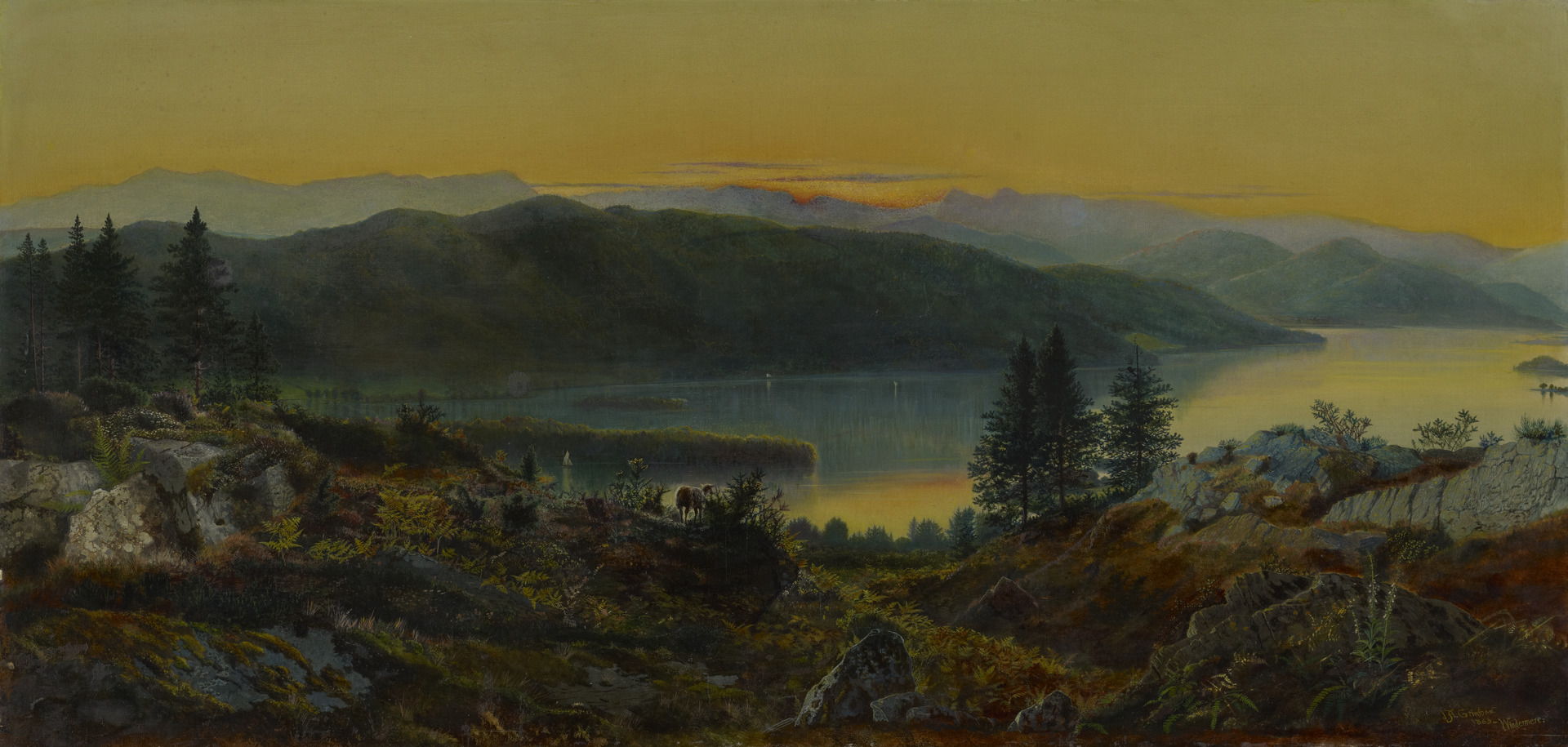
John Atkinson Grimshaw started his career painting flowers and other still lifes in the early 1860s, then switched to landscapes such as this finely detailed twilight view of Lake Windermere from 1863.
With the arrival of modern lighting indoors and on the streets of cities, from the late nineteenth century artificial lights started to feature in paintings of twilight.
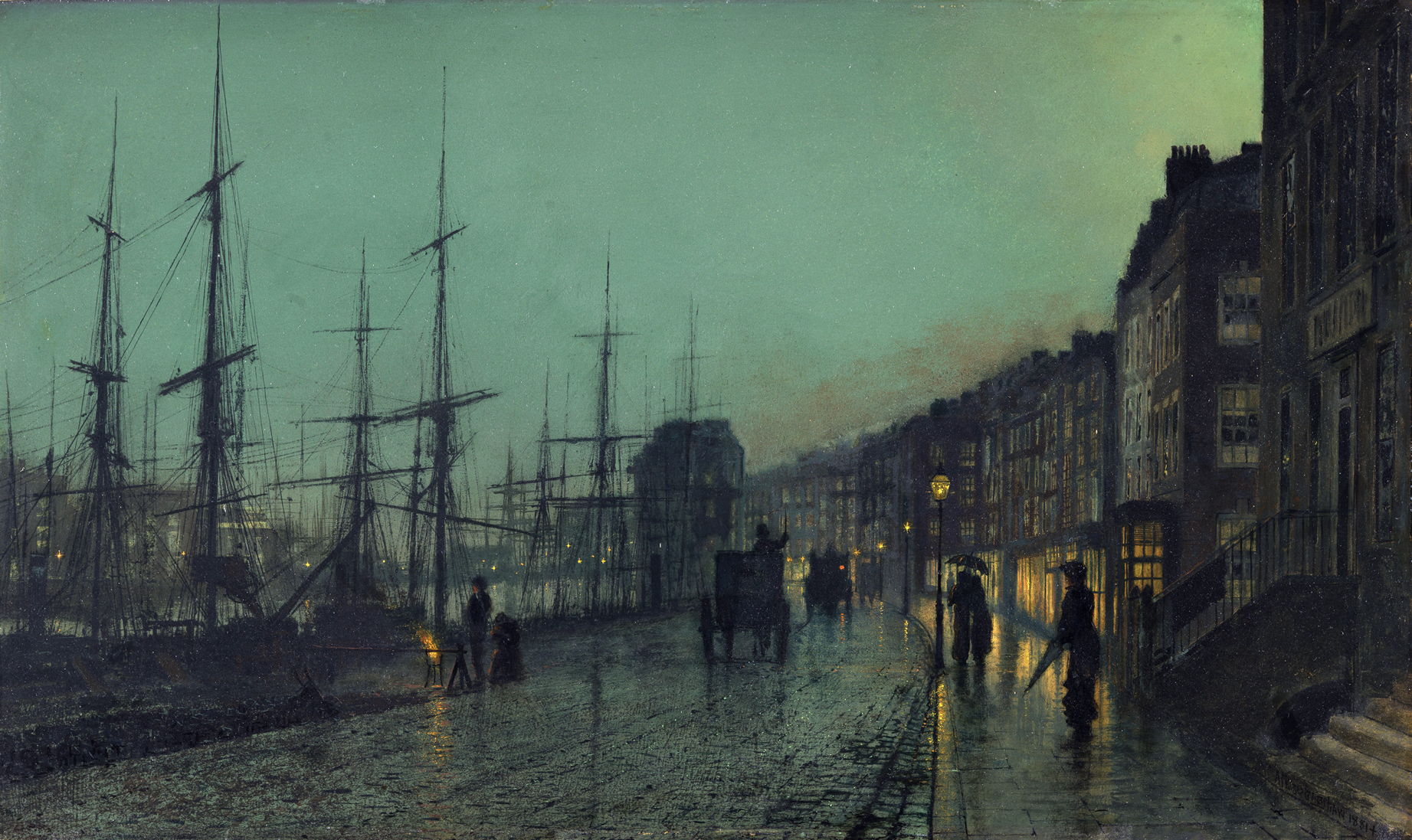
Grimshaw went on to specialise in painting twilight and nocturnes. In 1881 he travelled to Scotland, where he painted Shipping on the Clyde, showing the waterfront in the city of Glasgow in wet weather. Alongside is a forest of masts of trading ships, and a poor couple warming themselves by a brazier.

Ivan Pokhitonov’s Winter Twilight in Ukraine from about 1895 is an evocative oil sketch of the late afternoon on the edge of a village. Although its street is open and unlit, several of the cottages show lights at their windows.
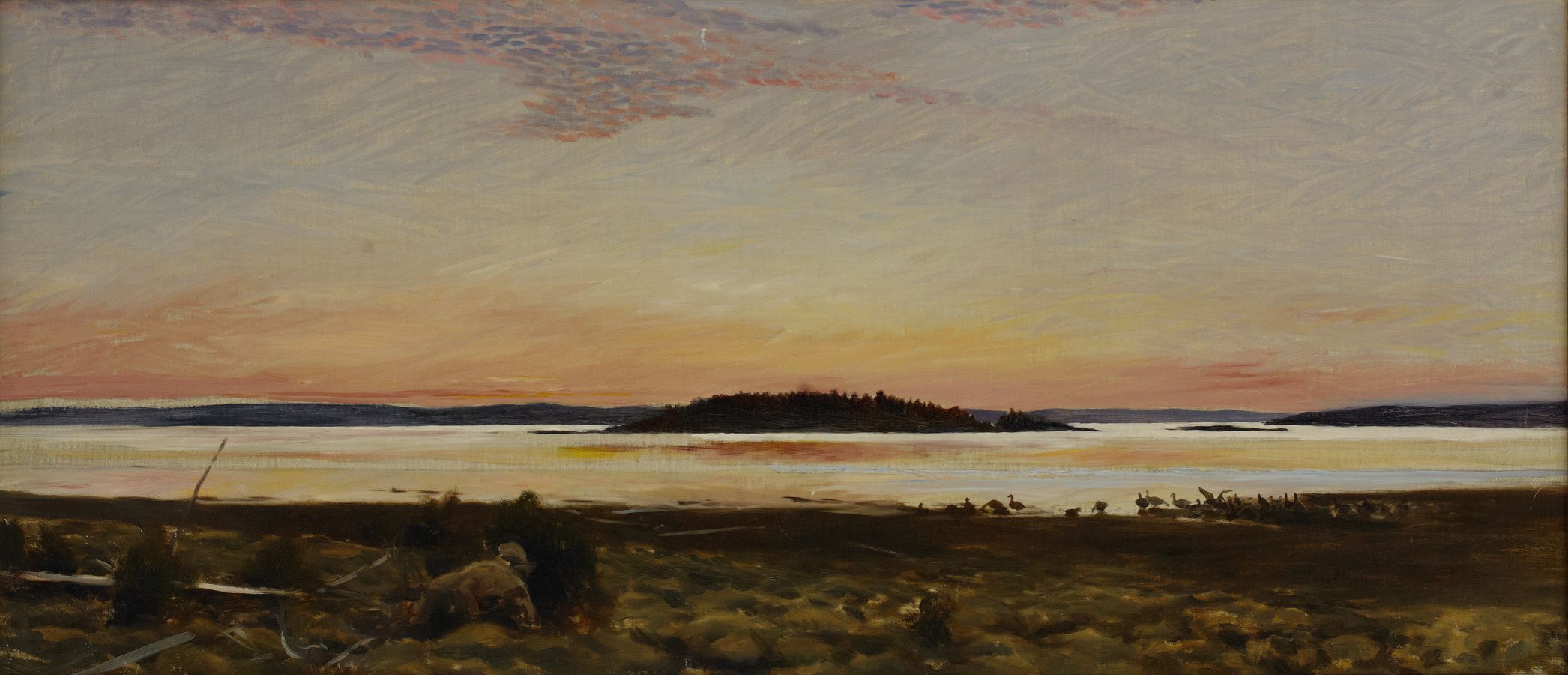
Some of the great Swedish natural history painter Bruno Liljefors’ finest works are almost pure landscapes, such as his Hunting Geese from 1896, with its superb mackerel sky of twilight.
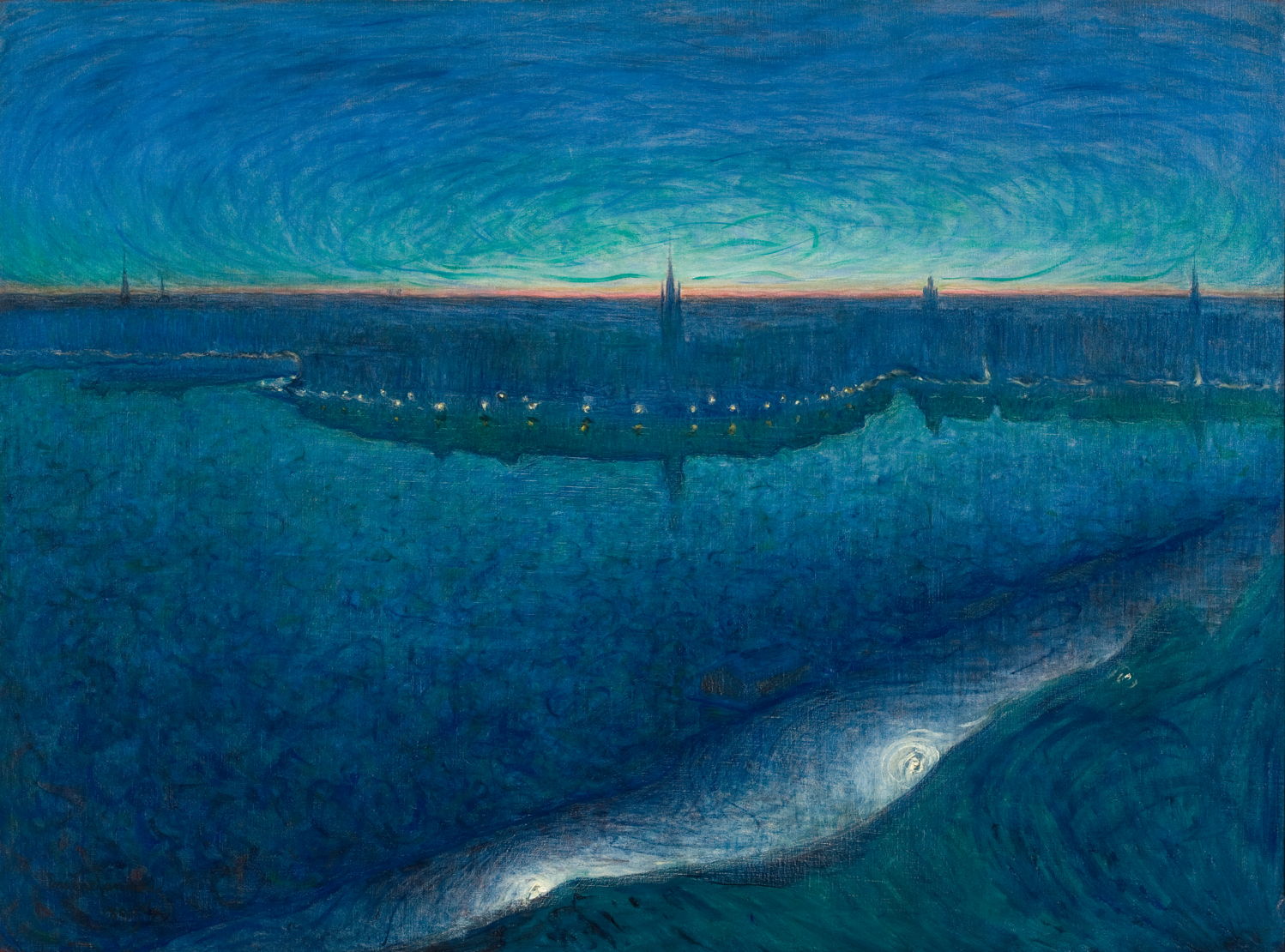
Meanwhile, in Stockholm, another specialist low-light artist Eugène Jansson was painting the capital in his Dawn Over Riddarfjärden from 1899. His soft squiggles of darker colour in the water become better defined in the sky, where they swirl calligraphically along the horizon.
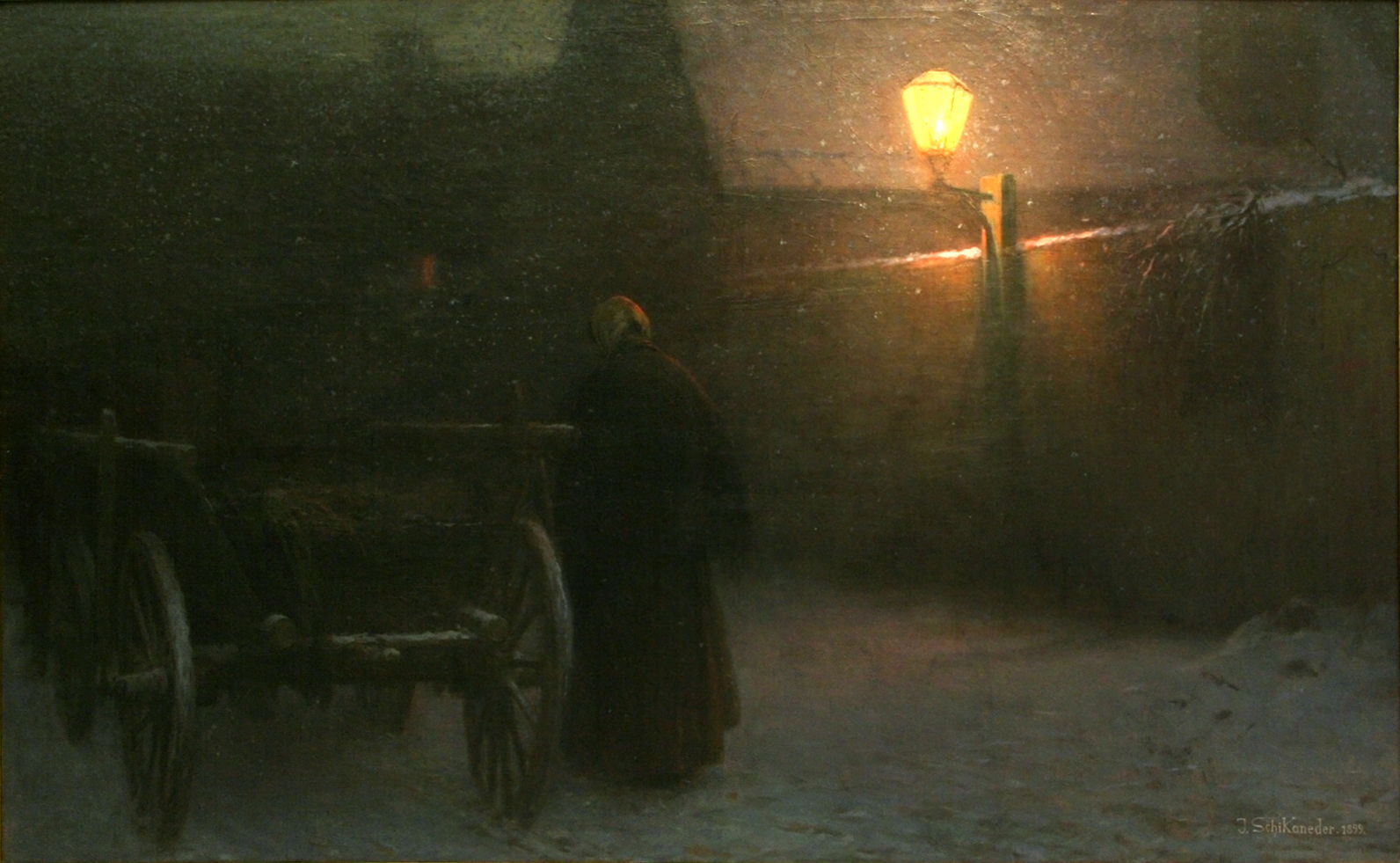
Jakub Schikaneder specialised in twilight views and nocturnes of his native city of Prague. Snow (Twilight in Winter) (1899) is one of several showing the serene desolation of winter twilight in town. Here a woman walks beside a horse and cart, past a street light.
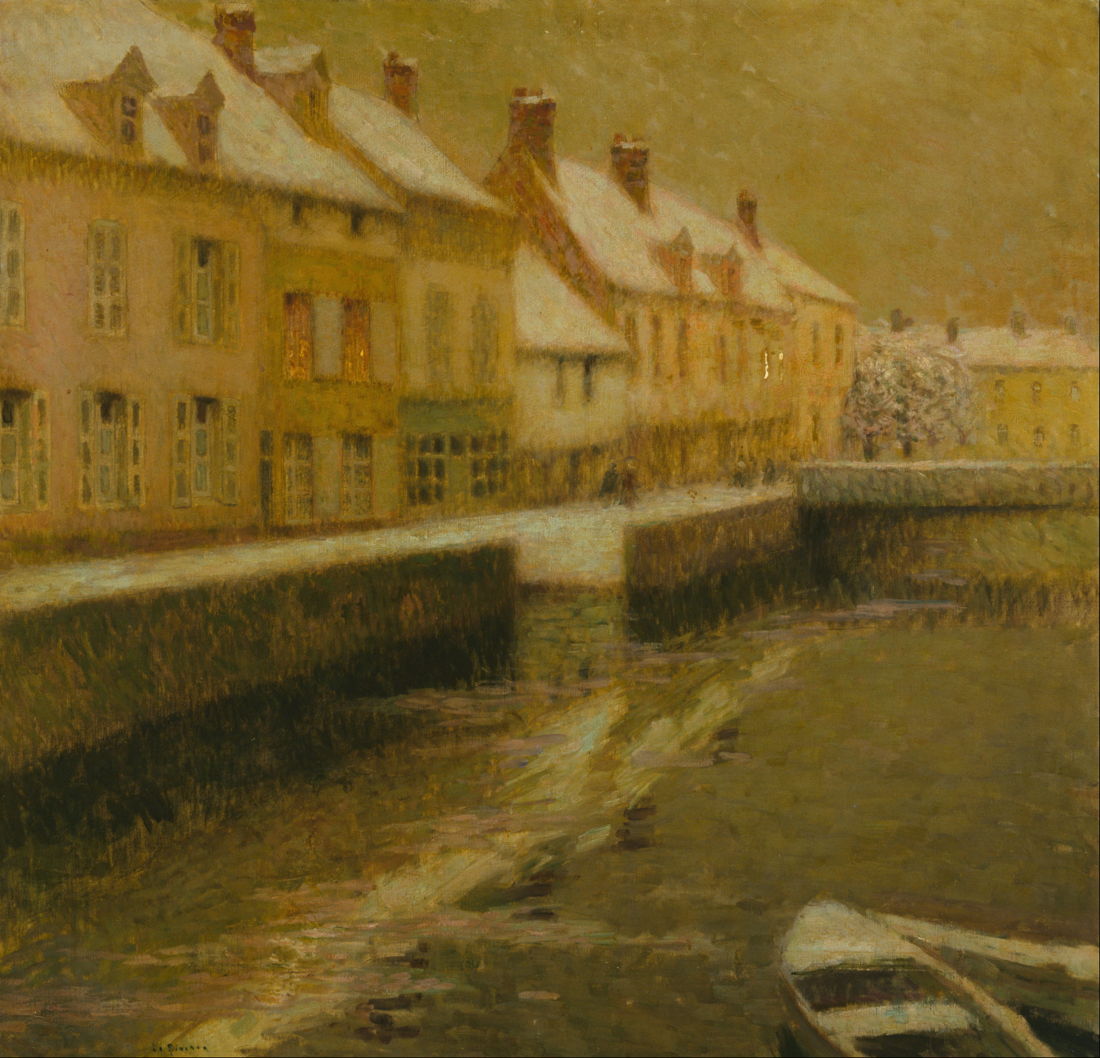
In 1899, the French-Mauritian painter Henri Le Sidaner was in Belgium during the winter, where he painted this Canal in Bruges, Winter (1899). His palette is restricted almost to the point of becoming monochrome, and its few figures in the distance are inconspicuous and do little to relieve its eeriness.
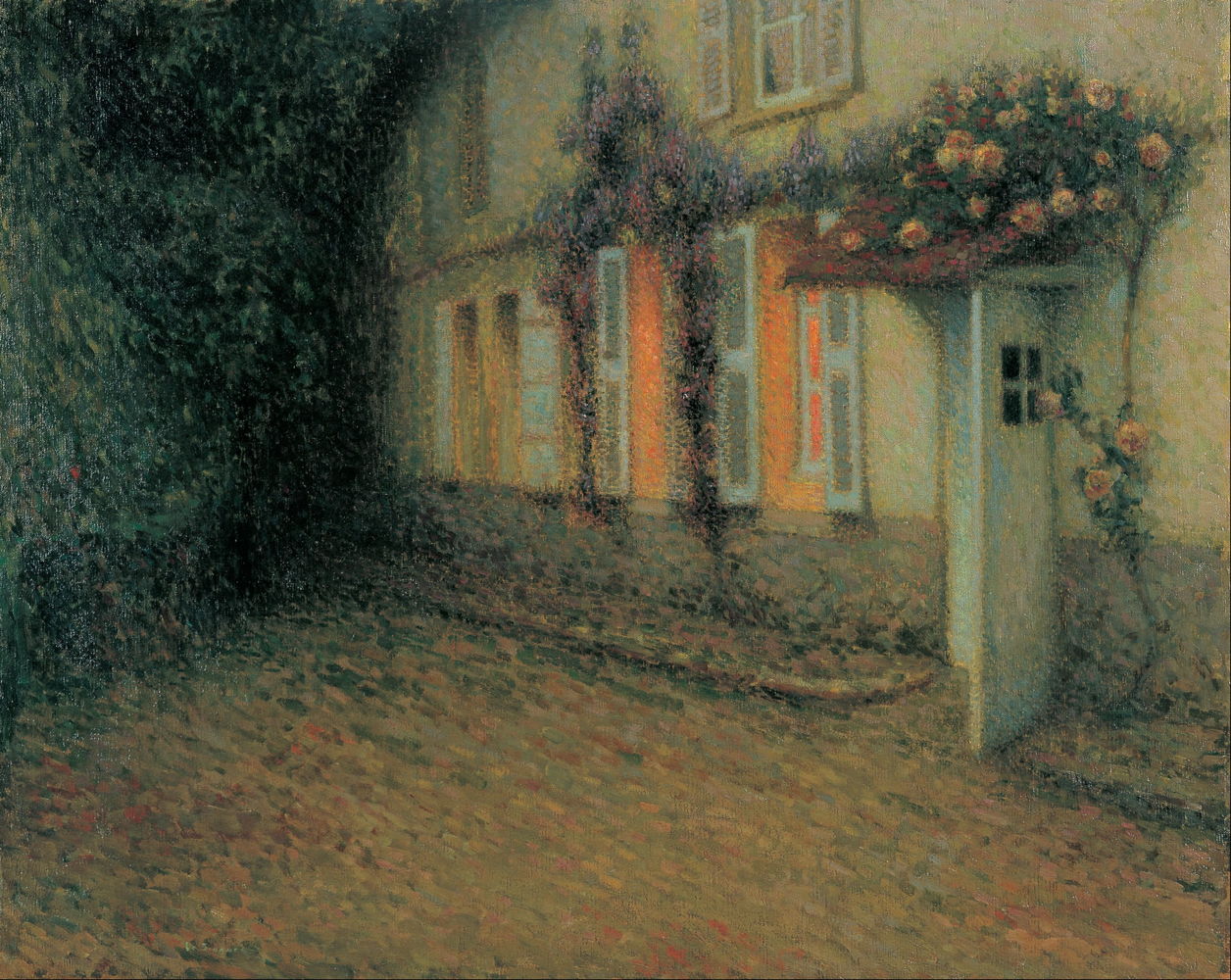
Le Sidaner painted one of his favourite twilight scenes of Roses and Wisteria on the House in 1907, showing the front of his house in the picturesque old village of Gerberoy in the north-east of France.

Jakub Schikaneder’s Autumn Red (1910) revisits one of his favourite themes, of a lonely figure at twilight. She appears here at dusk, with a fiery orange slash through the sky. It’s autumn, with the leaves starting to turn copper-brown and falling onto the water behind her. She stands on a narrow grassy strip between that water and a high wall. Dotted around her are small white and large red flowers.

James Dickson Innes had an affection for this period of the day, as seen in his Deep Twilight, Pyrenees, painted in 1912-13.
 The Eclectic Light Company