

Following a vision of the Holy Grail before the knights of the Round Table, all one hundred and fifty of them had vowed to leave on the quest to find it. After staying together overnight, they each departed on their own way.
Sir Galahad rode off that morning without a shield. Four days later, after staying at a monastery, he was presented with a shield that had a provenance going back to Joseph of Arimathea, that had been destined for Galahad. He gained a companion, Sir Melias, the son of the King of Denmark, who was made a knight by Galahad, but was soon seriously wounded and left Galahad to continue the quest on his own.

George Frederic Watts’ portrait of Sir Galahad from 1860-62 shows the knight making his way alone through a forest.
As Sir Galahad was praying at an old mountain-top chapel, he was told to go the Castle of Maidens to put an end to the wickedness there. He mounted his horse and was soon looking down at that castle, next to the River Severn, in western England. He first had to fight seven knights (representing the seven deadly sins) at once, but after he had killed the first with his spear the others ran away, leaving Galahad to enter the castle without further challenge.
Once inside, he blew a horn to summon the knights that owned the lands around the castle. When they arrived, Galahad had them pay homage to the Duke’s daughter who owned the castle, and order was restored. By chance Gawain, Gareth and Uwain killed the six knights who had fled.
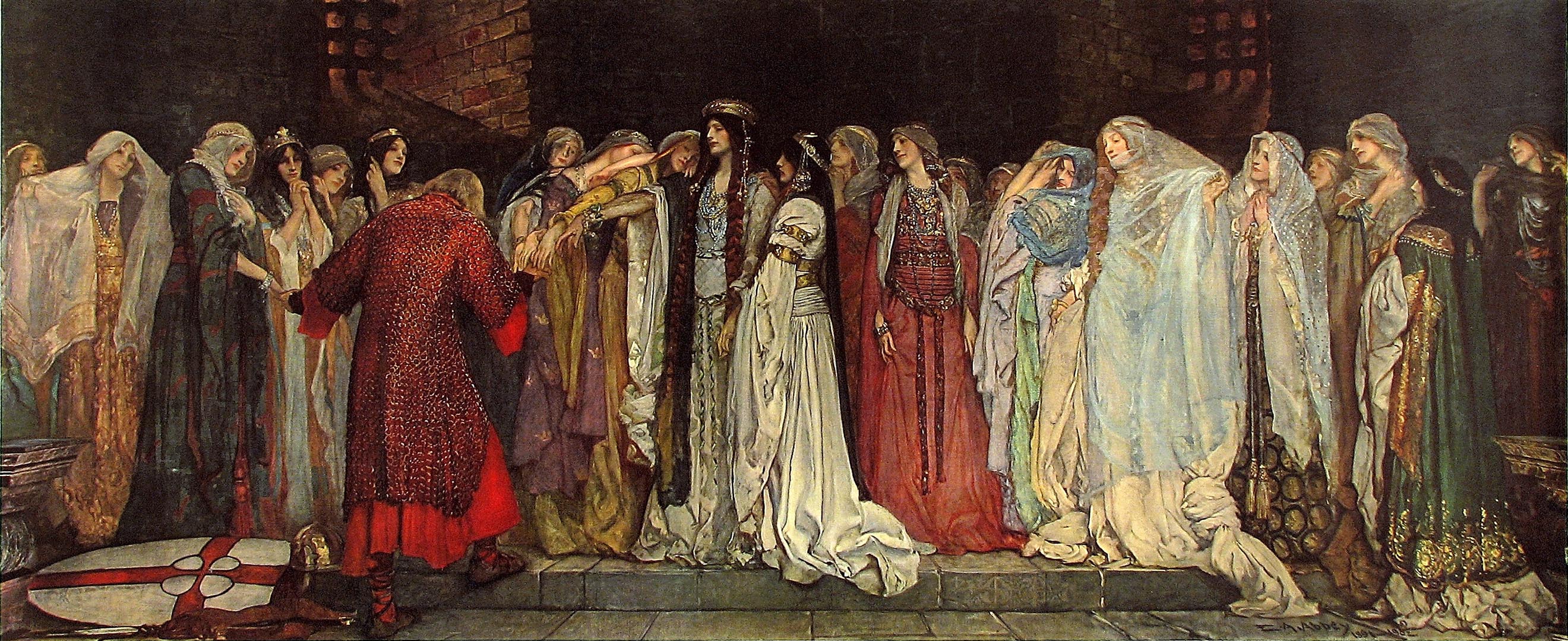
This unusual colour print of Edwin Austin Abbey’s Galahad at the Castle of Maidens shows one of a series of oil paintings he made between 1893-1902, titled The Quest and Achievement of the Holy Grail. The originals decorate the walls of a room in Boston Public Library.
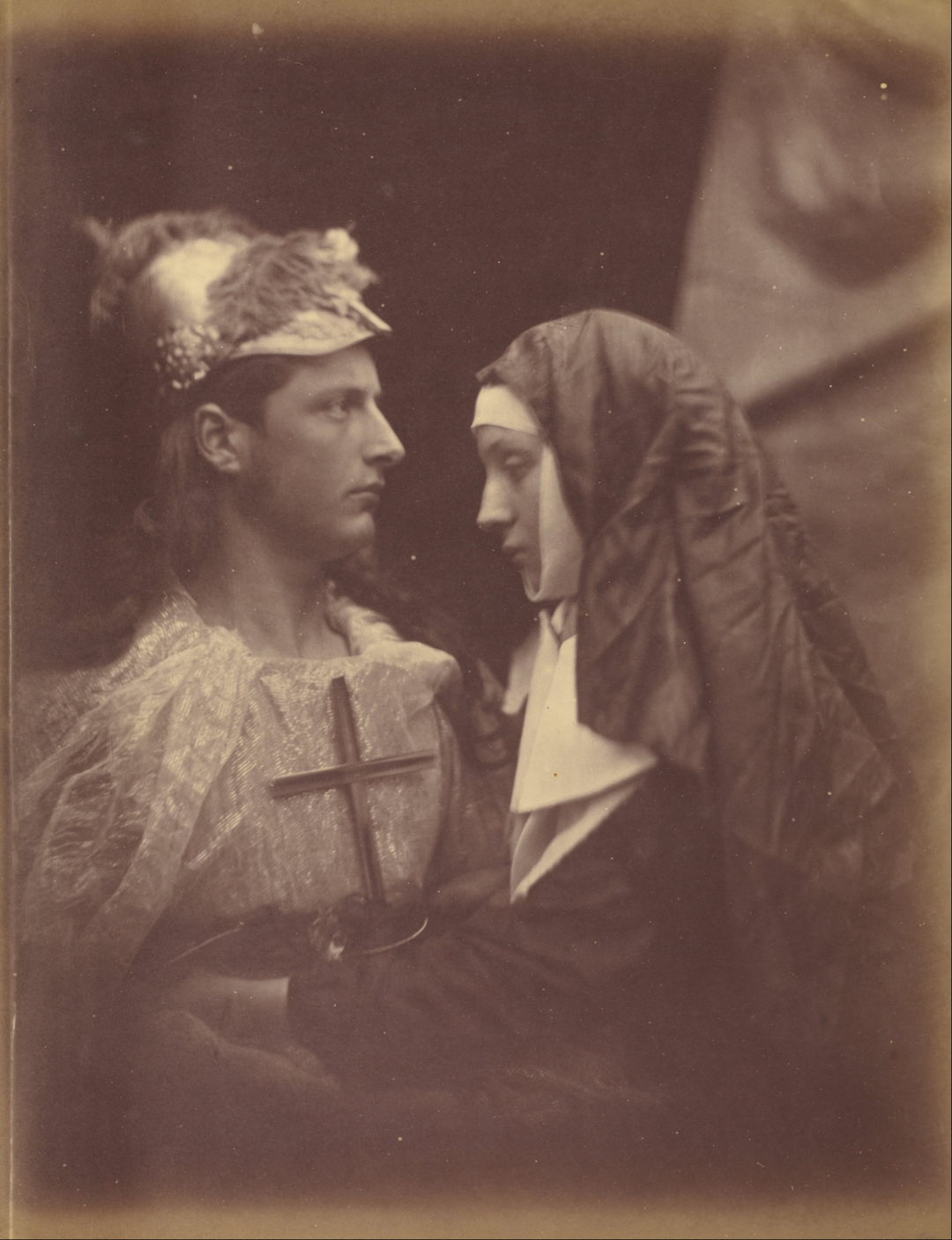
Other accounts of Galahad’s quest add other adventures. Julia Margaret Cameron’s pioneering photograph from 1874 shows Sir Galahad and The Pale Nun.
When Sir Galahad left the Castle of Maidens he disguised himself, and later met his father Sir Lancelot and Sir Perceval, who didn’t recognise him, so challenged him to a joust outside a hermitage. When Galahad had defeated them both, the recluse who lived there praised him as the best knight in the world. Fearing his father and Perceval would recognise him, Galahad rode away hastily.
Sir Lancelot came across an old chapel in a wild forest, but was unable to enter it. As he was tired, he lay down on his shield and fell asleep. He then half-woke and saw a sick knight borne on a litter being drawn by two horses. Inside the chapel a silver table appeared, and on it stood the Holy Grail. When the sick knight kissed the grail, he was immediately healed.
Once Lancelot was fully awake, the grail and the sick knight vanished. He went to fetch his horse and armour, but realised that they too had gone, so he walked on until he found a hermitage, where he made his confession, including admission of his affair with Queen Guenevere. After he had repented of his sins, Lancelot’s horse, arms and armour were restored to him.
Malory tells the stories of other knights in their quest of the Holy Grail, before returning to that of Galahad.

Arthur Hughes’ painting of Sir Galahad, the Quest for the Holy Grail from 1870 is dominated by the neutral and protective ‘grail angels’, who cast their golden light over the night scene. This was probably based on Tennyson’s poem The Holy Grail published the previous year, and may represent the moment when, having left Sir Perceval behind, Galahad is taken up to a heavenly city in a boat like a silver star.
Sir Galahad headed towards the sea. As he was passing a large castle he saw that it being attacked. He decided the fight its attackers, and beat them back, allowing the knights of that castle to put them to flight. From there he rode on to a hermitage near Castle Corbenic, where he lodged. A gentlewoman there asked him to accompany her, and the pair rode down to the sea, where they rested briefly at that lady’s castle before riding on to meet Sir Bors and Sir Perceval on a ship.
The four of them crossed the sea far away from Logres, where they had come from. They then transferred to another ship, one richly fitted out but without another soul on board, where the lady revealed that she was Sir Perceval’s sister. Among the many wonders they found on board was a sword that only one man could hold, and that proved to be Galahad. Sir Perceval’s sister told them the stories of the sword and its scabbard, going right back to events that took place only forty years after the Crucifixion.
Hanging above the bed in that ship were two swords, and three spindles coloured white, red and green, dating back to the time of Eve before the Fall. These had been made for King Solomon from the tree under which Cain had killed his brother Abel. Once Galahad had been fitted with the sword and its scabbard, the four of them returned to their ship, and the following morning they reached the castle of Carteloise, near the Scottish border.
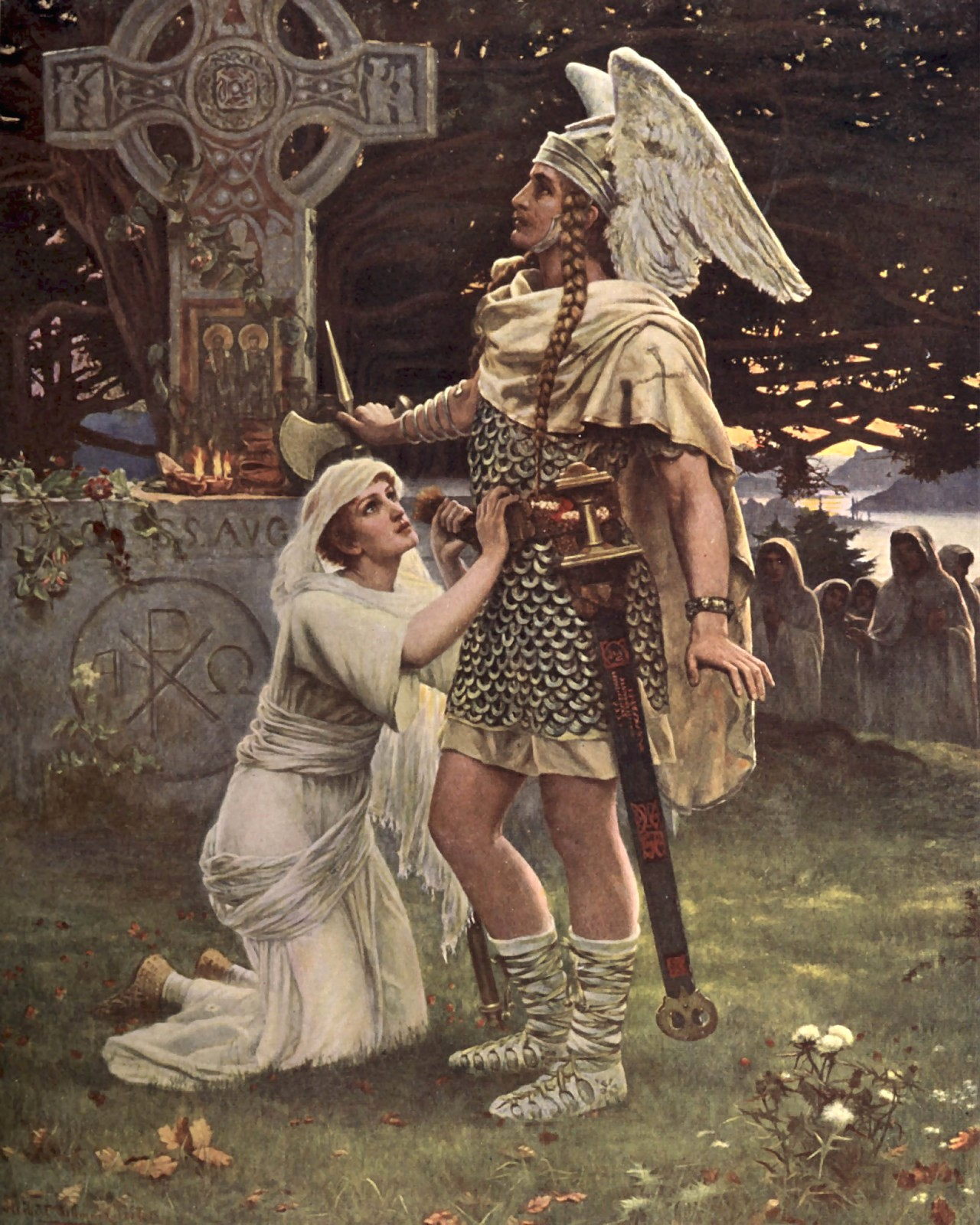
Herbert Gustave Schmalz’s Sir Galahad from 1881 may show Sir Perceval’s sister fitting the knight with his sword and scabbard, for which she made a girdle or belt.
After they had disembarked, they were challenged by ten knights to yield or die. The three knights of the Round Table made short work of the ten, and were soon inside the castle of Lord Hernox, who was being held prisoner until they had him freed. From there the four travelled on to a chapel where they saw a hart turn into a man, and four lions transformed as well. They were told that it was they who would bring the quest for the Holy Grail to an end.
Reference
Dorsey Armstrong (translator and editor) & Sir Thomas Malory (2009) Morte Darthur, a new modern English translation, Parlor Press. ISBN 978 1 60235 103 5. (A superb translation based on the Winchester manuscript.)
 The Eclectic Light Company