
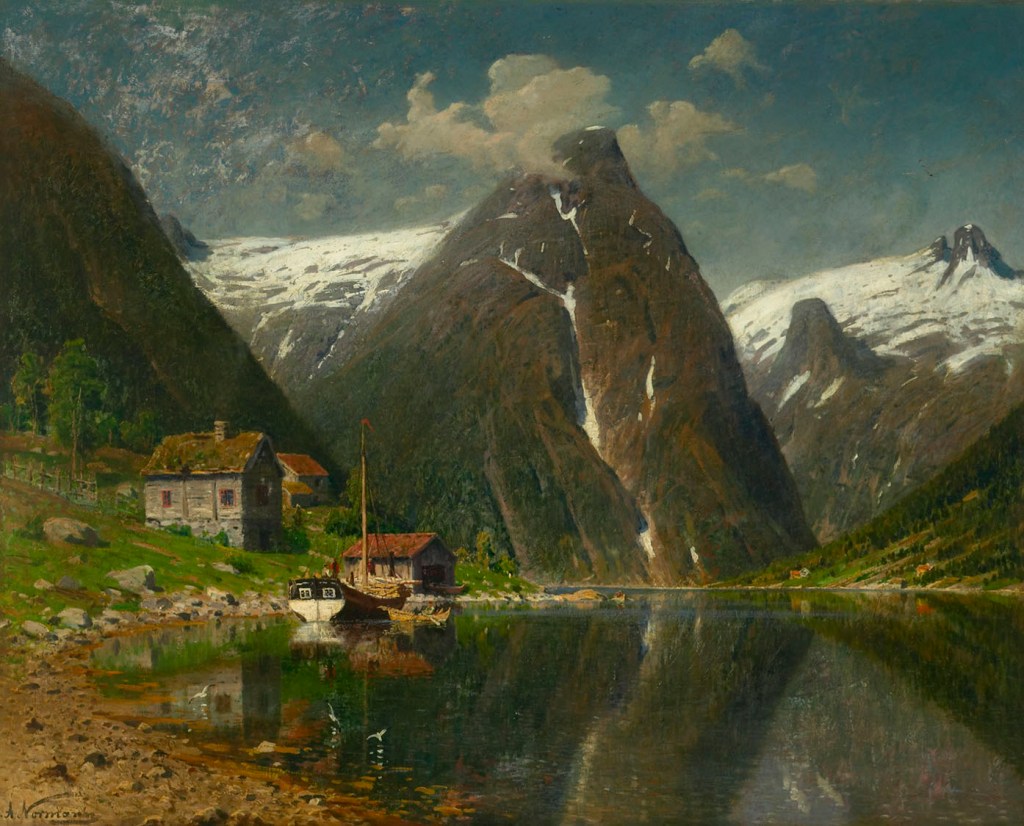
The backbone of Norway and Sweden is formed by a chain of mountains running about 2,500 kilometres (1,500 miles) from the fjord country of south-west Norway north-east to North Cape within the Arctic Circle. They include Galdhøpiggen, rising to 2,469 metres (8,100 feet), the highest peak in the mainland of northern Europe, and many others of over 2,000 metres (6,560 feet). Because of their relative inaccessibility by land, most that appear in paintings have been approached from the western coast of Norway and its deep fjords.
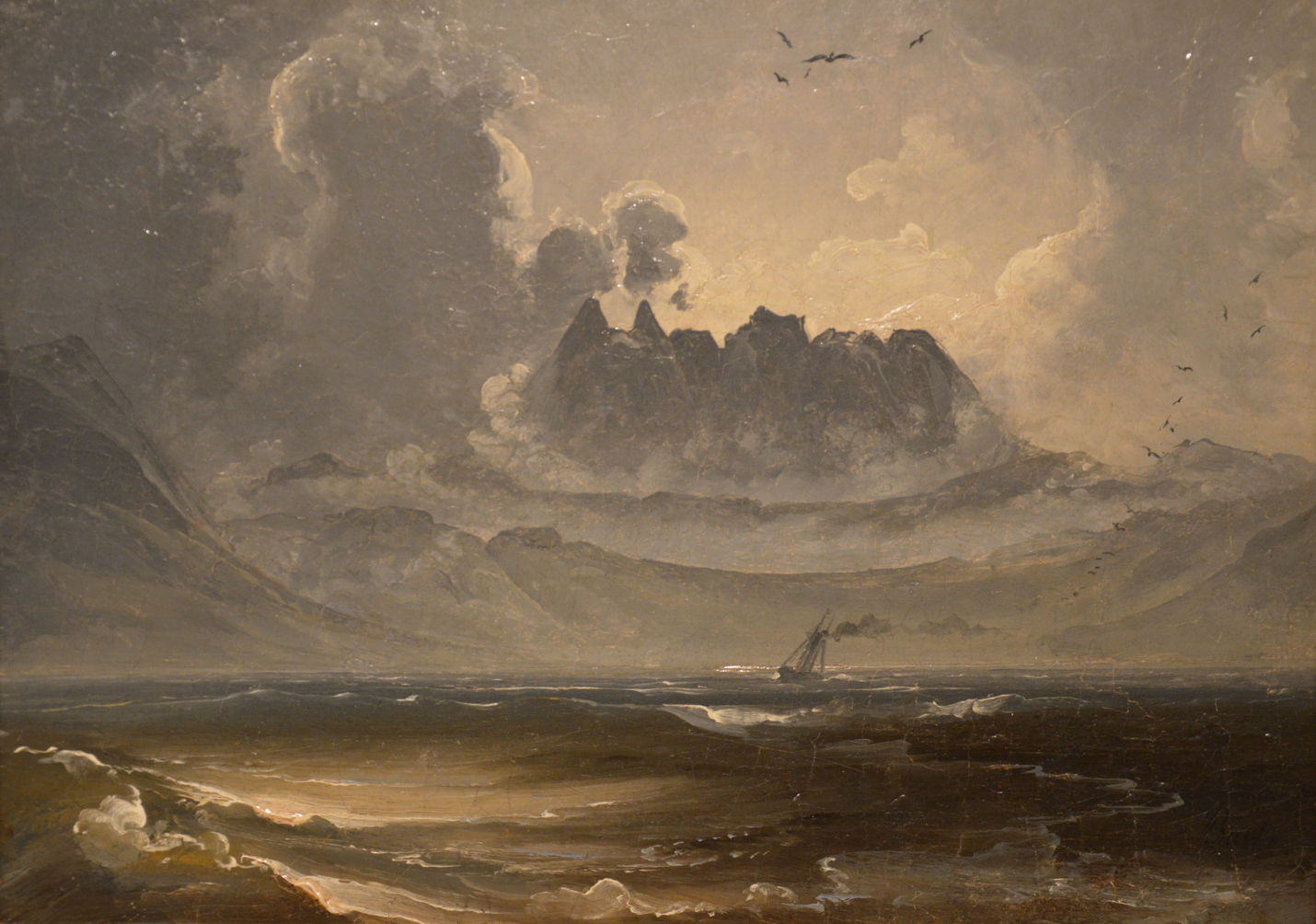
One of Peder Balke’s earliest surviving paintings of the Norwegian coast is the romantic and dramatic Mountain Range Trolltindene from about 1840. Its carefully framed clear patch in the clouds reveals this part of a mountain chain rising to over 2,000 metres (over 6,500 feet), at the western edge of the great Rondane National Park in central Norway.
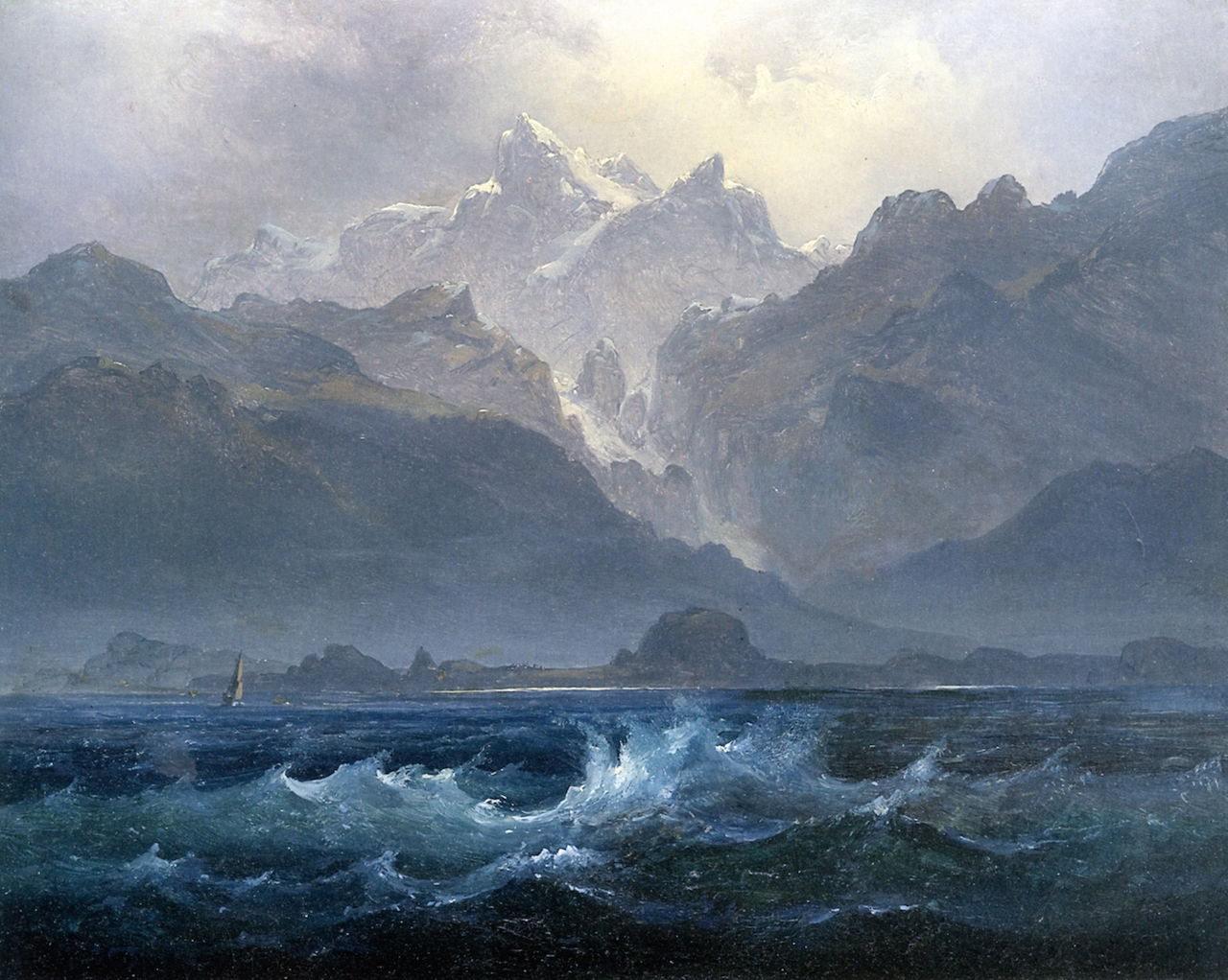
Balke’s painting of The Seven Sisters Mountain Range (c 1845-50) shows this spectacular chain of seven mountains on the island of Alsten on the Norwegian coast. They rise from sea level to over 1,000 metres (3,000 feet) in a tangled mass of rock spires and icefalls.

Hans Gude’s contrasting Vinterettermiddag (Winter Afternoon) from 1847 wouldn’t look out of place on a greetings card, although this hamlet is high in Norway’s mountains.
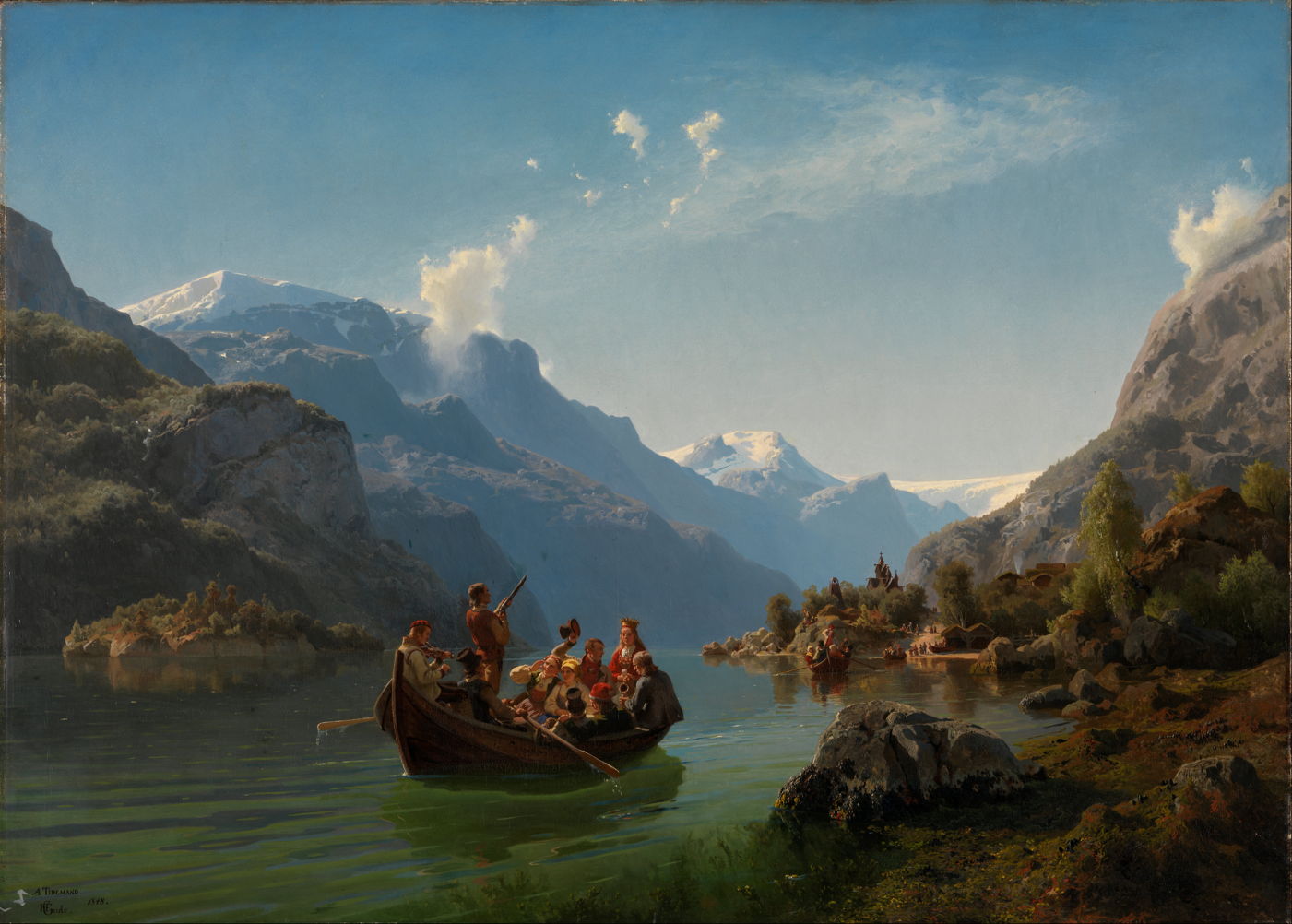
Gude collaborated with Adolph Tidemand to paint one of the world’s largest and most spectacular fjords carving its way from the Hardanger plateau to the sea, to the east of Bergen in Norway, in their Bridal Journey in Hardanger from 1848. Hardangervidda is the largest mountain plateau in Europe, and is dominated by its glacier Hardangerjøkulen and peaks rising to heights of over 1,500 metres (nearly 5,000 feet).
When the Norwegian artist Eilert Adelsteen Normann became commercially successful in Germany, he had a large ornamented wooden cabin built for him close to Balestrand in Norway, where he spent each summer. This picturesque area by Sognefjord had attracted quite a colony of artists, including Gude and Hans Dahl. During the rest of the year he taught, mainly in Germany, and some of his students were sufficiently inspired by their teacher’s work to spend their summers painting in Norway too.

Normann’s From Romsdal Fjord, painted in 1875, is the earliest of his dated works that I have located. It shows the ninth longest fjord in Norway, which carves its way through this huge mountain gorge. A small party of well-dressed people have arrived in small boats, for a picnic on a rock spit. A sailing boat is gliding slowly along the mirror surface of the water, and in the far distance is a steamer.

Munken gård in Esefjord was painted on the shore of this tributary to the mighty Sognefjord, in the south-west of Norway, near Normann’s summer cabin.

One of the regular passenger and cargo ferry services steams up an unidentified fjord in Normann’s The Steamship.

Sognefjord, Norway shows Norway’s longest and deepest fjord, as it carves its way due east from the southern bulge of the coastline. This view features Normann’s favourite small craft, and the sky and rock have become very painterly.
Sognefjord is fed by meltwater from Jostedalsbreen, the largest glacier in continental Europe, and the Hurrungane mountain range, rising to its highest peak Store Skagastølstind, with an elevation of 2,405 metres (7,890 feet). Like several Norwegian mountains, that was first climbed by the English mountaineer William Cecil Slingsby, on 21 July 1876. Slingsby made many first ascents in Norway during his thirty-year climbing campaign there from 1872, and is often regarded as the father of Norwegian mountaineering.
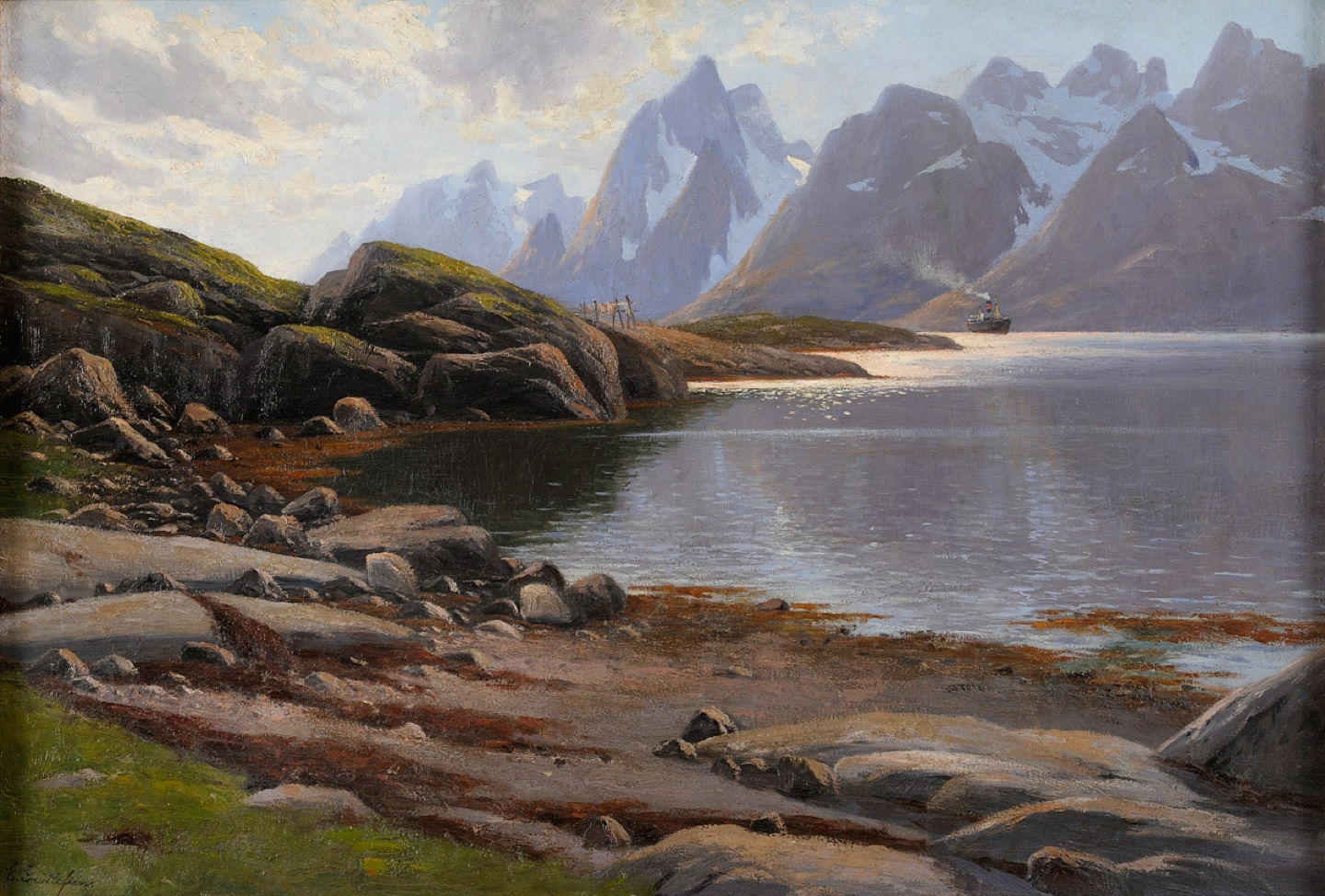
One of Normann’s former pupils, the German artist Elisabeth Grüttefien-Kiekebusch, was so moved by the Norwegian mountains and fjords that she spent her summers painting them. In about 1900, she painted this view In Raftsund at Digermulen showing the strait between the islands of Hinnøya and Austvågøya, among the Lofoten archipelago in the far north of Norway. Austvågøya consists of a mountain massif rising to over 1,000 metres (3,300 feet) with a rim of coastal lowland.

Nikolai Astrup was a prolific Norwegian painter in the first quarter of the twentieth century. He lived in Ålhus on Jølstravatnet, Jølster Lake, a long fjord-like fresh water lake surrounded by rugged hills and mountains rising to 1,500 metres (5,000 feet). The lake is fed from meltwater from Jostedalsbreen, and there’s still abundant snow on the mountains in Astrup’s view of A June Night and Old Jølster Farm.
 The Eclectic Light Company