
Relative size of objects and figures is one of the dominant cues for the perception of depth, but there’s more to size than the three-dimensional illusions it brings. Put four identical elongated rectangles at different heights, and it doesn’t take much to elicit the sense of depth.

Once the heights of the bars are altered, a feeling of recession starts to appear. Note that their widths have not (yet) changed, so this isn’t a strong sensation.

A combination of rising height in the picture plane, and changing height and width is even more convincing, although as their spacing remains equal this is still a long way from any formal linear perspective projection.

The effect of depth is completed once the rectangles are appropriately spaced, and this now resembles a series of pillars receding into the distance.
More unfortunately, we also associate size with importance and power. Speak to any small woman who’s a high-flyer in academia or business, and you’ll cringe at how often they’re treated like young schoolgirls rather than with the respect they merit. Oddly, some species of animal appear completely unaware that their small size really does mean that they wield less power: a domestic cat weighing but a few kilograms (pounds) assumes it’s every bit as dominant and ferocious as a massive lion.
Skilful manipulation of the size of figures can result in magical effects in paintings.

Richard Dadd’s Titania Sleeping from about 1841 is an elaborate example of ‘faery’ painting with its stream of intricately detailed human-like creatures of graded sizes.
Until the late Middle Ages, relative size of figures in many paintings paid little or no attention to depth recession, but was either ignored or determined by the role of the figure.
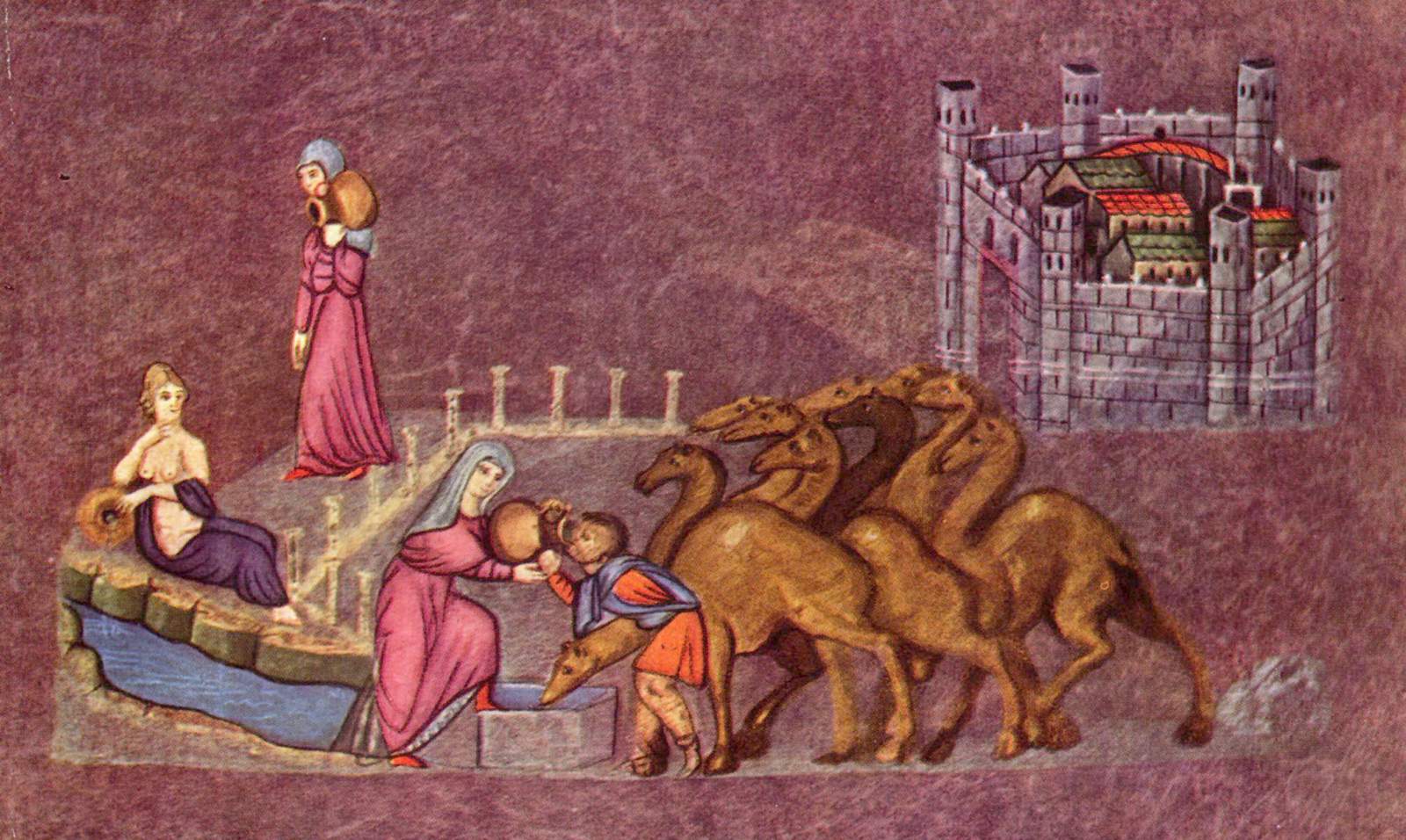
This page from the Vienna Genesis from about 525 CE tells the story of Rebecca and Eliezer, from Genesis chapter 24. In his quest for a wife for his son Isaac, Abraham sent his servant Eliezer back to their homeland of Mesopotamia to look for one. Eliezer reached the city of Nahor, where he stopped to water his camels and rest from his long journey. He pulled up at a well outside the city, where a young woman, Rebecca, had just drawn water. She offered him her water, and he recognised her as the chosen bride for Isaac, so presented her with the betrothal gifts he had brought with him.
This exquisitely painted miniature uses ‘continuous’ or multiplex narrative. In the background is a symbolic representation of Nahor. Rebecca is shown at the left, having walked out of the city with her pitcher on her shoulder, along a colonnade. In front of her is a pagan water nymph, presumably the spirit of that well. Rebeccah is shown a second time, and at similar size, giving Eliezer her pitcher to slake his thirst. His train of relatively tiny camels is also taking water.

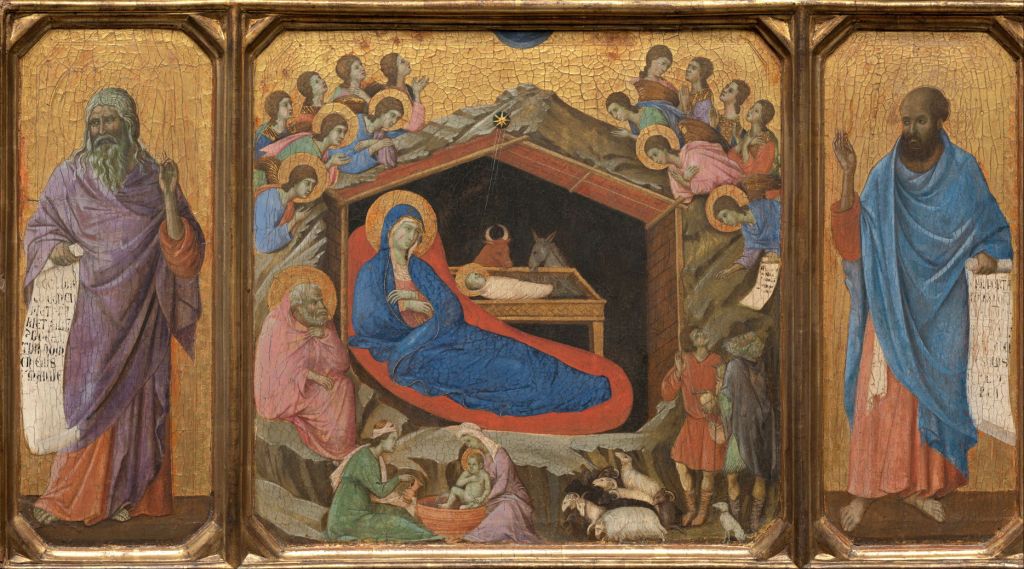
Even Duccio, in his Nativity with the Prophets Isaiah and Ezekiel from 1308-11, followed the rule of size equating to importance. The Virgin Mary is here much greater in stature than the figures in the foreground. Despite this ancient treatment, this painting remained at the high altar in the Duomo (cathedral) in Siena for nearly two centuries after its installation there on 30 June 1311, and was only removed in 1506.
Sometimes these old conventions appear strange if not slightly comical to the modern eye, so used to the more rigorous perspective of later paintings and photos.
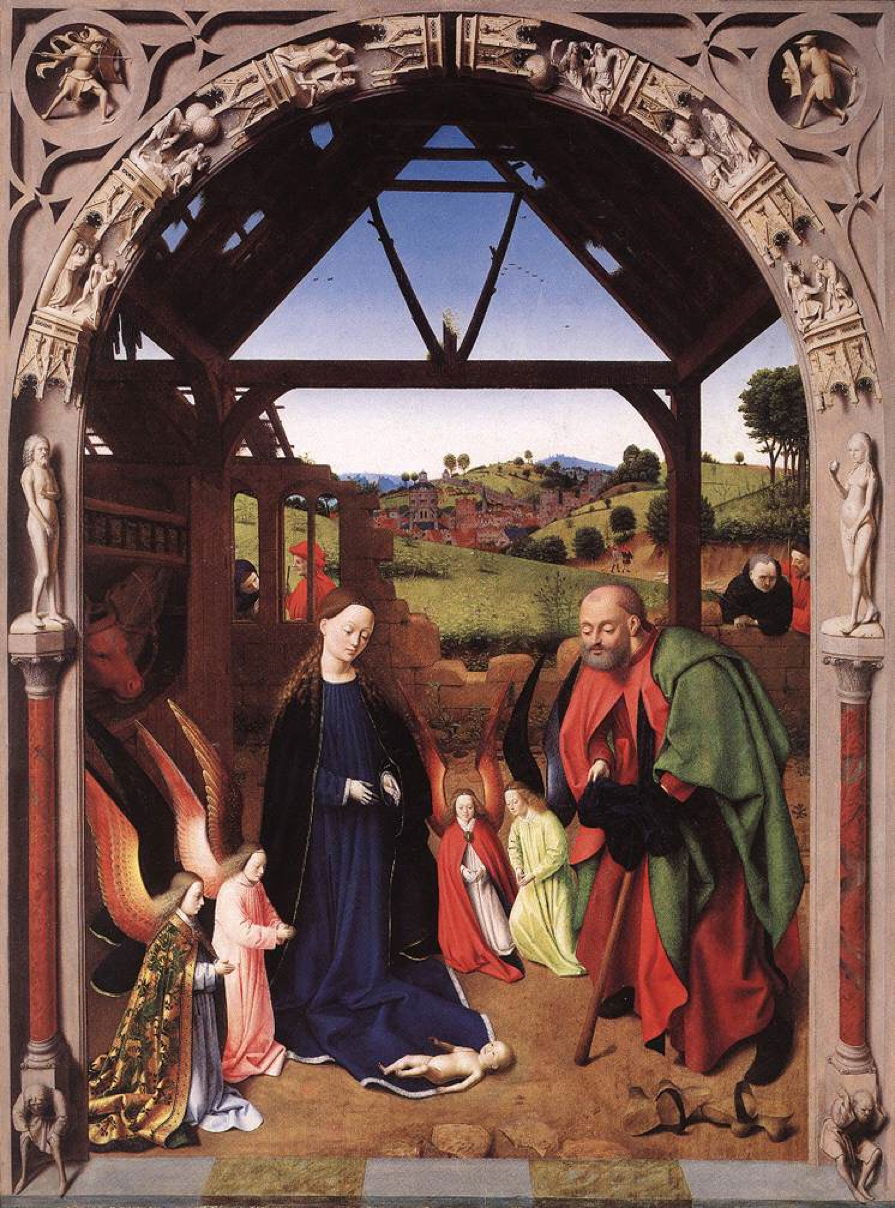
Petrus Christus’ The Nativity from about 1445-50 depicts the Holy Family as being more than twice the height of both angels and those who came to pay their respects to them. Joseph’s sandals, in the lower right corner, are massive compared to those smaller figures at the lower left.
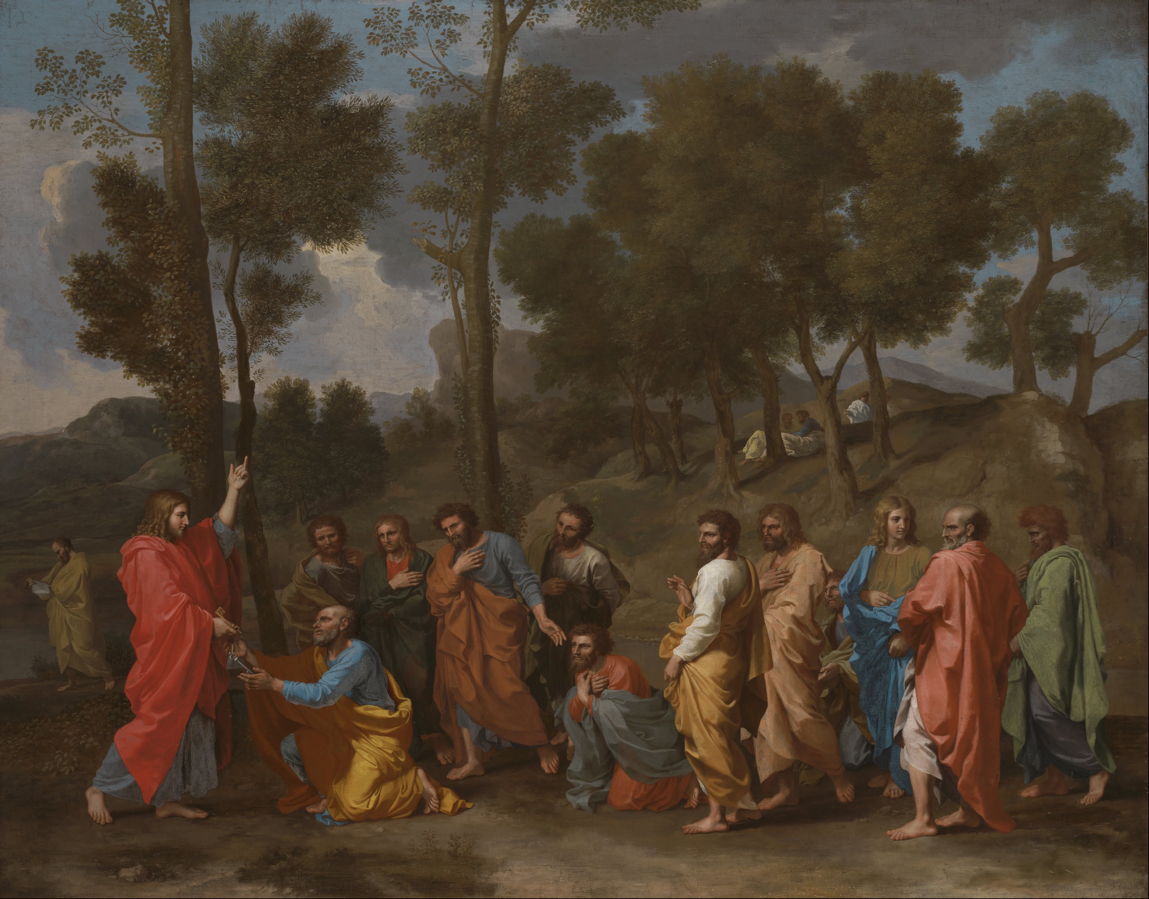
Even after the Renaissance, and the adoption of linear perspective projection, the occasional painting lapsed into the old convention. In Poussin’s Sacrament of Ordination (Christ Presenting the Keys to Saint Peter) from about 1636-40, he shows the figure of Christ a good few centimeters/inches taller than those of his disciples.
By this time, disparities in size more usually reflected real differences in stature.
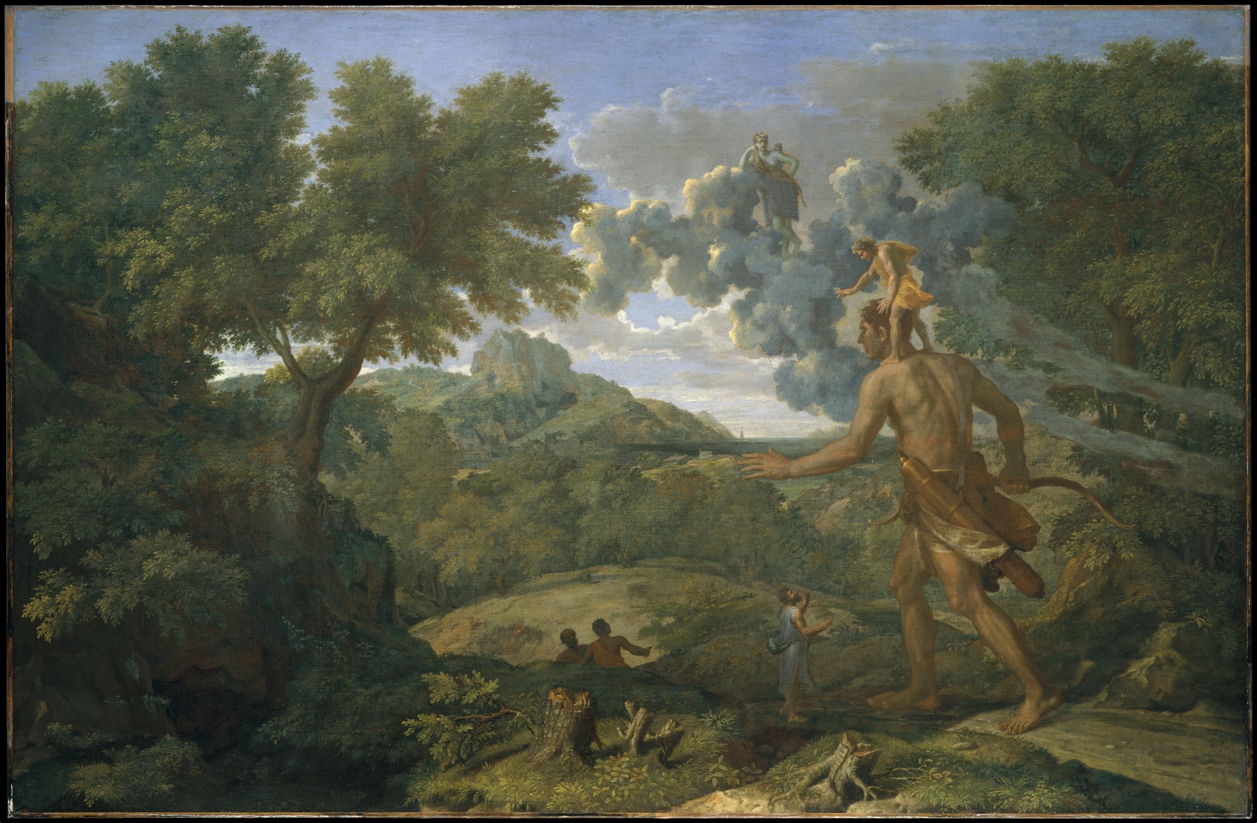
About twenty years later, Poussin made this obvious in the Blind Orion Searching for the Rising Sun (1658), where an aide stands on the giant’s shoulders directing him.
There were still occasions when painters struggled with relative size, though.

When Jacob Jordaens painted his undated account of Odysseus and his crew trying to escape from the blinded Cyclopean giant Polyphemus, he tried to be faithful to size and showed the sheep correct relative to the figure of Odysseus. This didn’t fit Homer’s account, though, where the crew secured themselves to the undersides of the sheep in order to escape. Jordaens could only have solved this by scaling the sheep relative to Polyphemus rather than Odysseus.
There are still occasional examples of paintings where relative size raises questions.

In about 1815, Pierre-Narcisse Guérin returned to conventional history painting with Aeneas tells Dido the misfortunes of the City of Troy. Aeneas arrives in Carthage on his epic journey following the fall of Troy. Dido, legendary founder and first monarch of Carthage, falls in love with him. Guérin shows the beginnings of the romance, and doesn’t provide clues, such as the presence of Aeneas’ ships, of its tragic outcome. The diminutive beauty being embraced by Dido is probably not intended to be human, although it seems unlikely to be Juno or Venus who acted together to make the love affair happen. Who this figure is, and how she became so small, remains a mystery.
 The Eclectic Light Company