
Aeneas and his survivors from Troy finally settled in Latium, where King Latinus had been advised by oracles that his daughter Lavinia would marry a foreigner, rather than the neighbouring King Turnus of the Rutuli.
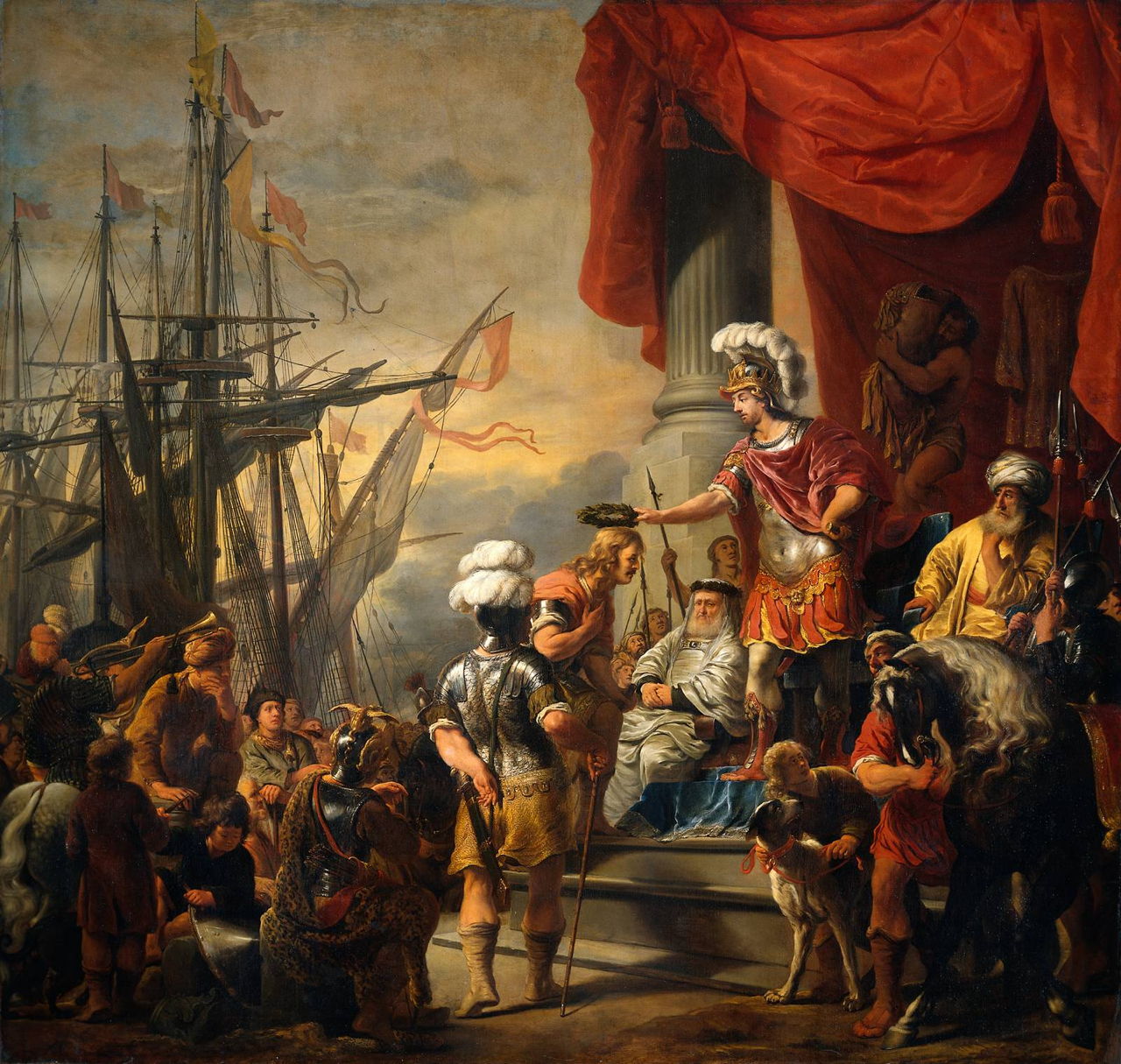
Ferdinand Bol’s Aeneas at the Court of Latinus from about 1661-63 shows Aeneas awarding a laurel wreath to the victor of a maritime race.
Once again, Juno intervened to try to block Aeneas from his destiny. She first used the Fury Alecto to bring war between the Trojans and the Italian people.
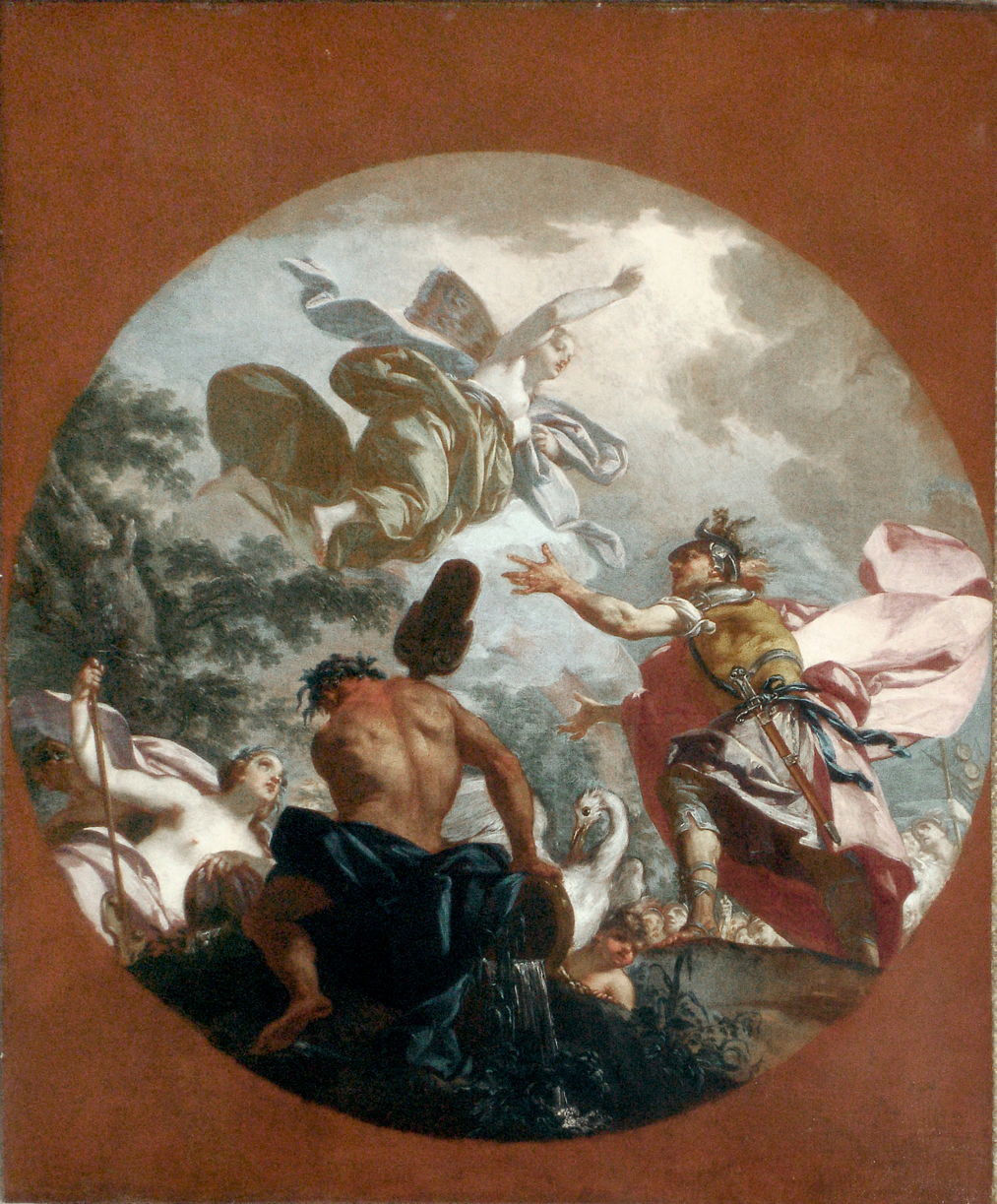
Claudio Francesco Beaumont’s Iris Sent to Turnus by Juno from about 1738-40 is a sketch for one of the medallions in the vault of the Armeria Reale of Turin. It shows Iris sent by Juno to tell Turnus, the Rutulian warrior, that he must take advantage of the absence of Aeneas to attack the Trojans. This leads to the burning of their fleet, forcing Aeneas and his companions to settle in Italy.
Fighting between Turnus and his Rutuli and Aeneas with his Trojans culminated in a personal duel between them.

Luca Giordano’s Aeneas and Turnus from the late 1600s is one of the few paintings showing the battle between Aeneas and Turnus. The Trojan hero has Turnus on the ground, under his right foot. At the lower left is one of Aeneas’ ships. Venus, Aeneas’ mother, and Cupid, his half-brother, are at the upper left, and the goddess at the upper right is either Minerva (with her owl), or Juno – as losers in the Judgement of Paris, both bore a lasting grudge against the Trojans.
Inevitably, this ended with Aeneas killing Turnus.
It took Ovid, in his Metamorphoses, to conclude the story of Aeneas. After he had founded the city of Lavinium, later to be instrumental in the founding of Rome, Aeneas was made an immortal god.

Peter Candid’s Aeneas Taken to Olympus by Venus from around 1600 shows Venus at the right, in her chariot with Cupid, anointing Aeneas, on the left, with nectar and ambrosia. Above them is the pantheon, arrayed in an imposing semicircle, and above them Jupiter himself, clutching his thunderbolts and ready to receive the new god.

Tiepolo’s sketch for a fresco ceiling in the Royal Palace in Madrid, The Apotheosis of Aeneas from about 1765, is another impressive account. The artist made this a little more elaborate by combining the apotheosis with the presentation of arms to Aeneas by his mother Venus. Aeneas is to the left of centre, dressed in prominent and earthly red. Above and to the right of him is his mother, Venus, dressed in white, ready to present the arms which have been forged for him by Vulcan, her partner, who is shown below supervising their fabrication. Aeneas’ destination is the Temple of Immortality, glimpsed above and to the left of him, through a break in the divine clouds.

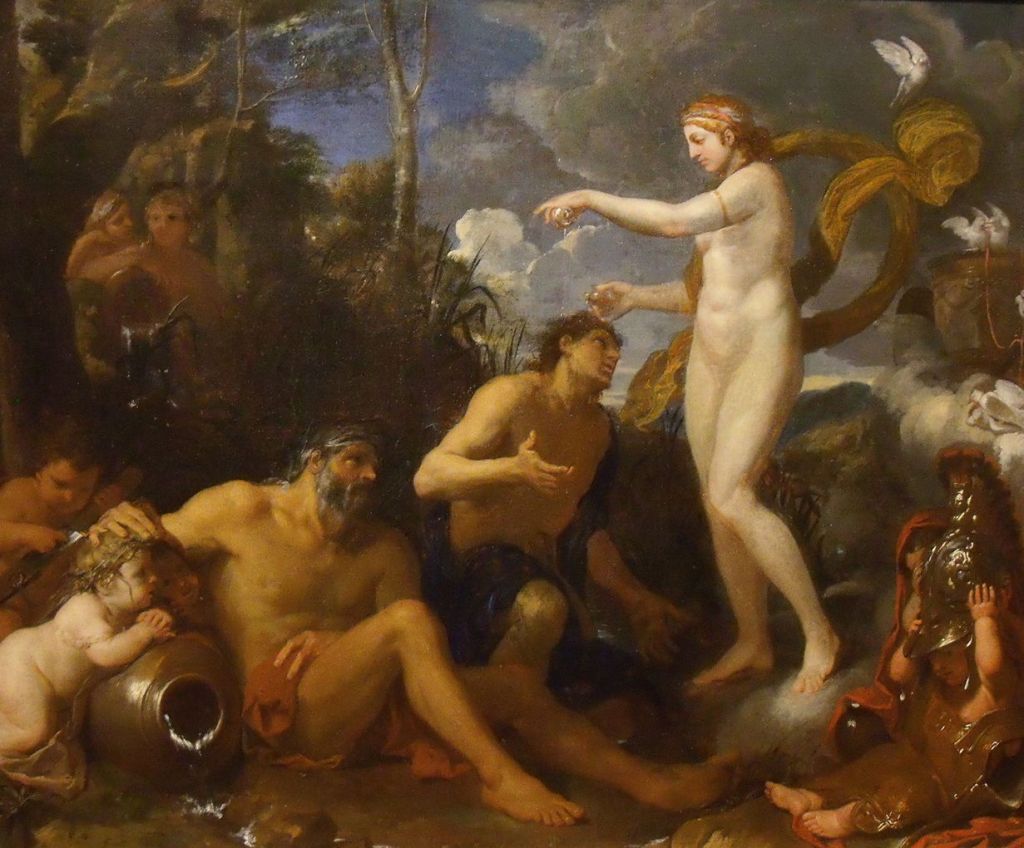
Charles Le Brun painted The Deification of Aeneas in about 1642-44. This is a faithful depiction from Ovid’s Metamorphoses, with the river god Numicus sat in the front, and Venus anointing Aeneas with ambrosia and nectar to make him immortal as the god Jupiter Indiges. At the right is Venus’ mischievous son Cupid, trying on Aeneas’s armour, and the chariot towed by white doves is ready to take the hero up to join the gods.
Legend has it that Aeneas named the city he founded Lavinium after his second wife. From there his son Ascanius went on to found another city, Alba Longa, in the Alban Hills not far from modern Rome. The descendants of Aeneas ruled that city until it came to the brothers Numitor and Amulius, who fought for its control. Numitor’s daughter was made a priestess of the goddess Vesta, and so was sworn to remain a virgin. Shortly after that she was found to be pregnant, giving birth to the twins Romulus and Remus, who were ordered to be drowned in the River Tiber, but survived and grew up to found the city of Rome.
There remains but one key figure in the Trojan epics whose later years I haven’t accounted for: Odysseus.
 The Eclectic Light Company