
There’s a special place in the Underworld for some in Greek mythology, for those damned to perform impossible tasks for eternity. Although a tiny backwater in classical myth, these unfortunates have had lasting impact on our language, in words like tantalise and phrases like a Sisyphean task. They have also featured in some fine paintings.
A few have visited the Underworld and returned; I’ve recently retold the story of Orpheus, so here’s a wonderful painting of Juno in Hades.

Jan Brueghel the Elder’s Juno in the Underworld (1596-98) shows the vengeful goddess seeking out the Furies to inflict themselves on Athamas. She’s described as passing its monstrous guardian Cerberus, and wondering why those damned to impossible tasks should suffer so. These are identified as Tityus, Tantalus, Sisyphus, Ixion, and the Danaids, although Brueghel’s apocalyptic vision of Hades comes dangerously close to losing Juno altogether in its sea of horror and suffering.

Juno’s cool blue robes and a couple of peacocks stand out from the reds and browns, the monsters and the tormented. She waves at the trio of Furies, with their snake-filled hair and screaming faces.
Sisyphus
Sisyphus was the founder king of Ephyra, who was greedy, cheated, and violated his moral obligations to guests and travellers by killing them. As punishment for these crimes, he was condemned to roll a huge boulder up a steep hill, forming the basis of the English phrase a Sisyphean task, which is endless and futile.
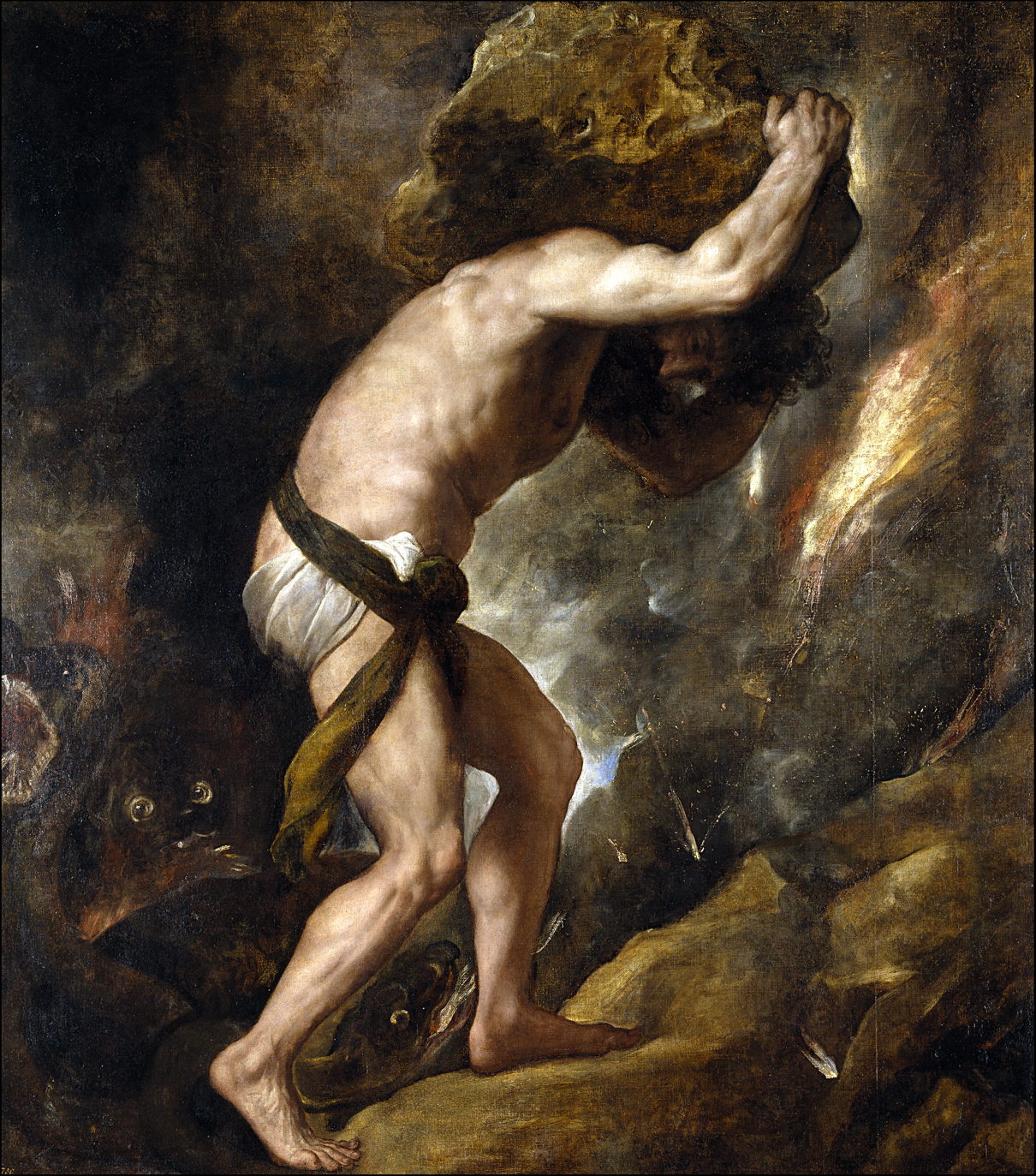
Titian’s famous painting of Sisyphus dates from 1548-49, but shows him carrying the boulder on his shoulder rather than rolling it uphill.
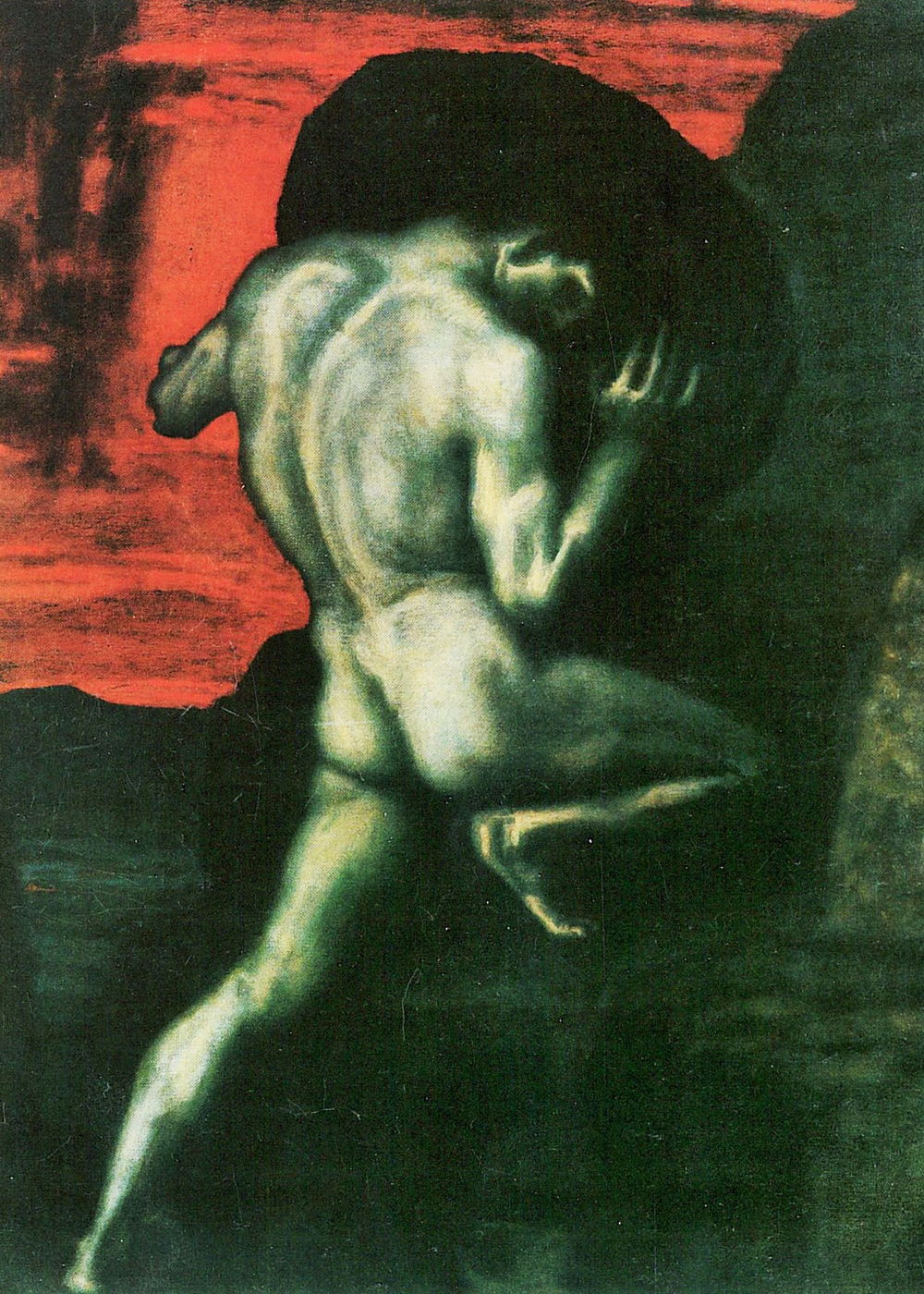
Like many great narrative painters of the end of the nineteenth century, Franz von Stuck faced an increasingly difficult task of attracting attention to his art. His painting of Sisyphus from 1920 may have been an expression of that frustration, and perhaps resulting self-criticism. A simple, bold, and powerful image, it was probably inspired by Titian’s painting.
Danaïds
Danaus and Aegyptus were twin brothers who lived in North Africa. Aegyptus was a mythical king of Egypt who had fifty sons, and his brother had fifty daughters, from polygamous relationships. When Aegyptus decided that his sons would marry his brother’s daughters, Danaus fled with those daughters to Argos, in Greece, where the reigning king handed over his throne to him.
Aegyptus and his sons were not to be put off so easily, joined Danaus and his daughters in Argos, and pressed ahead with plans for the weddings. The couples were assigned by lot, apart from two matches between Hypermnestra and Lynceus, and Gorgophone and Proteus, which were deemed necessary because of the rank of their mothers, who were princesses.
On the day of their weddings, Danaus equipped his daughters with swords, and told them to murder their husbands in bed that night. Once those drunken grooms had fallen asleep, the daughters each followed their father’s instructions, except for Hypermnestra: by the morning, of the fifty brothers only Lynceus survived.
In the end, while Lynceus and Hypermnestra lived happily ever after, the other forty-nine sisters were punished in Hades for the sin of murder. They were given an impossible task, of filling a large container with water; as that container had holes in its bottom, they now spend the rest of eternity carrying water to the container and pouring it in.

The murderous sisters don’t seem to have had much of a showing in art until Martin Johann Schmidt painted The Labour of the Danaides (1785) on copper. He makes the allusion to Danaïds also being known as water-nymphs, like Naiads, by placing a river god at the left.

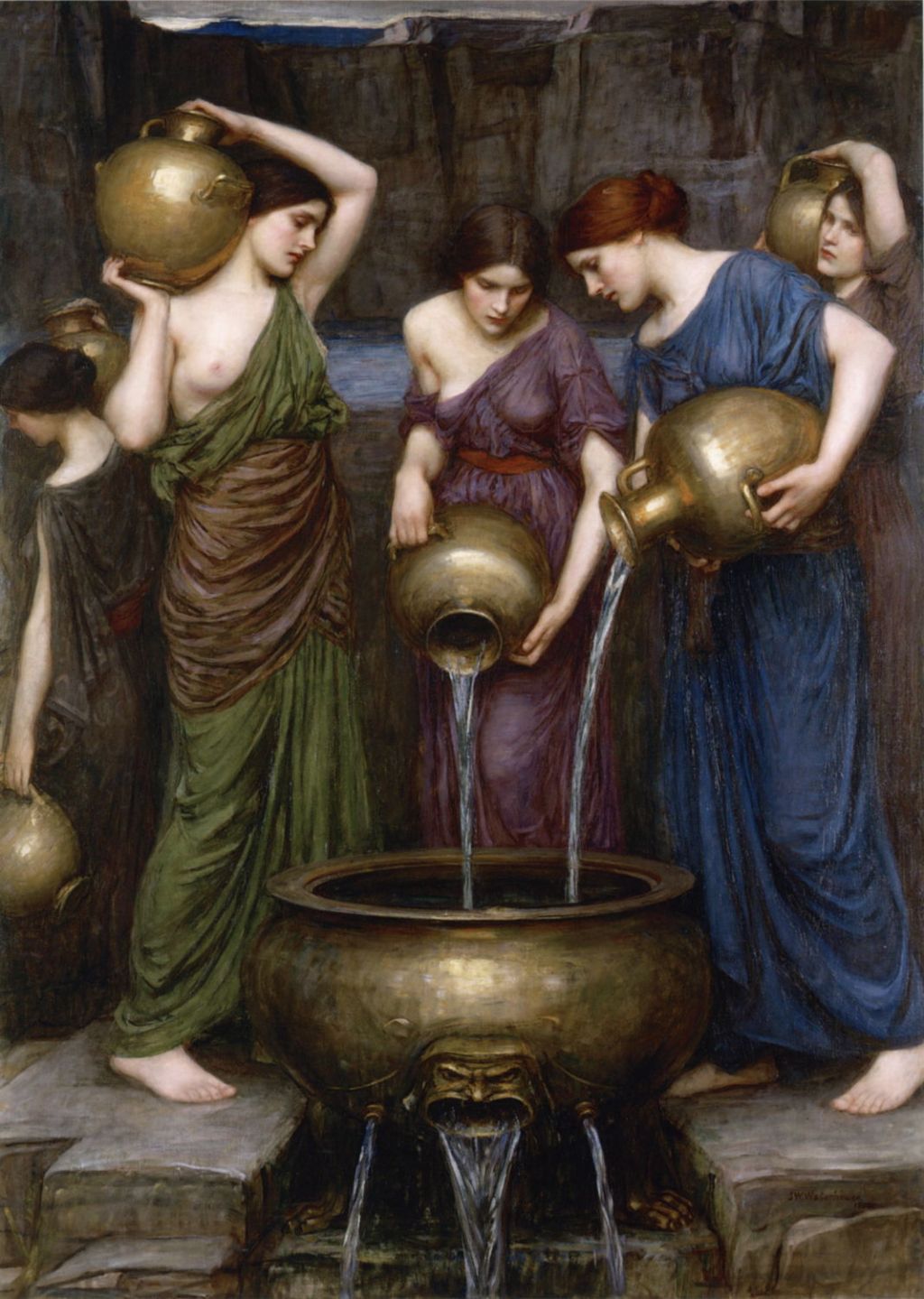
John William Waterhouse revived them for two paintings, of which this, The Danaides, was the first, and completed in 1903. He made a second slightly more complex composition in 1906, which now hangs in Aberdeen Art Gallery in Scotland. Rather than a battered and leaky barrel, Waterhouse has the Danaïds filling an ornamental cauldron.

I have been unable to find a date for Walter Crane’s version, The Danaides, which was probably for a triptych painted between 1890-1915 and shows a remarkably similar cauldron.

Towards the end of his life, John Singer Sargent painted this vast canvas of The Danaïdes (c 1922-25), which decorates the entrance to the Library of the Museum of Fine Arts in Boston.
Ixion
Ixion was the son of the King of the Lapiths in Thessaly. He had murdered his father-in-law Deioneus by pushing him into a bed of burning coals and wood, resulting in Ixion going mad. Zeus showed pity on him, and brought him to Olympus, where he promptly lusted after Hera, Zeus’s wife. When Zeus found out, Ixion was expelled from Olympus, and Zeus instructed Hermes to bind Ixion to a winged fiery wheel and send it spinning across the heavens. Snakes were added to his punishment in later versions of this myth.

Jules-Élie Delaunay’s Ixion Plunged into Hades (1876) shows Ixion writhing in agony in the Underworld, as he is bound to a wheel by snakes.
Tityus
Tityus or Tityos was a giant, one of the many sons of Zeus, who tried to rape the goddess Leto. Her twin children Artemis and Apollo then killed him with their arrows, and he was sentenced to spend his time in the Underworld with two vultures feeding on his liver, which like that of the Titan Prometheus regenerated each night.

Jusepe de Ribera’s Tityos from 1632 is atmospheric but anatomically incorrect, as the vulture is seen feeding from a wound on the giant’s left side, not the right, where the liver is.
This myth also features in a cameo painted by Claude in his Landscape with Aeneas at Delos from 1672.
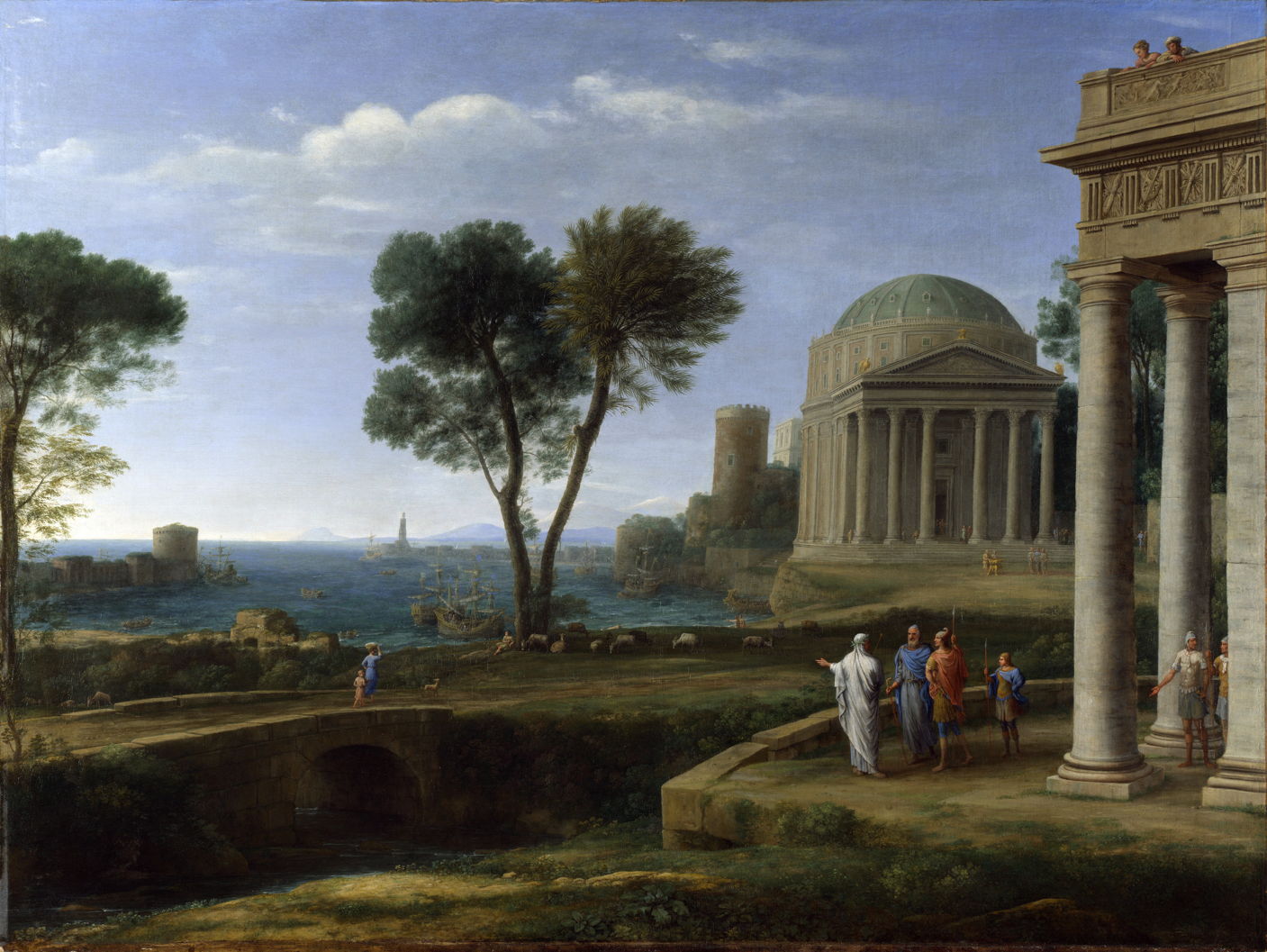
Claude’s masterpiece was the first of half a dozen works painted in the final decade of his life, based primarily on Virgil’s account in the Aeneid. Its meticulous details are supported by a coastal landscape of great beauty.

The relief at the top of the temple, immediately below a couple of casual onlookers, tells the story of Leto’s twins killing Tityus, who is seen at the right of the relief, fallen down and wounded by the arrows of Artemis (centre) and Apollo (left).
Tantalus
Tantalus, whose name lives on in the English word tantalise and its relatives, abused the hospitality of Zeus by stealing ambrosia and nectar, then offered up his own son Pelops as a sacrifice. He cut the boy’s body up and served it to the gods at a banquet. As punishment, Tantalus was condemned to stand in a pool of water underneath a fruit tree. When he reached for the fruit, the branches raised so they were out of his reach, and when he bent down to drink, the water receded to leave him eternally thirsty.
Unfortunately the only painting that I know of Tantalus isn’t a particularly good retelling, and isn’t available for free use either.
Ocnus
The last of those damned to impossible tasks, Ocnus is claimed to have founded either Mantua or Bologna. Although his crime isn’t recorded, he spent his time in the Underworld weaving a rope from straw. As fast as he can do that, a donkey behind him eats his rope. Sadly, his punishment isn’t recorded in a well-known painting.
 The Eclectic Light Company