
Years before Odysseus reached Ithaca, other Greek warriors had returned home from the sacked city of Troy. Among them were Menelaus, King of Sparta and former husband of Helen, Pyrrhus (or Neoptolemos) son of the dead Achilles, and Agamemnon, overall commander of the Greek expeditionary force and King of Mycenae. All three are linked in the tragedy of Orestes, son of Agamemnon.
Menelaus had agreed that his daughter Hermione should marry Pyrrhus, so on their return the king implemented that marriage by taking Hermione away from Agamemnon’s son Orestes, and giving her to Pyrrhus. However, Pyrrhus hadn’t returned alone from Troy, but had brought a concubine, Andromache, who had been the wife of Hector and mother of Astyanax, who had been killed during the sacking.
The arrival of Andromache and the enforced marriage to Pyrrhus were understandably very distressing to Hermione, who quickly developed a dislike of Pyrrhus’s concubine, which was mutual. Hermione accused Andromache of using sorcery to prevent her from conceiving a child by Pyrrhus, which might have strengthened her position, in return for which Andromache taunted Hermione for remaining childless. As a result, Hermione started to plot the murder of her bitter rival.
Orestes visited Hermione, and the couple seized the opportunity to elope. He then started plotting the murder of Pyrrhus to release Hermione from her enforced marriage. Although some accounts claim it was Orestes who killed Pyrrhus, others claim that he was killed when he visited the oracle at Delphi, because he desecrated the temple there; either way, Pyrrhus was dead and Hermione was free to marry Orestes.
When Orestes’ father Agamemnon returned to his kingdom of Mycenae, he found that his wife, Clytemnestra, who was Helen’s (half-)sister, had made Agamemnon’s cousin Aegisthus her lover. Clytemnestra and Aegisthus then plotted the murder of Agamemnon, and although there’s disagreement about which of them actually did the deed, the hero Agamemnon was then killed, leaving Aegisthus and Clytemnestra to rule Mycenae.
Back in Sparta, Orestes and Hermione had a son, Tisamenos. Eventually, after Aegisthus and Clytemnestra had had children of their own, Orestes returned to Mycenae, where he murdered his mother Clytemnestra, Aegisthus, and their daughter, confusingly named Helen, in vengeance for the death of his father. Orestes returned to Sparta, and Hermione disappeared, probably dying. When Aletes, the surviving son of Aegisthus and Clytemnestra, came of age, Orestes returned to Mycenae, killed Aletes (his half-brother), married Erigone, his half-sister, and assumed the throne.
Aeschylus’ Oresteia is a trilogy of plays tracing this run of murders and tragedy in the lives of Agamemnon and his son, Orestes. The first of the three, Agamemnon, tells of the return of the king to his wife, Clytemnestra, and her long-standing lover Aegisthus. They have been plotting to murder Agamemnon to avenge Iphigenia’s death, and secure the throne for Clytemnestra, which they do, also killing Cassandra his concubine.
Orestes, son of Agamemnon and Clytemnestra, returns home in the second play, The Libation Bearers, to avenge his father’s death some years later. Orestes then concludes that play by murdering his own mother and her lover Aegisthus. The third play, The Eumenides (one of the euphemistic names for the Furies), opens with the Furies hunting Orestes down, haunting and tormenting him to drive him mad, because of these murders.
The Oresteia weren’t a popular source of stories during the Renaissance, and the earliest post-classical work of art that I have been able to locate which shows Orestes and the Furies is from the end of the eighteenth century, two millennia after the painted pots shown below.

In Girodet’s ink and chalk drawing of The Meeting of Orestes and Hermione (c 1800), Hermione is seen at the right, her arms folded, looking coy as Orestes approaches her. The second woman, with Orestes, is presumably Hermione’s maid.
This is one of a series of illustrations made by Girodet to accompany Racine’s play, and has subtleties which you might expect from a great narrative artist. Visible in the gap between the figures is a table-leg in the form not of a Fury foretelling Orestes’ fate, but of a siren, implying that Hermione is luring Orestes to her. Hermione, for all her apparent coyness, has let the right shoulder-strap of her robe slip, in her enticement of Orestes. She has assumed the role of femme fatale, as portrayed by Euripides and Racine.

Just a decade later, Pierre-Narcisse Guérin made two paintings exploring this story. In Andromache and Pyrrhus (1810), the central figures of Pyrrhus, seated on the throne, and Andromache, kneeling at his side and clutching her young son, are in conflict with two other women. It’s most likely that the figure at the right is Hermione, who is being displaced from her enforced role as Pyrrhus’ wife by Andromache.
The child is almost certainly Astyanax. Although some accounts tell that Pyrrhus threw the boy to his death from the walls of Troy, others, including Euripides, claim that Astyanax survived the sack of Troy, and accompanied his mother when she was taken as Pyrrhus’ concubine. When Hermione plotted the murder of Andromache, she included the killing of Astyanax.

Guérin’s Orestes Announces the Death of Pyrrhus to Hermione (c 1810) shows a scene described later in Euripides’ and Racine’s plays, in which Orestes has just murdered Pyrrhus at Delphi, and here tells Hermione of that death by flourishing the sword he used. Hermione is shocked, as is her maid standing behind her.
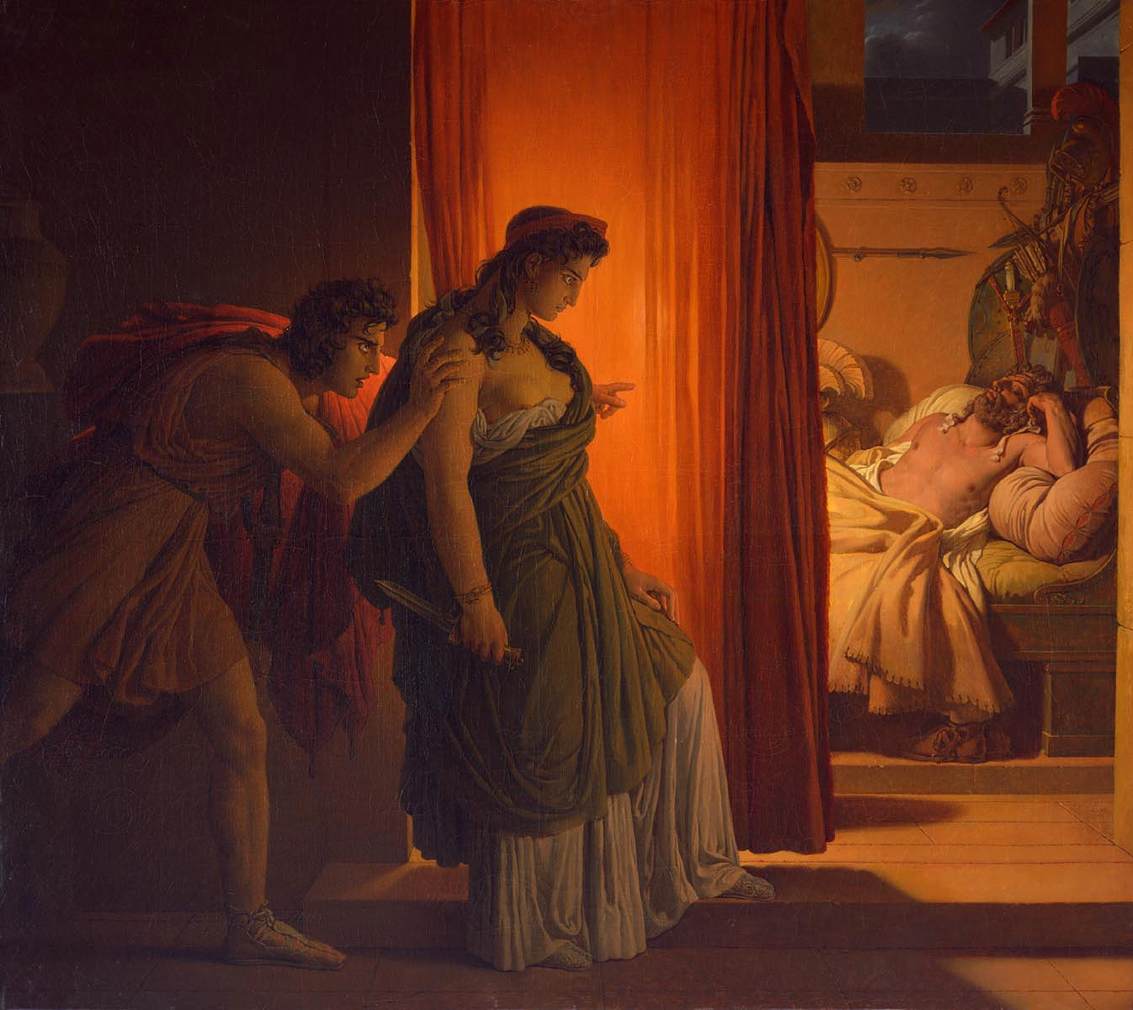
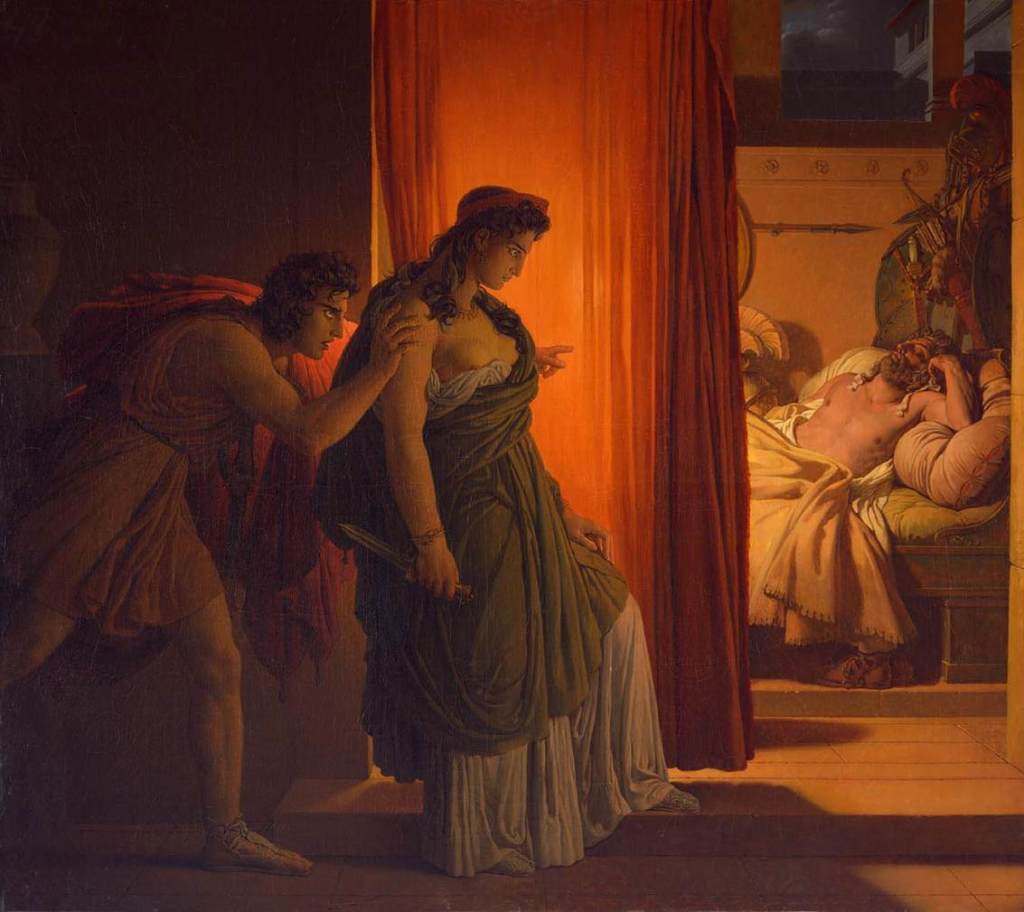
The story in Guérin’s next painting of doomed relationships, Clytemnestra hesitates before killing the sleeping Agamemnon (1817), is thankfully taken in part from Aeschylus’ Oresteia, and much clearer. Here he shows Clytemnestra about to kill her husband with a short sword while he’s asleep in bed.
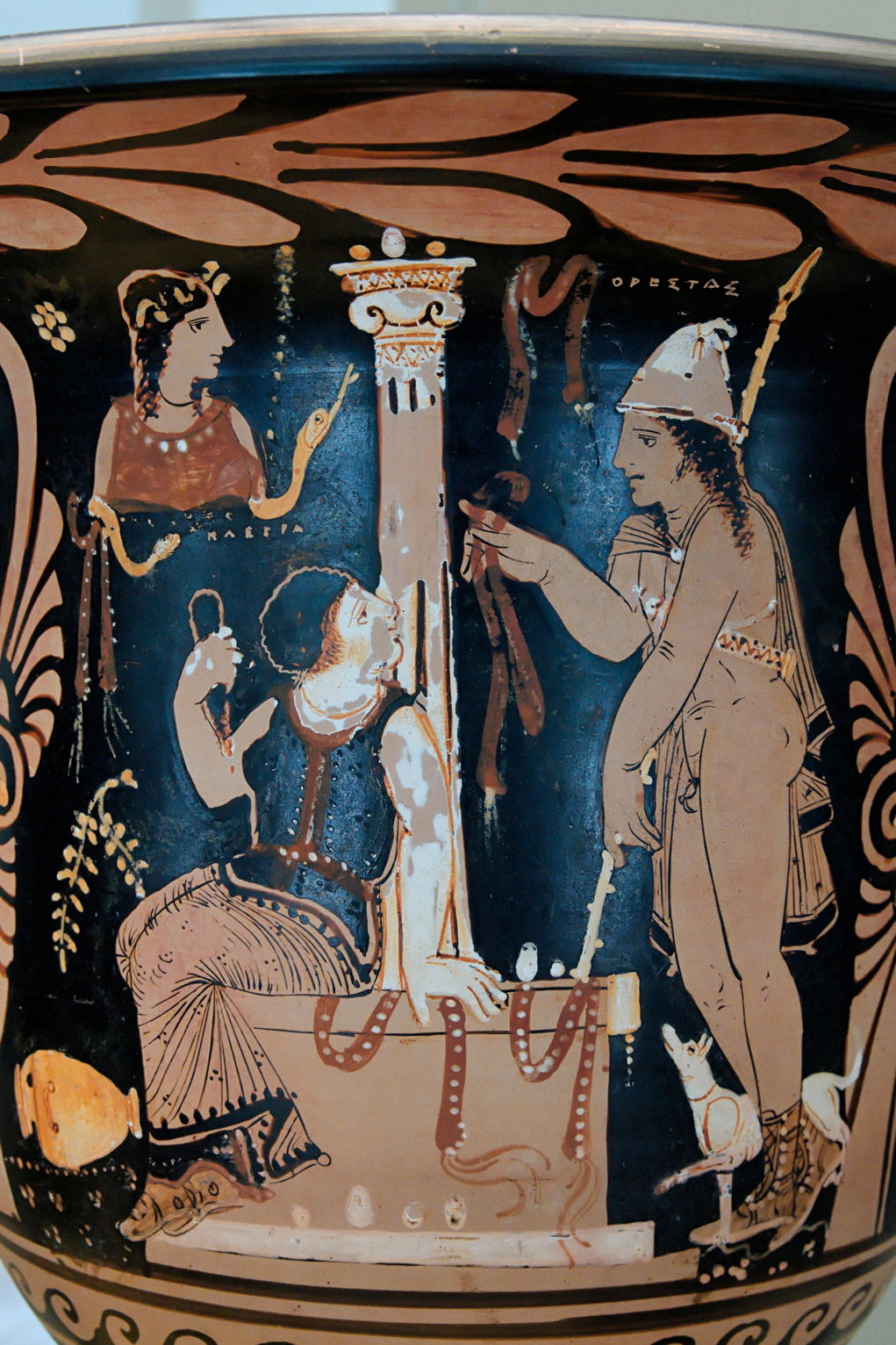
This depiction of the Meeting of Electra and Orestes at the Tomb of Agamemnon from 340-330 BCE shows Orestes meeting his sister Electra at their father’s tomb, variations of which have been shown in more recent paintings too.
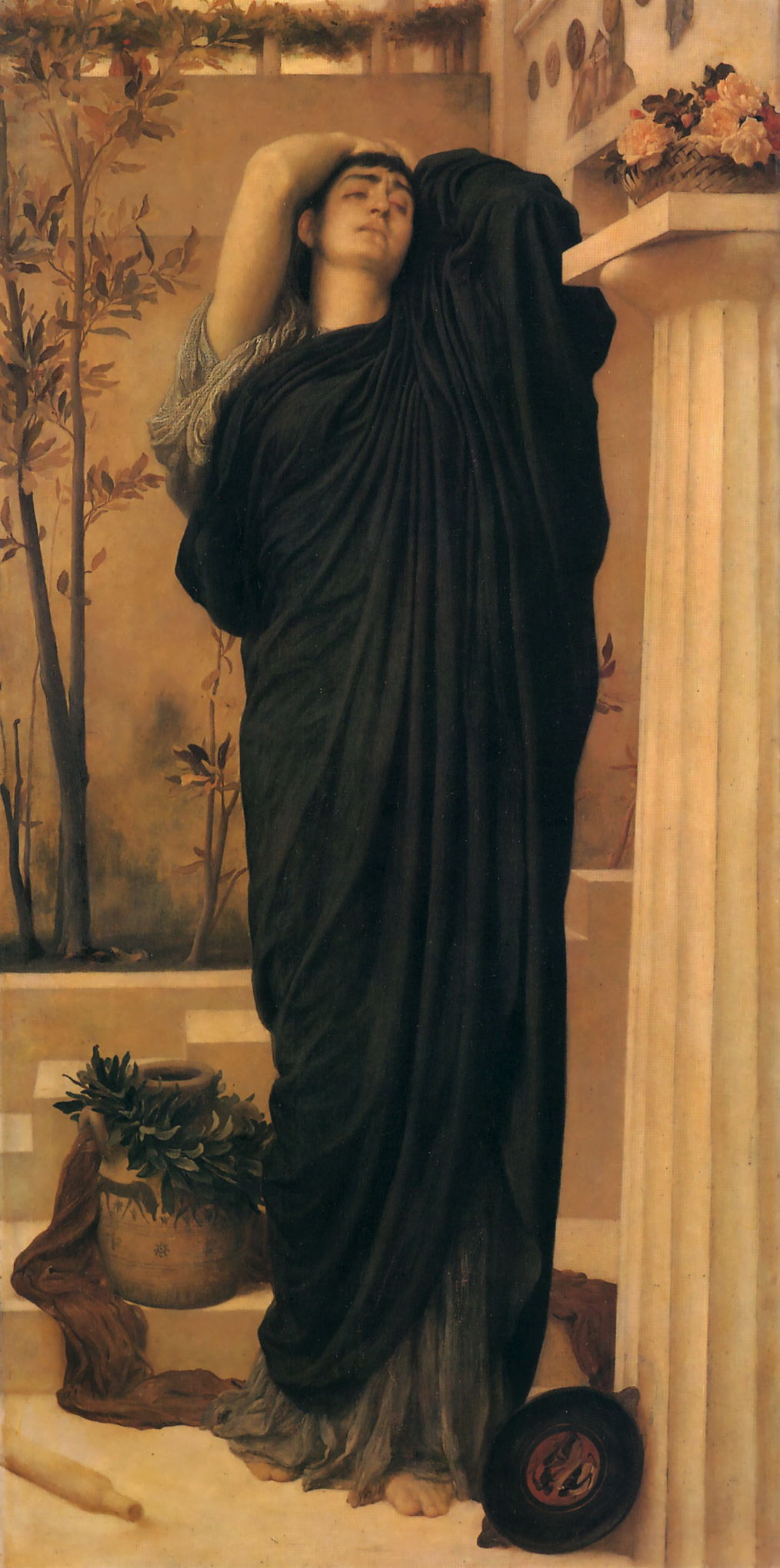
Frederic, Lord Leighton shows Electra in funereal black, beside a substantial mausoleum. She is in profound grief, her brows knitted, her eyes closed and their lids puffy from tears. Her arms are thrust up behind her head, where her hands are pressed against the top of her head, in a ritual gesture as if tearing her hair.

In this drawing of an undated krater in Naples, Orestes has been driven to seek sanctuary at Delphi, and in the top left is a black Fury pointing a snake towards the figures.
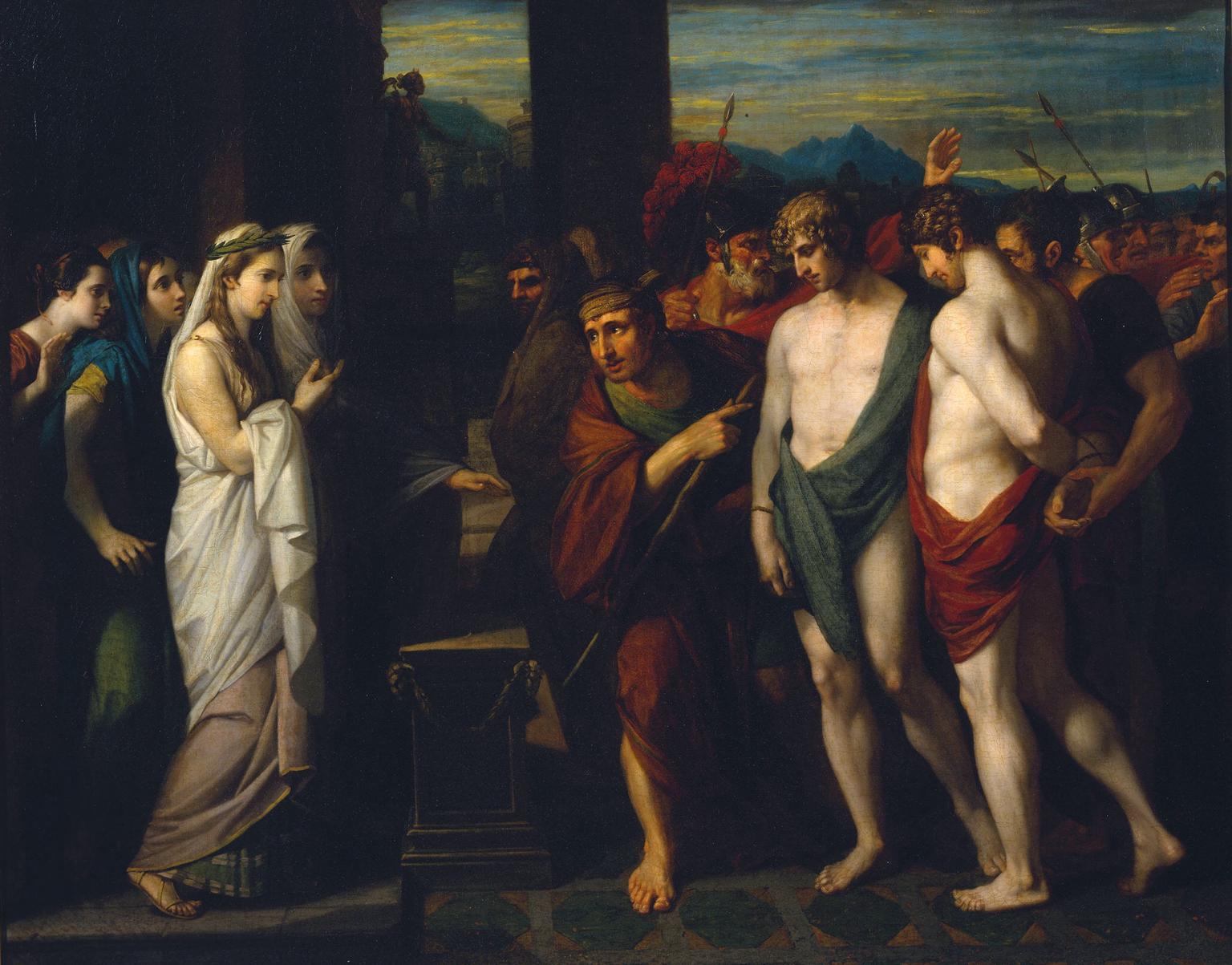
Benjamin West is claimed to have painted Pylades and Orestes Brought as Victims before Iphigenia soon after his arrival in England. In this scene, Orestes and Pylades, his cousin, are prominent in the right foreground. They have been brought before Iphigenia, a priestess of Diana, prominent in the left foreground, who stands in judgement over them.
Following his matricide, Orestes was told by the Oracle at Delphi to make reparation by returning to Delphi the gold statue of Diana, seen in the distance slightly to the left of centre. In attempting to seize and remove that statue, Orestes was committing an act of sacrilege, for which he and Pylades are to be sacrificed on the low altar between the priestess and the young men.

Sargent’s large masterpiece Orestes Pursued by the Furies was started in 1922, and completed in 1925, just prior to his death. Over its 100 square feet of canvas, it shows a young and naked Orestes cowering under the attacks of the Furies, as he tries to run from them. The swarm of no less than a dozen fearsome Furies have daemonic mask-like faces, blond hair swept back, and hold out burning brands and fistfuls of small snakes.
For all their military triumph, the returning Greeks were ill-fated. Next week I’ll start telling the story of one of the few Trojan warriors to survive.
 The Eclectic Light Company