
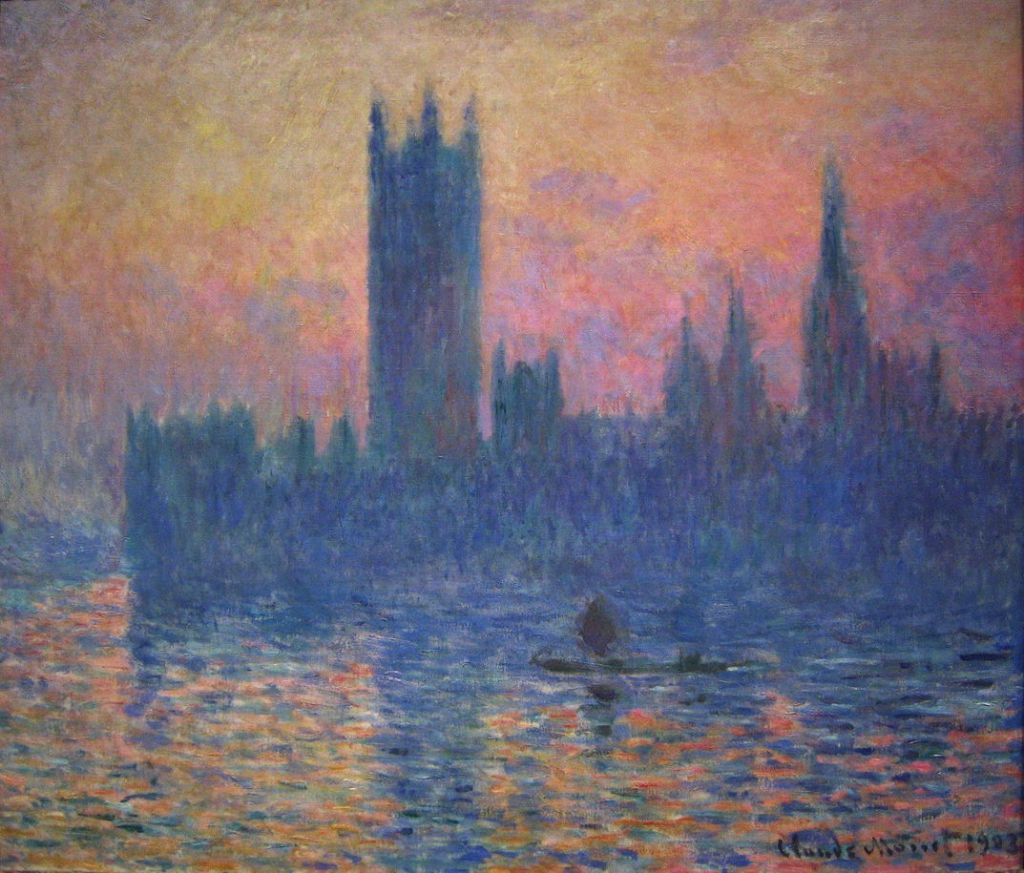
Claude Monet visited London at least five times. The first was in 1870-71, when he sheltered there during the Franco-Prussian War, and painted a little. He returned briefly in 1898, when I don’t think he had time to paint. He then returned for three substantial visits in 1899, 1900 and 1901, a total of six months, when he painted some of his finest series from the banks of the River Thames.

Most of his views show the Palace of Westminster, seen here in 2005, with its distinctive Elizabeth Tower housing Big Ben at the right. At the opposite end, to the south-west of the site, is the larger and higher Victoria Tower, and the middle of the waterfront has the smallest spire-like Central Tower.

To aid location of Monet’s vantage points, I refer to the circled numbers on this map.
1870-71
When the Franco-Prussian War started in 1870, Monet, his family, and Pissarro fled to London, where they saw the works of Constable and Turner. Pissarro lived in, and painted, the leafy suburbs of London around Norwood, Monet worked more in central London. He submitted paintings for the Royal Academy exhibition in early 1871, but they were refused. He then left London for Zaandam in the Netherlands, returning to France later that year.

Monet’s The Thames below Westminster (1871) is a radical departure from all previous views of this section of the Thames. Painted from the Embankment to the north of Westminster Bridge, near what is now Whitehall (⑦), the three towers to the south are almost superimposed, and show exaggerated aerial perspective with the mist. The river is bustling with small paddleboat steamers. In the foreground a pier under construction is shown almost in silhouette. The small waves and reflections on the river are painted with coarse brushstrokes, adding to the impression that this is a rapid and spontaneous work.

Fog is exactly the sort of transient effect of light and atmosphere the Impressionists sought out. The following year, when he had returned home, Monet painted the view which gave rise to the style’s name, Impression, Sunrise. This appears to be a brisk oil sketch of fog and the rising sun in his home port of Le Havre, on the Channel coast, and one of a series showing the port at different times and in varying lights. Monet exhibited this in the First Impressionist Exhibition in 1874, where its name became that of the whole movement and its distinctive style.
1899-1901

When he returned to London in 1899, and in the following two years, staying at the Savoy Hotel, Monet chose a very different view of the Palace, from a location at the opposite end of Westminster Bridge, for his series of 19 paintings. These were all started from the second floor of the Administrative Block at the northern end of the old Saint Thomas’s Hospital on the ‘south’ bank (Khan, 2011) (④), and completed slowly over the following three or four years.
His The Houses of Parliament, Sunlight Effect (1903) is even more radical than the painting of thirty years before, showing little more than the Palace in silhouette, the sun low in the sky, and its broken reflections in the water.

The Houses of Parliament, Sunset (1903) shows the same view in better visibility, but with the sun setting and a small boat on the move in front of the Palace.
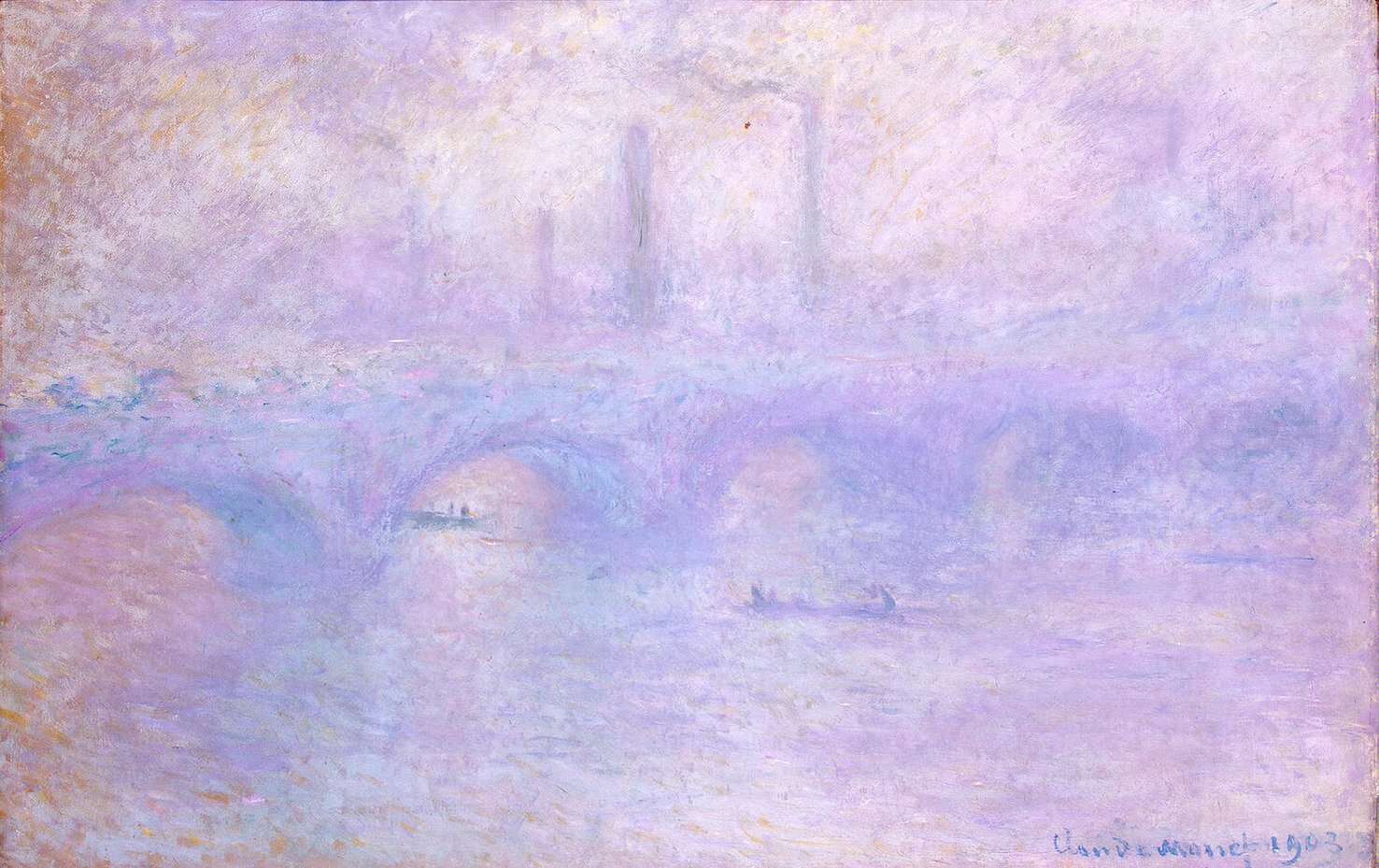
Monet’s Waterloo Bridge from 1903 is the ultimate conclusion of his paintings of fog, in which only the vaguest of forms resolve in its pale purple and blue vagueness. His location here is hard to estimate, but was probably on the south bank of the Thames, between Waterloo and Blackfriars Bridges.

In The Houses of Parliament, Stormy Sky (1904) the sun is higher and further to the south, allowing Monet to balance the silhouette of the Palace with its shadow cast on the water, and the brightness in the sky with its fragmented reflections. This appears to have been painted from his earlier location, ④ on the map above.
From those three visits, Monet painted a total of about a hundred views of the River Thames, its bridges, and the Palace of Westminster.
References
Wikipedia on Monet’s Parliament series
Baker J and Thornes JE (2006) Solar position within Monet’s Houses of Parliament, Proc Roy Soc A 462:3775-3788. doi:10.1098/rspa.2006.1754
Khan SF (2011) Monet at the Savoy Hotel and the London Fogs 1899-1901, PhD thesis, University of Birmingham. Available here.

