
By the early 1880s, many painters had made instantaneous narrative paintings that didn’t resolve, and those were starting to attract a following at exhibitions. This article looks at some examples shown to the public during the decade prior to the coining of the phrase ‘problem picture’, 1885-95.

Marie Spartali Stillman was one of the last of the Pre-Raphaelites, who continued to develop Pre-Raphaelite narrative painting long after the movement had ceased to exist, in her extensively worked watercolours. In 1885, she took a break from her favourite themes of Dante and the early Renaissance. In Love’s Messenger, the finest of her single-figure paintings and one of her most successful, she invites the viewer to speculate about a previously untold and open story.
The woman stands by her embroidery at an outside window. On her right hand is a messenger dove/pigeon, to which a letter is attached. She clutches that letter to her breast with her left hand, implying that its contents relate to matters of the heart. The dove is being fed corn, which could either be its reward for having reached its destination, making the woman the recipient of the message, or preparation for its departure if she is the sender.
On balance, the presence of corn on the windowsill implies that it’s more likely that the dove has just arrived, and the woman is the recipient. These clues are accompanied by alternative interpretations of the other objects and symbols, such as the embroidery.

Another of the leading women painters of the day, Henrietta Rae, tested the water with some unresolved narrative about the same theme, relationships between men and women.
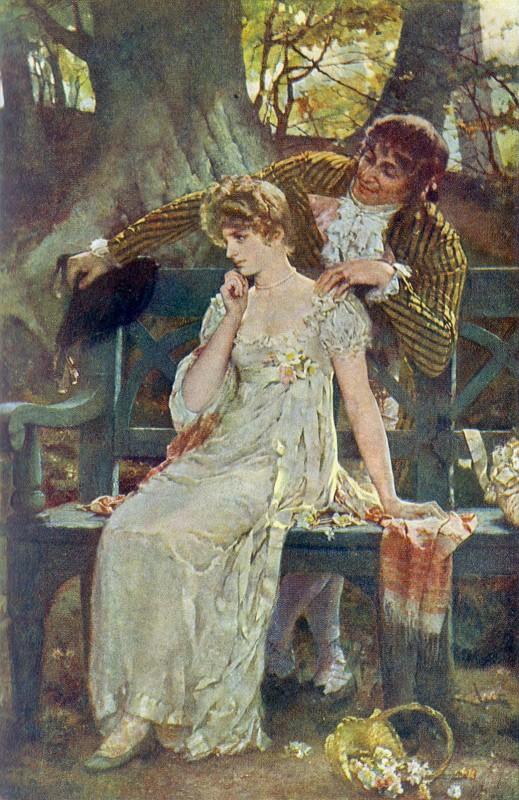
Rae’s Doubts from 1886 may additionally have been incisive social comment. A young woman sits on a garden bench, clearly in a quandary. Behind her, forcing his attentions on her, is an older man who is dressed as a tasteless fop. Around her are signs of his attempts to charm her with baskets of flowers. The ring finger on his left hand is already occupied, suggesting he may even be proposing an adulterous relationship, and perhaps referring to the ‘kept woman’, as in William Holman Hunt’s earlier The Awakening Conscience (1851-53).
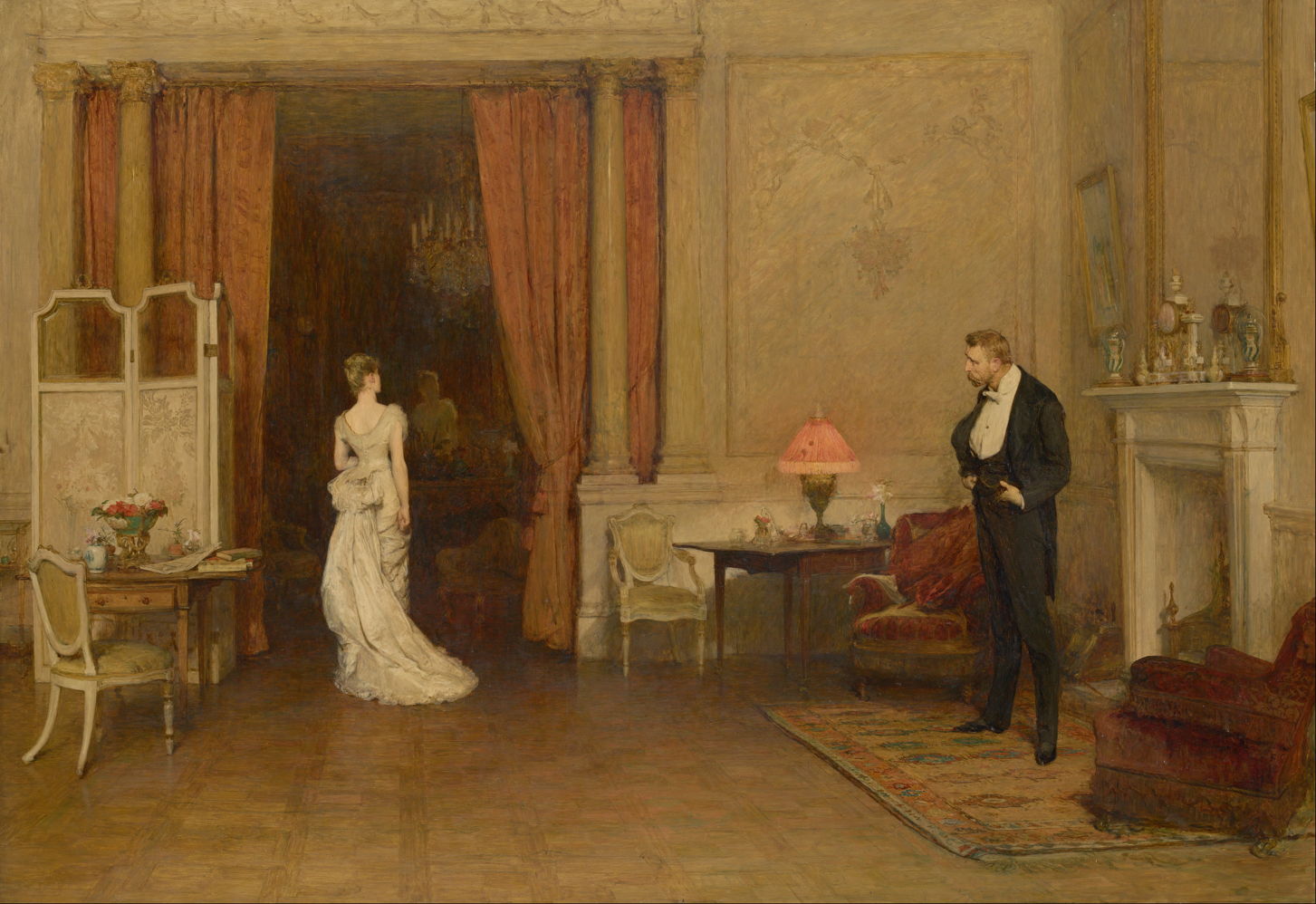
William Quiller Orchardson painted a series of three works about unhappy marriage, a highly topical subject at the time. The last of these, The First Cloud from 1887, continues its thread of a young and pretty bride who marries an older man for his wealth. With their faces largely concealed, the narrative relies on their body language and physical distance. When it was first exhibited, the following lines from Tennyson appeared on it:
It is the little rift within the lute
That by-and-by will make the music mute.
Unresolved narrative was also becoming prevalent in the Nordic countries. The first of two examples by Hans Andersen Brendekilde from Denmark tackles contemporary social issues common across Europe.

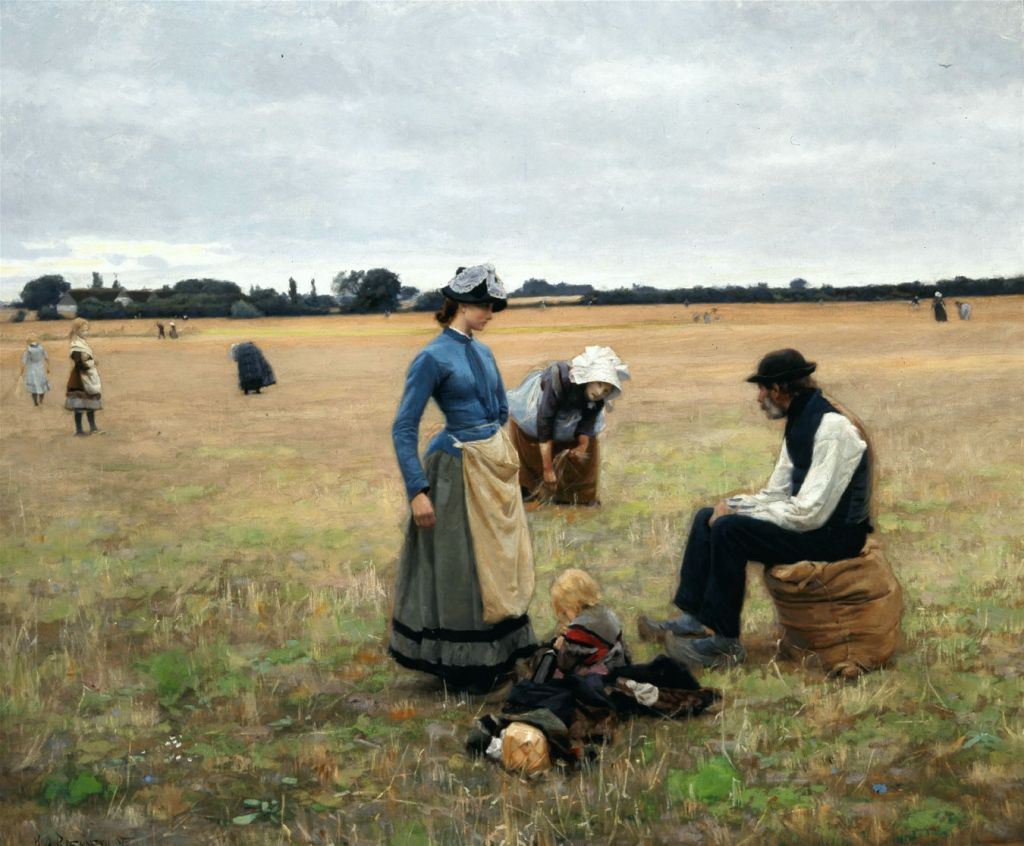
Like many of the best of these unresolved narratives, Brendekilde’s Cowed from 1887 requires careful reading which would have been considerably easier for the viewers of the time.
Superficially, it shows gleaners at work in a field after the harvest, but there’s much more to its story than that. Being gleaners, these are among the poorest of the poor. The owner of the large farm in the left distance has gathered in their grain, and their harvesters have been paid off for their effort. Then out come the losers, to scavenge what they can from the barren fields.
The family group in front of us consists of three generations: mother is still bent over, hard at work gleaning her handful of corn. Her husband is taking a short break, sitting on a sack in his large blue wooden clogs. Stood looking at him is their daughter, engaged in a serious conversation with her father, as her young child plays on the ground.
The daughter is finely dressed under her coarse gleaning apron, and wears a hat more appropriate to someone ‘in service’ as a maid or similar, in a rich household in the nearby town. She looks anxious and flushed. She is almost certainly an unmarried mother, abandoned by her young child’s father, and it’s surely she who is oppressed or ‘cowed’. Their difficult family discussion is being watched by another young woman at the far left, who could be a younger sister.

In 1892, John Everett Millais returned with his Blow Blow Thou Winter Wind. It’s a bitter day in the British winter, snow already on the ground and more on its way. An icy wind is blowing, and there is little shelter. In the foreground, a destitute mother sits cradling her young baby inside an inadequate shawl, her few worldly possessions in a small bundle beside her. Behind, a dog bays into the air, and a man walks into the distance.
The viewer is invited to speculate on the relationship, if any, between the man and the woman, and the circumstances by which she and her baby find themselves in such straits. At the time it would inevitably have evoked the theme of the ‘fallen woman’ in its variations.

Brendekilde’s social-realist People by a Road, from 1893, shows a young carpenter with references to Jesus Christ, preaching to a family of itinerant stone-breakers. The group at the left are old road-workers, breaking larger rocks into coarse gravel. They may well have lived out under the wooden shelter behind them, as they slowly made their way along the road. Standing and apparently preaching to them is a cleanly-dressed carpenter, his saw held in his left hand. The building behind them, on the opposite side of the road, is a church, from which a large congregation has just emerged.

One of Millais’ last paintings before his death the following year was Speak! Speak! (1895), also one of his most enigmatic. At this stage of his life, he spent much of his time in Scotland, either in his home near Bowerswell where this was painted, or in the castle and estate at Murthly in Perthshire, where he went shooting and fishing. He bought this huge four-poster bed from Perth for this painting, and had the lamp copied from one he had seen in the Victoria and Albert Museum.
Millais’ son later reported this scene was intended to be set in ancient Rome, where the young man had spent much of the night reading through the letters of his lost love. At dawn, the curtains were parted to reveal her, dressed for her bridal night, gazing upon him with sad but loving eyes. The title of the painting is therefore the words he said to her spectre, and must at the time, given the artist’s own terminal illness, have had personal relevance too. The woman’s figure is intentionally ambiguous, Millais himself being unsure as to whether she was real, or just a spectre.
That year William Frederick Yeames’ Defendant and Counsel (1895) was exhibited in London, illustrated as an engraving in newspapers, and so became the first mass-market problem picture in Britain.

