

Among Claude Monet’s most remarkable and distinctive achievements were his series paintings. This article considers how they developed, outlines some of the major series he painted, and what he intended by painting them. Because of the difficulties distinguishing one member of a series from others, I refer to them by their approximate title and their number in the Wildenstein catalogue raisoné, for example W123.
The road to series paintings
From some of the earliest paintings in his long career, Monet made two or more representations of the same motif. For instance, in 1864, he painted two similar versions of La Rue de la Bavolle, à Honfleur (W33, W34), and three similar versions of another view at Honfleur (W37, W38, and W51). It is also worth noting that in 1865 he painted his first Grainstack, although on that occasion it was a singleton.
He painted three identical compositions of a view of Le pont du chemin de fer, Argenteuil, in W318, W319, and W320, in 1874, where the differences were mainly in movable elements such as boats and trains, and in light. The following year he reached a group of four, although this time there were changes in composition too, in Red Boats at Argenteuil (W368, W369, W370, W371).
In 1878, his first loose series started to appear, with Branches of the Seine at Vétheuil (W481, W481a, W482, W483, W484), but with slight changes of view, in addition to different effects of light. Closer matches exist between paintings of the Banks of the Seine at Lavacourt, in summer (W495, W496, W497, W498, W499) and winter (W513, W514), painted in 1878-9.
Another suggested early series is that of the Cabane des Douaniers of 1882, but I can only see four branches, of 2-4 works each, making a total of 13 (W731 to W743), which could be coincidence rather than a series. There is no doubt, though, that his paintings of Pourville in the same year amount to a series with two branches, one consisting of W776 to W782, the other W783 to W786, a total of 13 again.

Monet painted several views of the Manneporte in 1882, but I cannot see any real series among them, and in 1884 painted his second Grainstacks, in just 3 canvases. A different three Grainstacks were painted in 1885 (W993 to W995), which were unusual in including figures.
Monet returned to the Manneporte at Étretat in 1885-6, and completed a loose-branched series; one of its four branches consists of six canvases, W1014, W1014a, W1015, W1015a, W1044, and W1045, but the other branches are smaller in number, making 13 paintings in all.

Later in 1886 he completed a short series of the Pyramides de Port-Coton (6 paintings, W1084 to W1089), and three smaller groups at Belle-Île. This was followed in 1888 by a series of 6 paintings of Antibes (W1158, W1159, W1160, W1161, W1161a, W1163), and in 1888-9 by 6 more Grainstacks, W1213 to W1217 and W1217a, the last being sadly destroyed later by fire.

Major series

Working through the catalogue raisoné, I can see the following major series:
- 1889, La Vallée de la Creuse, 10 paintings W1219 to W1227
- 1890-1, the main Grainstacks, 25 paintings W1266 to W1290, discussed below
- 1891, Les Peupliers, 11 paintings W1291 to W1301,
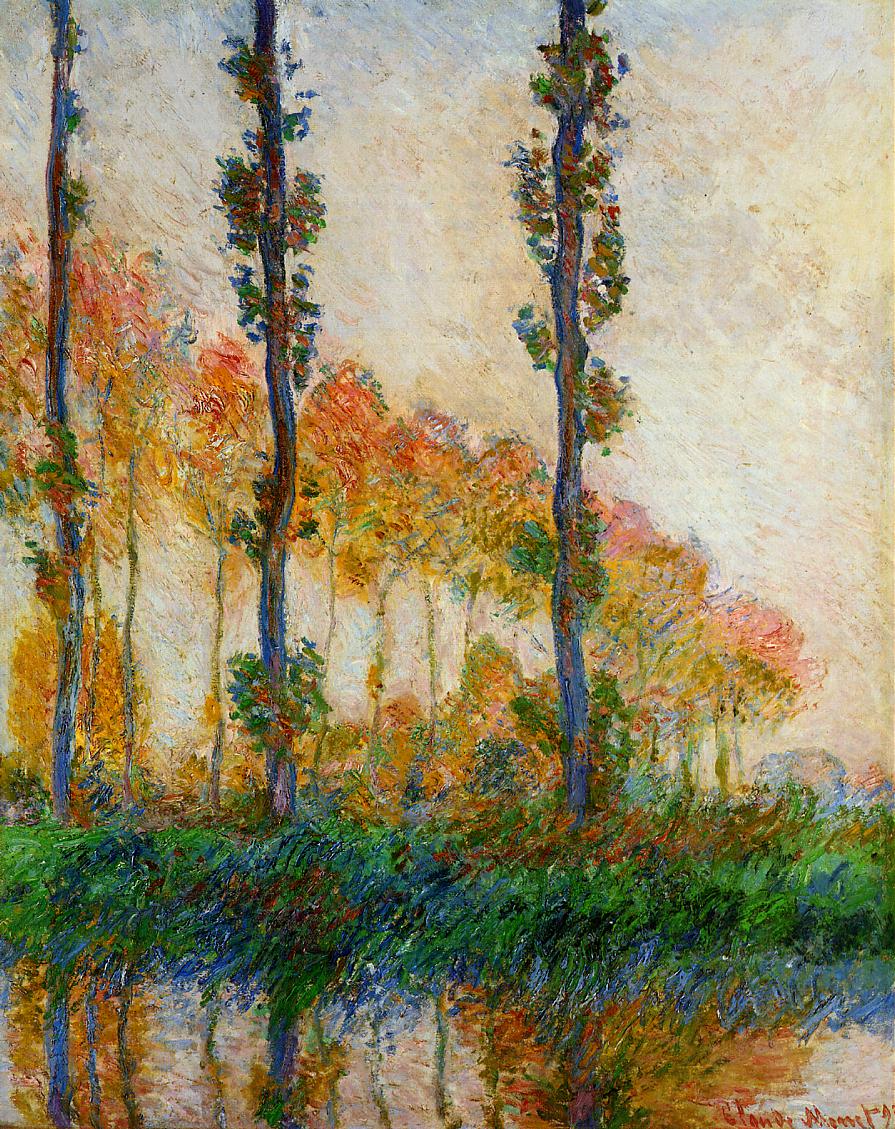
- 1891, Les Trois Arbres (a branch of Les Peupliers), 6 paintings W1303 to W1308,
- 1892-4, Rouen Cathedral, 9 paintings W1321 to W1329 (W1319 and W1320 preparatory), and 17 paintings W1345 to W1361,
- 1893, Les Glaçons, Bennecourt, 7 paintings W1333 to W1338a,
- 1894, La Seine à Port-Villez, 6 paintings W1370 to W1375,
- 1894, Vernon, 7 paintings W1380 to W1391a,
- 1895, Mont Kolsaas, Norway, 13 paintings W1406 to W1418,
- 1895-7, Pourville, 7 paintings W1421 to W1427, and 6 paintings W1440 to W1444,
- 1896, La Seine, 4 paintings W1435 to W1437, and 17 paintings W1472 to W1488.
It would be tedious to continue tracing further series in Monet’s work, but the great majority of his remaining paintings should be classified as belonging to one or other of his late series:
- Water lilies (Nympheas),
- The (Japanese) Bridge at Giverny,
- Charing Cross Bridge, London,
- Waterloo Bridge, London,
- The Houses of Parliament, London,
- Various Venetian series, including the Palazzo Dario, and the Grand Canal and Santa Maria della Salute.

In the period 1890 to 1897, Monet painted few works which were not part of a series, and after 1896, almost all his paintings were in series.
Motivation
It is clear that Monet was, intentionally or not, painting loose series well before the exhibition in May 1891 made his Grainstacks series so famous, and well before the even better planned Rouen Cathedral series of 1892-4. However neither he nor his major dealer, Durand-Ruel, had made any particular fuss about previous series, nor do I believe that they were exhibited as series, at least not until long after Monet’s death. Why did this change?

I think the answer lies in the crisis that Monet and his school of Impressionism was going through in the later 1880s. Suddenly Neo-Impressionism (Divisionism), with its claim to a ‘more scientific basis’ and spectacular paintings by Signac, Seurat, and Pissarro, had stolen the limelight. Monet was no longer in the lead of the avant garde, and had to respond.
His response was ingenious, as there was no way the Divisionists could assemble series of 15 paintings or more to capture their ‘moments’, given the painstaking technique required. Series were also a visible return to the core values of Impressionism, reinforcing its objective of capturing fleeting moments in time, something that Divisionism couldn’t claim.

However his working methods had become anything but brisk. Instead of taking just a few weeks en plein air to paint 15 Grainstacks, as he might have done in the 1880s, it took him more than 6 months, during which he manipulated their market to ensure strong sales when they were ready.
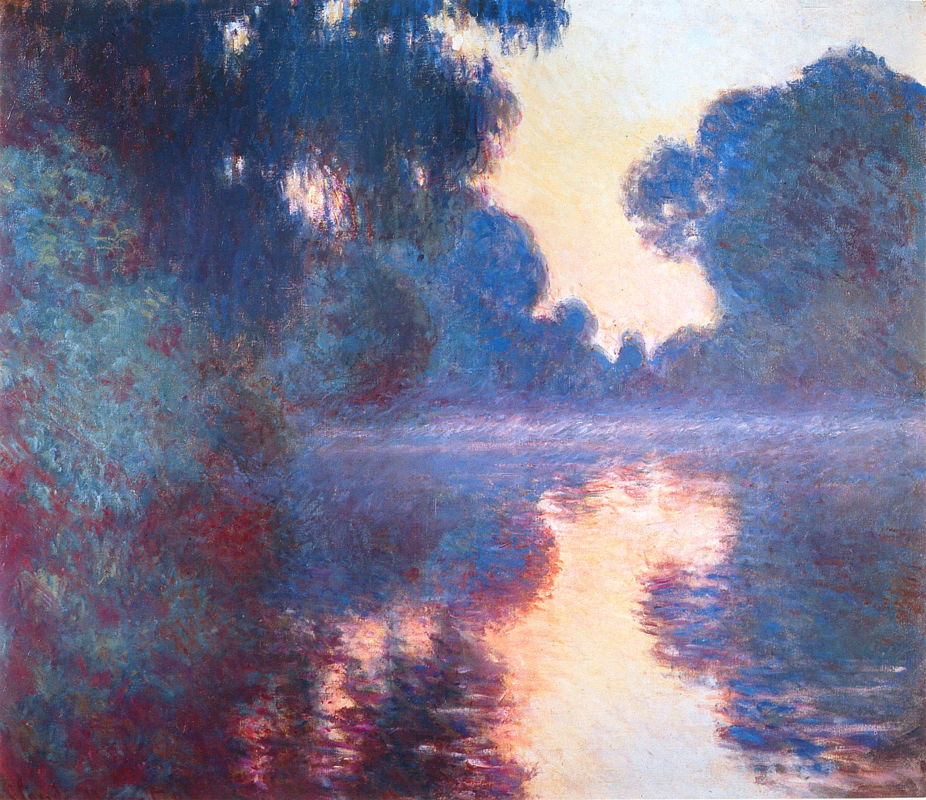
Looking at those paintings, while they may well have been started en plein air, there had been a sustained studio phase for each, with layers of wet-on-dry, not the wet-on-wet characteristic of the rapid work in front of the motif as portrayed in the Grainstacks myth. Several have significant pentimenti where Monet adjusted their original composition.
For Monet series made both artistic sense and were commercially ideal. He was able to explore the effects of light, colour, and his sensations, however instant or delayed, across a series of paintings with essentially simple motifs and compositions, in which figures were either small or absent altogether.
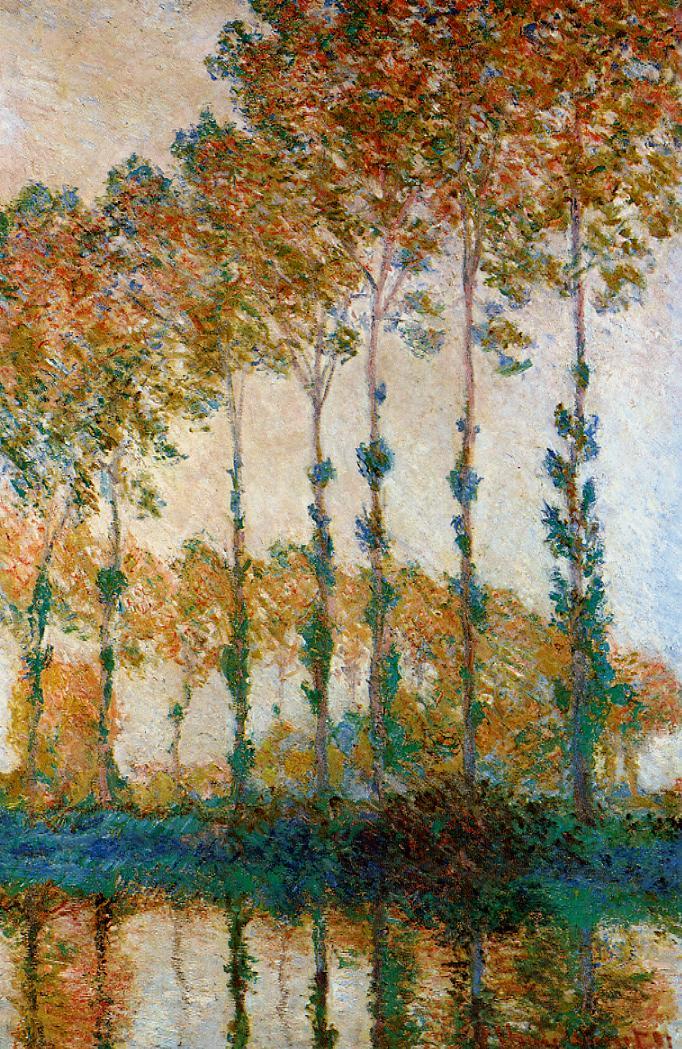
For his sales and repayment of the heavy investment made by Durand-Ruel and other dealers, they were honeypots. Effectively limited editions, most were snapped up briskly at excellent prices. The new collectors of Impressionist art, and of Monet’s work in particular, all wanted a chance to own a painting from his series, and were given the opportunity, for a price. Hence the paintings in each series have been dispersed across the globe, and are so seldom seen together as series, which defeats the artistic objective, of course.
Grainstacks, 1890-91
The French word in each title in this series is meules, which here means a stack of cut cereal with the grain still attached, a grainstack rather than haystack containing hay or straw, the threshed cereal. In the late nineteenth century in northern France, it was standard practice to cut cereal crops when they were ready at the end of the summer, then to stack the intact stalks and heads until an itinerant threshing machine visited the area, and the grain could be separated from the straw.
Monet first painted a series of canvases depicting grainstacks at Giverny, literally outside his back yard, in 1889. In the early autumn of 1890, he started a fresh series consisting of two grainstacks, now accorded Wildenstein numbers of W1266 to W1279. During that winter, the farmer was able to start threshing, and one of those grainstacks was consumed.
Apparently Monet paid the farmer to retain the single remaining grainstack to enable him to continue the series, allowing him to paint W1280 to W1290, each showing that single grainstack. After various delays while Monet apparently made further adjustments to the paintings in the series, the first fifteen canvases were shown at an exhibition at the Durand-Ruel Gallery in Paris, which opened on 4 May 1891. They all sold, for sums of up to 1,000 francs, and provided Monet with an excellent return for his winter’s work.
The remaining ten paintings in the series were sold to Durand-Ruel and other dealers by the end of 1891, and all have now been dispersed into art galleries and private collections around the world. Wikipedia’s article on the series here gives further details. However, the last time most of the works in this series were shown together was in May 1891. The following year Monet started his still more famous series of Rouen Cathedral, completed in 1894.

The myth about the Grainstacks is that they depict transient effects of season, weather, and light, as they were painted en plein air over the course of the winter. Looking at all twenty-five, I have long had my doubts, and suspected that Monet spent a lot of the time prior to their exhibition making further changes to them, which couldn’t have been en plein air nor faithful accounts of each motif at the moment they depict. This in no way lessens Monet’s sublime achievement, nor their art in any way. It’s just that they aren’t the paintings described by the myth that has grown around them.

Looking at Grainstacks, End of Summer, considered to be one of the earliest in the series and numbered 1266, the trees behind the two grainstacks are still in full summer leaf, with no indication of the advent of autumn. Yet Monet’s signature gives the year as 1891. Looking at its paint surface in detail (below), some has been applied wet-in-wet and blended with underlying and adjacent paint, but many other brushstrokes have clearly been applied over dry under-layers.

The blue-grey shadow of this grainstack was applied with relatively dilute paint wet-on-dry over thicker off-white paint which has marked surface texture. However, that off-white paint has itself been applied wet-on-dry over a pale green layer. This couldn’t have been achieved in the same day, even when the ambient temperature was warmer during the early autumn, but probably reflects at least three sessions with drying time in between them.
Looking later in the series, at paintings which were most probably started in early 1891, when there was still snow on the ground, there is strong evidence of similar methods, with layers applied wet-on-dry and pentimenti to adjust the composition. Drying of oil paint during the winter is prolonged, and it may have been weeks before under-layers were sufficiently dry for overpainting in this way.


Grainstack, Sun in the Mist, numbered 1286, is thought to be one of the later paintings in the series, apparently showing the sole remaining grainstack in the Spring of 1891. It too has multiple layers applied wet-on-dry, with many hatched brushstrokes in shades of orange and pink apparently applied over a well-dried surface. These are again shown well in the detail (below) of the grainstack itself.
At the right side of the foot of the grainstack, the lowest layer of paint consists of dull blue and green which appear to have been applied at about the same time and have blended in places. When that layer had dried, infrequent and relatively thick streaks of white were added wet-on-dry. When that had dried, brown-orange was applied to form the uppermost layer. That uppermost layer has also been used to remodel the form of the grainstack using thickly applied flesh, pale yellow and orange paint.

The evidence points to Monet starting each of this series with a sketch using more dilute paint in front of the motif in the circumstances described in the title. He then brought each canvas into his studio, where he continued to work on it, making further adjustments, adding partial layers of paint, and tweaking each work in comparison to the others in the series. This would have taken place over a period of several weeks: in the case of the canvases started at the end of the summer of 1890, such as W1266 above, that could have amounted to six months.
References
Tucker PH (1989) Monet in the ’90s. The Series Paintings, Museum of Fine Arts Boston and Yale UP. ISBN 0 300 04659 6.
Wildenstein D (1996) Monet, 4 vols, Taschen and the Wildenstein Institute. ISBN 3 8228 8559 2. (The first volume is Wildenstein’s biography The Triumph of Impressionism, now available separately, and the excellently illustrated catalogue raisoné fills another three huge volumes.)

