
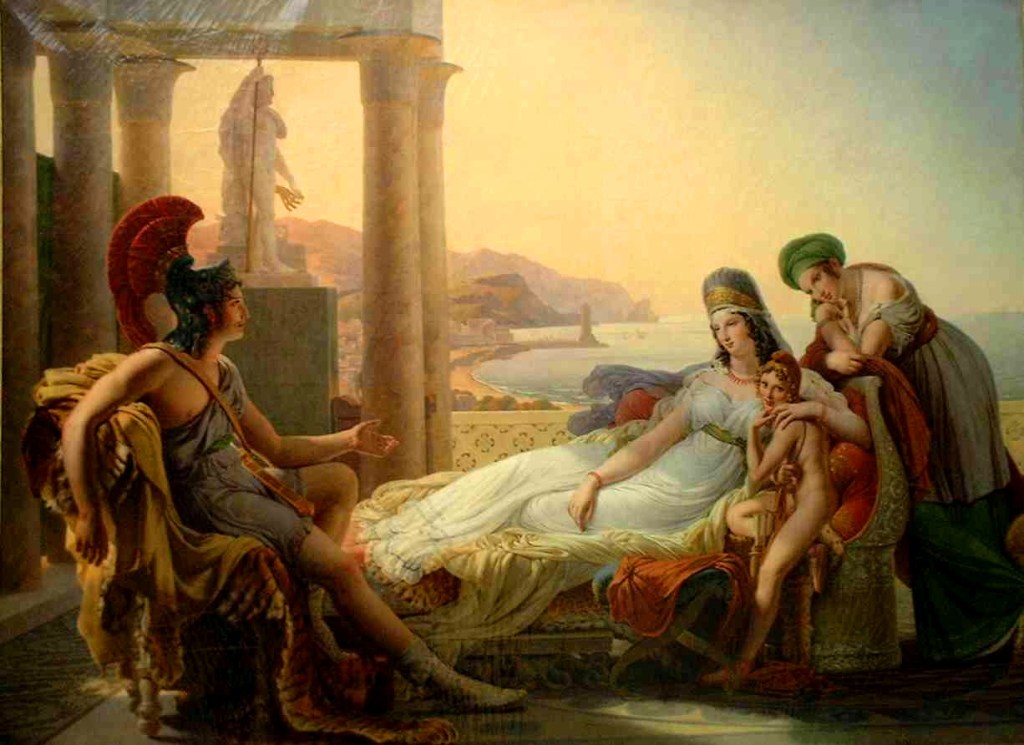
Aeneas and his men had fled Troy as it was being sacked, and started their journey around the Mediterranean in search of their destiny. After they fought with the harpies on the Strophades, their leader Celaeno told them to leave and head for Italy, where she prophesied they would become so hungry that they would eat their tables, before reaching their goal.
They eventually round the south-eastern tip of Italy, but are caught in the whirlpool of Charybdis when trying to pass between the mainland and the island of Sicily, and are forced ashore. There they rescue one of Odysseus’ crew and escape the giant Polyphemus. Aeneas’ father Anchises then dies of old age, and they turn to head north.
Juno has it in for Aeneas and his men, so gets Aeolus, King of the Winds, to blow the fleet south again. This angers Poseidon, who brings calm to allow the remains of the fleet to shelter off the coast of North Africa. Aeneas’ mother Venus appears to her son and encourages him to enter the city of Carthage. She then tells Cupid to visit Dido, the recently widowed Queen of Carthage, and encourage her to love Aeneas.
Dido and her brother Pygmalion (not the better-known Pygmalion who fell in love with a statue) are of royal blood, probably the children and heirs of the King of Tyre. Dido married Sychaeus, but Pygmalion wanted their riches too, so had her husband murdered when he was at the altar in their home.
Dido took her riches and fled to North Africa, seeking sanctuary on a plot of land she acquired from the Berber King Iarbas, whom she rejected as a suitor. He gave her as much land as could be encompassed by an oxhide, so she ingeniously cut the oxhide up into thin strips, which she fastened end-to-end to enable her to circumscribe an entire hill. There she built the city of Carthage, into which she drew those who had fled with her, local Berbers and many others. The city had since grown wealthy and powerful with her as its queen.

JMW Turner depicts this in one of his works inspired by Claude Lorrain, Dido building Carthage, or The Rise of the Carthaginian Empire (1815). Dido is seen on the left bank, dressed in blue. Opposite is the monumental tomb of her husband Sychaeus.

Once ashore in Carthage, Aeneas meets Dido, as shown in Pierre-Narcisse Guérin’s Aeneas tells Dido the misfortunes of the City of Troy, painted in about 1815. He tells her the story of his escape from the ruins of Troy, and of his guilty secret, that his wife Creusa had become separated from the rest of the family, and was presumed dead.

It is Cézanne, in his watercolour sketch of Aeneas Meeting Dido at Carthage, painted in about 1875, who depicts this most clearly. Queen Dido is at the left, surrounded by her court. The warrior figure of Aeneas stands to the right of centre, and to the right of him is the shrouded spectre of Creusa.
Dido had sworn to her late husband that she would love no other, but as she and Aeneas get to know one another, both Juno and Venus (through her other son, Cupid) conspire to grow that into love. Venus wanted Dido to provide her son with a safe haven, and Juno wanted to halt his progress. This comes to a head when the couple go out with a hunting party, and take shelter in a cave from a torrential rainstorm brought by Juno. Virgil makes it explicit that they made love in that cave.

Francesco Solimena’s painting of The Royal Hunt of Dido and Aeneas from about 1712 shows the moment that Cupid has loosed his arrow at Aeneas.
As so often happens, Dido and Aeneas made love under different assumptions. For Dido, given her commitment to her husband, she consented on the basis that this was also the act of union in marriage. For Aeneas, who had made no such commitment to his wife, who disappeared in dubious circumstances, there was no such agreement, and he remained free to pursue his destiny.
The next external influence on the couple’s relationship then comes into play: Jupiter, wanting to hasten Aeneas on his journey to start the founding of Rome and to appease Dido’s rejected suitor, sends his messenger Mercury to tell Aeneas that he must not tarry with Dido, but prepare to sail, leaving her behind. Aeneas instructs his crew to get their ship ready to resume its journey in complete secrecy. He then goes to Dido to break the news to her, only to find she already knew of his intention to desert her, as he had previously abandoned Creusa.

Pompeo Batoni’s painting of Dido and Aeneas (1747) draws on ambiguity. It could be read as showing the couple after their lovemaking in the cave, with Dido still partly undressed, and Aeneas adjusting his clothes. However, the presence of Aeneas’ ship in the left background implies this is the moment that he has returned to break the news that he must sail shortly.
Behind the couple is Dido’s sister Anna. In Virgil’s account in the Aeneid, she goes to Aeneas to plead Dido’s case before the queen’s suicide; in Ovid’s later retelling in his Heroides, Anna takes Aeneas the letter written for her by Ovid.
Dido’s letter, as supposed by Ovid, is an elegaic tour de force. It expresses her side of the story and her view of their relationship brilliantly. She points out that she could well be pregnant with a brother for Aeneas’ son Ascanius. She appeals to his emotion in a calculating and crafted way. Most of all, she raises questions about Aeneas’ abandonment of Creusa, which should have had greatest impact on his heart. No matter what Mercury might say, how could Aeneas abandon a second wife as well?

Another of Claude Lorrain’s late paintings shows Aeneas’s Farewell to Dido in Carthage (1676). His fleet awaits him now, despite Dido’s passionate pleas for him to remain as her husband.
Mercury intervenes again, and Aeneas is driven to sail immediately. When Dido sees this, her only option is to fall on her sword, taking her own life.

In Joseph Stallaert’s The Death of Dido (1872), the queen has fallen on the sword given her by Aeneas, and now lies dying on the couch on which the couple had previously made love, pointing at his ship leaving harbour by the light of the early dawn. Resting her hand on Dido’s chest wound, her sister Anna comforts the queen in her dying moments, as the queen’s nurse and a maidservant are in attendance. There is no sign of a funeral pyre, but suggestive smoke is made by the small altar at the extreme left.

Normally titled The Death of Dido, Tiepolo’s painting from 1757-70 shows an odd composite scene in which Aeneas, packed and ready to sail with his ship, watches on as Dido suffers the agony of their separation, lying on the bed of her funeral pyre. A portentous puff of black smoke has just risen to the left, although it’s surely far too early for anyone to think of setting the timbers alight.

Henry Fuseli’s Dido (1781) has mounted her funeral pyre, and is on the couch on which she and Aeneas made love. She then fell on the sword given her by Aeneas, and that rests, covered with her blood, beside her, its tip pointing up towards her right breast. Her sister Anna rushes in to embrace her during her dying moments, and Jupiter sends Iris (above, wielding a golden sickle) to release Dido’s spirit from her body. Already smoke seems to be rising up from the pyre, which will confirm visually to Aeneas that she has killed herself, as he heads towards the horizon, and history moves towards the founding of Rome.

