

This weekend I’m bringing together words you seldom hear in the same sentence, let alone next to one another: British Impressionists and British beaches (mostly). Even the most enthusiastic student of nineteenth century European painting would be hard-pressed to name a British Impressionist, and precious few travellers ever come to Britain for its beaches. Nevertheless, I hope you’ll find these paintings worth a few moments of your time.
I start with an American by birth who was more of a herald than a recognised Impressionist, James Abbott McNeill Whistler, who loved sketching in oils on the beaches of Northern France.

Whistler often chose to travel from his studio in London to paint motifs which a decade or so later were to enter the Impressionist repertoire. His Crepuscule in Opal: Trouville, painted during a visit to the Normandy coast in 1865, is one of his many.

In the 1880s, Whistler painted more small outdoor views on panels, such as Harmony in Blue and Pearl: The Sands, Dieppe from about 1885. This is similar in size to equivalents painted by the Macchiaioli, and the Australian Impressionists, who called them ‘nine by fives’ as those were their dimensions in inches. His style is nothing if not sketchy, although characteristically not high in chroma.
Although Jacques-Émile Blanche was born in Paris, he spent much of his career painting portraits in his studio in London, and associated with British Impressionists in the New English Art Club.

In about 1886, Blanche took the opportunity for a short stay in Dieppe, where he painted Dieppe Beach in front of the Casino.
The quintessential British Impressionist was Philip Wilson Steer (1860-1942), who adopted the style during his training in Paris in 1882-84.

Steer’s early works, from around 1887, seem to have been painted on the beaches of northern France, including Children Paddling, Étaples (1887) above, and Boulogne Sands (1888-91) below. They’re bright, high in chroma, and appear to have been quick oil sketches painted en plein air during the summer. And if you know these beaches, you’ll recognise the importance of speed, before the weather can change to wind and rain as it often does even in the height of summer.
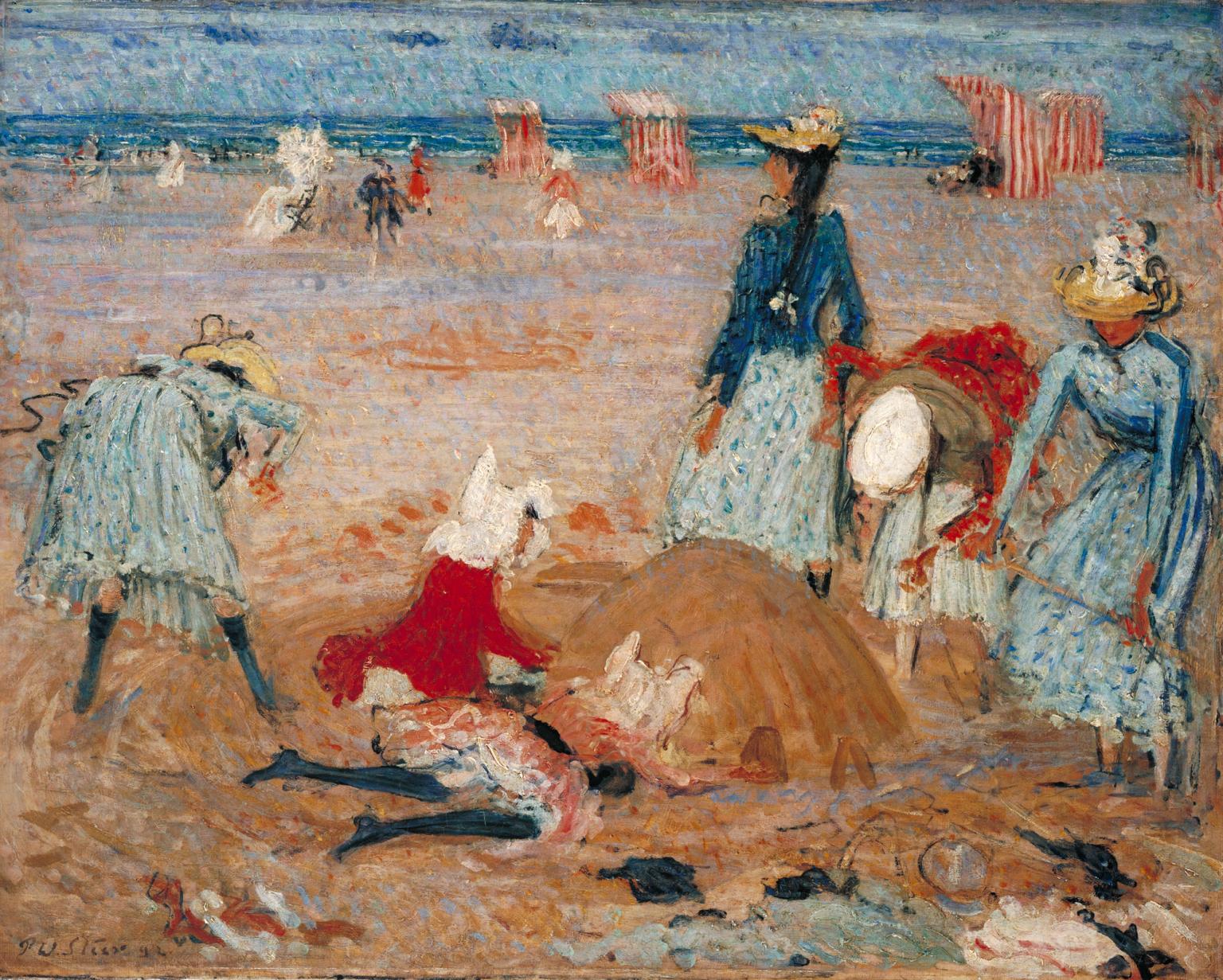
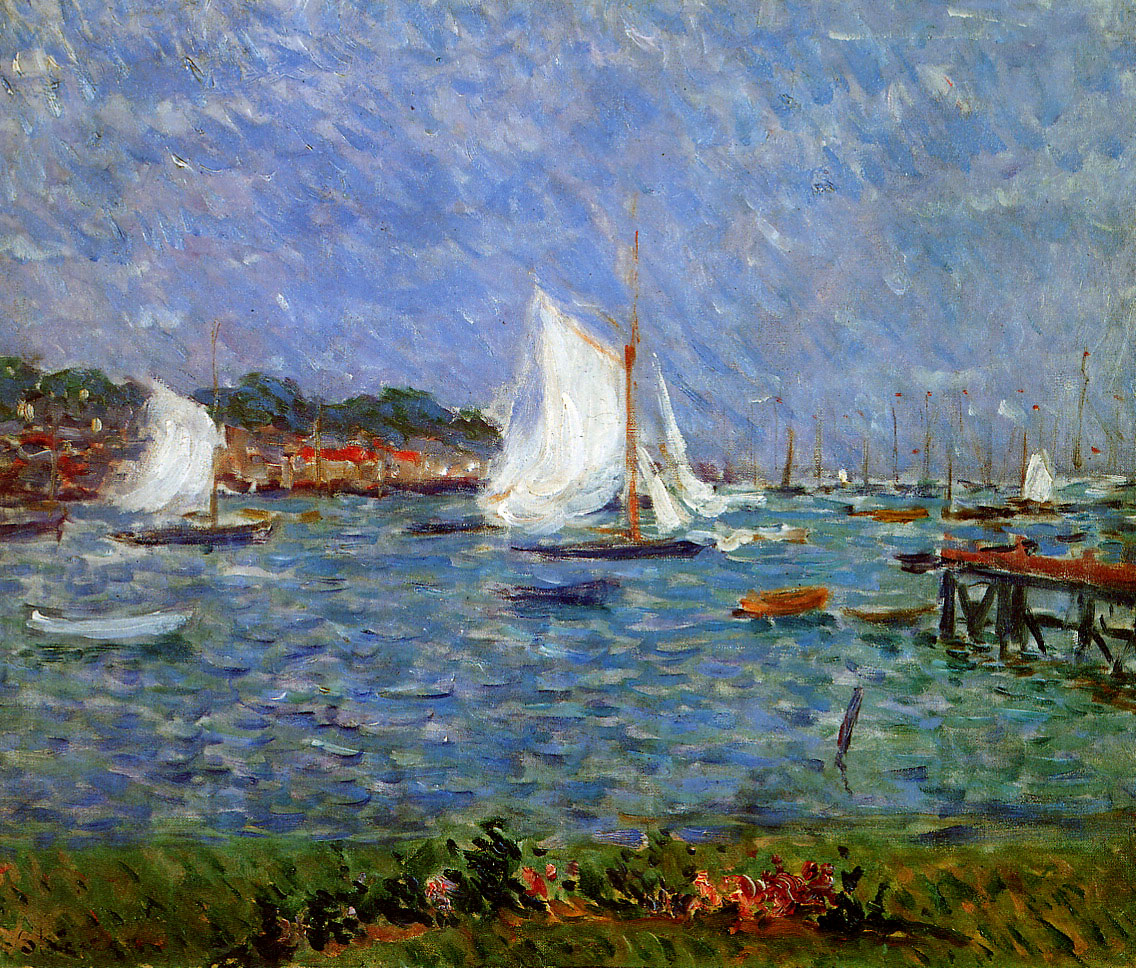
Steer’s coastal and beach views are among the most overtly Impressionist works painted in England in the late nineteenth century: this is Summer at Cowes, on the Isle of Wight, from 1888.

In the late 1880s, Steer was regularly visiting the coast of north Suffolk, painting in two small but popular resorts, Walberswick and Southwold, which are only a mile apart. Among the scenes he painted there are Girls Running, Walberswick Pier, above, and The Beach at Walberswick below, from about 1889. Originally, the two girls were shown to be holding hands, but Steer reworked that only to leave their shadows with their hands together.

In the autumn of 1888, Steer was the leader of a breakaway group from the New English Art Club that styled itself the London Impressionists. Their only exhibition was held at the Goupil Gallery in London in December of that year. He also exhibited five paintings at Les XX in Brussels, Belgium.

