
In 1898, the young Canadian artist Emily Carr set out from her home in British Columbia to paint the First Nations villages and forests of Vancouver Island. Over the following forty years she returned repeatedly to continue documenting the trees, people and their culture. In this article, I show a small selection of her portraits of trees.

In 1907, when visiting Baranof Island, she painted what was effectively her manifesto, in this view of the famous Totem Walk at Sitka (1907). The totems here were made by the Tlingit and Haida peoples, but had been removed from their original locations for display at the St Louis World’s Fair in 1904. Following that, they were moved again into this new park.
Sitka and Baranof Island are in a narrow coastal tongue at the far south of Alaska, where it meets the north-west of British Columbia. Sitka National Monument was declared three years after Carr completed this painting.

Her fascination with trees continued to develop in her watercolour of this Arbutus Tree from about 1909, probably painted near Vancouver. Known to Canadians as the arbutus, and the madrone or madrona in the US, these are more generally known as strawberry trees from the appearance of their fruit, and are evergreens. This species, the Pacific madrone or Arbutus menziesii, is found extensively along the west coast of North America as far south as California.

Carr also started to paint distinctive works showing the dense trunks of a Wood Interior (1909), here lit powerfully by rays of low sunshine. This was to remain a recurrent motif throughout her career. These massive trunks may well be western red cedars, which are of particular significance to First Nations people of this area.
In 1913, Carr organised an exhibition of two hundred of her paintings from her travels to the north, the largest solo exhibition mounted by an artist in Vancouver at that time. Reaction to her paintings and a lecture she gave on them was mixed: when she offered her paintings to the new provincial museum, they were refused, and the minister of education failed to offer any support. She was so deterred that she almost abandoned painting, and ran a boarding house for the next fourteen years.

She still painted occasionally, and in 1922 made this portrait of another Arbutus Tree, in oils, much more loosely and in vibrant high chroma.
In 1924, Emily Carr met with Seattle artists, most importantly Mark Tobey, who helped her rebuild confidence in her art, and she returned to forests and people in the late 1920s to paint some of her most outstanding work.

Path among Pines (c 1930) is a sign of the changes taking place in her art at this time. Its trees are solid forms, with swirling hues over their surfaces. The path swoops up into the distance in a carved curve. Totems would remain important in Carr’s art, but she was now taking to the forest too.
By 1930, her career was transformed. She was a national if not international success, and travelled to New York, where she met Georgia O’Keeffe among others. She also exhibited with the Group of Seven that year.

Lawren Harris had advised Emily Carr to concentrate on “the tremendous elusive what lies behind” those First Nations villages, and during the 1930s she shifted her attention more to the forest and landscape. Forest, British Columbia (1931-32) is one of her finest paintings of the theme she had been developing since Totem Walk at Sitka in 1907.
Its broken processional composition consists of a series of theatrical planes, behind which columns of tree-trunks recede into the depths. These are illuminated from within. Carr had been influenced by abstract art, although she didn’t intend painting abstracts herself. She produced many finished charcoal drawings of the interiors of forests as she worked her ideas up for these paintings.

Old Tree at Dusk (c 1932) uses similar sculptural language in a more open setting, with the heightened drama of night. Her brushwork is also starting to impart structure into the bark of the trees.

Blue Sky (1932-34) is another major work, showing a clearing with an elevated canopy formed by very high trees. Her brushwork in the sky continues to become more structured, forming a high arch to echo that in the trees and give the impression of the interior of a cathedral.
In 1933, she bought a caravan which she named The Elephant, and had towed to different landscapes around Victoria to enable her to paint there.

In her Dancing Sunlight (1937-40), vortexes of brushstrokes have replaced all solid form. Trees, light, foliage, even the sky have been swept into those strokes, which sweep across the canvas like a whirlwind.

Somberness Sunlit (1937-40) shows a similar approach, in this case with the sunlight which has penetrated through the canopy dissolving the form of the tree trunks.

Over this period, Carr had a growing concern over the deforestation occurring on the West Coast, which paralleled the earlier encroachments and destruction by Europeans of the First Nations cultures. Themes which she had expressed previously were now rephrased using patterned and unifying brushstrokes, in paintings such as this untitled work from 1938-39.

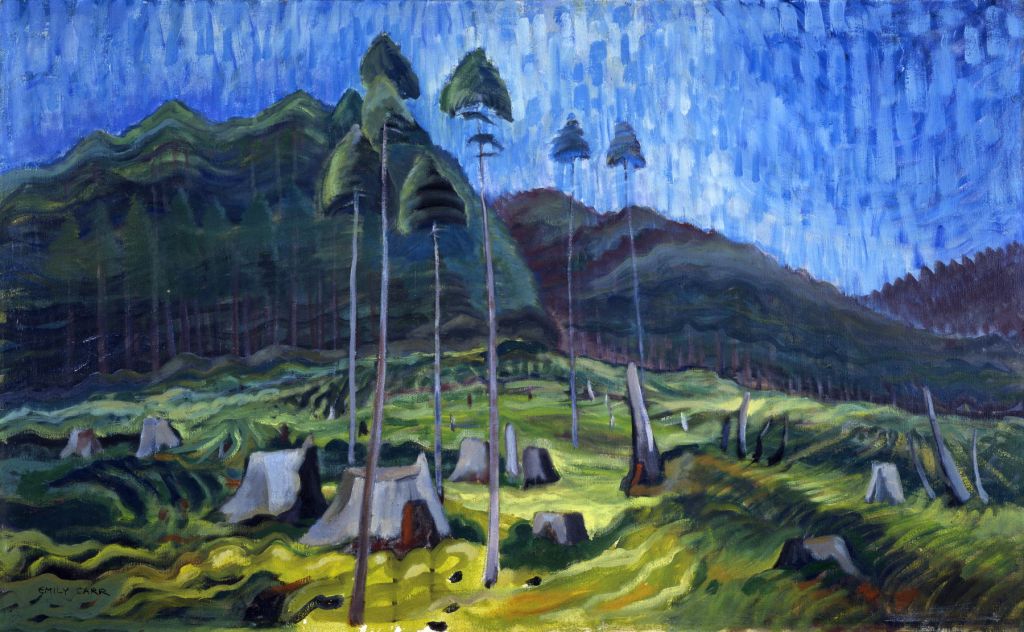
Odds and Ends (1939) is another of her most important paintings, showing the young and very high trees left behind as being of no commercial value after felling. Carr described the low stubs left on the stumps as being the trees’ tombstones.

In Plumed Firs, painted in 1939-41 after her second heart attack, Carr revisits a similar motif, following felling, with greater unification of her brushstrokes and marks between sky, forest, and the bare land left after felling.

