
In the period up to the start of the nineteenth century, the personification of Truth evolved in paintings from a fairly straightforward nude woman, to one emerging from a well clutching a mirror or flaming torch. Prior to the late nineteenth century, artists had limited engagement with contemporary political issues, but that changed with the Franco-Prussian War in 1870-71, the Paris Commune, and the Third Republic which followed.

Jules Lefebvre painted his version of Truth in 1870, the year of the start of the Franco-Prussian War. She is naked and bearing her mirror, but the well seems to have been lost in the gloom behind her. The crucial clue is given in the rope she holds in her left hand. This painting is thought to have been a major influence on Frédéric Bartholdi, who that year made his first small model of the sculpture which was to be presented to the US as the Statue of Liberty, of Truth fully clothed.

Almost a decade into the Third Republic, in about 1879, Paul-Jacques-Aimé Baudry painted Truth. There’s an interesting link between him and Jean-Léon Gérôme, as it was he who in 1897 made a statue of Baudry in La Roche-sur-Yon. The well is now clear and extensively detailed, and the mirror brandished to shine its reflected light on her face.

In 1883, Lucien Pallez made a figure of Truth which is still in the Parc de la Tête d’Or in Lyon, France. Sadly his original is now in a sorry state, but this plaster replica shows her in full glory, complete with both well and mirror.

By far the best-known painting of this proverbial allegory is Jean-Léon Gérôme’s Truth Coming out of her Well to Shame Mankind from 1896. It’s commonly claimed this was a pointed comment about the Dreyfus Affair, which was searing a hole in French politics and society at the time.
Alfred Dreyfus was convicted of treason in December 1894, for passing French military secrets to the German Embassy in Paris, and was imprisoned in the notorious Devil’s Island penal colony in French Guiana, from which few ever returned. After a further investigation in 1896, which revealed another Army officer as the culprit, new evidence was suppressed, leading to the acquittal of that officer, and clumsy attempts were made to charge Dreyfus with additional crimes.
France divided in its support for Dreyfus, and the famous novelist Émile Zola published his notorious article J’accuse! in 1898, resulting in him effectively being banished to Britain for a year.
Gérôme’s painting in fact refers to a quotation attributed to Democritus, “Of a truth we know nothing, for truth is in a well” (or, more literally, ‘in an abyss’). But for the first time, his Truth isn’t carrying a mirror, but a whip with which ‘to chastise mankind’. There are also serious problems in trying to associate this painting with the Dreyfus affair.
This is actually Gérôme’s second treatment of this theme, the original dating from the previous year, before the suppression of new evidence that should have acquitted Dreyfus, and long before Zola’s J’accuse! of 1898. The title he had given that earlier work was Mendacibus et histrionibus occisa in puteo jacet alma Veritas, which translates as ‘The nurturer Truth lies in a well, having been killed by liars and actors’, one of the original proverbial sources associating Truth with a well.
Gérôme used the same allusion in his preface to Émile Bayard’s posthumous collection of collotype plates of photographs of nudes, Le Nu esthétique. L’Homme, la Femme, L’Enfant. Album de documents artistiques inédits d’après Nature, published in 1902:
Photography is an art. It forces artists to discard their old routine and forget their old formulas. It has opened our eyes and forced us to see that which previously we have not seen; a great and inexpressible service for Art. It is thanks to photography that Truth has finally come out of her well. She will never go back.
Truth Coming out of her Well was Gérôme’s favourite painting in his later life, and remained within his reach when he died in his studio in 1904.

Just two years later in 1898, Édouard Debat-Ponsan painted Nec mergitur, or Truth Leaving the Well (nec mergitur meaning ‘and it does not sink’). He was firmly convinced of the innocence of Dreyfus, and is believed to have painted this work as his bold public statement in support. Its key elements, the nude woman emerging from a well brandishing her mirror, are clear. Two archaic figures are trying to restrain her emergence, as symbols of the Catholic clerical and military establishments at the time.

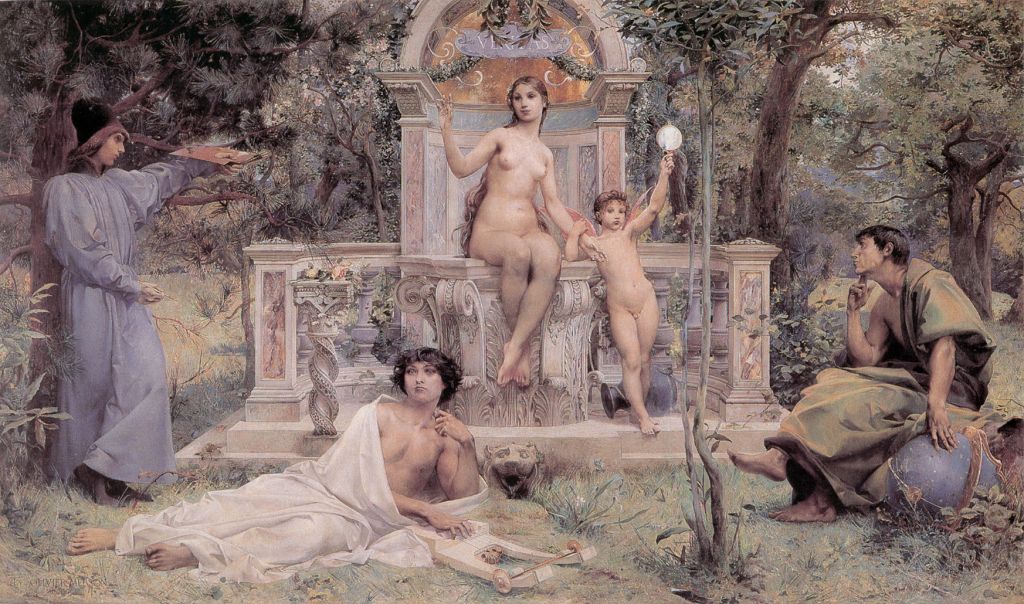
The last of this unusual group of paintings is Luc-Olivier Merson’s Truth from 1901, which is full of ornate Art Nouveau decoration. The personification of Truth here sits naked as the day she was born, under the Latin inscription for truth, veritas. At the left is an artist with palette and brushes, below a musician and poet with a lyre, and at the right a scientist-philosopher with his globe of the stars.
Look carefully at where Truth is sitting, though, and she is on an ornate stone wellhead. The darkness of the top of the well is just visible to each side of her buttocks, and below her feet water dribbles gently from the mouth of a lion, forming a small stream. The winged putto who is holding her left arm is raising her mirror in his left hand. Behind his feet is the large pot on a rope which would be lowered into the well to draw water.
At the very end of the nineteenth century, there was this sudden rush of paintings depicting the personification of Truth as a nude woman climbing from a well. They apparently came from nowhere, were popular for a decade or so, then vanished. All three of the most celebrated paintings made between 1896 and 1901 were made in France by French artists, in Salon style, rather than the post-Impressionism which is now associated with that period.
Only one of those, painted by Édouard Debat-Ponsan at the height of the crisis in 1898, appears to have a clear link to the Dreyfus Affair. The most famous of them, Gérôme’s from 1896, is almost certainly about the more enduring concern about faithfulness and accuracy in art, and links to his rejection of Impressionism and more modern painting, and his hopes for the future of the new art of photography. Yet somehow this seems to have been forgotten. I can see the figure of Truth climbing out of that well yet again.
As for the Statue of Liberty, perhaps we should respect her origins in Jules Lefebvre’s Truth.

