

Nicolas Poussin was another prolific painter of instantaneous narratives throughout his career. His three main literary sources were Ovid’s Metamorphoses, the Bible, and Tasso’s epic Jerusalem Delivered. This small selection starts with the last, his personal favourite.

This is Poussin’s first version of Rinaldo and Armida from about 1630. Armida, a Saracen witch, had been waiting for Rinaldo, greatest of the Christian knights, at the ford on the river Orontes. When he arrived, he found a column with an inscription enticing him to go further, leaving his esquires behind as he boarded a boat. He then came to an island that appeared deserted, so decided to rest there, and put his helmet down beside him.
A little later, he heard a sound from the river, and spied a beautiful woman emerging naked from the water. She sang a song that lulled him to sleep, then came over intending to kill him. But when she saw him breathing gently in his sleep, her anger melted away and she fell in love with him instead. She then put garlands of flowers around his neck, arms and feet that she had bewitched to act as bonds, had him lifted into her chariot, and abducted him.
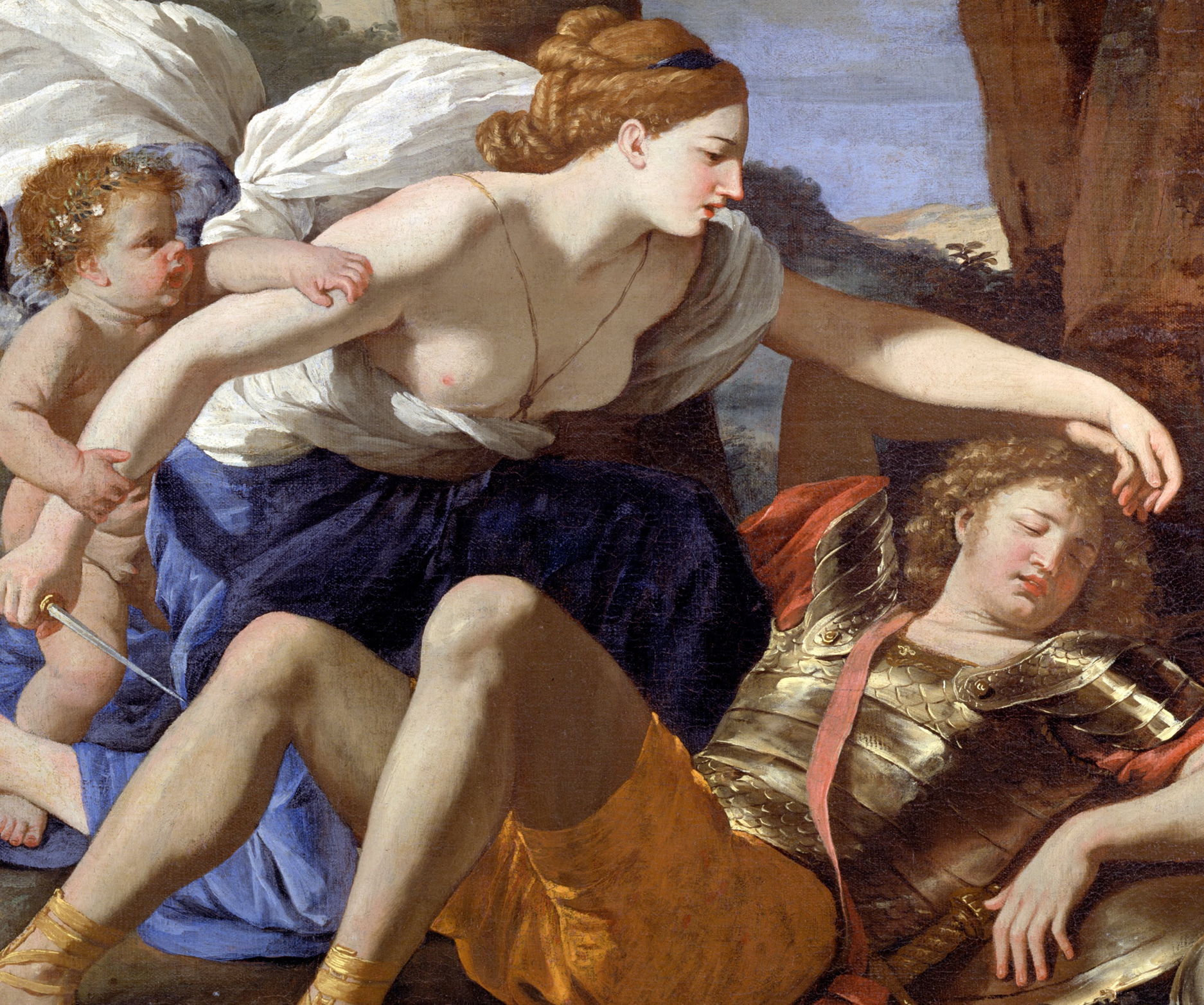
Distinctive elements include Armida’s facial expression and posture, particularly the conflict between her arms. Her expression is key to understanding the narrative, as she is perplexed, in a quandary, unsure whether to kill or kiss the young knight. Armida’s right hand represents her original intent, to murder him with her dagger, an action the amorino is trying to stop. Her left hand, though, reaches down to touch his hand in a loving caress. Poussin manages to tell us what she had intended to do in the immediate past, and what she is going to do next in the future: three moments in time conveyed in a single image.
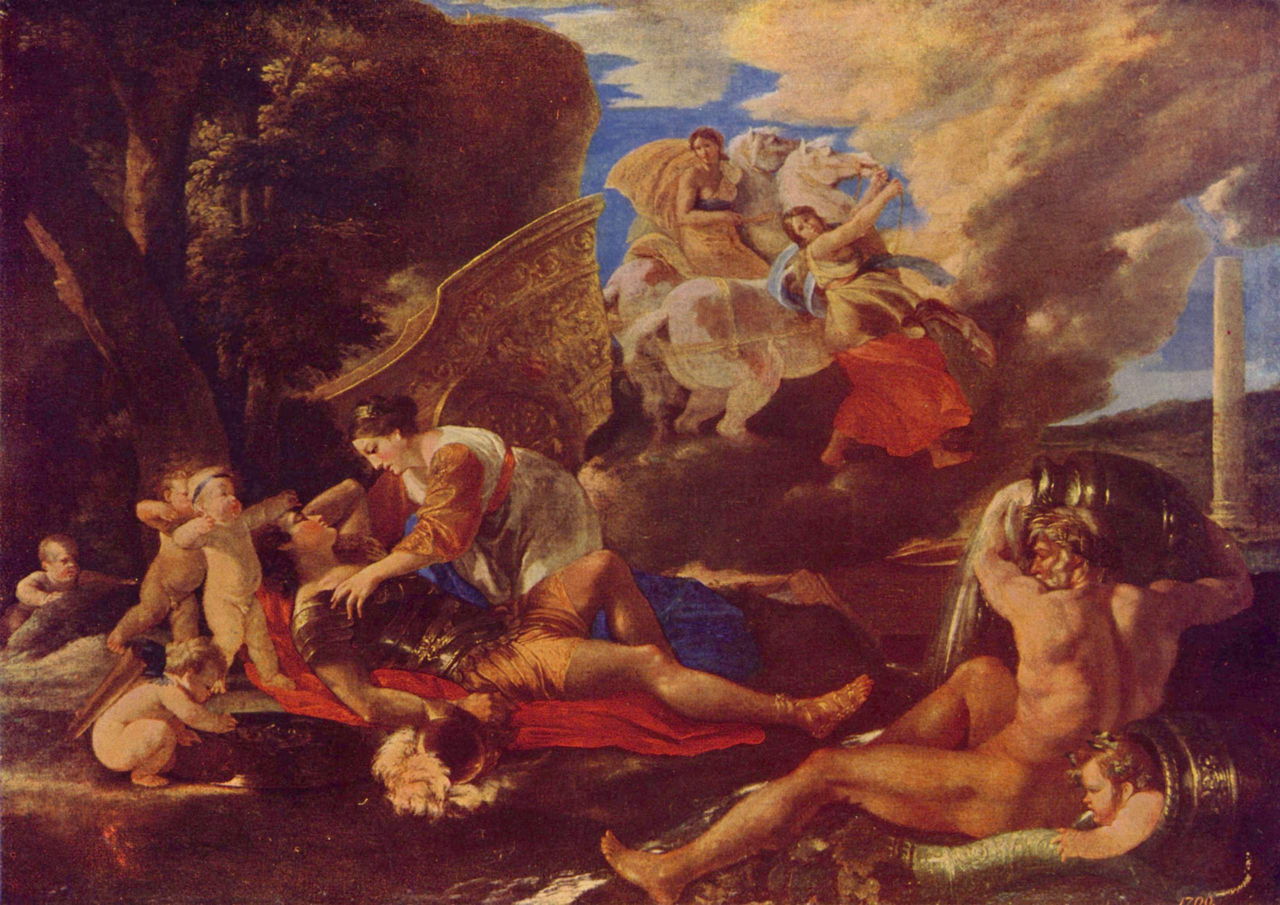
Painted about five years later, Rinaldo and Armida (c 1635) is a more explicit account, in which Armida is falling in love with Rinaldo. There are many amorini who seem less engaged in the action. A river-god pours his river from a pitcher. In the background, Armida’s chariot is already prepared for the abduction of Rinaldo.
Later in the story, Tancred (crusader knight) and Argante (Saracen knight) fight one another to the death. By dusk, Erminia and Vafrine are nearing the crusader camp, when they spot Argante’s corpse, and a little beyond it the unconscious Tancred, who at first appears dead. When Erminia, who is in love with Tancred, recognises his faint voice, she leaps from her horse and weeps over him. Vafrine tells her that there is still time to cure his wounds and save his life, and removes Tancred’s armour.
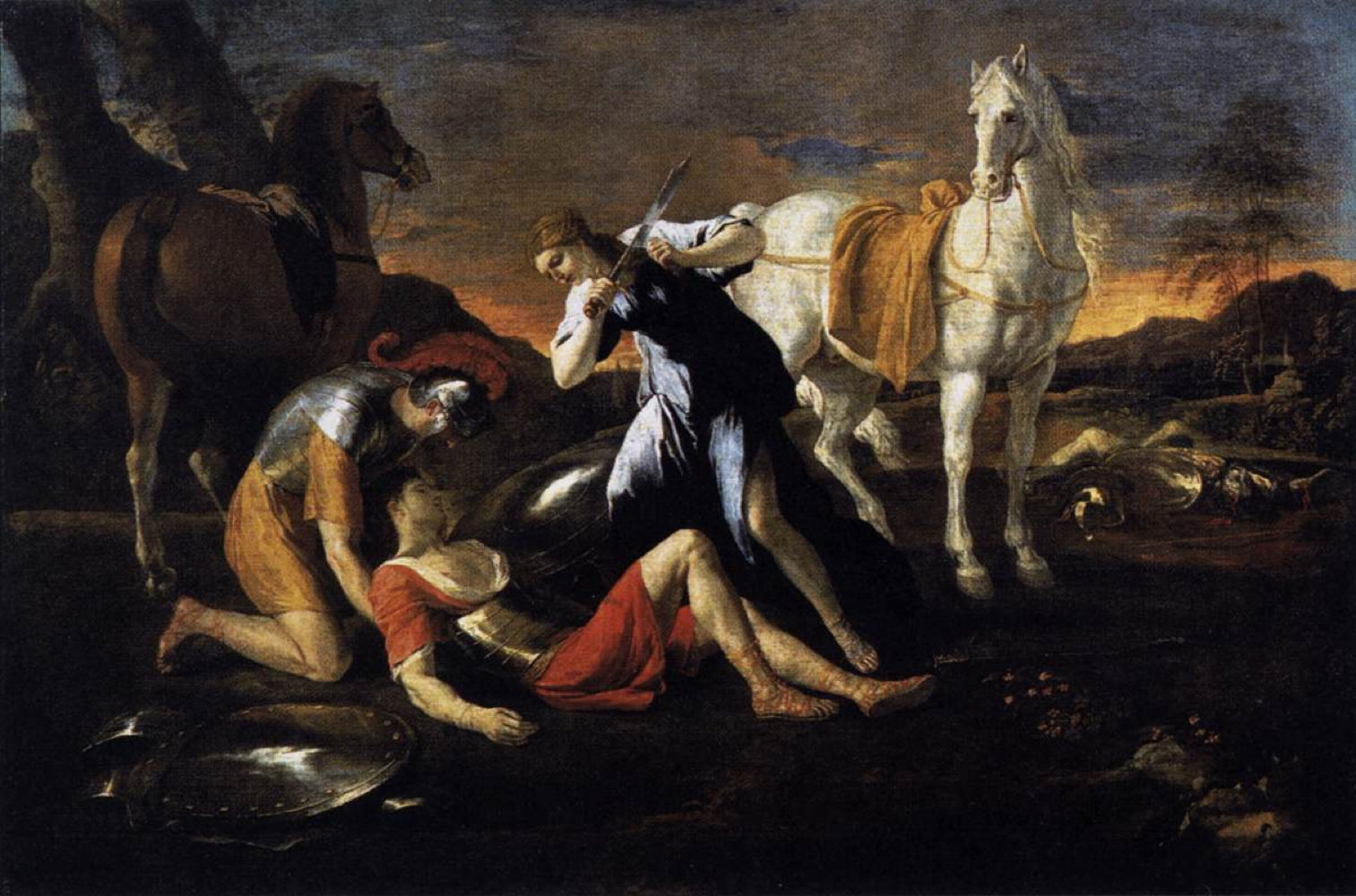
Erminia has nothing to use as bandages to bind Tancred’s wounds, so cuts her hair off and uses that. Tancred regains consciousness, and recognises Vafrine. Others who have been searching for Tancred arrive, and start to carry him back to camp. Tancred insists on two things, though: that Argante is given a proper burial, and that he is carried into the city of Jerusalem to rest. Poussin here adds the detail of Erminia using Tancred’s sword to cut her hair, and Argante’s body is behind them.
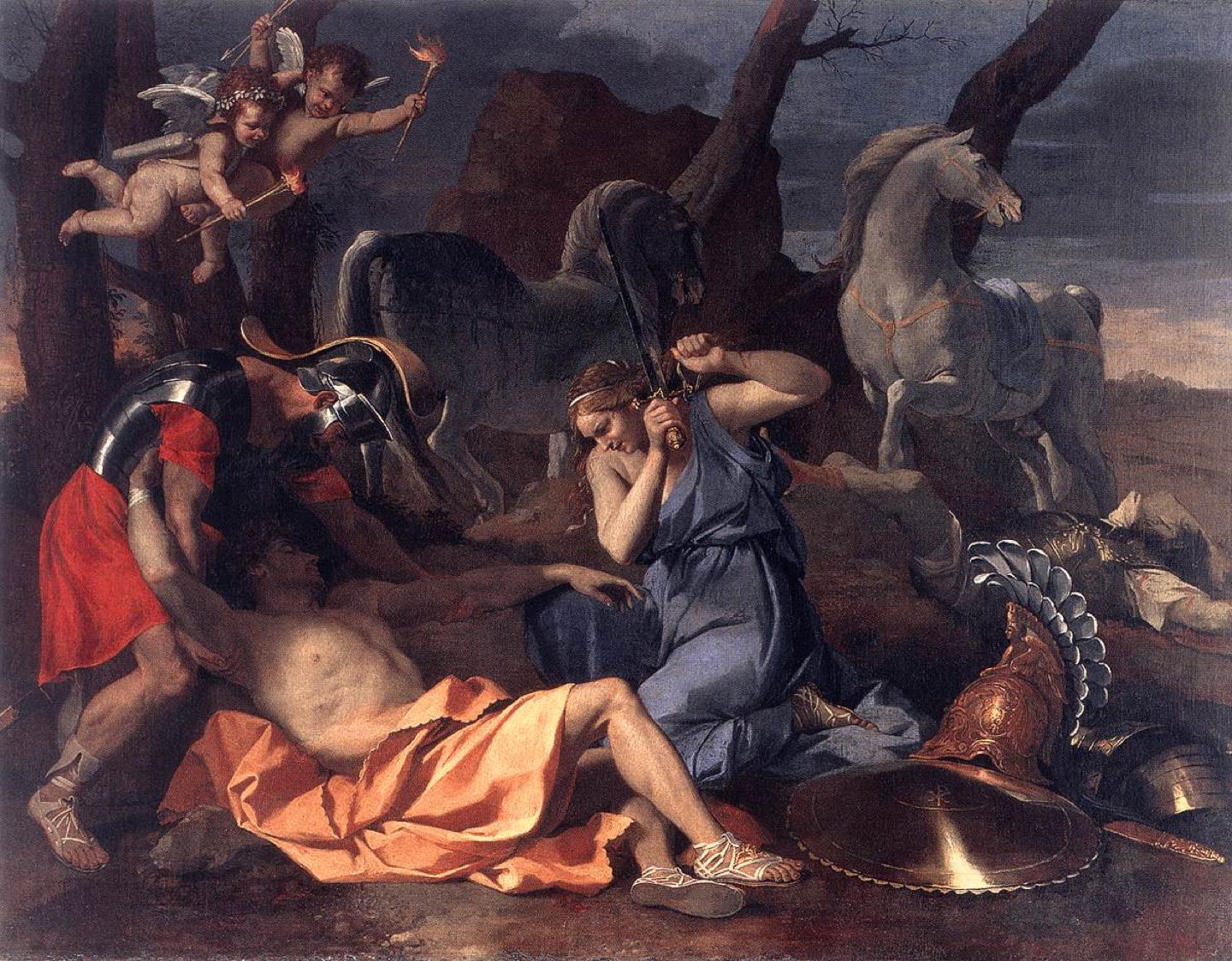
This slightly later version by Poussin is thought to date from about 1634, and has a more powerful close-in composition. Erminia’s arms are in a similar position, also using Tancred’s sword, but she is now kneeling at Tancred’s side. The love between Erminia and Tancred is also made clear in the pair of cupids, and the two horses are anticipating the arrival of other crusaders to carry Tancred away.

Poussin’s famous painting of The Judgment of Solomon from 1649 uses a near-symmetric composition for this biblical story. Although timed slightly before its climax, when the sword is raised, he depicts the body language clearly. Solomon’s hands indicate his role as the arbiter, in showing a fair balance between the two sides. The baby’s true mother, on the left, holds her left hand up to tell the soldier to stop and spare the infant. Her right hand is extended towards the false mother, indicating she has asked for the baby to go to her rather than die. The false mother points accusingly at the child, her expression full of hatred. Hands are also raised in the group at the right, indicating reactions to Solomon’s judgement.

His Landscape during a Thunderstorm with Pyramus and Thisbe (1651) succeeds in telling the climax to this tragic story set in one of Poussin’s finest landscapes. The city of Babylon is in the distance, along a picturesque and pastoral valley. But the peacefulness of this landscape has been transformed by the sudden arrival of a thunderstorm: the gusty wind is already bending the trees, and near the centre of the view has broken a large branch with its force. Two bolts of lightning make their way to the hills below.

In the foreground, there is frantic activity in response not only to the storm, but to a lioness that is attacking a horse, whose rider has fallen. An adjacent horseman is about to thrust his spear into the back of the lioness, while another, slightly further ahead, is driving cattle away from the scene. Others on foot, and a fourth horseman, are scurrying away, driven by the combination of the lioness and the imminent storm.
In the foreground, Pyramus lies dying, his sword at his side, and his blood flowing freely on the ground, down to a small pond. Thisbe has just emerged from sheltering in the cave, has run past the bloodied shawl at the right, and is about to reach the body of her lover. She’s clearly distraught.
When instantaneous narrative is painted by a master, provided you can remember the underlying story, it’s easy and pleasurable to read. But can you use it to tell a new story, not known to the viewer? That was the challenge taken up in the nineteenth century.

