
Peter Paul Rubens was one of the most prolific and accomplished narrative painters. He specialised in telling religious and classical stories using the instantaneous technique. This article shows a small selection of his finest narratives mostly drawn from Ovid’s Metamorphoses, spanning thirty-five years of his career from 1604-39.

Rubens’ The Fall of Phaeton, started in about 1604, is perhaps the best of several superb paintings of this story. He seems to have reworked this over the following three or four years, and elaborates the scene to augment the chaos: accompanying Phaëthon in the chariot of the sun are the Hours (Horae, some shown with butterfly wings), who are thrown into turmoil, and time falls out of joint as Phaëthon tumbles out of the chariot. A notable forward reference is shown in the background at the bottom right, where the earth is on fire as a result of Phaëthon’s folly.
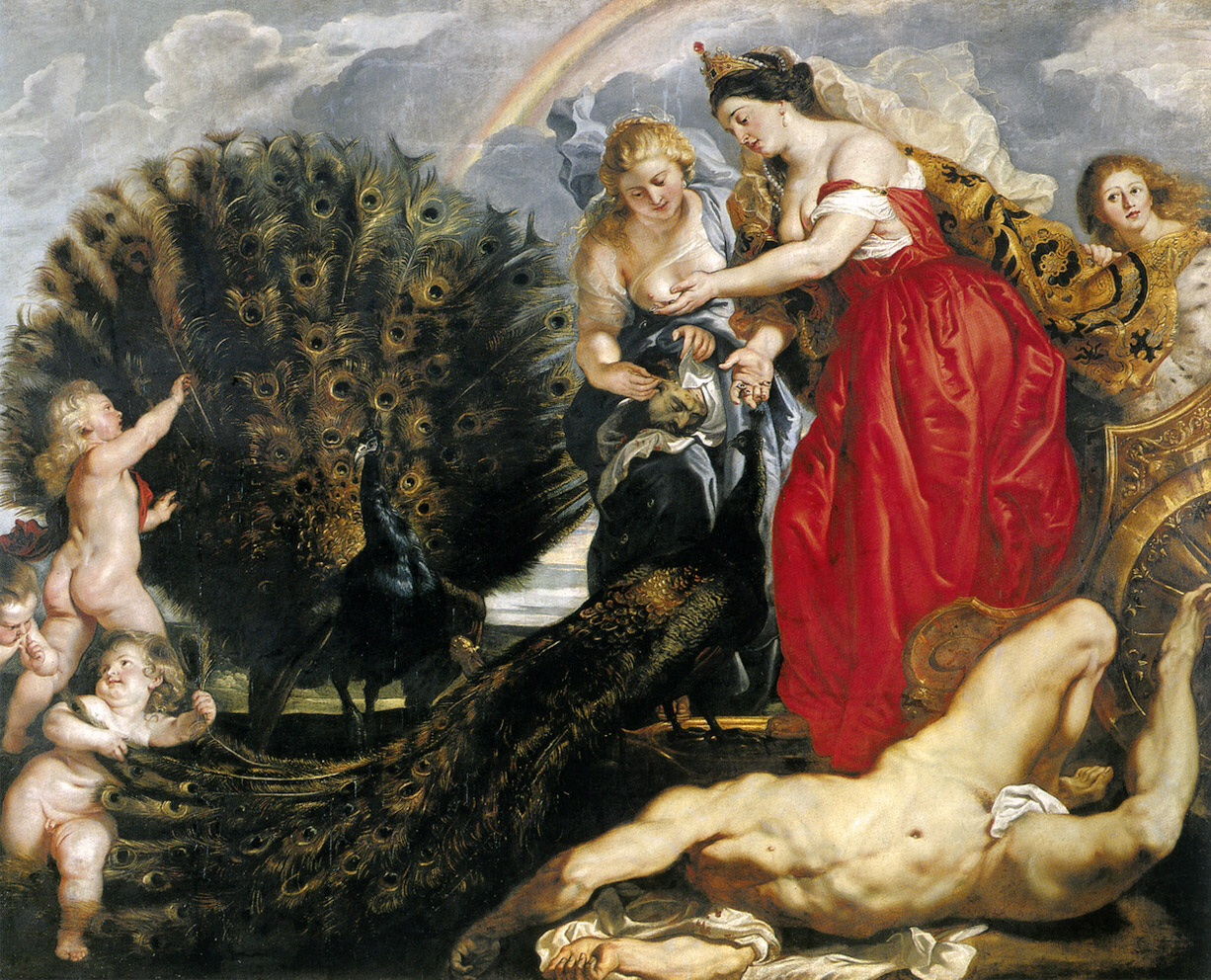
Rubens’ finest painting of the story of the rape of Io is his Juno and Argus from about 1611, showing this part of its outcome. Juno, wearing the red dress and coronet, is receiving eyes that have been removed from Argus’ severed head, and places them on the tail feathers of her peacocks. The headless corpse of Argus lies contorted in the foreground as a backward reference. Rubens took the opportunity of adding a visual joke, in which Juno’s left hand appears to be cupped under the breasts of the woman behind.

His Perseus and Andromeda (c 1622) shows a late moment when the height of action is just past, but its outcome is more obvious. Andromeda is at the left, unchained but still almost naked. Perseus is in the process of claiming her hand as his reward, for which he is being crowned with laurels, as the victor. He wears his winged sandals, and holds the polished shield that still reflects Medusa’s face and snake hair. One of several putti (alluding to their forthcoming marriage) holds Hades’ helmet of invisibility, and much of the right of the painting is taken up by Pegasus, derived from a different version of the myth. At the lower edge is the dead Cetus, its fearsome mouth wide open, as an obvious backward reference.

Rubens’ initial oil sketch of The Fall of Icarus (1636) is presumed to have been turned into a finished painting by his apprentice Jacob Peter Gowy. Icarus, his wings in tatters and holding his arms up as if trying to flap them, plunges past Daedalus. The boy’s mouth and eyes are wide open in shock and fear, and his body tumbles as it falls. Daedalus is still flying, though, his wings intact and fully functional; he looks towards the falling body of his son in alarm. They are high above a bay containing people with a fortified town at the edge of the sea, where the body of Icarus will land shortly.

His superb The Rape of Proserpina (1636-38) shows a carefully composed composite of Ovid’s account. Pluto’s face looks the part, his eyes bulging and staring at Minerva, who is trying to stop the girl from being abducted. Below the chariot, the basketful of flowers which Proserpine had been picking is scattered on the ground, as a backward reference. Rubens shows irresistible movement to the right, as Pluto struggles to lift the girl into his chariot. Two winged Cupids are preparing to drive the black horses on, once the couple are secured inside.

His painting of The Rape of Hippodame (Lapiths and Centaurs) (1636-38) is another powerful composition. At the right, Eurytus is trying to carry off Hippodame the bride, with Theseus just about to rescue her from the centaur’s back. At the left, Lapiths are attacking with their weapons, and behind them another centaur is trying to abduct a woman. Facial expressions, particularly that of the Lapith at the left bearing a sword, are particularly powerful. Food and furniture from the wedding feast are tumbling at the lower left, as a backward reference.
Finally, an example of one of his religious narratives, from the final years of his retirement.

This version of Susanna and the Elders, painted between 1636-39, recasts the basic elements of the story in a broader view. The two elders are clambering over a low wall, while Susanna is sitting on her clothing, on a low stool, trying to pull a dark cloak over her body. There are backward references to her interrupted toilet at the lower left. Her small lapdog is running towards the men, and its barking may have acted as the alarm to Susanna that she has been seen. Rubens times this early, before the elders put their proposition to Susanna; indeed at this stage they may not even have formulated their blackmail.

