
The paintings of JMW Turner and John Constable were sufficiently different for them not to be rivals. Had history been different, though, Turner might well have been eclipsed by his contemporary Thomas Girtin. As Girtin died 35 years before John Constable and 49 years before JMW Turner, his achievements were cruelly limited, but Turner recognised how good his friend and rival was when he said about him “Had Tom Girtin lived I should have starved”.
Thomas Girtin was born to a prosperous brush maker in Southwark, London, on 18 February 1775, the same year as Turner, but his father died when he was three. As a boy, he was given drawing lessons, and was taken on as an apprentice by Edward Dayes, a watercolour painter of views based in Long Acre, in central London, in the summer of 1789. Such apprenticeships had long been the main route for training as a painter, but in the same year Turner had entered the new, improved version of the Royal Academy Schools, formal training instead of seven long years learning the trade.

Girtin soon started showing great promise, as in the fine sky and effective aerial perspective in his Rochester, Kent: from the North (c 1790), although some have argued that this dates from a couple of years later.

He probably terminated his apprenticeship as early as 1792, by which time engravings of his work were being published in Copper Plate Magazine. He adjusted his technique to facilitate the making of prints from his topographical views, as shown in his Kirkstall Abbey from the N.W. (c 1792). By the following year he was working for the antiquarian James Moore.

He gradually used less ink, confining it to foreground detail of this view of Jedburgh Abbey, Roxburghshire from about 1793.

Although he had possibly travelled to paint earlier, his first major painting tour with James Moore was of the Midlands in 1794. They visited Warwick, Stratford, Lichfield, Peterborough, and Lincoln; this fine view of Lichfield Cathedral (1794) was one of its successes, and already secured him a place alongside the better watercolour landscape painters of the day. In the same year he had his first painting accepted by the Royal Academy, a view of Ely Cathedral now in the Ashmolean Museum in Oxford.
Later in 1794, Girtin started attending instruction in the home of Thomas Monro, along with the young JMW Turner, where the two became friends and of great mutual influence.

Girtin’s skills of composition were well in advance of his experience and time. This view of Glasgow Cathedral (1794-5) has similarities to some of Constable’s studies of Salisbury Cathedral from around 1830.
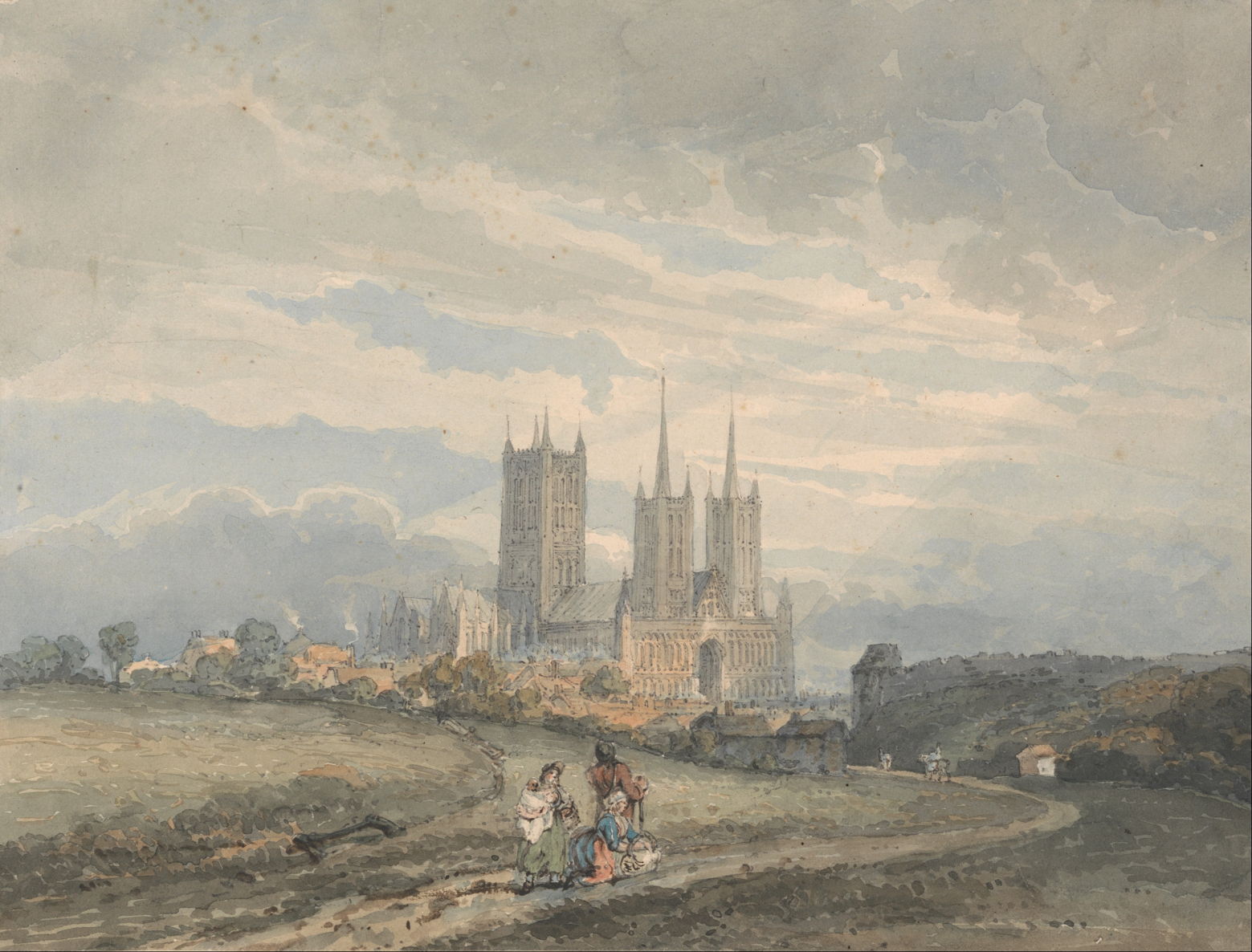
Girtin’s Lincoln Cathedral (c 1795) shows the last vestiges of ink and an illustrative approach fading, and his pure watercolour starting to flourish.
In the late summer of 1796, Girtin toured independently for the first time, travelling in the north of England and into the Scottish borders. Among many sketches made during this trip were those for the next painting of Holy Island.

Holy Island and Lindisfarne are spectacular and evocative locations on the north-east coast of England, steeped in history, wild and mysterious. Connected to the mainland via a tidal causeway, Girtin would have had little time there to attempt painting en plein air even if he had wanted to, so painting this back in his studio he would have been reliant on his sketches, notes, and memories of the previous year.
In 1797, Girtin had ten watercolours accepted for exhibition at the Royal Academy, made from his sketches during that northern tour the previous year. These generated his first newspaper reviews, and he was now able to charge significant amounts for commissions, and to enjoy growing patronage.
In 1798, he was again well represented at the Royal Academy, with nine of his watercolours being hung in its annual exhibition. During the late summer, he toured North Wales, making sketches he then worked up into finished paintings over the following winter.
The results of his previous year’s visit to North Wales resulted in acclaim of the six watercolours which he showed at the Royal Academy in 1799. However, his hopes of accompanying Lord Elgin to Greece on an archaeological expedition failed. In the end, Elgin employed the Neapolitan watercolour painter Giovanni Battista Lusieri (1755-1821) to document the expedition and its archaeological discoveries.
Girtin’s tour that year was to Yorkshire, a far cry from Greece, but which saw him venturing into more transient effects of light, and de-emphasising architectural features.
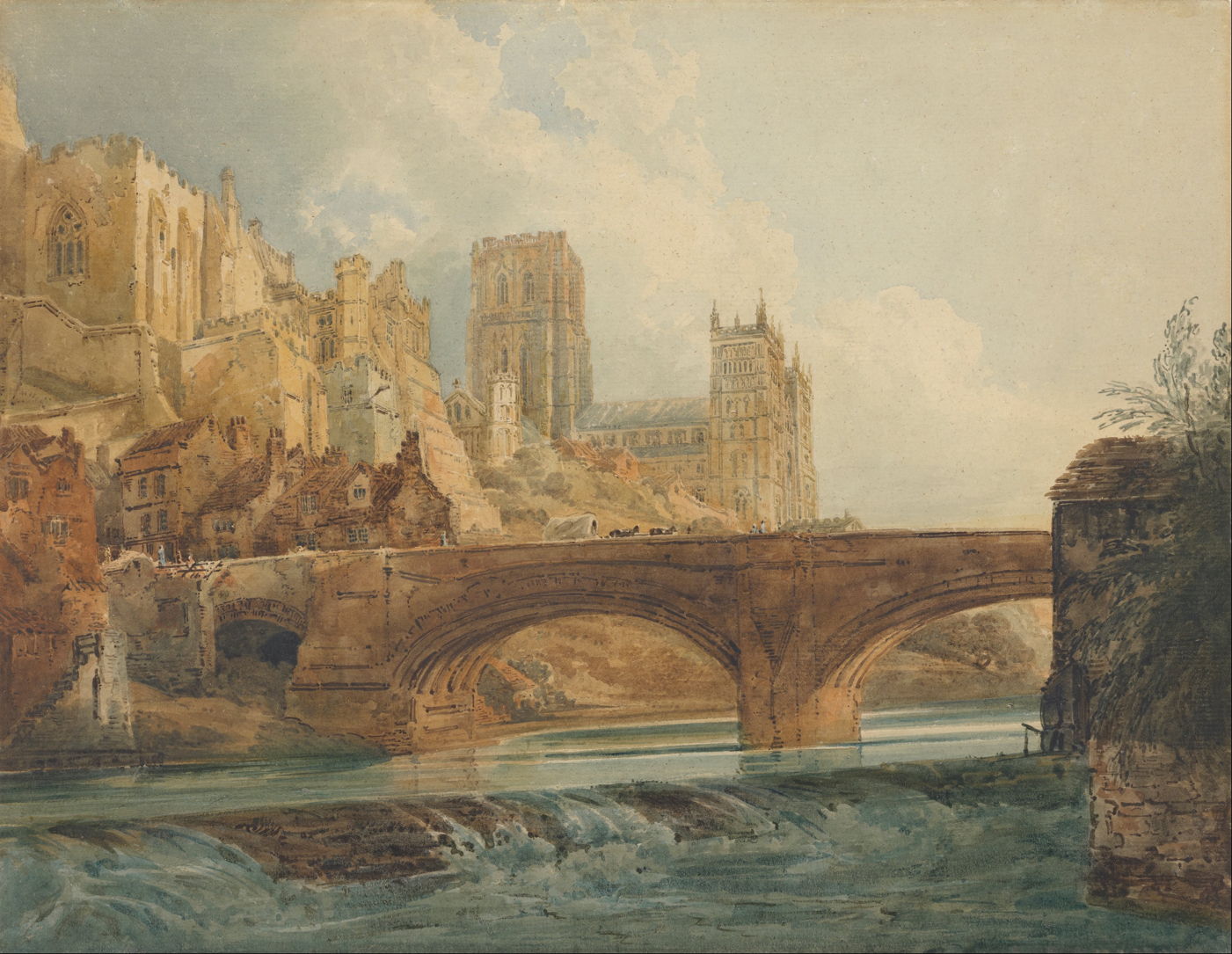
His wonderful view of Durham Cathedral and Castle from about 1800 contains as much detail as his earlier views, but is better integrated into the whole instead of competing for the viewer’s attention.
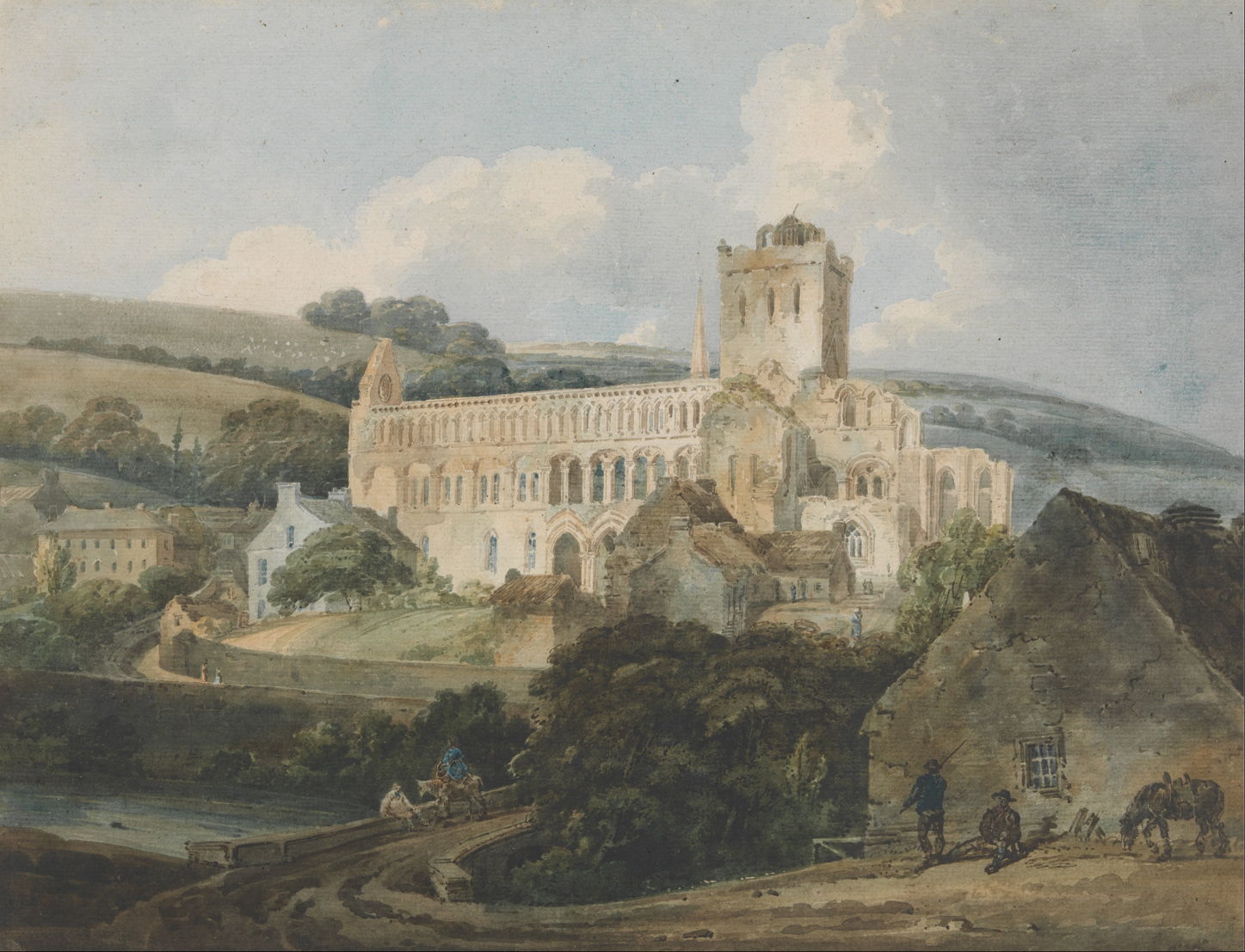
The ruined abbey at the centre of his Jedburgh Abbey from the South East (1800) bears only the marks of the brush, not of the pen.
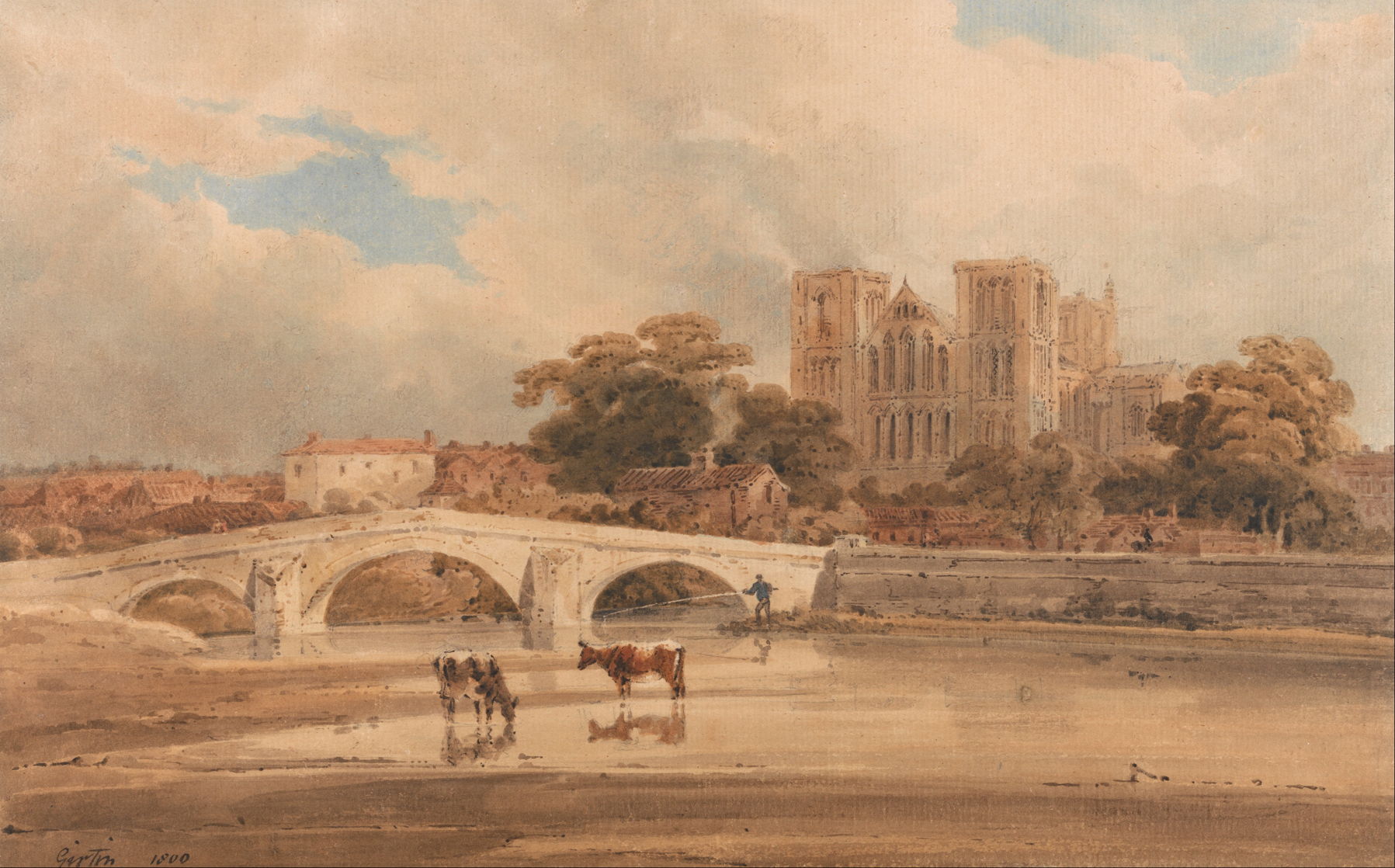
In his Ripon Minster, Yorkshire (1800), the features of the river – its bridge, cattle, and a single angler – steal the gaze, rather than the bulk of the minster behind.
In 1800, he showed his last watercolours at the Royal Academy. He also managed to tour two areas, returning to Yorkshire, where he concentrated his sketching along the River Wharfe. Then in the late summer he went back up to the Scottish borders, before marrying in the autumn.

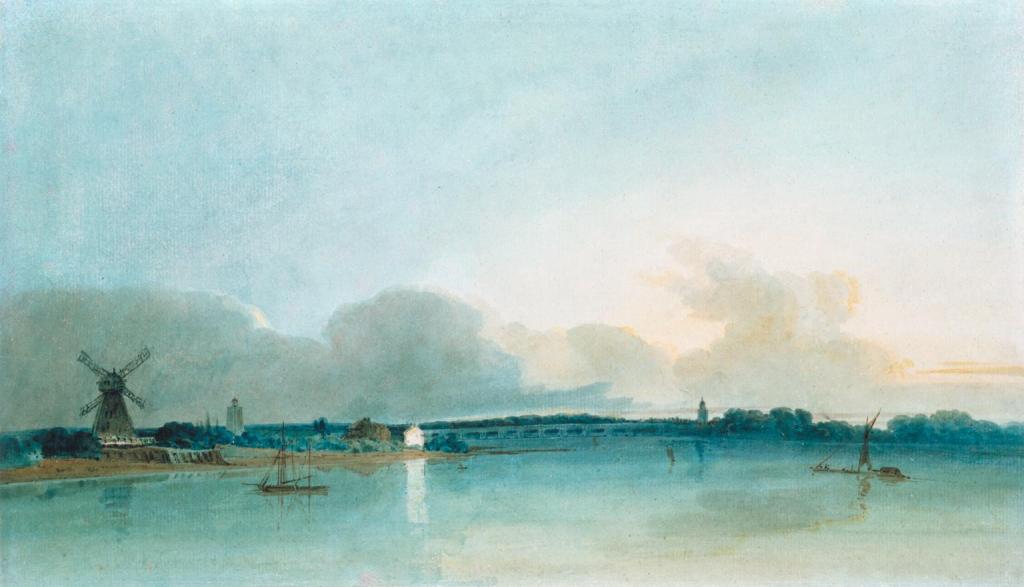
Among the paintings he completed in 1800 is The White House at Chelsea, probably his most famous. Girtin chose to look upstream of the River Thames from a location close to the modern Chelsea Bridge. The landmarks shown include, from the left, Joseph Freeman’s windmill (or Red House Mill), a horizontal air mill, the white house close to where Battersea Park is now, Battersea Bridge, and Chelsea Old Church. For once, buildings are the least significant elements in the painting, which is dominated by the sky, water surface, and the momentary light on the white house.

Another superb product from his Yorkshire tour the previous year, Girtin’s The Village of Kirkstall, Yorkshire (1801) shows an angler fishing from his cart in the ford in a sophisticated composition.
The following year, 1801, Girtin exhibited an oil painting at the Royal Academy, the only work in oils he appears to have shown. This was met with great acclaim, but is believed to have been lost. He toured Yorkshire for the last time, and then spent the winter of 1801-2 in Paris.

In addition to completing watercolours from his tour in 1801, Girtin spent much of the spring and summer of 1802 producing watercolour studies, then the final 5.5 x 32.9 metre panoramic painting for Eidometropolis in London. This was finished by its opening on 2 August 1802, and was a major speculative commitment on Girtin’s part. Unfortunately it doesn’t appear to have been a commercial success, and the panorama has since been lost.
Following one of his visits to North Yorkshire, Girtin painted Guisborough (Gisborough) Priory in watercolour.

The Yale Center for British Art has an oil painting apparently made from this view, which some believe to have been the only surviving oil painting by Girtin. However others dispute this attribution, considering it too crude to have been painted by him.

Over the last year or so, Girtin’s health had been troubling him more, and he died, probably of an asthma attack or a complication of pulmonary tuberculosis, on 9 November 1802, aged 27.
While Turner’s broader training in the Royal Academy Schools enabled him to excel in other genres, Girtin was his only serious rival as a watercolour and landscape painter. Who knows what might have happened if Girtin had been spared such an untimely death.
References
Smith G (2002) Thomas Girtin: the Art of Watercolour, Tate. ISBN 978 1 854 37394 6.

