

Of the available narrative formats, the most popular is instantaneous, where the image is intended to show what was happening at a single moment in time, and contains references to other moments to make it narrative. Unless a painting refers to at least two moments in time, it can’t be truly narrative.
This gives the artist the choice of the instant to depict, then to devise forward and backward references. Classical teaching derived from Aristotle’s Poetics was to pick a moment of change or transformation. Among the most skilful of the painters who told stories using instantaneous narrative is Nicolas Poussin, and his painting of Rinaldo and Armida from about 1630 is a canonical example.
Example

This draws its narrative from one of Poussin’s favourite literary works, a then-popular epic poem by Torquato Tasso (1544-1595) titled Gerusalemme Liberata (Jerusalem Delivered), and published in 1581. I have written a series of fourteen articles showing paintings and telling its story starting here, and this episode is covered here.
The sleeping knight is Rinaldo, the greatest of the Christian knights engaged in Tasso’s romanticised and largely fictional account of the First Crusade, who has stopped to rest near the ‘ford of the Orontes’. On hearing a woman singing, he goes to the river, where he catches sight of Armida swimming naked.
Armida, though, has an evil aim. She has been secretly following Rinaldo, intending to murder him with her dagger. As the ‘Saracen’ witch who is trying to destroy the crusaders’ campaign, she has singled out its greatest knight for this fate. Having revealed herself to him, she sings and lulls him into an enchanted sleep so she can thrust her dagger home.
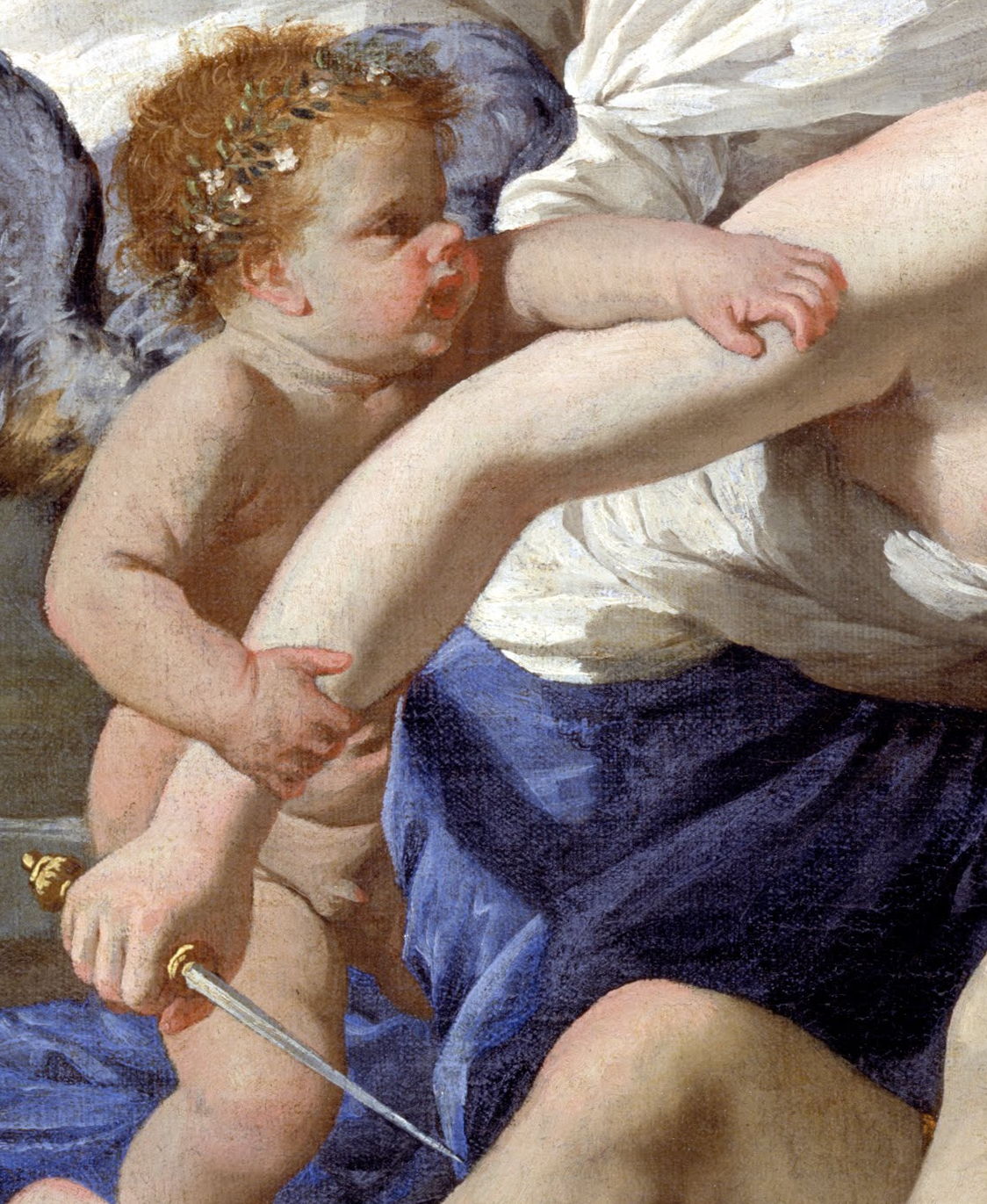
Just as she is about to do this, she falls in love with him instead, and this is the instant, the twist or peripeteia (to use Aristotle’s term), shown here. A winged amorino, lacking the bow and arrows of a true Cupid, restrains her right arm bearing her weapon.

Her facial expression and left hand reveal her new intent, which is to enchant and abduct him in her chariot, so he can become infatuated with her, and forget the Crusade altogether.
This is a single moment in time, in which Poussin has ingeniously incorporated references to both the past and future. Provided you’re familiar with Tasso’s story, it’s a superb example of instantaneous narrative, as practised throughout the history of painting across all continents and cultures. It still relies on the underlying story to bring narrative closure, though, as an image of a single moment, however ingeniously composed, can only suggest the resolution or outcome.
The moment
Timing is of the essence in this form of narrative, as I’ll show using a simpler story of the fall of Icarus.
According to classical Greek legend, Daedalus was the master craftsman who was most famously responsible for creating the Labyrinth on Crete, which contained the Minotaur. Because of his knowledge of the Labyrinth, Minos, the king of Crete, shut him up in a tower to prevent him from spreading that knowledge. Daedalus therefore set about building himself and his young son Icarus sets of wings, so they could fly from the island and escape.
Ovid’s Metamorphoses (book 8, 183-235) describes how they did this, tying feathers together, securing them at their midpoints with string, then at their bases using beeswax. Once Daedalus had completed his own set of wings, he found that flapping them in the manner of a bird generated lift, so he made a second pair for his son.
Father and son then prepared to make their escape from Crete. Daedalus specifically warned Icarus that he should not fly too low, or the moisture from the sea would soak the feathers, nor too high, or the heat of the sun would melt the wax and the wings would disintegrate. They set off, and were making good progress passing several islands when Icarus became over-confident and soared upwards towards the sun. This melted the wax as Daedalus had warned, Icarus’ wings fell apart, he plummeted into the sea, and was drowned near what became known as Icaria, an island ten miles southwest of Samos, in the northern Aegean Sea.
There are two significant changes of fortune, both of which are accompanied by an element of revelation: the first is when Daedalus and Icarus start their flight, which marks a change from bad to good fortune, with the new knowledge being the discovery that they can fly. The second is the moment that Icarus’ wings disintegrate, and his fortune changes from good to bad, with the confirmation of Daedalus’ prior suspicion that the beeswax would melt.
As moments of peripeteia, according to classical Aristotelian narrative, and particularly for a tragedy such as this, these should be the most powerful and moving events to show in a painting, given references to the prior and subsequent states of fortune. In the overall structure of this story, there is no doubt that the second moment of peripeteia is the climax, with the most dramatic action.
Too early

Van Dyck’s Daedalus and Icarus (1615-25) puts the boy at the centre, his wings already attached to his back, and his father apparently explaining the importance of flying at the right altitude. Father and son hold out their right hands, pointing with the index finger as if using it to enumerate important matters. Icarus looks to the front, appearing to concentrate, while his father looks at him and appears to be speaking.

Frederic, Lord Leighton, in his Icarus and Daedalus (c 1869), shows the pair on the roof of the tower overlooking a bay. Daedalus is crouching while fitting his son’s wings, and looks up at Icarus. The boy stands in heroic pose, holding his right arm up, partly to allow his father to fit the wings, and possibly in a gesture of strength and defiance. Icarus is looking to the right, presumably towards the mainland to which they will soon be travelling. This painting also suggests that Daedalus is dark-skinned, and Icarus more ‘Caucasian’ in appearance; Daedalus is wearing a scalp-hugging cap which appears intended for flight.
Although they’re fine paintings, neither captures the drama of this story.
Peripeteia

Jacob Peter Gowy’s finished painting from an oil sketch by Rubens shows Icarus, his wings in tatters, plunging down through the air past Daedalus. Icarus holds both his arms up as if still trying to fly despite the loss of his wings, his mouth and eyes are wide open in shock and fear, and his body appears to be tumbling as it falls. Daedalus is still flying, his wings intact and fully functional; he looks alarmed, towards the falling body of his son. They are both high above a bay containing people and a fortified town at the edge of the sea, now named Icaria.
Too late

Long believed to be Pieter Brueghel the Elder’s original painting, this Landscape with the Fall of Icarus is now thought to be a very good copy of the original from about 1558, possibly painted by de Momper. This is a big landscape in which Ovid’s three other activities are shown. However Icarus has already plunged into the sea, only his legs being visible above the surface, slightly closer to the viewer than the prominent ship at the right. From the direction of gaze of the shepherd, Daedalus has flown off to the upper left.

Herbert Draper’s Lament for Icarus (1898) shows a more apocryphal and romantic view, in which three nymphs have recovered the apparently dry body of Icarus, and he is laid out on a rock, while they lament his fate, to the accompaniment of a lyre. Perhaps influenced by contemporary thought about human flight, Draper gives Icarus huge wings, and they are shown intact, rather than disintegrated from their exposure to the sun’s heat.
By the moments depicted in those paintings the story has all but passed.
Those examples lay out the principles applied in successful paintings using instantaneous narrative.

