

There are well over two thousand species of palm, none of which are native to Northern Europe, and are characteristic of North Africa, the Middle East, and other more tropical climates. In European painting they have long been most strongly associated with Egypt, and in more recent centuries with the Mediterranean coast. Some hardier species have been introduced to coastal resorts, where their association with tropical islands is thought to encourage tourists to feel they’re in Trinidad rather than Torquay in Devon.

Fra Bartolomeo’s The Rest on The Flight into Egypt from about 1500 is a traditional composition showing Mary and Joseph during their journey to Egypt with the infant Jesus. The palm trees appear to be based on the Canary palm, native to the Canary Islands and probably the best-known species at the time.

Raphael’s Holy Family with a Palm Tree from 1506 shows an extended family group during the flight to Egypt, according to the visual clue of the palm tree. That palm is depicted in careful detail, even down to its realistically shaggy trunk.

William Blake’s Virgin and Child in Egypt from 1810 is one of his unusual glue tempera paintings in which he achieves fine modelling of flesh. This is in essence a Virgin and Child against Blake’s imagined view of the Pyramids, and a tiny Sphinx, together with the River Nile and the city of Cairo. The left and upper borders feature what looks like a date palm with its fruit clustered at the base of the leaves.
As artists travelled more widely in the late nineteenth century, palm trees appeared in more secular settings.

Field of Banana Trees is an unusual work painted by Pierre-Auguste Renoir during his visit to Algeria in 1881. He may not have realised it at the time, but this grove of banana palms is extremely atypical of North Africa, although it gave him a wonderful opportunity to assemble brushstrokes to form its vegetation. Banana trees aren’t a palm species, but are closely related to plantains. Standing proud of all those bananas is a solitary palm keeping watch over them.
About a decade later Renoir developed severe rheumatoid arthritis, and started visiting the south of France regularly, before he settled there in Cagnes-sur-Mer in 1907.
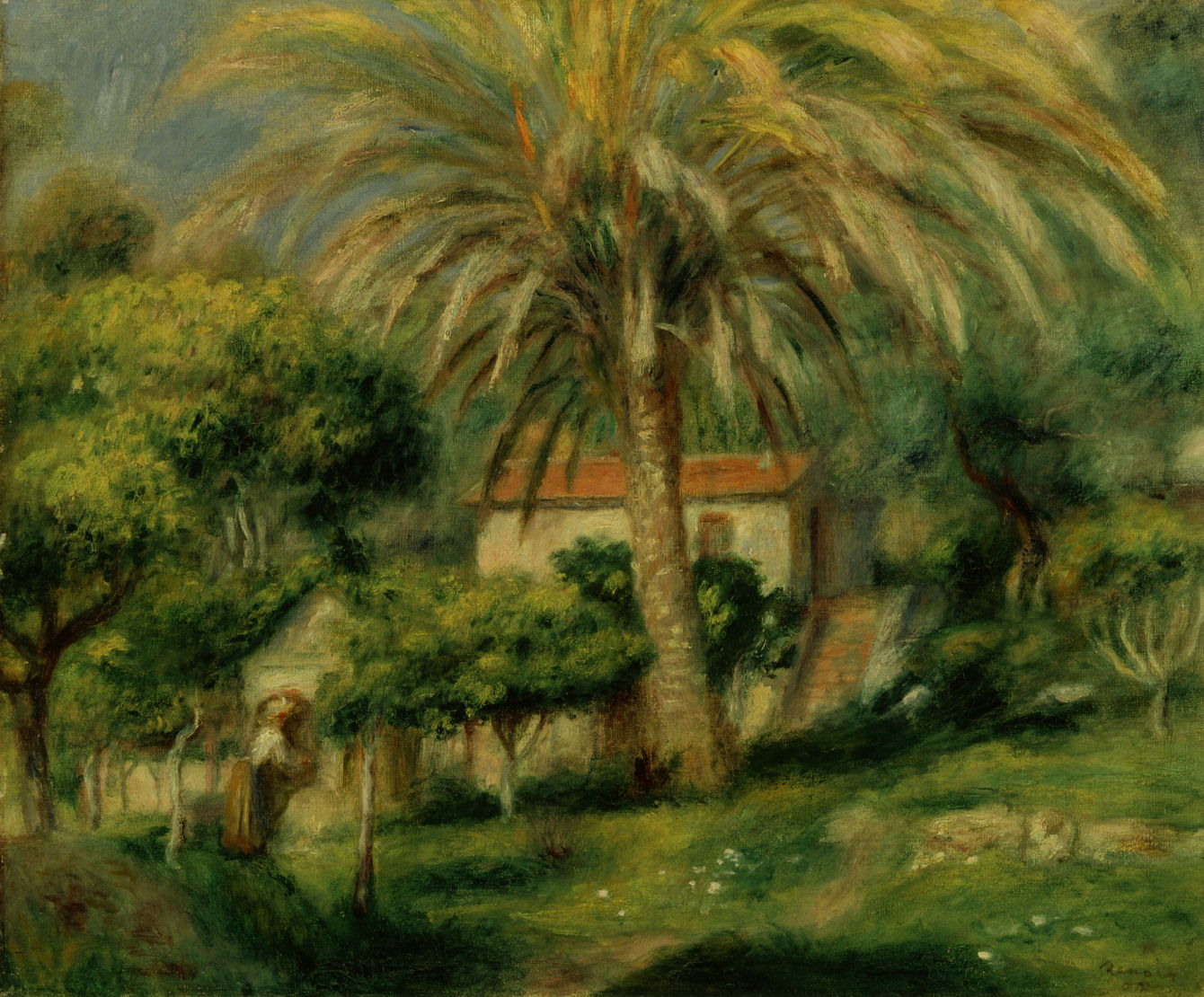
Renoir’s The Palm from 1902 shows a fine palm tree standing outside a villa near Le Cannet, not far from Cagnes-sur-Mer. This is also most likely to be a Canary palm.

Walter Crane travelled widely in the early twentieth century, as far as Colombo in modern Sri Lanka, where he painted this gouache Under the Palms at the Galle Face, Ceylon on 17 February 1907. These are likely to have been coconut palms.

The Norwegian artist Nikolai Astrup took a holiday in Algeria in 1923. This pastel painting of Algiers shows Engel, his wife, staring out into the night from the verandah of their hotel in the city. Exotic palms are silhouetted against the lit buildings, and a row of hackney carriages awaits their customers.

Pierre Bonnard, who lived much of his later life at Le Cannet, painted at least two variations of this view of a Pink Palm at Le Cannet (1924), in which he clearly enjoyed its unusual colour contrasts and the rich textures of its vegetation.

Later in the 1920s, Joseph Stella developed rhythmic palm structures, in Palm Tree and Bird from 1927-28. These were to be a recurrent feature in many of his later works.
My last painting shows a palm-like species, a pandanus tree, sometimes known as a screw palm.

When Thomas Baines was a member of an expedition to the region of the Zambezi River in November 1859, he painted a large Pandanus Palm, here showing its distinctive aerial prop roots forming a cone at the base of its trunk.

