
Edgar Degas is probably the one major painter whose progressively impaired vision is least in doubt. This is now thought to be result of a degenerative central retinal disease, although several other causes have been proposed. This article looks at what evidence there is in his art, comparing earlier works from up to 1873 with those from twenty years later.
Degas’ training soon earned him a reputation for his draughtsmanship, and in April 1855 he was admitted to the École des Beaux-Arts in Paris, a highly competitive process. He remained there for only one year before travelling to study further in Italy. From then he copied masters in collections, and it was when he was doing that in the Louvre in 1864 that he first met Édouard Manet.
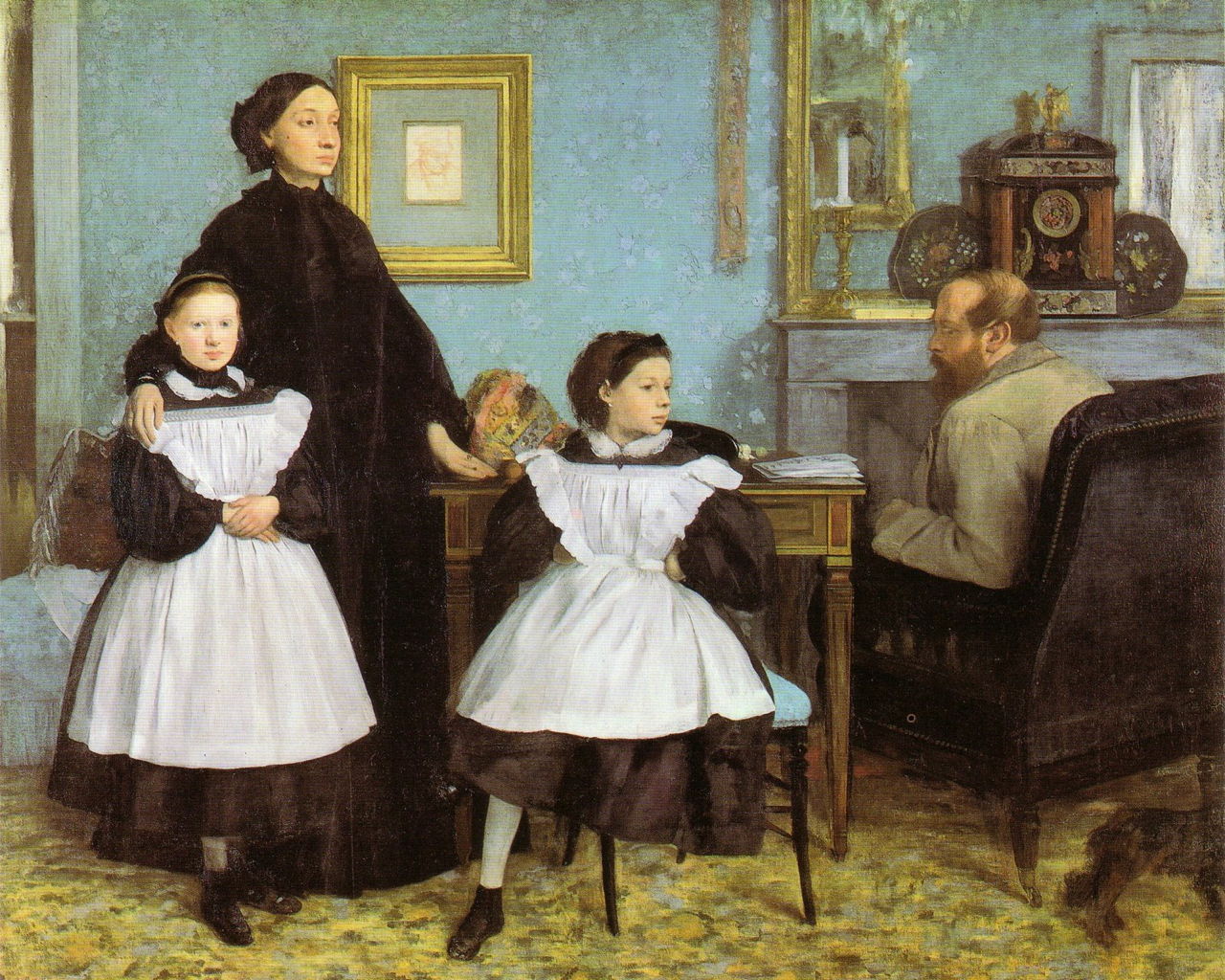
Degas painted some small portraits early in his career, but his first major work is this finely detailed group portrait of The Bellelli Family, which he laboured over for nearly ten years between 1858-67. His preparations for this were protracted and deep, with many sketches and studies, and a separate oil painting of his two cousins completed in about 1866.
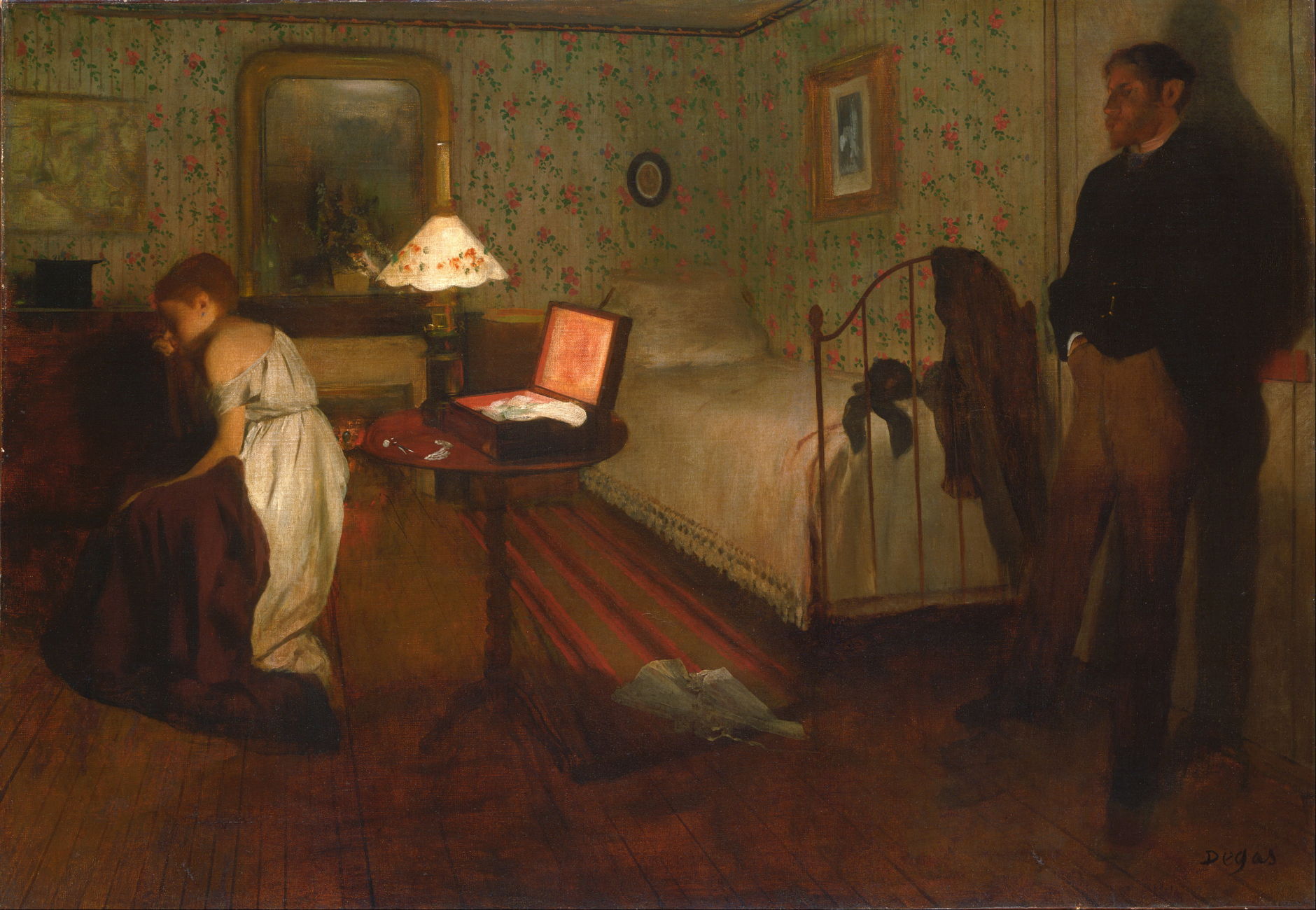
Best-known and most enigmatic of his early narrative paintings is Interior (1868-9), popularly known as ‘The Rape’, with its many fine details including a small pair of scissors and other items of a small clothes repair kit on the table top in front of the open case. The least distinct passages here are in the two figures, with the man’s face rendered slightly vaguely in the weak light.
Although not known for his landscapes, those he painted in his early career are a marked contrast.
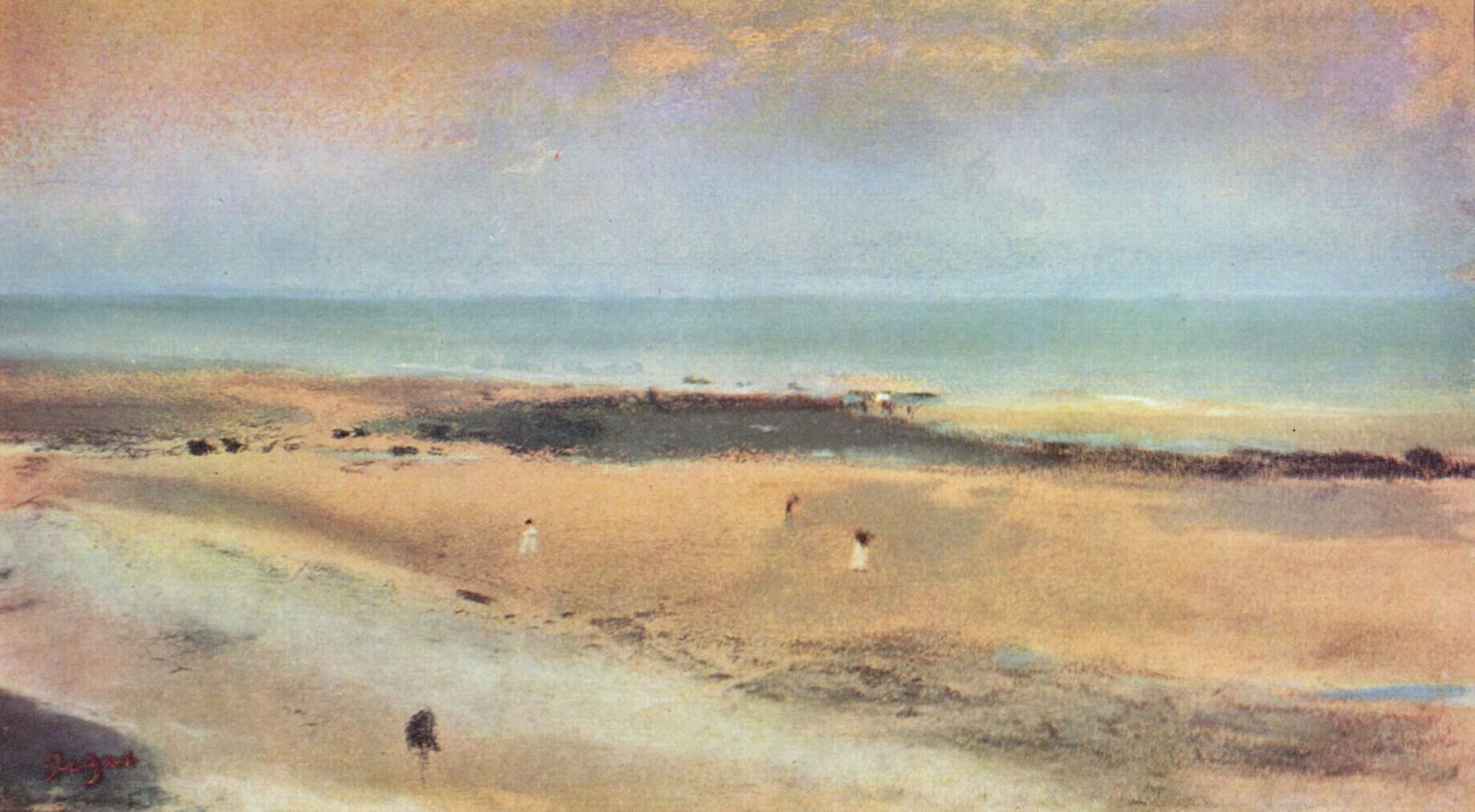
In the summer of 1869 he travelled to the north coast of France, where he visited Manet and painted some landscapes in pastels, on the Normandy coast. Among those is Beach at Low Tide (c 1869-70), emphasising the flatness and emptiness, with vague forms uncharacteristic of a keen draughtsman.
Degas’ first visual problems appear to have been recorded in 1870, when he had joined the National Guard in the Franco-Prussian War. He then discovered he was unable to see a rifle shooting target with his right eye, which he attributed to exposure when a sentinel during the siege of Paris, which didn’t start until mid-September. The following summer he became more worried, and apparently reported some form of photophobia.

In addition to the landscapes mentioned above, Degas painted occasional outdoor views, such as this pastel painting In the Woods, probably made after the war.

Degas first became enthusiastic about ballet when he saw the Paris Opera production of La Source in 1866. His initial paintings concentrated on static scenes and the orchestra, but around 1870 he started to become more involved and began to paint it almost obsessively.
The Dance Class (c 1873) is an early and elaborately-composed example of the works that were to make up half his total output. It shows well his meticulous draughtsmanship, and the strange effect of ballet dress in apparently dismembering the dancers, who become head, arms and legs with the white blur of chiffon between. This is most intense in the tangle of legs making their way down the spiral staircase at the upper left, and in the group of dancers just to the right of those stairs.
In the 1870s, Degas changed the main focus of his work from history painting to the depiction of ‘modern life’, part of the agenda of the developing Impressionist movement. He spent the winter of 1872-73 visiting his mother’s family in New Orleans, in the USA, where he painted A Cotton Office in New Orleans (1873), below. Following his return to Paris, he, Monet, Renoir, Pissarro, Sisley, and Cézanne formed the group which was to mount the First Impressionist Exhibition in 1874, shortly after the death of his father.

Degas painted A Cotton Office in New Orleans in 1873, when he was visiting his mother’s family there. This features several family portraits, and has a narrative background, showing a cotton buyer visiting the Musson cotton merchants.

When in New Orleans, he painted this portrait of Madame René de Gas (1872-73), his first cousin and sister-in-law Estelle Musson Balfour de Gas. She too suffered from deteriorating vision, and the cousins had first met during her visit to France in 1863-65 when in mourning for her husband, who had been killed at the Battle of Corinth in the American Civil War. She married Degas’ brother in 1865, and returned with him to New Orleans. By the time of this portrait, she was blind in her left eye, and her right was deteriorating rapidly, leaving her completely blind by 1875, at the age of only thirty-two.
Following his return to France, Degas’ vision deteriorated. When he was close to Walter Sickert from 1883, he described losing central vision to the point where he could only see clearly away from where he was looking, what’s known as central scotoma, and typical of central retinal disease.
In 1888, Degas started ‘taking the waters’ for a ‘cure’ for his eye problems, at Cauterets to the north of the Pyrenees, which became an annual event. The following winter he wrote his first poetry, and started to withdraw from some activities, visiting the ballet less often, and declining invitations to exhibit. He still maintained some of his friendships, though, and after his summer ‘cure’ at Cauterets visited Spain with the painter Giovanni Boldini.
During these later years in his career, Degas turned to more unconventional media, mixing print-making and monotypes with pastels and peinture à l’essence, oil paint from which most of the drying oil had been removed. Unlike other French Impressionists, almost all his painting took place indoors in his studio, and included precious few landscapes. He also started to experiment with photography.

Most remarkable of all his late paintings is this composite work using peinture à l’essence of a Dancer Fastening Her Shoe (c 1893-98). This brings together four different views of the same dancer fastening her left shoe, in a manner which must have been inspired by Muybridge and Marey’s composite photos. Although Degas appears to have had more of a struggle arriving at the form of these figures, they are each outlined clearly in black.
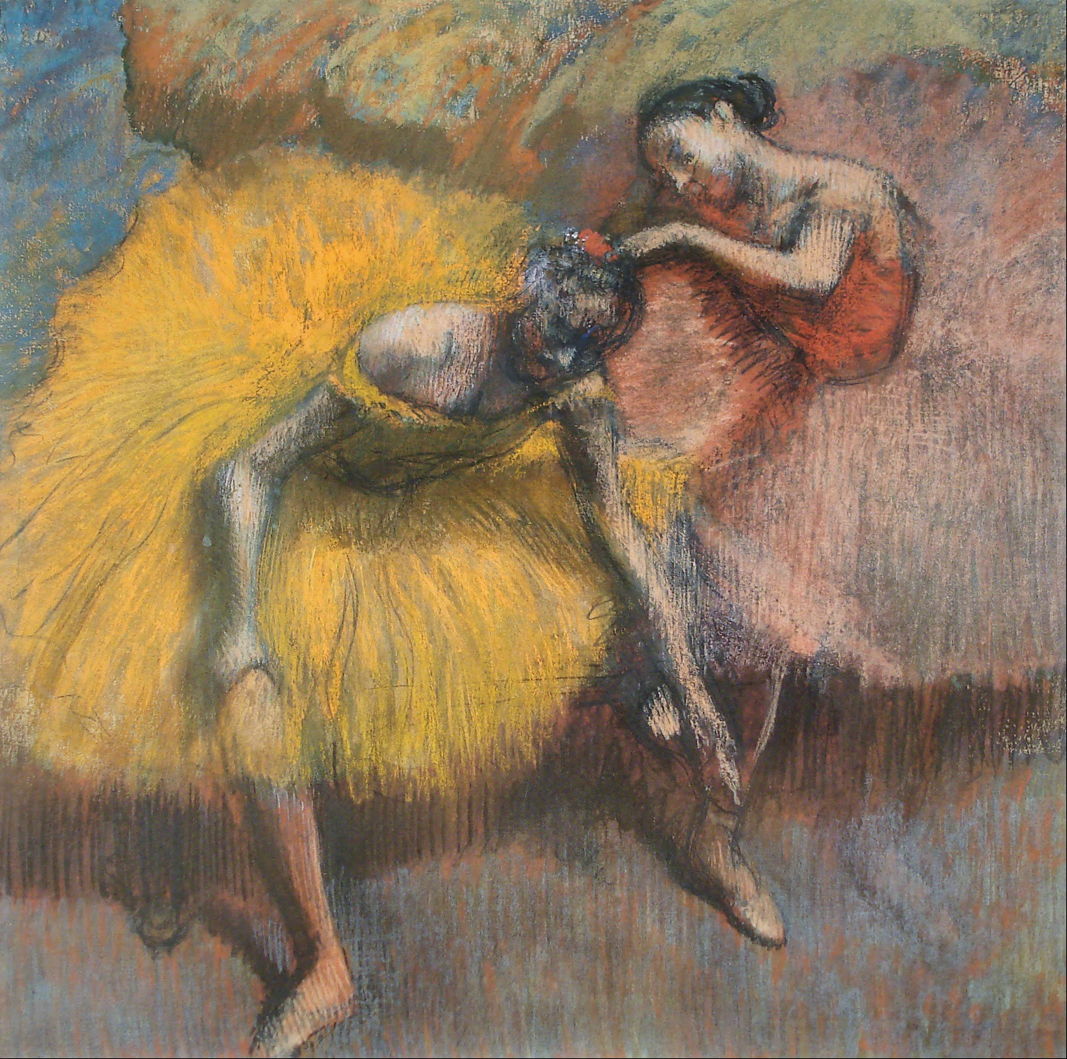
Degas also explored other themes and concepts in these paintings, even when his eyesight and health were failing in his old age. Two Dancers in Yellow and Pink from about 1898 is one of his highly textured pastel paintings using rich colours. One of the dancers is bending forward, and her disembodied legs seem to be in union with her arms. Their faces are indistinct, although that’s also the case in many of his earlier ballet paintings.

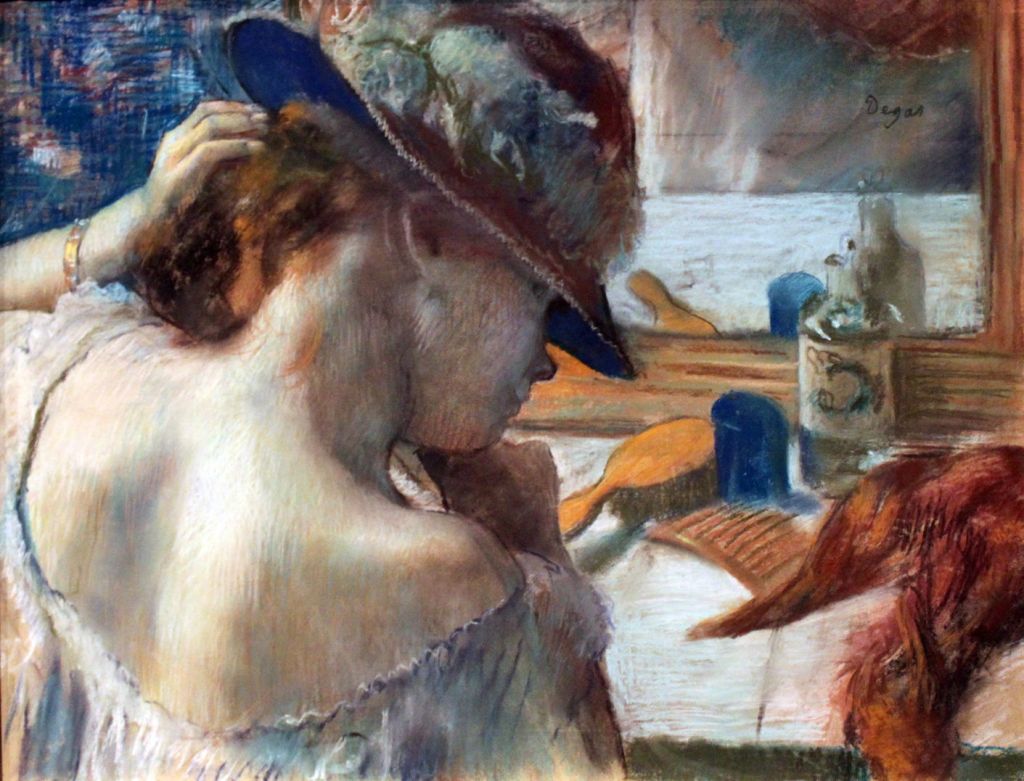
His pastel In Front of the Mirror from 1889 shows a woman preparing herself in front of a mirror, with her face carefully concealed. Some of the fine details here are surprisingly crisp, including the bracelet on the woman’s left wrist, and the highlighting around the brim of her hat.

In this oil painting of After the Bath from about 1895, the woman has adopted a strange and unnatural position, as if she has almost fallen from the edge of the deep bath. Her left foot is still cocked over its edge, as the rest of her lies on her right side on a towel. A maid stands behind her, attending to her long hair. There is greater vagueness in their form as well.

In 1890, apparently out of the blue, Degas started to make landscape images again. Some of these were monotypes, others painted in pastel, such as Steep Coast (c 1892). Some were clearly made from real landscapes he saw during his travels at this time; others, like this are at least flights of fancy inspired by real views.
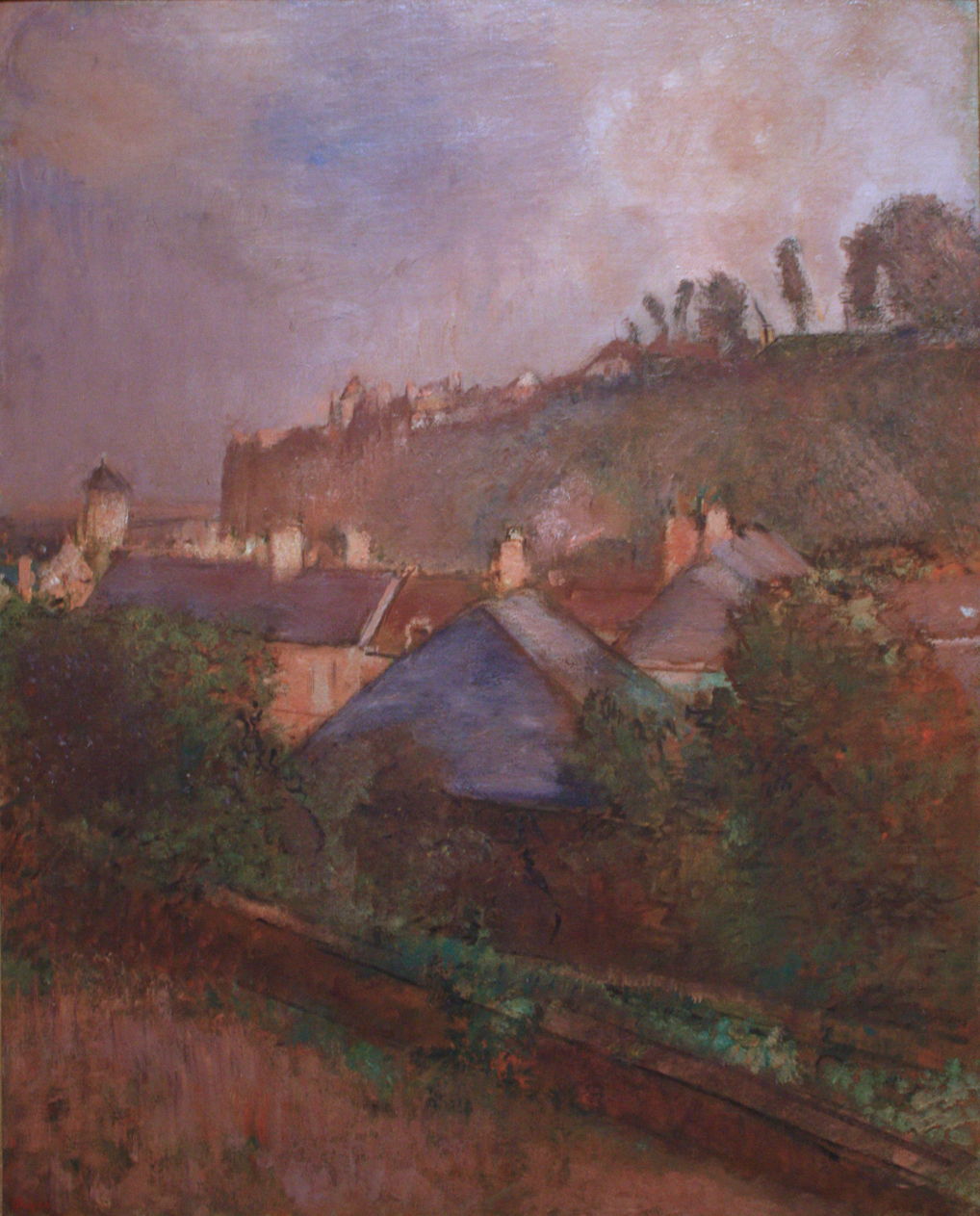
The artist had visited the village of Saint-Valéry-sur-Somme during family holidays in his childhood and youth. During the mid-1890s, he returned, staying either with his brother René or the painter Louis Braquaval, and seems to have painted these views of the village by the end of 1898. He’s also thought to have taken many photographs of the village at the time, although those have subsequently been lost. Degas has painted in many of the edges using black, so structuring their forms.
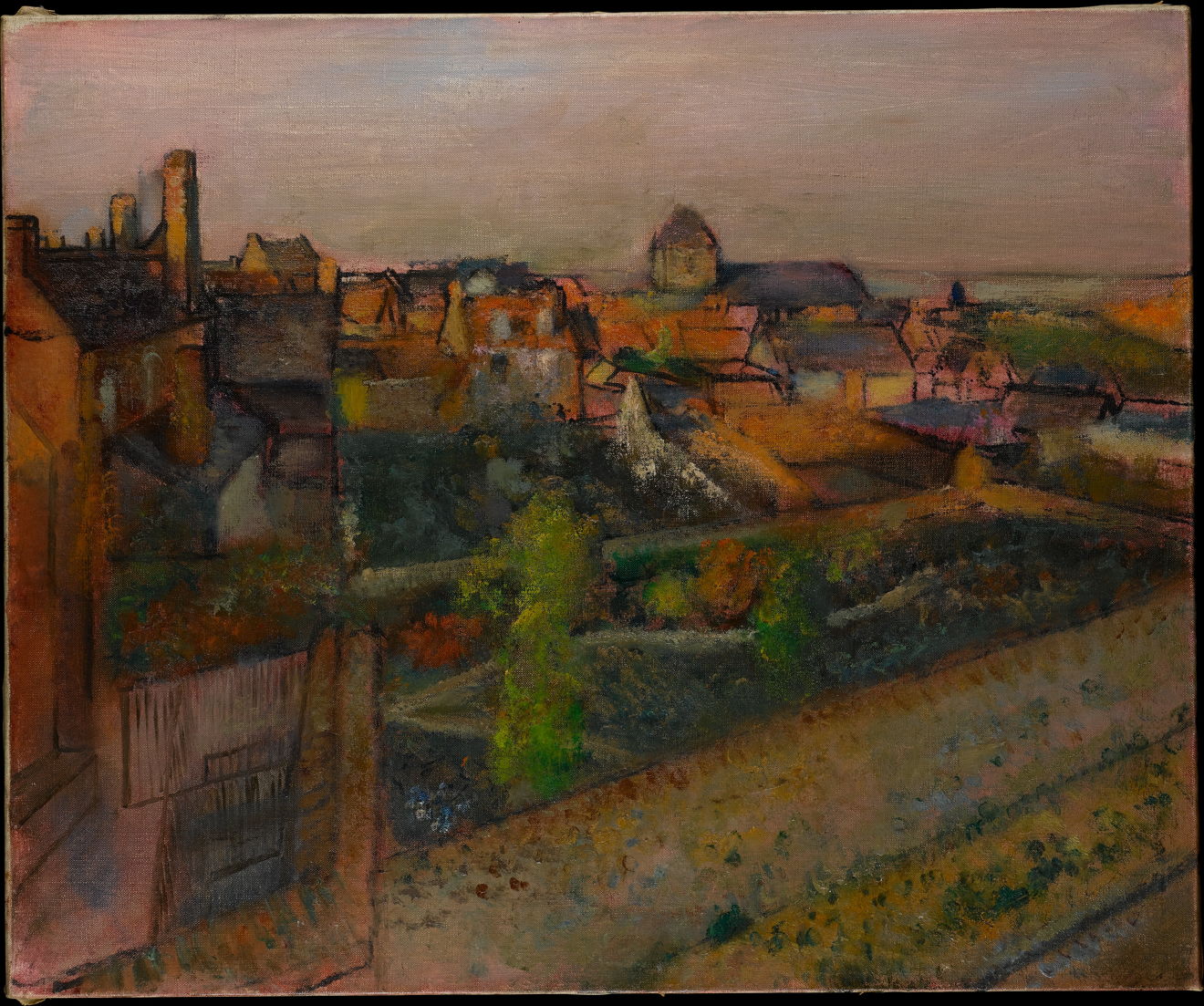
The last twenty years of Degas’ life was marked by his increasing withdrawal, loss of friends, and worsening eye problems. He didn’t stop painting until towards 1910, although his productivity declined well before then.
There can be no doubt that, from quite early in his career, Edgar Degas suffered progressive loss of his central vision in both eyes. For many painters, that would have ended their career, but he must have trained himself to compensate by looking with his visual periphery. One complication, though, is the change that took place over those two decades in painting style of other artists. We’ll never know how much of the change in Degas’ art was the result of that secular trend, how much is attributable to his change in media, and how much the effect of his failing sight.
References
Carol Armstrong (1991, 2003) Odd Man Out, Readings on the Work and Reputation of Edgar Degas, Getty. ISBN 978 0 8923 6728 3.
Ann Dumas, Richard Kendall, Flemming Friborg & Line Clausen Pedersen (2006) Edgar Degas, the Last Landscapes, Merrell. ISBN 978 1 8589 4343 5.
Richard Kendall & Jill DeVonyar (2011) Degas and the Ballet, Picturing Movement, Royal Academy of Arts. ISBN 978 1 9057 1169 7.
Christopher Lloyd (2014) Edgar Degas, Drawings and Pastels, Thames & Hudson. ISBN 978 0 5000 9381 8.
Michael F Marmor & James G Ravin (2009) The Artist’s Eyes. Vision and the History of Art, Abrams. ISBN 978 0 8109 4849 5.

