
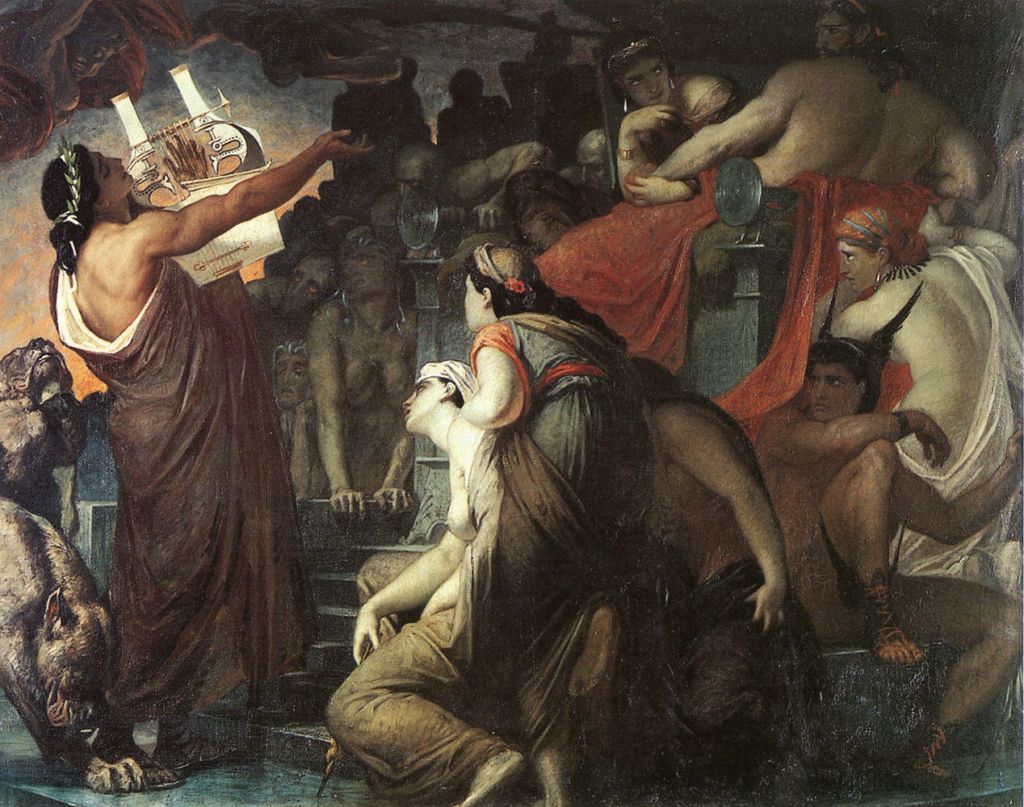
Not all heroes of the Greek and Roman civilisations in classical times were swashbuckling warriors. Among those who achieved fame for their more cerebral skills was Orpheus, the great Thracian bard, an accomplished poet and musician. There are various accounts of his origins, and more agreement that he was one of the Argonauts who sailed with Jason. But for much of his life he was known for his ability to charm the animals with his lyre.

Aelbert Cuyp’s Orpheus with Animals in a Landscape from about 1640 is one of at least two different paintings he made of this story. Here he has included a wide range of both domestic and exotic animals and birds, including a distant elephant, an ostrich, herons and wildfowl, although Orpheus is seen playing a violin.

Orpheus and Animals (1650) is one of Paulus Potter’s most unusual paintings, showing a wide range of different animal species, some of which were not well-known then, and one of which (the unicorn) did not even exist. Those shown include a Bactrian camel (two humps), donkey, cattle, ox, wild pig, sheep, dog, goat, rabbit, lions, dromedary (one hump), horse, elephant, snake, deer, unicorn, lizard, wolf, and monkey.

Franz von Stuck is one of the few modern painters who followed the ancient Greek tradition of naming his figures, at least in some of his earlier work. Although readily recognisable by the prominence of his musical instrument, in Orpheus Charming the Savage Beasts with his Lyre (1891) his name is inscribed behind his back. The eclectic mixture of predators and prey includes several with long symbolic traditions: the flamingo painted so elegantly was believed by the ancient Egyptians to be a living representation of the god Ra.
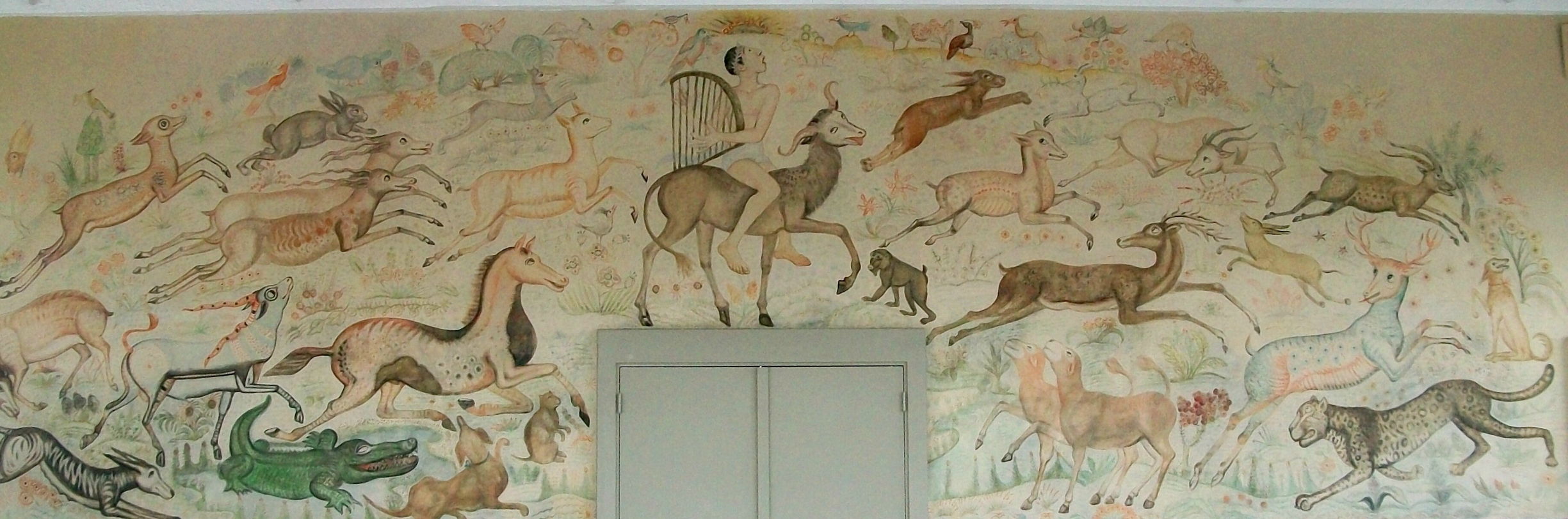
In 1930, Anita Rée was commissioned to paint a mural for a girls’ secondary school in Hamburg, Germany, which she completed in October 1931: her joyous Orpheus and the Animals has been preserved, and is now part of a ballet school. This image shows but part of it, with Orpheus riding a mythical beast over the lintel of the door.
Orpheus’ great influence over the arts in more recent times is the story of his brief marriage to the beautiful Eurydice. After the ceremony, just as the bride was wandering in joy with Naiads in a meadow, she was bitten on the heel by a snake, and died.

Among the earliest paintings of this story in the post-classical era is Jacopo da Sellaio’s superb panel showing Orpheus, Eurydice and Aristaeus from 1475-80. This is one of a series that’s now dispersed across continents. It employs multiplex narrative to show the start of the story, with Orpheus left of centre, tending a flock of sheep, as his bride is bitten by the snake. At the far right, Orpheus, with the assistance of Aristaeus, puts Eurydice’s body in a rock tomb.

One of Nicolas Poussin’s most famous narrative works, Landscape with Orpheus and Eurydice (c 1650-53) shows Orpheus with his lyre at the right, and Eurydice standing in white, as a snake approaches from the left. Poussin had a thing about snakes, and painted other landscapes with snakes threatening people, and his enigmatic Landscape with a Man Killed by a Snake (c 1648). Here his normally peaceful rustic landscape is showing ominous signs of falling apart: the distant castle is on fire, with smoke billowing into the sky.

In Eurydice and the Serpent, a pastel from 1915, Ker-Xavier Roussel shows them just a moment before the bite, with the snake seen on the ground in front of her.

Ary Scheffer’s moving painting of Orpheus Mourning the Death of Eurydice is one of his early works from about 1814. The snake is still visible at the far left, as Orpheus cradles the limp body of his new bride, and breaks down in grief. Scheffer’s handling of complex limb positions is masterful, with the symmetry of their right forearms, and the parallel of her left arm with his left leg. His lyre rests symbolically on the ground behind his left foot.
Orpheus was heart-broken, and mourned her so badly that he descended through the gate of Tartarus to Hades to try to get her released from death. He came across Persephone and her husband Hades, and pleaded his case before them. He said that, if he was unable to return with her to life on earth, then he would stay in the Underworld with her. He then played his lyre, music so beautiful that those bound to eternal chores were forced to stop and listen. Tantalus, Ixion, the Danaids, even Sisyphus paused and sat on the rock that he normally tried to push uphill. The Fates themselves wept with emotion.
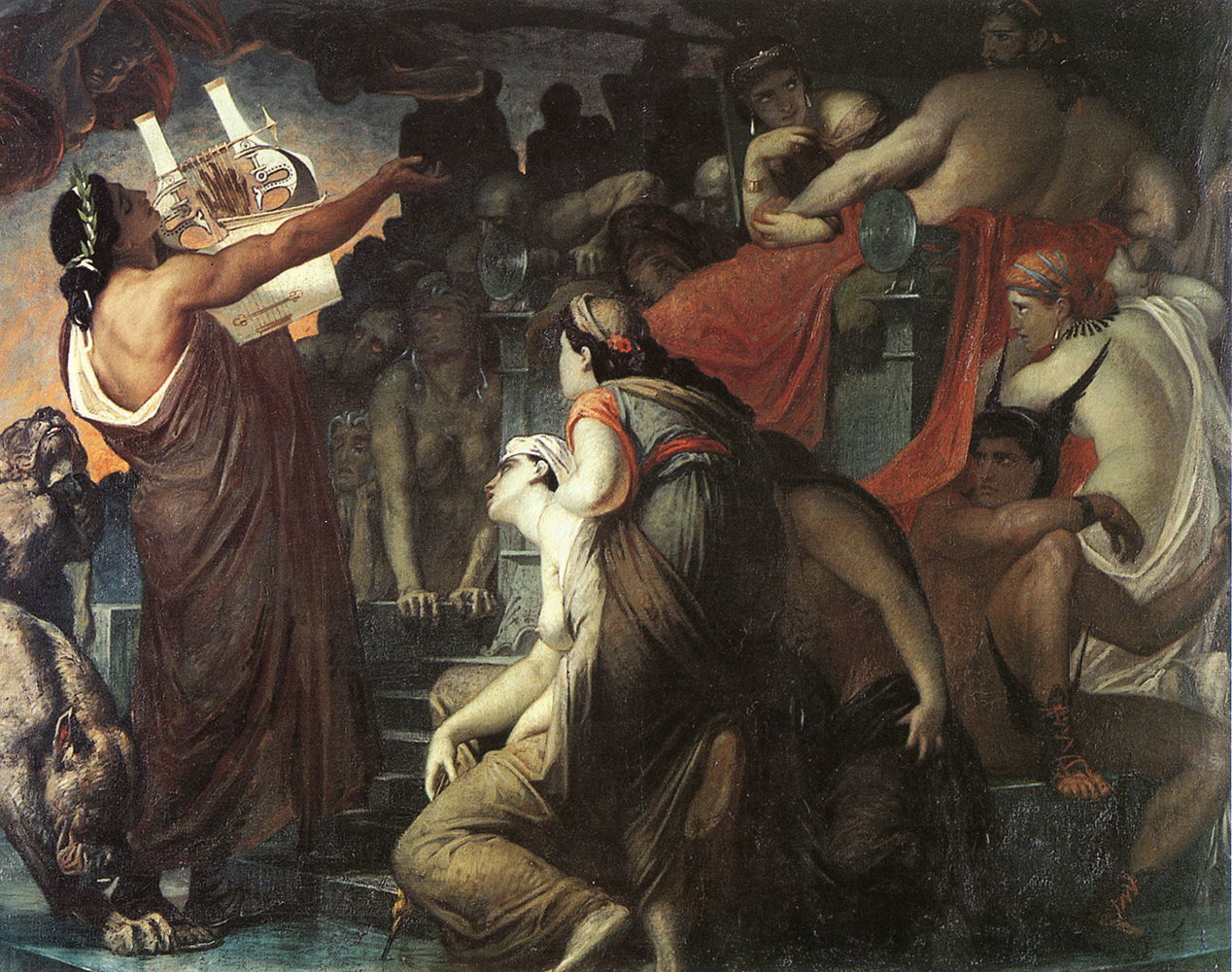
Henri Regnault’s Orpheus in the Underworld (1865) is probably based more on the popular opera by Offenbach, first performed in 1858. Orpheus is seen at the left, his lyre in his hand, singing to the dead. Behind him, at the left edge, are two of the heads of Cerberus, who guards the entrance to the Underworld, and sat on the double throne at the upper right are Persephone, who only spends half the year in the Underworld, and Hades himself.
Just as his lyre had enchanted the animals before, it moved Hades and Persephone.

