
Few painters die in pursuit of their art. This weekend I look at two exceptions, who both died making painted records of expeditions in two of the most hostile parts of the earth. Today’s subject is Ludwig Becker (1808-1861), who emigrated from Germany to Australia, where he tried to complete the first south-north crossing of the continent, but never returned.
Becker was born near the German city of Frankfurt am Main in 1808. He trained in sciences and painting in Darmstadt before being appointed court painter to the Archduke of Hesse, back in Frankfurt. Around 1850, he travelled first to Britain, then migrated from the port of Liverpool to Australia, arriving in Launceston, Tasmania, in early 1851, and the following year travelled to Bendigo in mainland Australia, where he mined for gold. He seems to have been multi-skilled, as a naturalist, geologist and painter in watercolours.

He painted this watercolour view of his prospector’s tent at Bendigo in 1853, one of several exhibited in Melbourne the following year.
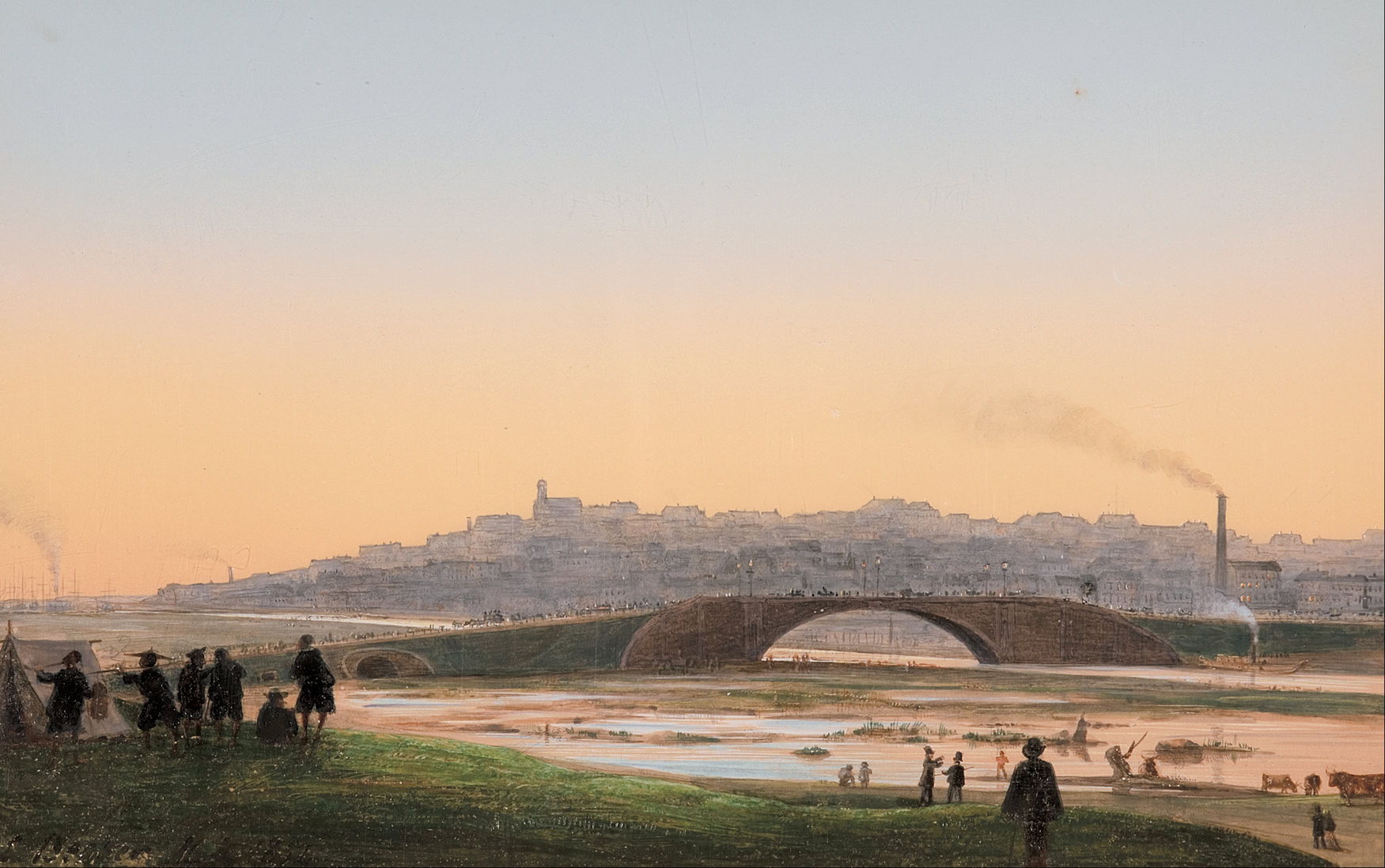
His fine watercolour view of Melbourne from across the Yarra dates from 1854. He appears to have settled in the city for the next six years or so, and became a council member of the Victorian Society of Fine Arts in 1856.
Over this period, he was also an active naturalist, corresponding with John Gould, father of Australian ornithology, and sending his drawings to Europe. His illustrations appeared in various natural history publications, including accounts of the local botany. In 1859, he joined the Philosophical Institute of Victoria (becoming the Royal Society of Victoria the following year), which soon started to organise a major expedition to cross the continent of Australia from Melbourne in the south to the north in the Gulf of Carpentaria.
Led by Robert O’Hara Burke, a police superintendent, with William John Wills his third-in-command, it became known as the Burke and Wills Expedition. Like Scott’s ill-fated expedition to the South Pole, it also became part of an unofficial race, against John McDouall Stuart, a South Australian who intended to complete the first south-north crossing of the continent.

Nicholas Chevalier painted this Memorandum of the Start of the Exploring Expedition to mark their departure in 1860. The team left Royal Park, Melbourne on the afternoon of 20 August 1860 with nineteen men and about twenty tonnes of equipment and stores. Included were more than twenty-four camels, horses and wagons.
Becker was one of two scientific officers in the core of the party, his roles being its naturalist, geologist and artist.
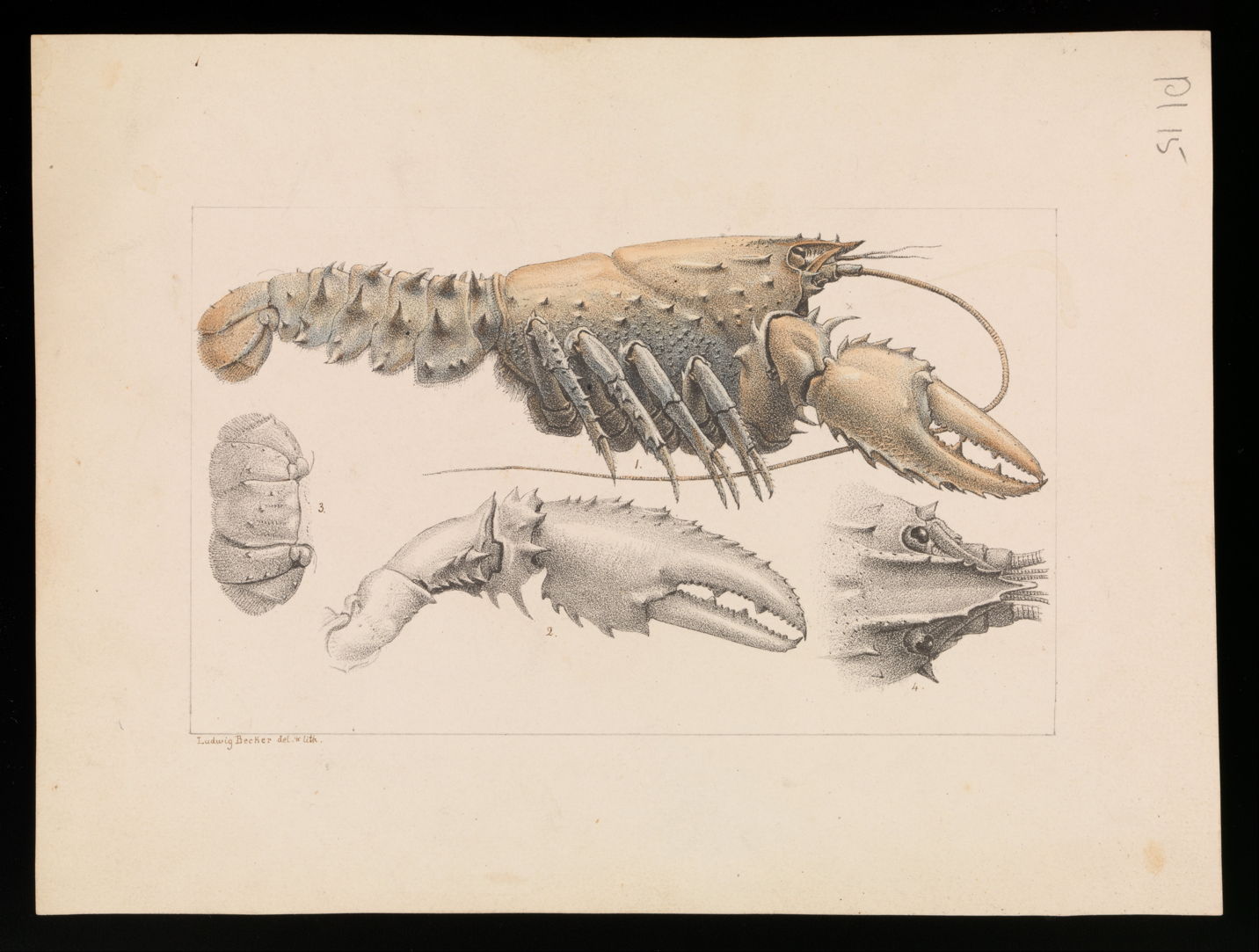
Becker’s fine scientific illustration of a Murray Spiny Crayfish, Euastacus armatus was completed in 1860-61, probably during the early months of the expedition when he was still sending a lot of scientific material back to Melbourne.
Burdened with its gear and stores, the expedition moved too slowly for its leader, Burke, who abandoned much of their provisions within the first two months. At that stage, the second-in-command resigned, and Burke ordered Becker to stop making scientific observations and walk on foot like the rest of the party, rather than riding. Becker was then put in a party led by William Wright, who had been promoted to third-in-command despite his incompetence.
By February 1861, Becker and others were suffering from scurvy, then became very ill because of bad water.
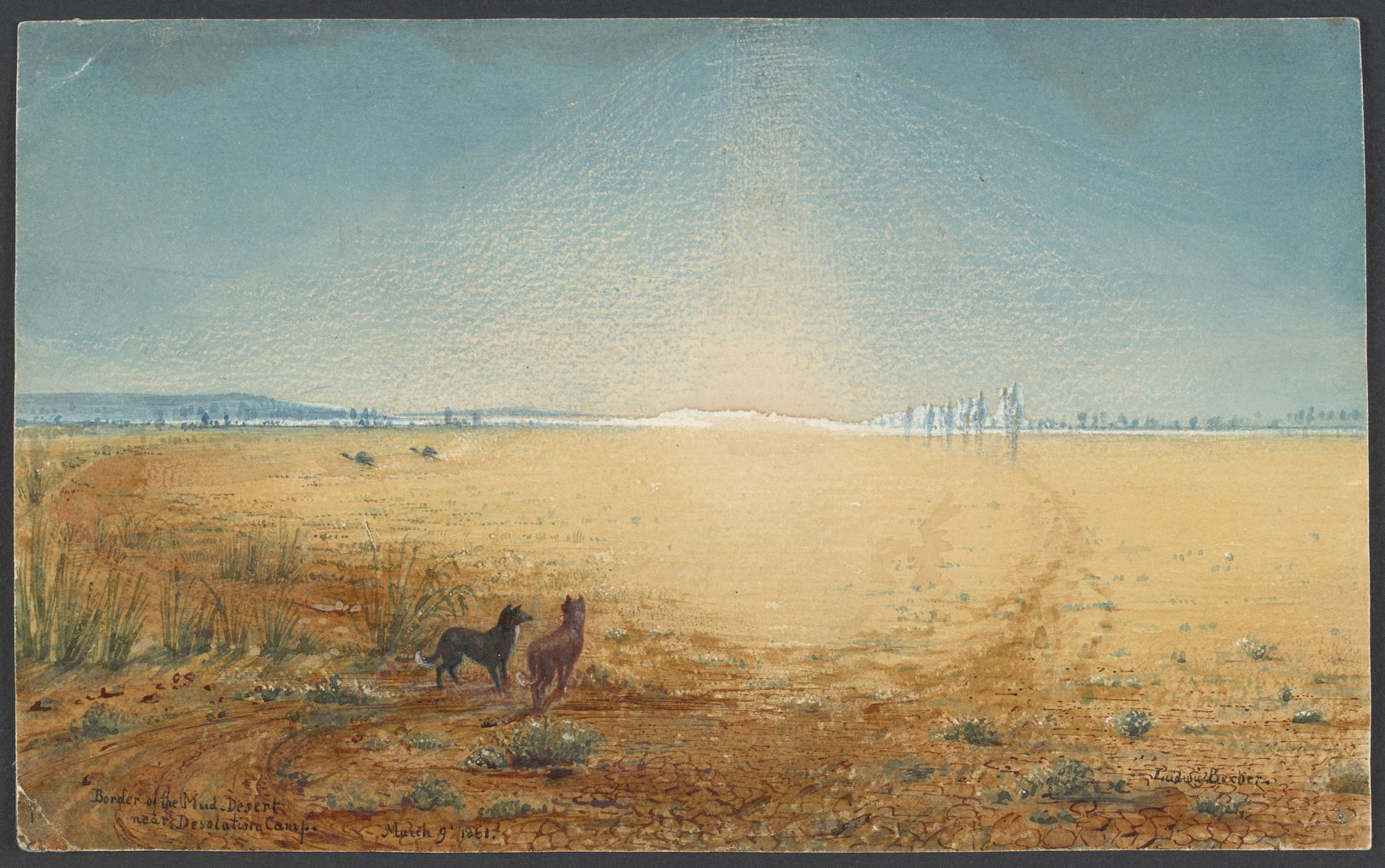
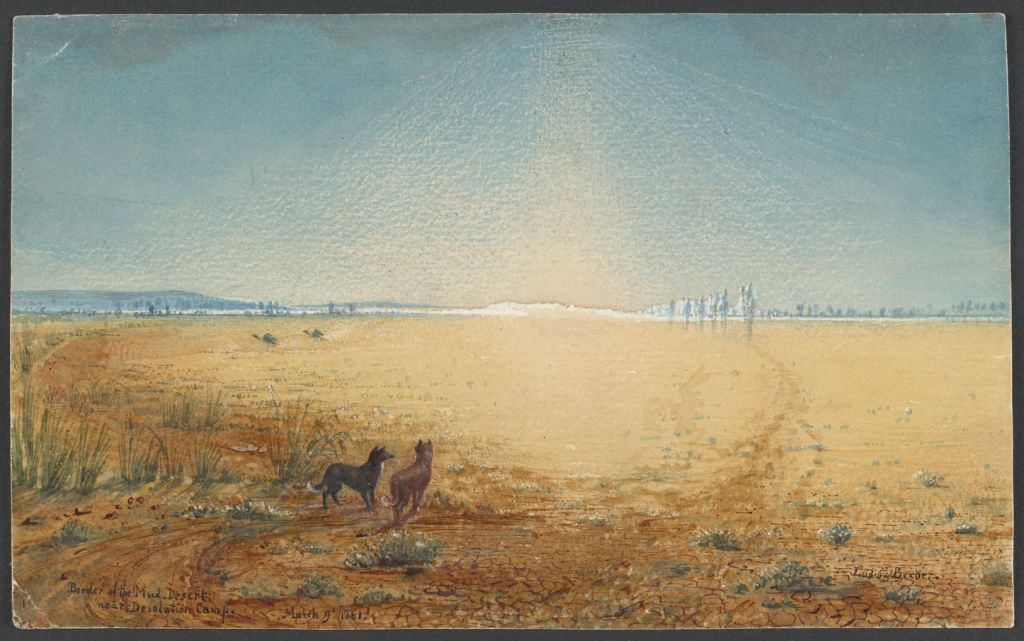
Becker painted this watercolour view of the Border of the Mud-Desert near Desolation Camp on 9 March 1861, as his health continued to deteriorate. He finally died on 29 April 1861, in their camp at Bulloo, from dysentery complicated by scurvy. He completed seventy watercolours, drawings and maps during the expedition, at times going without food and sleep in order to work. Six other members of the expedition also died, including its leader Burke, and only one who had set out from Melbourne returned to it alive.
References

