

One of the most effective ways of drawing a viewer’s eye deep into a landscape painting is to include a Wanderer. These often tiny figures started appearing in paintings by German Romantic artists in the early nineteenth century. As they usually have their back to the viewer, they’re also known as Rückenfigur, ‘back-figure’, and are best known today in the paintings of Caspar David Friedrich.
Thomas Fearnley (1802–1842) was an enthusiastic painter of the Rückenfigur, and quite a wanderer himself. As his name suggests, he was of British origins, but in the middle of the eighteenth century his grandfather moved to Norway to conduct his trading business there. His grandson Thomas was born in south-east Norway in 1802. Seventeen years later he started his training as an artist, progressing from the Norwegian National Academy of Craft to the Art Academy in Copenhagen in 1821, then to its sister academy in Stockholm in 1823.
By then, Fearnley had proved himself proficient enough to be commissioned by Crown Prince Oscar of Norway and Sweden. After touring the Nordic countries painting their landscapes, in 1828 he went to Germany, and the following year became a student of JC Dahl in Dresden.

Fearnley’s nocturne of The Bridge of Hauge outside Arendal from 1829 is an example of German Romanticism as practised by Caspar David Friedrich and JC Dahl, here set in a rugged Norwegian landscape. Arendal is in the far south of Norway, on the northern coast of the Baltic Sea.
The following year, Fearnley painted one of his first landscapes with a Wanderer. It seems reasonable to conclude that this traveller, viewer, and artist was Fearnley’s artistic alter ego, a Rückenfigur typical of German Romantic paintings.

He often appears wearing a distinctive hat, sometimes a top-hat, or the red cap of Landscape with a Wanderer from 1830.
From Dresden, Fearnley went on to Munich in 1830, then two years later started life as a wanderer himself, touring through France, Britain and reaching Venice later in 1832.

He painted A Terrace in Amalfi in Moonlight in 1834, another atmospheric nocturne. Amalfi is a town on the south-west coast of Italy, set amid a famously scenic coastline. Fearnley uses the cunning device of the awning to hide the direct light of the moon, in what must have been a plein air sketch, executed at speed.

A couple of times, Fearnley’s wandering painter assumes importance, as in The Painter and the Boy (c 1834). This view of the Italian coast was most probably painted en plein air over a period of a few days, the figures being added late in the process. The artist with his back to the viewer doesn’t appear to be Fearnley, cannot be identified as any real painter, and must be presumed to be his alter ego.

Fearnley’s Rider in a Landscape from the same year is set much further north, in the fjords of Norway. Its lone rider is whipping their horse on as they descend a rough track leading down to the shore of the fjord at the right. Behind them the world has turned dark grey with the heavy rain of an approaching storm, while the sun still shines on the ice-capped mountains in the far distance.

Fearnley painted this detailed oil sketch of Sunrise in the Wengeralp in 1835, in preparation for a larger finished work that he completed three years later. This is located above Wengen in the Bernese Oberland in Switzerland, and isn’t far from Grindelwald and its glacier, which he was to paint a couple of years later.
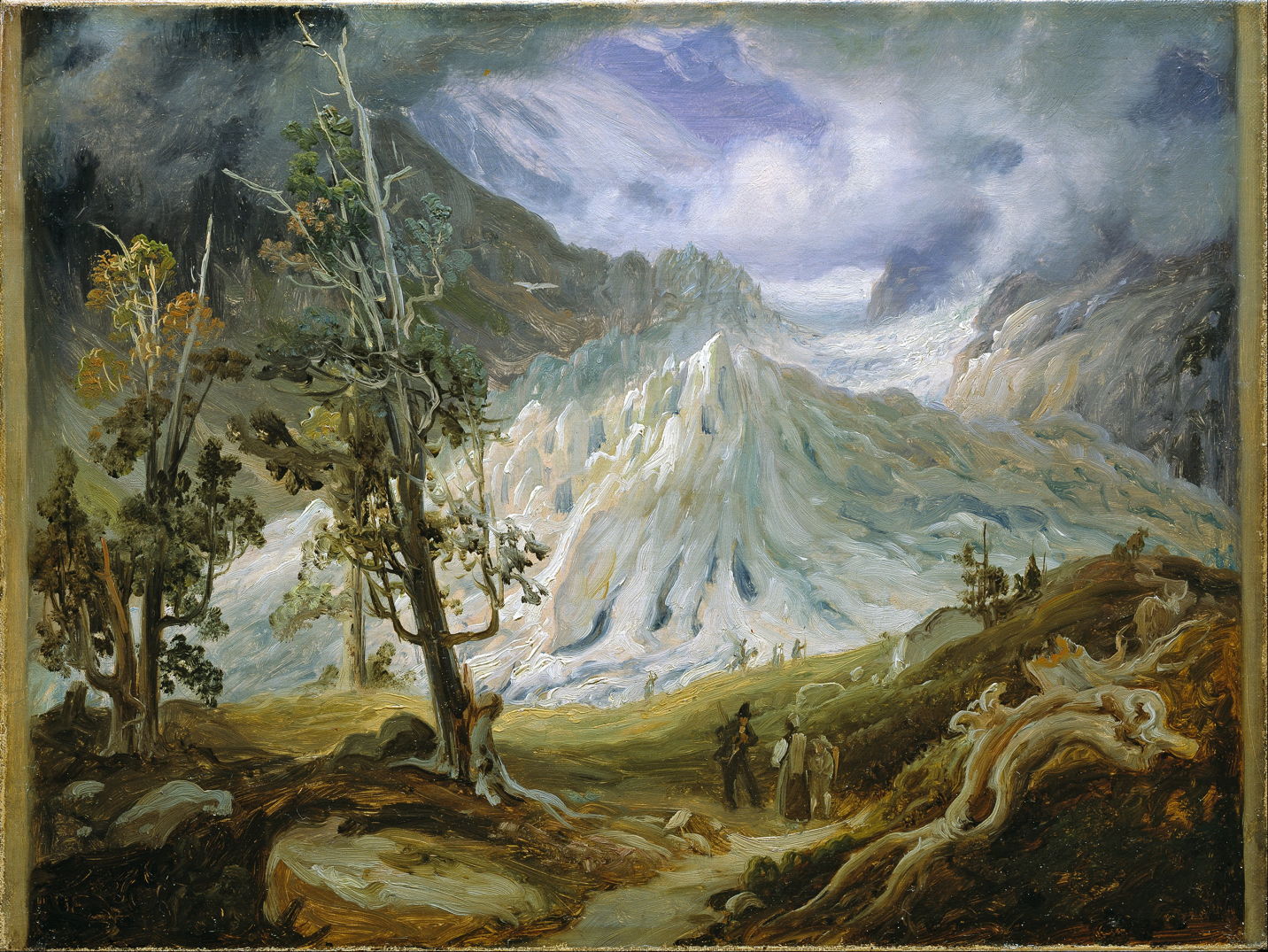
In about 1837, Fearnley visited the Grindelwald Glacier, and produced this superb plein air oil sketch. In addition to the ghostly-white eagle soaring above the ice, he included more than half a dozen figures. Prominent among the nearer group is a Wanderer wearing a large black hat. Even the line of people far back against the foot of the glacier has been painted in some detail, with the leader holding a staff, and one of them mounted on a pony or similar.
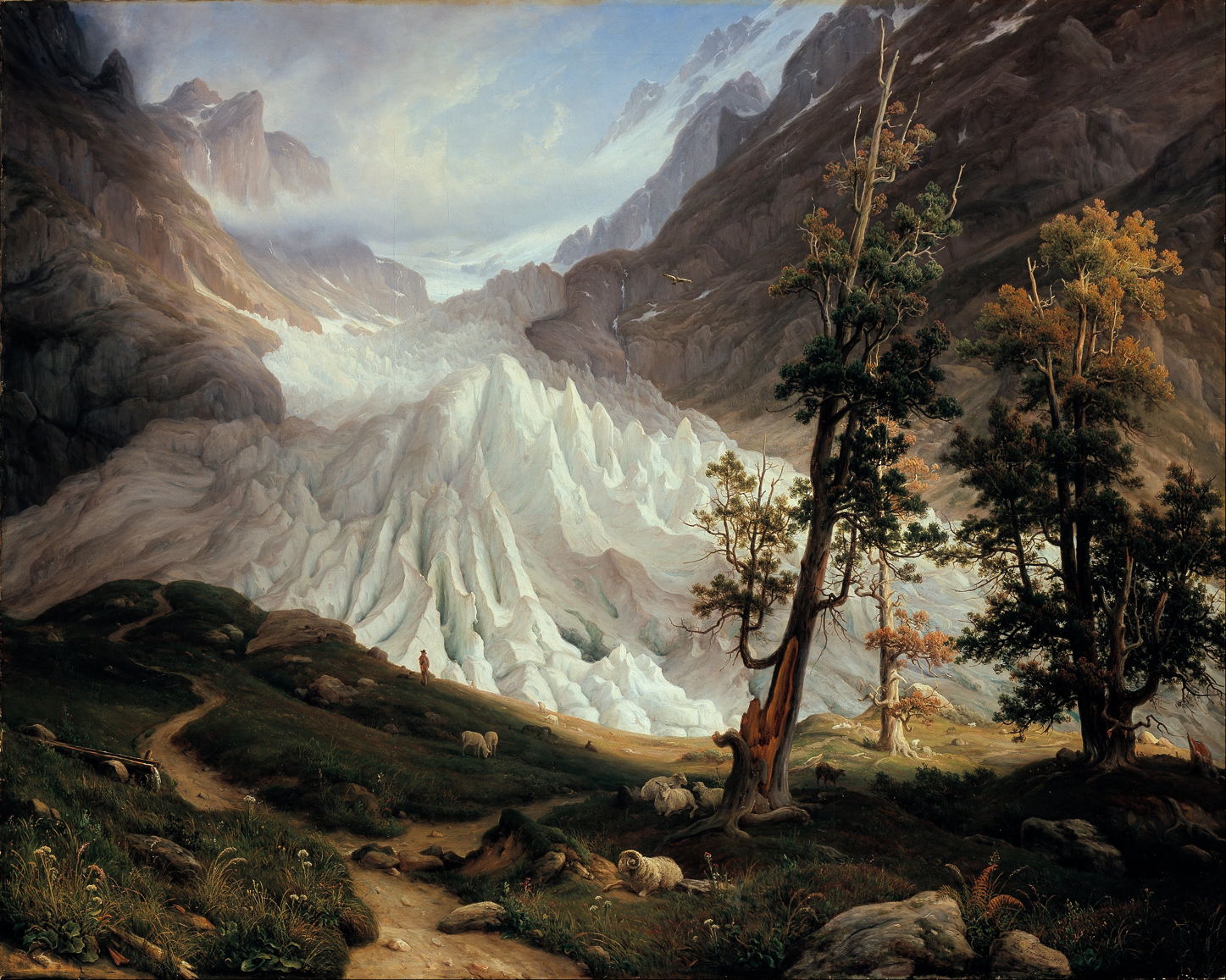
A year or so later, Fearnley painted this large finished version. The method he used to transfer from his original sketch has reversed the sides of the image, but many details have been retained. The eagle still soars, the trees are very similar, but the figures have changed completely. On the now lush pastures in front of the massive wall of ice, Fearnley has found a flock of sheep instead of people. In the distance, with his back towards us, is the Wanderer, posing as a shepherd but looking away from the viewer, towards the glacier, and wearing a distinctive black hat.
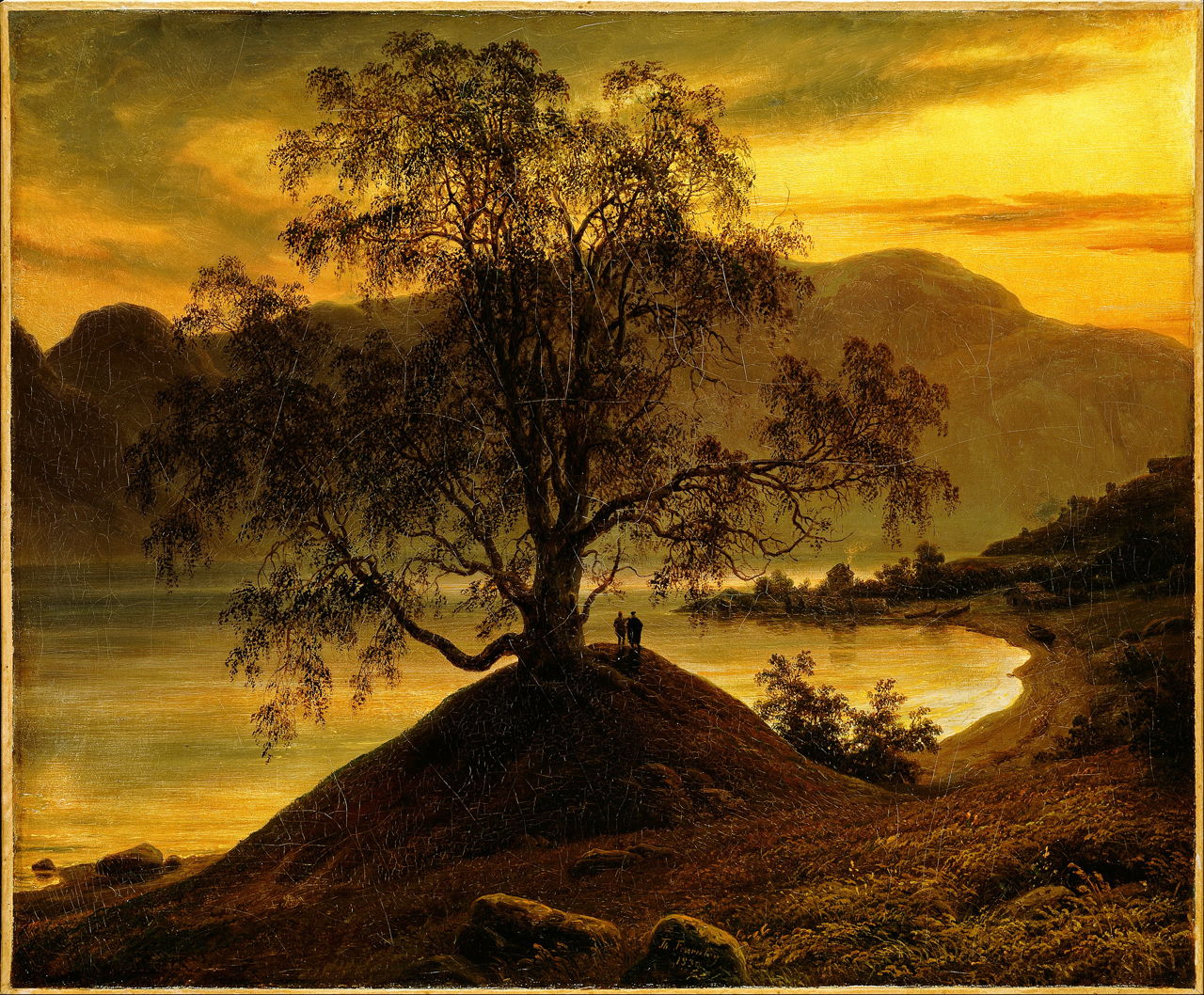
Back in Norway the following year, Fearnley’s Old Birch Tree at Sognefjord features two small figures at is centre, and many other absorbing details such as the smoke rising from the chimney of the house on the other side of the small bay.
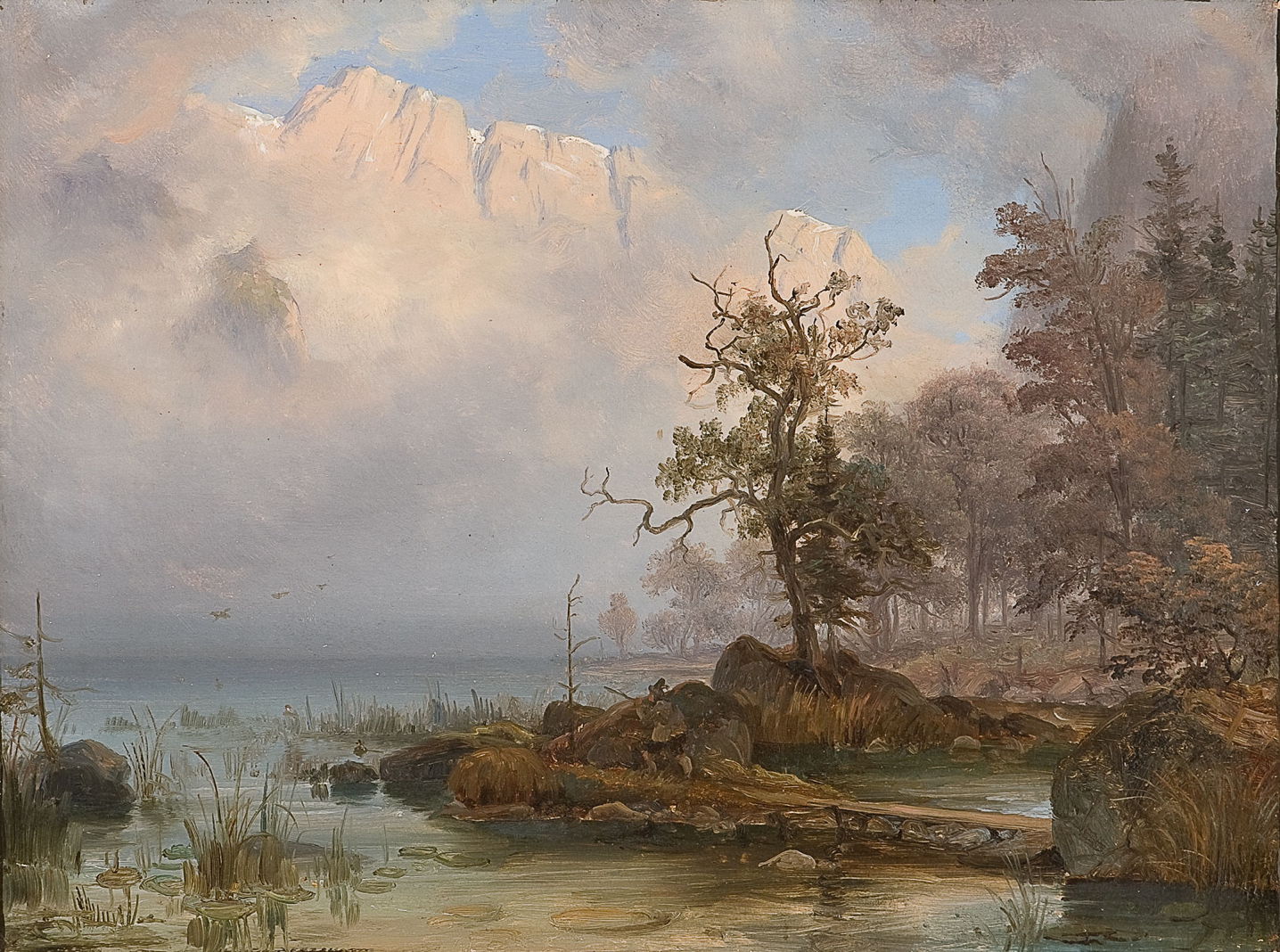
In The Duck Hunter, the figure is camouflaged to increase the challenge made of the viewer. This is heightened in another large finished work, showing The Labro Falls at Kongsberg (1837), below.
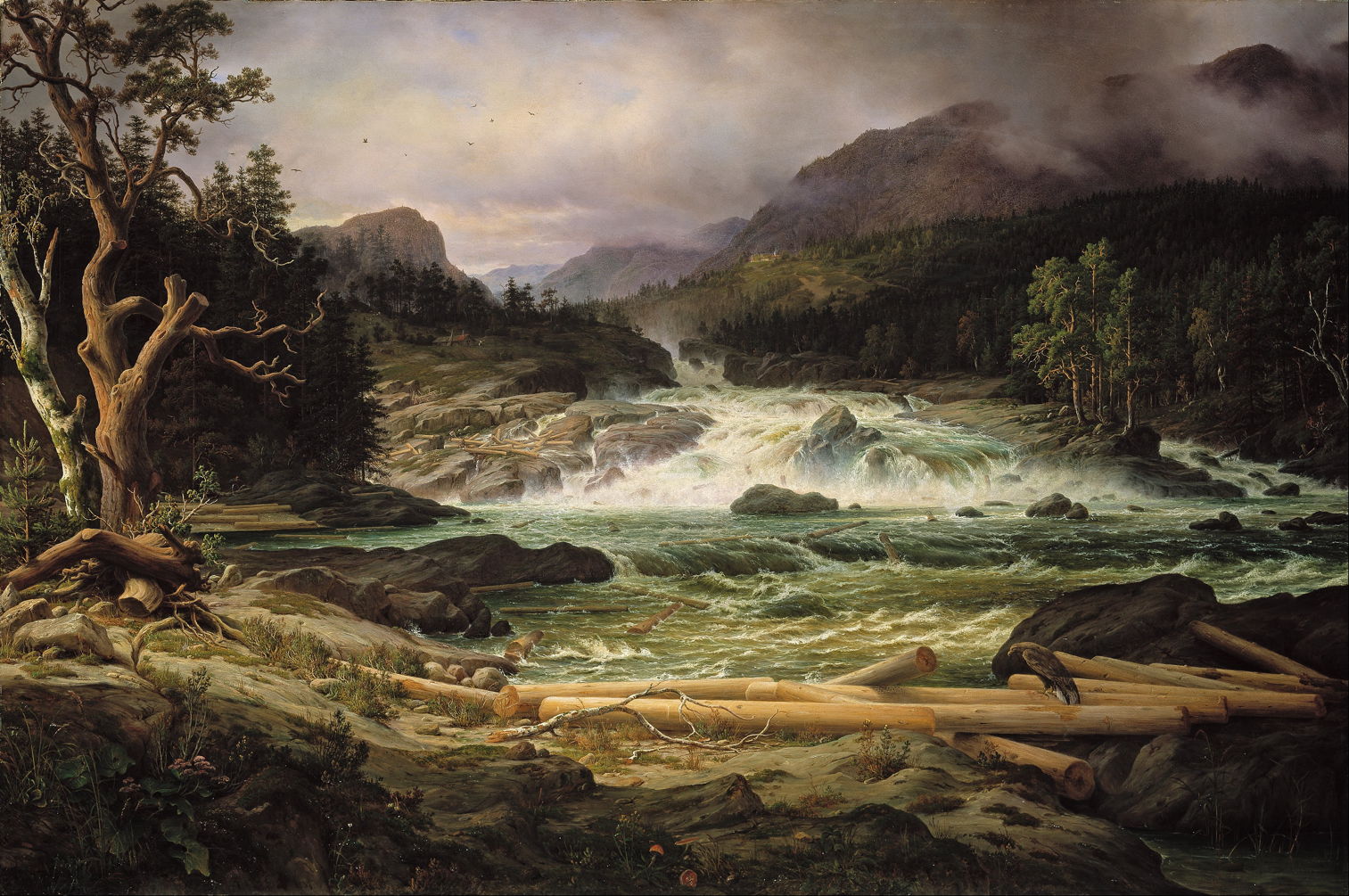
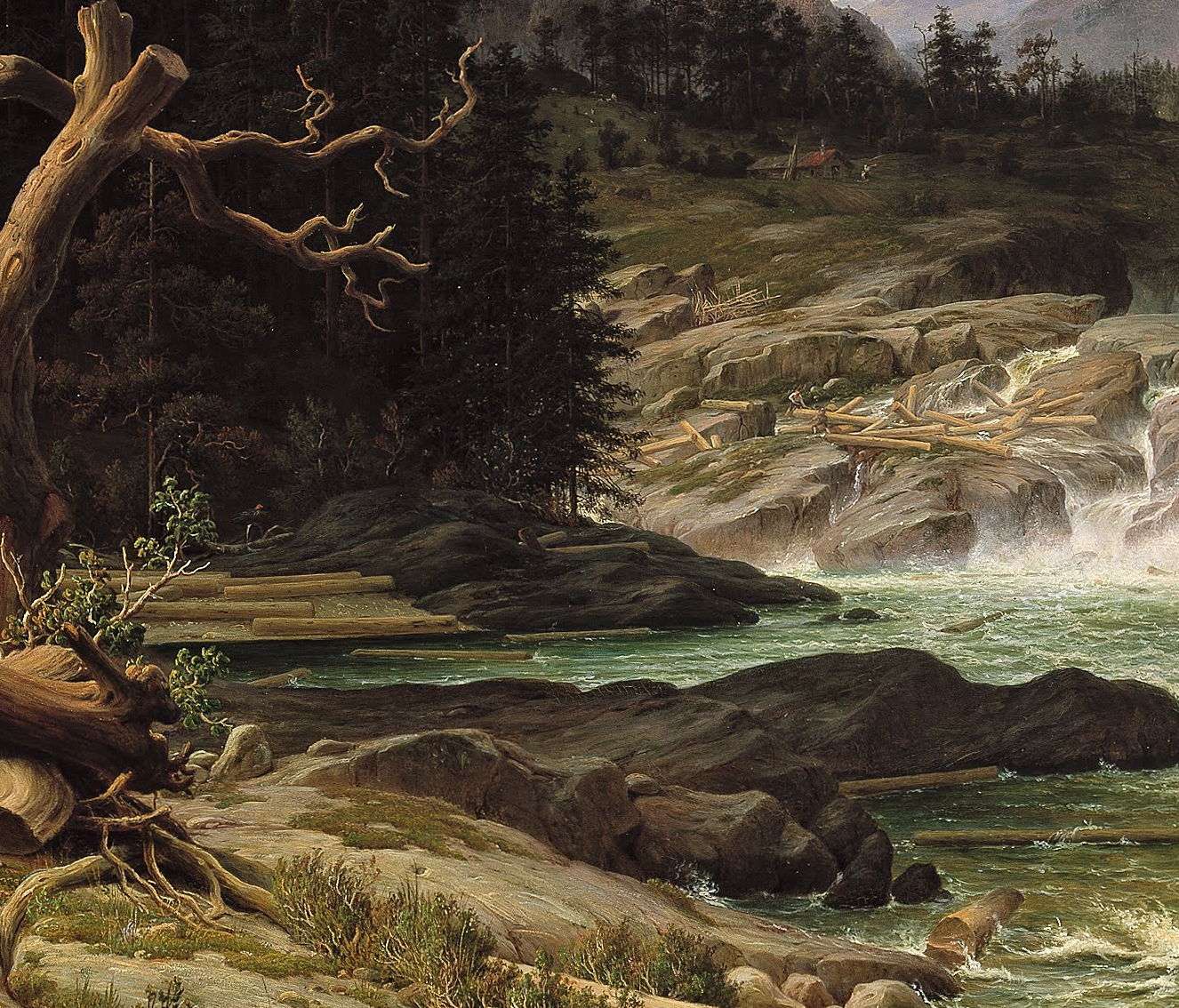
You don’t get many points for spotting the large eagle in the foreground, or the scattered fungi. Rewards increase with the birds wheeling in the sky, and the cabin in the middle distance. To get full marks, you have to notice the tiny red cap among the shadows, to the left of centre in the detail below. I think that is Fearnley’s alter ego, collecting brushwood for the fire in his cabin in the upper right of the detail.
Fearnley is by no means the only landscape painter to have used these tiny figures to draw the viewer into their highly detailed landscapes, and make them marvel at seeing what they couldn’t have seen in reality. It’s an effective trick that adds interest to a view, and enriches the dialogue between the artist and viewer. The people may be little, but their purpose is as ambitious as the grander landscape around them.
When he was in Munich early in 1842, Thomas Fearnley contracted typhoid, and died there when he was only 39.
He had in reality been quite portly, and looked nothing like any of his painted figures. But look closely at many landscapes and you’ll see Fearnley’s Wanderer.
Reference
Sumner, Ann, and Smith, Greg (eds) (2012) In Front of Nature, The European Landscapes of Thomas Fearnley, Barber Institute of Fine Arts. ISBN 978 1 907804 10 6.

