
Once Heracles was able to wear his lion-skin and wield his club again, when he had expiated his sins in servitude to Queen Omphale, he resumed his adventurous lifestyle.
After Ilus had founded the city of Troy, the task of building its defensive walls fell to his son Laomedon. He struggled with this until the gods Apollo and Poseidon agreed to help him. Once those walls were complete, the two gods reminded Laomedon of their bargain for repayment, but the king denied ever agreeing to it.
Poseidon responded by flooding the city, so destroying the crops of the surrounding lands of the Troad. Poseidon then demanded the King delivered his daughter Hesione to feed a sea monster, in a scene reminiscent of Andromeda being offered to Cetis. It was Heracles who rescued Hesione from that fate, but Laomedon again failed to repay his debt to him, so Heracles gave Hesione to Telamon, whose brother Peleus married Thetis and fathered Achilles.

The only accessible painting of Heracles’ involvement is Hans Thoma’s Hercules Delivering Hesione (1890). Heracles stands on the beach in front of the early city of Troy, his trademark club in his right hand. A naked Telamon is busy keeping the sea monster at bay by throwing boulders at it. Heracles is bargaining with the fair and beautiful Hesione, whom he ultimately gives in marriage to the loyal Telamon as a reward for his services.
Heracles came into conflict with Achelous the river-god over Deianira’s hand in marriage. While others might have been content to leave competing suitors to plead their cases in words, Heracles rushed at Achelous to engage him in a fight. By Achelous’ own account, Heracles eventually got the better of him and forced him onto his knees.
The river-god then shifted shape, changing first to a snake so he could slither away from his opponent. Heracles mocked him for that, reminding him of his conquest of the Lernean Hydra. When Heracles got a stranglehold on him, Achelous changed into his third and final form, that of a bull. Once again Heracles brought him down, and wrenched off one of his horns. That missing horn was transformed into the Horn of Plenty, cornucopia.

This exquisitely engraved rock crystal plaque by Annibale Fontana, showing Heracles and Achelous wrestling, is one scene from a life of Heracles. This was originally set with others into a gilded casket owned by the ducal Gonzaga family, of the city of Mantua in Italy. Heracles, on the right, wears his signature lion-skin, and Achelous is conventionally old, bearded, and shaggy.

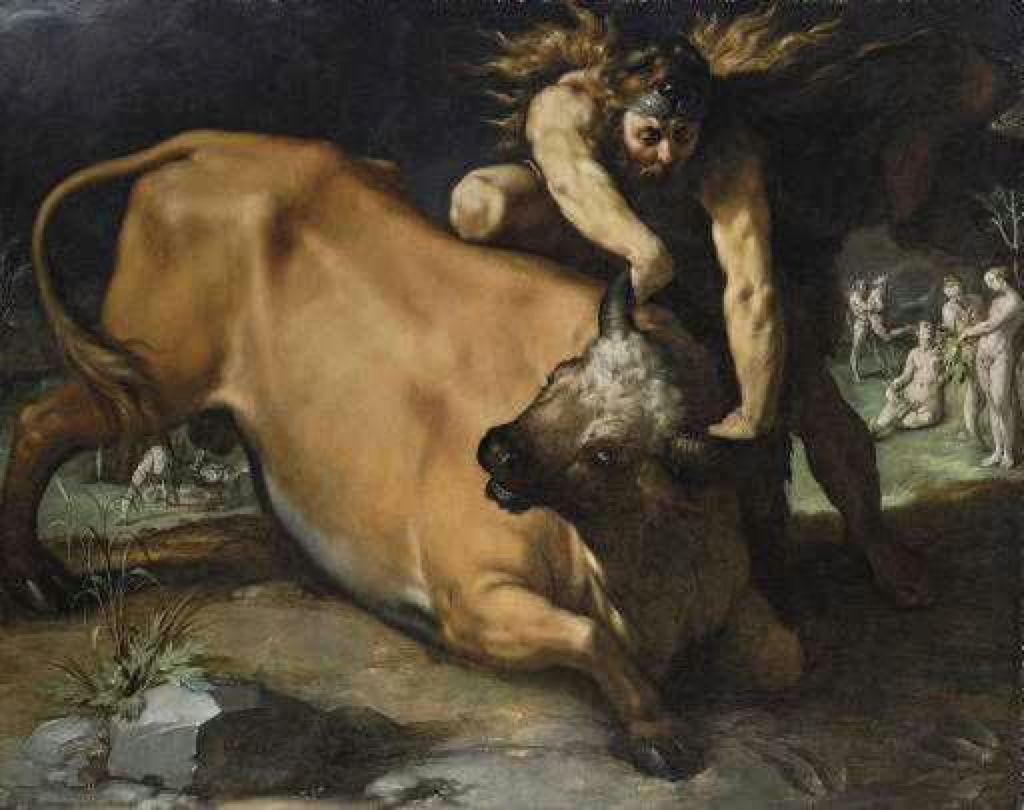
Cornelis van Haarlem’s painting of Hercules and Achelous, probably from around 1590, shows a late stage in the wrestling, with Achelous in the form of a bull, brought to the ground by Heracles, who is here trying to twist his horns off.

Guido Reni’s Hercules and Achelous (1617-21) opts for a more conventional wrestling match, with Achelous still in his initial human form.

Noël Coypel, the father of the better-known history painter Antoine Coypel, painted Hercules Fighting Achelous in about 1667-69. This too opts to show the pair during the first phase of their fight. In addition to wearing his lion-skin, Heracles wields his fearsome club, although Ovid’s retelling doesn’t refer to its use on this occasion.

Nicolas Bertin’s Hercules fighting Achelous (1715-30) is more elaborate. Heracles has almost got Achelous onto the ground, and looks as if he’s about to punch him with his fist. Heracles’ club rests in the foreground. The woman at the right is Deianira, over whom they are fighting, and a winged goddess is ready to place the laurel wreath on the victor.
For once, the most detailed and magnificent account of one of Ovid’s myths is modern, painted in 1947 for a department store in Kansas City. Thomas Hart Benton’s Achelous and Hercules (1947) is a gem of narrative painting.

At the centre, Heracles, stripped to the waist and wearing denim jeans, is about to grasp Achelous’ horns. Immediately to the right, Deianira is also shown in contemporary American form, with a young woman next to her bearing a laurel crown. They’re sat on the Horn of Plenty, and Benton is one of few to include this important reference.
To the left of centre, Benton shows a second figure of Heracles holding a rope, making this multiplex narrative. That is part of a passage referring to ranching and cowboys, and further to the left to the grain harvest. To the right, the Horn of Plenty links into the cultivation of maize (corn), the other major crop from the area.
It was his marriage to Deianira that was to prove the undoing of Heracles.

