
A multiplex narrative painting contains representations of two or more moments in time from a story, merged together in a single image. At the height of their popularity during the Renaissance some paintings far exceeded that, with as many as twenty-three scenes from the Passion of Christ being integrated into a single image. This article shows three examples, and concludes with the later decline of the technique.
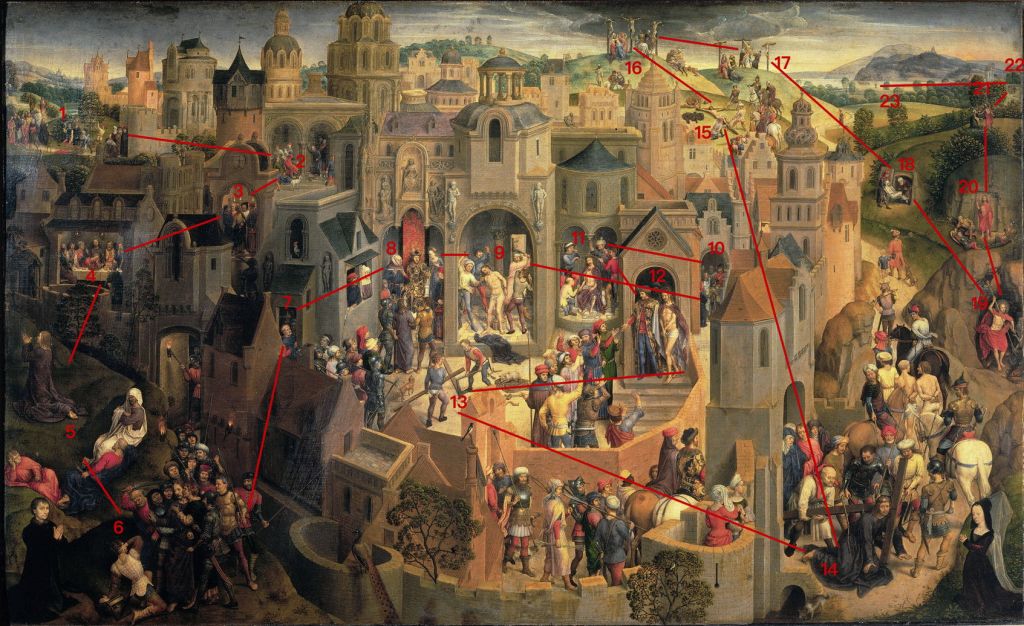
In about 1470 the early Netherlandish painter Hans Memling (c 1433–1494) integrated twenty-three Scenes from the Passion of Christ into a single fictional aerial view of Jerusalem.

This was commissioned by Tommaso Portinari, an Italian banker based in the Belgian city of Bruges, who as the donor earned himself a place at the lower left corner, with his wife Maria Baroncelli at the lower right. Spread across the rest of this relatively small oak panel are scenes that require the words of six chapters of the Gospel of Saint Luke, each fully integrated into its single visual narrative.

I have marked up each of the scenes and the links between them in this image, and step through them with the aid of details below.
As is characteristic of the period, Memling’s Jerusalem is depicted as a walled mediaeval city, familiar in appearance to those in northern Europe. Some of its towers have an oriental flavour, but nothing the contemporary viewer would find too unusual. The narrative path taken through these buildings starts at the upper left and, with few exceptions, winds its way without crossing its own path and causing any confusion. Its only navigational complexity arises between the ninth and thirteenth scenes. Otherwise it sweeps down from the top to the foreground procession to Calvary and concludes at the upper right.
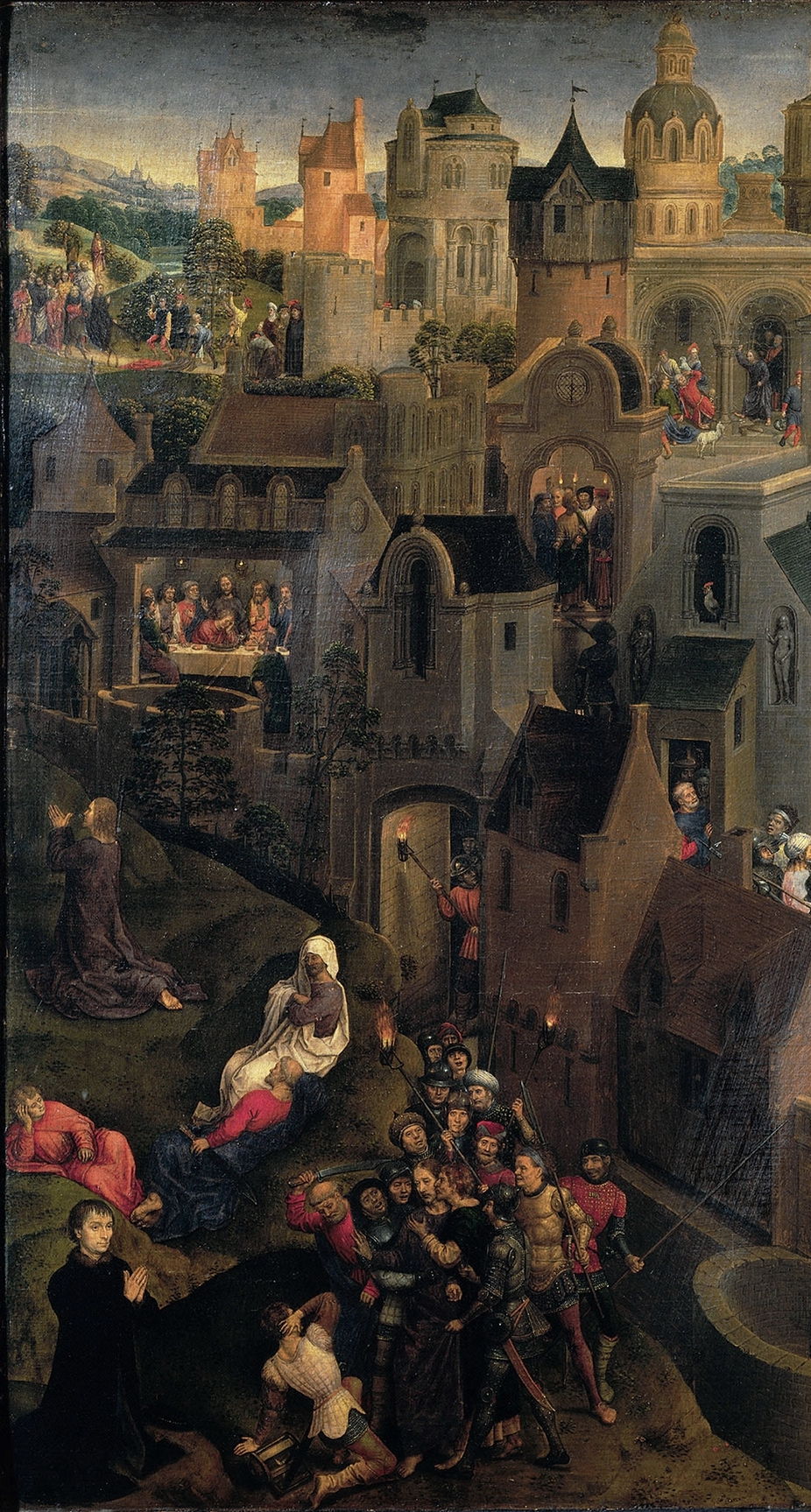
The sequence opens with Jesus’ triumphal entry into Jerusalem, highlighted at the top left. From there, he drives the money-changers from the Temple. Close to that is the betrayal by Judas to the High Priests, which leads down to the Last Supper, also highlighted. Memling adopts a conventional view of the table, with Christ recognisable in the same dark blue robes.
Jesus is obvious as he prays in the Garden of Gethsemane, and again when he is arrested. Judas is seen kissing him, and Peter has severed the ear of Malchus. The narrative path then moves up to find Peter denying Christ, with a cock crowing in the window above him.

With Christ now under arrest, the narrative continues inside the city walls, going from Peter to Jesus brought before Pilate, who is sat on his throne. Christ is then stripped and whipped in the centre of the panel; to ensure consistent identification, his dark blue robes are draped on the threshold in front of him.
Here the narrative path becomes more difficult to trace, as it jumps over two later scenes to Pilate’s second interrogation further to the right, before returning to the crowning of thorns, with Christ sat partly dressed in his robe. The other dominant scene in this section follows, as Christ is led out to the crowd in the scene widely known as Ecce Homo, behold the man, in which he is condemned to death by the people.

In the yard in front of the scene of the Flagellation, two men are making the cross. Following that the procession leaves the city, Christ having fallen to his knees under the weight of the cross, with Simon of Cyrene helping him bear its weight. Pilate, distinguished by his hat and clothing (matching those seen earlier), is shown behind them, as he’s about to ride out through the city gate. Further to the front of the procession are the two thieves to be crucified on either side of Jesus, their hands tied behind their backs.
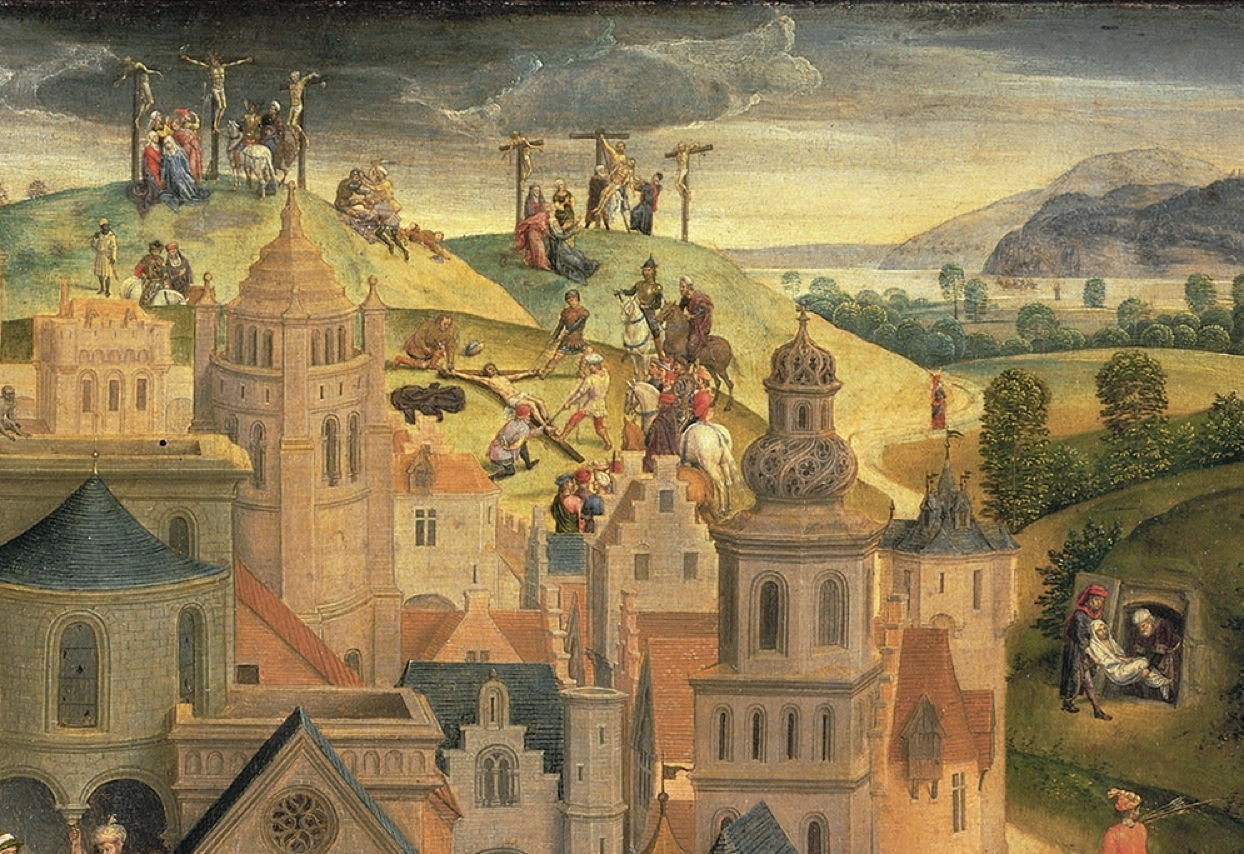
The winding road to the place of execution leads the narrative up to the first of three scenes of the Crucifixion, in which Christ is nailed to the cross as it rests on the ground. The left of the two skyline scenes shows the three dying on their crosses, then to the right is the Descent from the Cross, as Christ’s body is lowered and taken to the Entombment.

When Christ’s body is placed in the tomb, it’s swathed in white, to be replaced by red when he enters Limbo, bearing a staff with a crucifix at the top. Directly above that is the start of the Resurrection series, with Christ (still in red robes) standing by the entrance to the tomb, as the guards are asleep in front of him.
Above that, the resurrected Christ meets Mary Magdalene in the scene known as Noli Me Tangere. He appears again on the road to Emmaus above that, and finally to the Apostles in the far distance, on the shore of the Sea of Galilee.
Inevitably, Memling’s Passion was soon imitated by others, with at least one slightly later painting being known by an anonymous artist. Memling also used the same technique about a decade later in his painting for the altar of the Tanners’ guild in Our Lady’s Church in Bruges, slightly less successfully.
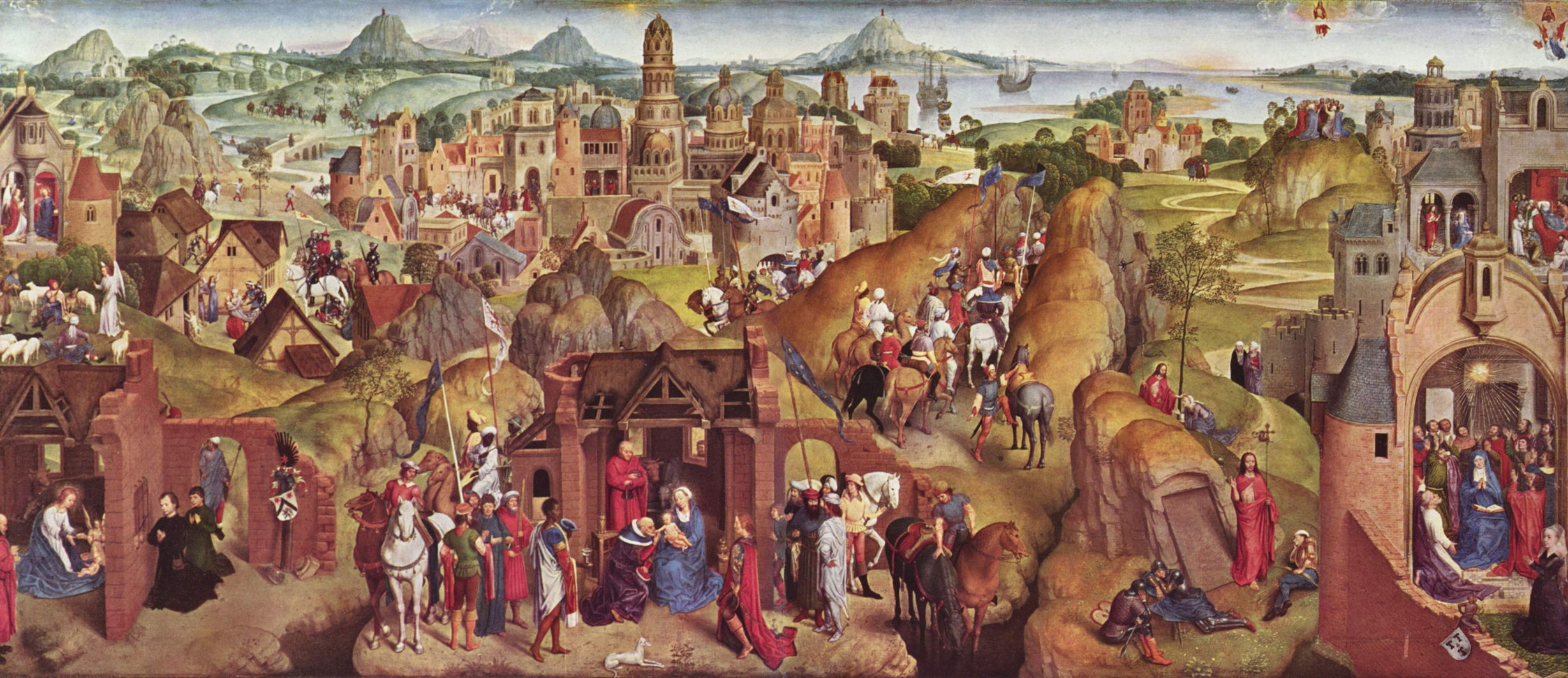
Memling’s Advent and Triumph of Christ (1480) uses the same technique with twenty-five scenes from the whole life of Christ, starting with the Annunciation at the top left, omitting the Crucifixion itself, and ending with the Assumption of Mary at the lower right. The narrative thread is unfortunately more fragmented than in his Scenes from the Passion of Christ, and this doesn’t appear to have been attempted again after 1500.
The Crucifixion is one of the most popular themes for Christian religious painting, and one of the most conventional. In 1565 Jacopo Tintoretto painted a unique multiplex account in a commission for the Scuola Grande di San Rocco in Venice, one of the major religious works of the century: his vast Crucifixion (1565), which is over 5 metres (17 feet) high, and 12 metres (40 feet) across.
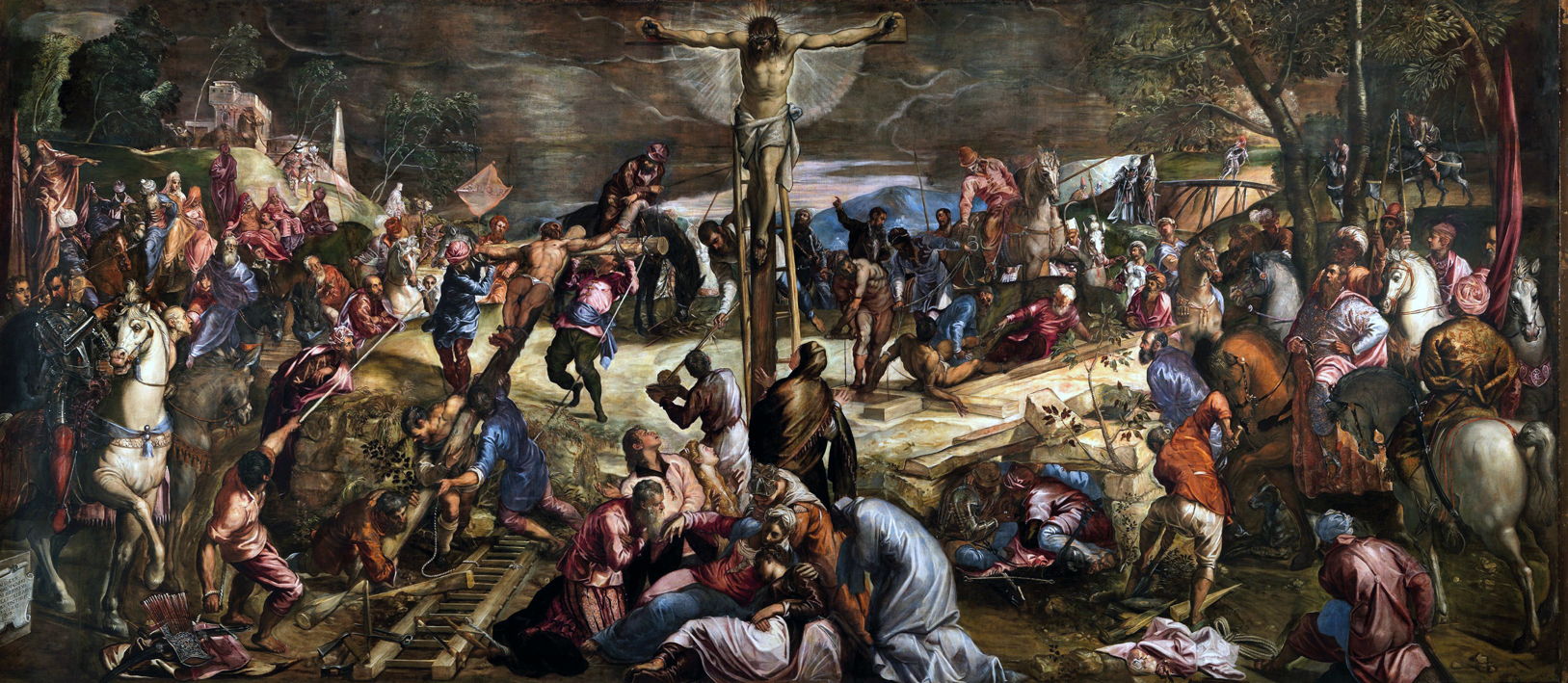
Tintoretto applies lessons he had learned painting tall works for the Madonna dell’Orto, and employs multiplex narrative in an ingenious and modern manner. Naturally, the painting centres on Christ crucified, but the two thieves executed beside him are not shown, as would be traditional, already hanging from their crosses.

Instead, to the right of Christ, the ‘bad’ thief is still being attached to his cross, which rests on the ground. To the left of Christ, the ‘good’ thief is just being raised to the upright position. There is nothing in the well-known gospel accounts which actually makes this anachronistic, but it’s most probable that the crucifixions were more simultaneous. It is thus an innovative device which shows the three executions at different times, but avoids any archaic repetition of figures or other content, as Tintoretto applies it to discrete passages within the whole.
Spaced out around the canvas are relevant sub-stories from that whole. At the foot of Christ’s cross is his group of mourners, including the Marys. Each of the crosses has attendant workers, busy with the task of conducting the crucifixion, climbing ladders, hauling on lines, and fastening each victim to his cross. This mechanical and human detail brings the scene to life and adds to its credibility and grim process.
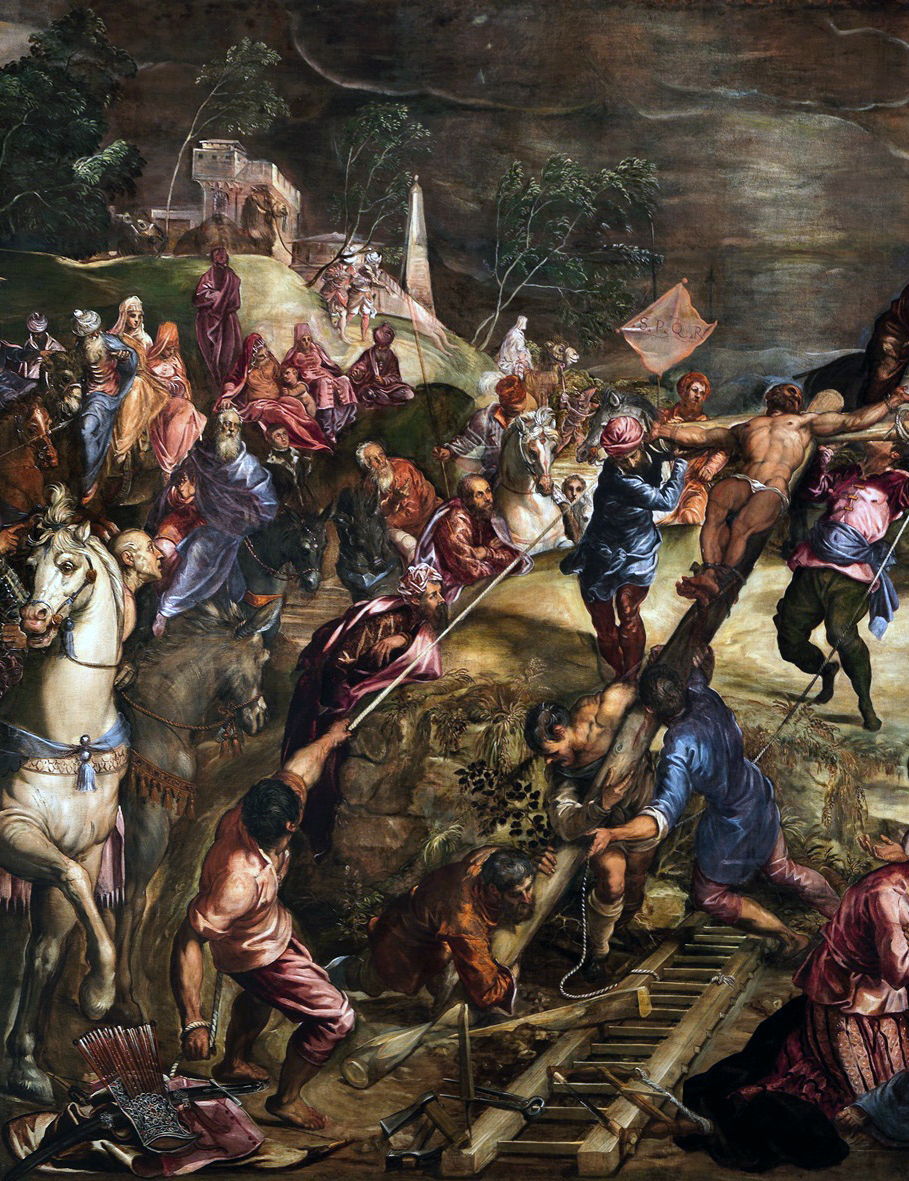
The crowd on the left is spread out. In the distance is a flag bearing the letters SPQR representing the Roman Empire, and its link through Pilate. Most faces are turned towards Christ, with their eyes wide in awe.
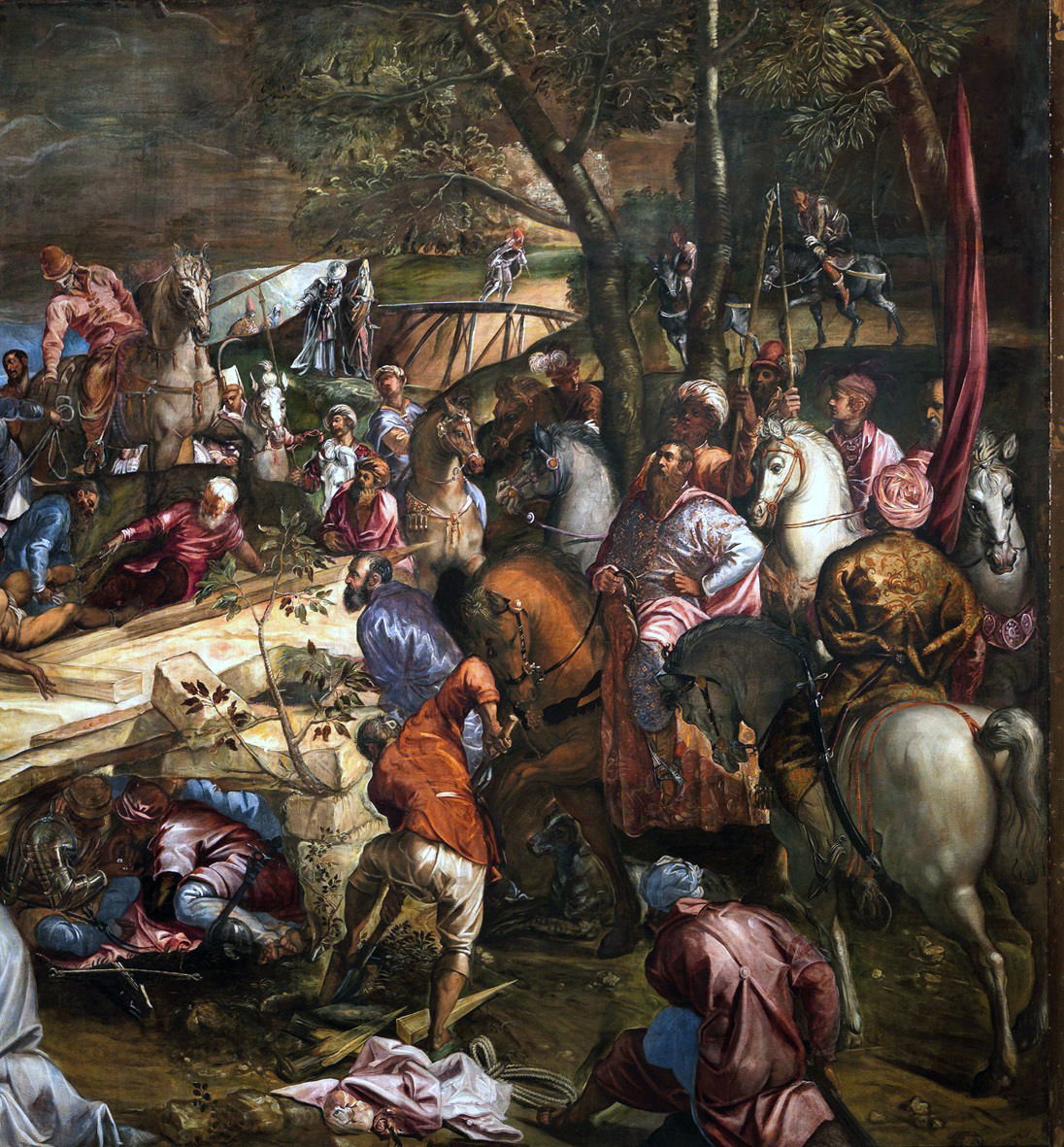
On the right, in a small rock shelter suggestive of a tomb, two men are gambling with dice. To the right of them, a gravedigger has just started his work with a spade. The ruling class, perhaps Herod himself, have turned up on horseback, and they too stare wide-eyed at Christ.
Unlike Memling’s Passion, Tintoretto makes no attempt to paint a sequence of events in a thread of individual scenes. Instead, different passages appear in their spatial context. I have marked up the image below to enumerate those that I can identify.

These are, in approximate order of the sequence of events:
- the distant flag bearing the letters SPQR, representing the Roman Empire, and Pilate’s trial of Jesus;
- the ruling class, perhaps including Herod himself, on horseback;
- the ‘bad’ thief is being attached to the cross on the ground;
- the repentant thief is being raised on his cross to the upright position;
- Christ’s cross is already fully raised, and the crucifixion in progress;
- at the foot of Christ’s cross is the group of mourners, including the Marys;
- a sponge is being dipped in vinegar to be offered to Christ;
- a gravedigger has started his work with a spade;
- two men are gambling with dice in a small rock shelter.
Nicolas Poussin is better-known for his ingenious instantaneous narratives that depict a single moment in time but include backward and forward references. He also painted at least one major work using extensive multiplex narrative, The Israelites Gathering the Manna in the Desert from 1637-39.
We have considerable insight into this work thanks to the artist’s letter of about 1637, repeated in a 1639 letter to Chantelou, who commissioned the painting. In that he revealed he was showing three separate phases which the Israelites went through: the starved state to which the Israelites were reduced before the provision of manna, the joy they experienced when the manna was provided, and its effect in improving their respect for the leaders.
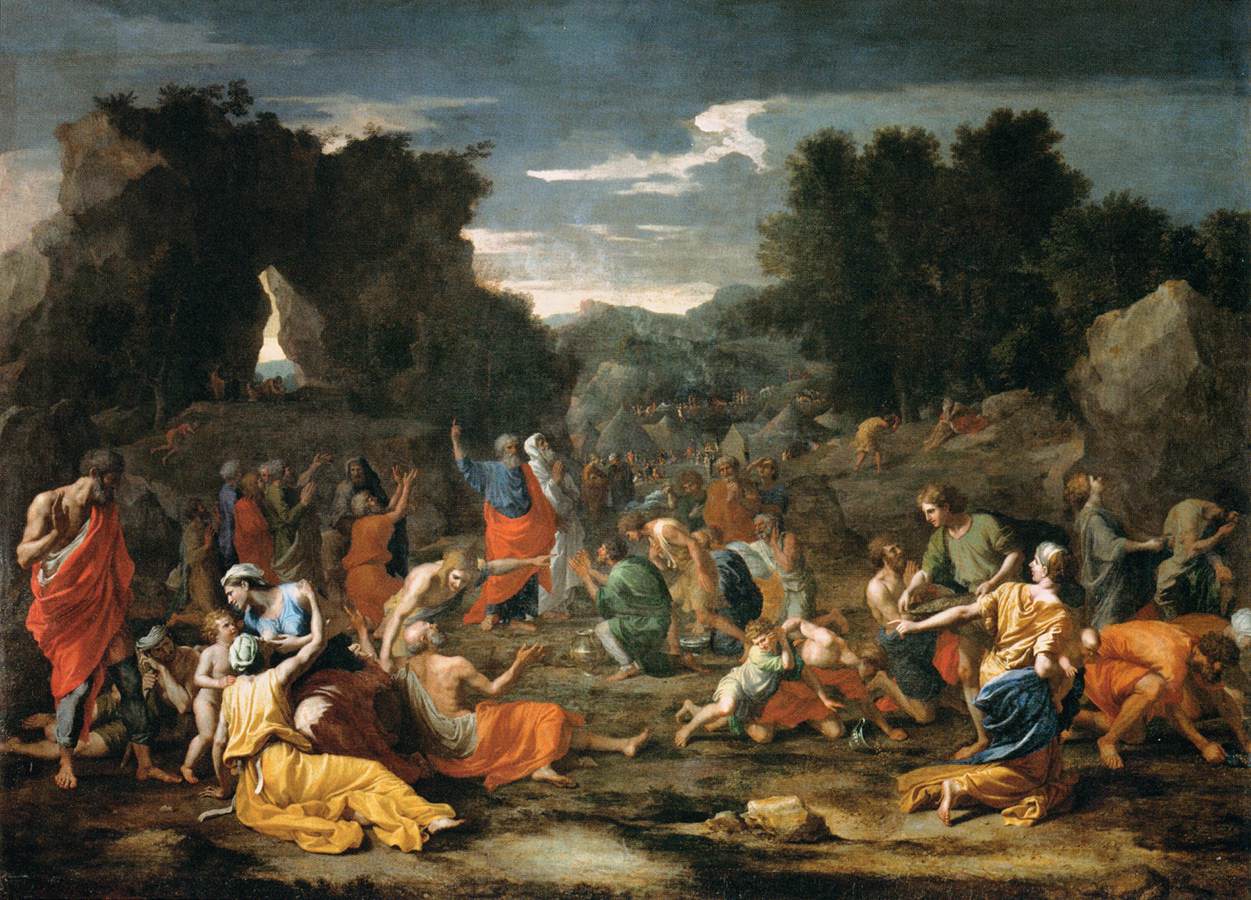
Poussin uses colour and light, together with signs in body language, to guide our gaze through the complexity of his painting. The details below show each of the scenes which it incorporates.
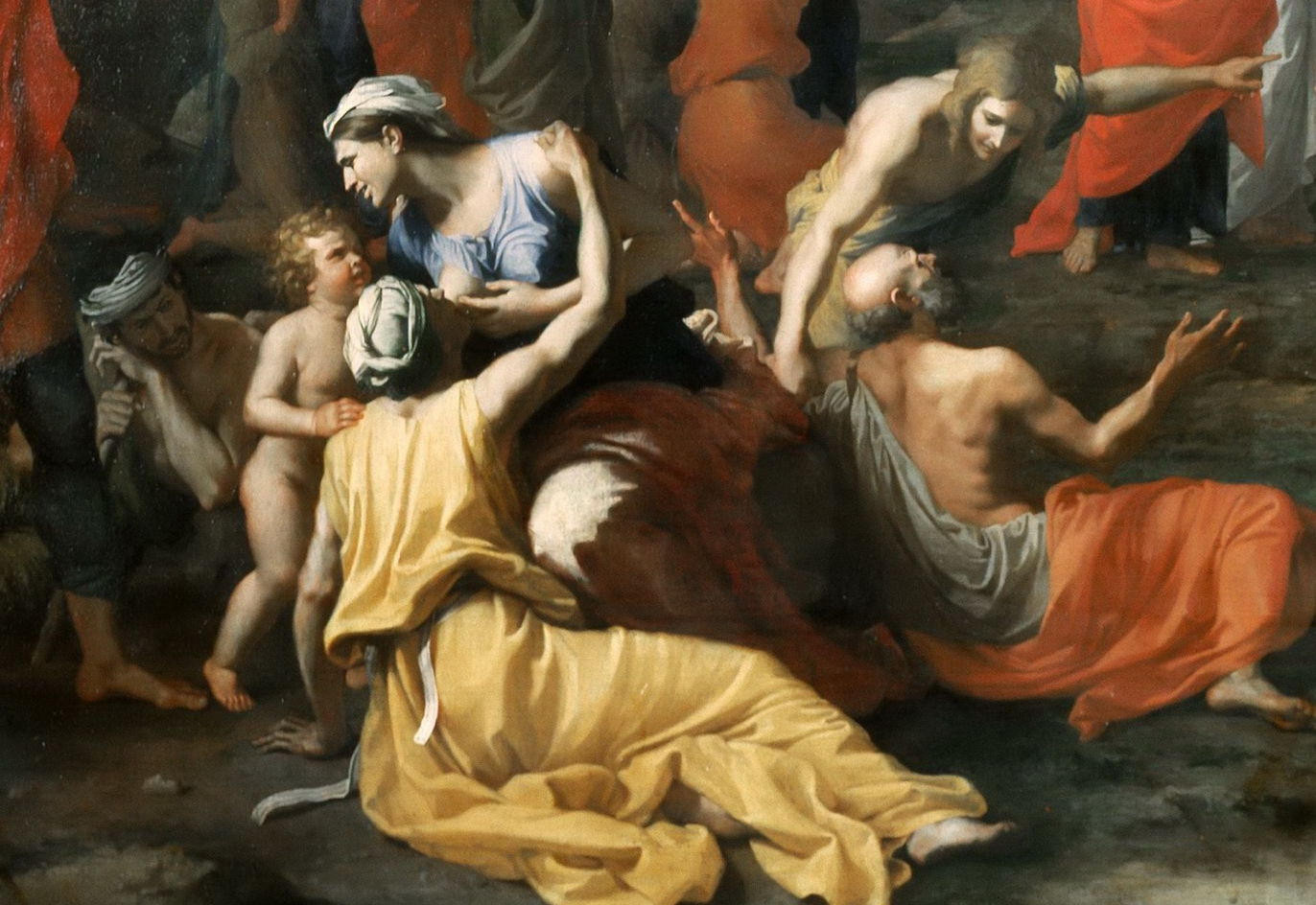
Closest to us, at the left, is a group of five figures who are still battling with starvation. Among these are a woman with a toddler, who is suckling not that infant, but her aged mother wearing yellow robes. To the left of the child is a man who might have come from Géricault’s Raft of the Medusa, propping his head against a stick. To the right is an elderly man, being helped up by a woman who is pointing to the right of the painting, although he is pointing back (towards Moses and Aaron), still asking what their leaders had done to address their predicament. This scene shows the earliest moment in time.
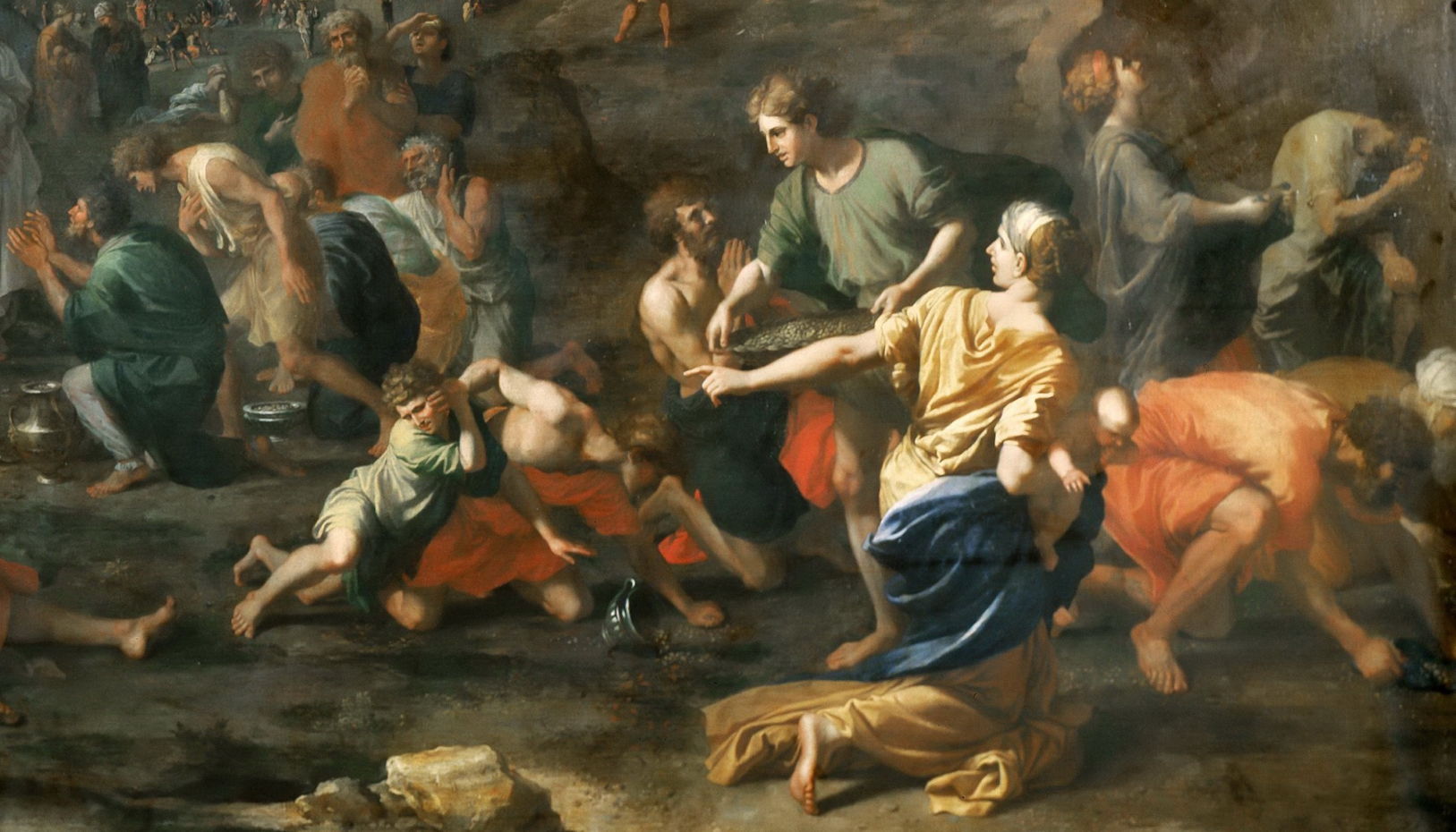
Follow the woman’s pointing arm across to the right of the painting, and there is a larger group who are brightly lit and brilliantly coloured. The foreground contains nine figures busy gathering the manna in the way prescribed by God. Two of them look up to heaven and express their gratitude, but two younger men (or older boys) are fighting to collect their day’s ration, and others seem to be reminding them of the rules. The woman in yellow is here pointing back at the first group to complete the link between them. This is the second moment in time.
Behind and to the left, a cluster of about eight men seem to be expressing their gratitude in deliverance, and some look left and up towards the figures of Moses and Aaron.
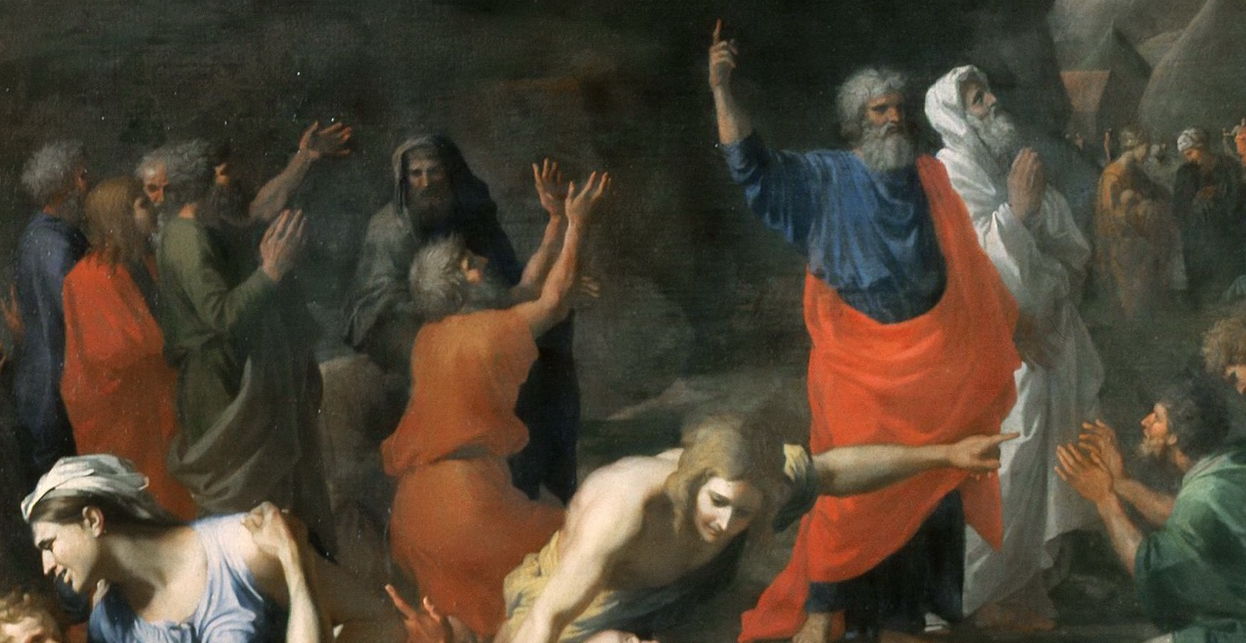
The two leaders, brightly lit and coloured, stand slightly further back. Behind them, to the left in the painting, are some fans, their hands raised to heaven, applauding Moses and Aaron.
This painting remained controversial even after the artist’s death. The French Académie Royale de Peinture et de Sculpture organised a series of lectures and debates on Poussin’s paintings in 1667, and devoted one complete session, led by Charles le Brun, to consider this painting. Le Brun’s lecture was recorded by André Félibien, published in a book of the lectures and in Félibien’s biography of Poussin, and has been the basis for research, comment, and debate ever since.
The seventeenth century saw a rapid decline in multiplex narratives, in the quest for greater realism in paintings.
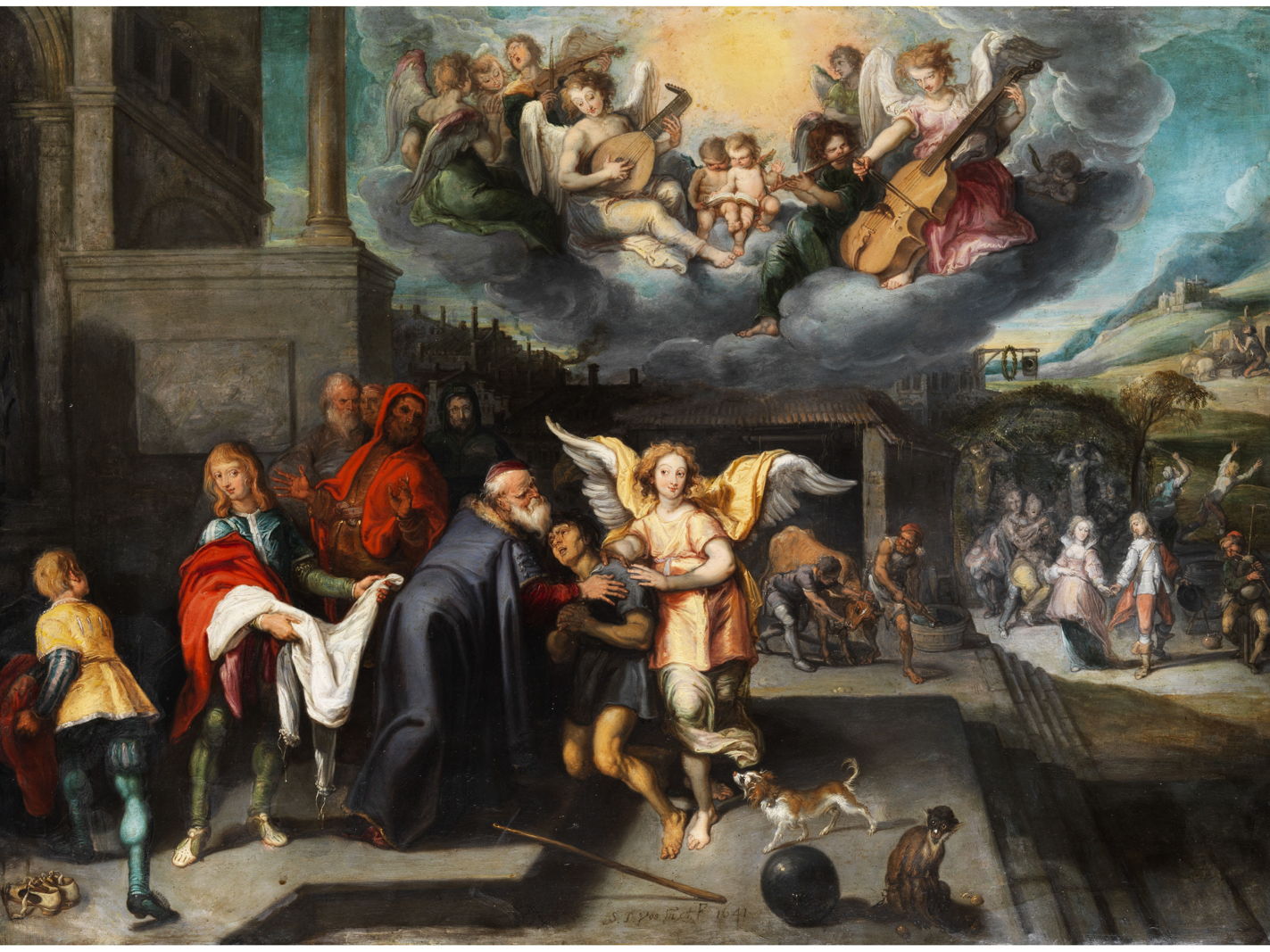
Simon de Vos’s Return of the Prodigal Son from 1641 is painted in oil on copper. The son is being returned to his father by a guardian angel, as a heavenly orchestra plays in celebration. Behind them the fatted calf is just about to be killed in advance of the main storyline. At the far right is an earlier scene in which the son, then a swineherd, is praying, and below that he is seen carousing in a bar.

Sebastiano Ricci employed multiplex narrative in The Battle of the Lapiths and Centaurs in about 1705. In the left background, he shows the event that sparked the battle off, with Hippodame being carried away by the centaur Eurytus. In the right middle distance is a later scene of centaurs raping other Lapith women at the wedding feast, and the foreground is filled with even later scenes of murderous fighting.

