
The late nineteenth century was a period of great turmoil in European politics. Protests often became violent, as in the Paris Commune of 1871, and strikes in the mining areas of north-east France and Belgium. These days we associate that period with the rise of socialism, which was closely related to the Arts and Crafts Movement, hence with some of the Pre-Raphaelites. What may be forgotten is that many intellectuals including artists were anarchists rather than socialists.
As a political movement anarchism was never coherent (as expected) and died out quietly after the First World War. In France at least it was largely based on the writings of Pierre-Joseph Proudhon (1809-65), who was the first to describe himself as an anarchist, but is also known as a socialist, just to confuse. The movement’s central tenet was the abolition of rulers and the state in favour of voluntary communal projects for welfare and education, for example.
Anarchism peaked during the period 1880-1914, when it became widespread, and in some places led to the attempted assassination of political leaders and initiating revolution. Friction with international socialist movements and their leader Karl Marx put distance between the two schools of thought, and socialists and Marxists adopted the aim of dictatorship of the proletariat in direct opposition to anarchism.
The great majority of the French Impressionists were anything but anarchist, as you can imagine with Edgar Degas and his family of bankers and merchants, and their sole anarchist appears to have been Camille Pissarro. When Georges Seurat developed what he intended to be a replacement for Impressionism based on contemporary colour science, he attracted a group of professed anarchists, although there’s little evidence that Seurat himself was that concerned with political thought.
Viewing selected paintings by Neo-Impressionists confirms how their political views influenced their art, the aim of this weekend’s two articles.

Les Modistes (Two Milliners in the Rue du Caire, Paris) from 1885-86 shows Paul Signac’s style just as he was making his transition to Neo-Impressionism. These two young milliners are busy making fashionable hats. His brushstrokes have shortened, but not yet become the dots characteristic of Pointillist technique. This is the first of his series of interiors showing bourgeois life in an anarchist light.
The eighth and final Impressionist Exhibition was held in Durand-Ruel’s gallery in Paris, in May-June 1886. This revealed to the public for the first time a large collection of Neo-Impressionist paintings by Pissarro, his son Lucien, Paul Signac and Georges Seurat. These included Seurat’s huge masterpiece A Sunday Afternoon on the Island of La Grande Jatte, whose gathering of social classes can be read in anarchist terms.

In 1887, Pissarro became a full member of the Neo-Impressionists, and paintings such as this of Farm Houses, Éragny (1887) leave no doubt about his changed style. With Durand-Ruel not interested in such works, he was forced to seek other outlets. He found Vincent’s brother Théo van Gogh particularly helpful, and sold this through him for 300 Francs in March 1888. This wasn’t as much as his family needed, but at least it kept them from starving.

In the summer of 1887, Pissarro worked on another Neo-Impressionist painting of workers Haymaking, Éragny. Although not a large canvas by any means, he found the work slow and tedious, something to occupy rainy days when he remained indoors. His labour was rewarded when this too was taken on by Théo van Gogh, who sold it to a customer on the same day that he’d received it from Pissarro.

Pissarro’s later version of Apple Picking, Éragny had been largely completed in the autumn of 1887, but may have required further work early the following year. One of the canonical works of Neo-Impressionism, it was exhibited to favourable reviews at the Cercle de XX in Brussels in 1889, and was bought by Théo van Gogh in March 1888.

The following year, Pissarro’s intensely sensory and idyllic painting The Gleaners proved a lesson in the practicality of Pointillist technique. He had started work on this in early 1888, using a squared-up study in gouache to finalise his composition. He found the painting hard, and wrote that he needed models to complete its detail. It was finished a year later in 1889, when he set his price at a mere 800 Francs. Although it achieved that, by the time framing and commission charges had been deducted, Pissarro received just 620 Francs from Théo van Gogh’s firm.
After three years of painting the most gloriously Neo-Impressionist works, Pissarro was worn out by the end of 1889, and little better off for all those painstakingly slow canvases. He decided to return to the Impressionist mainstream.

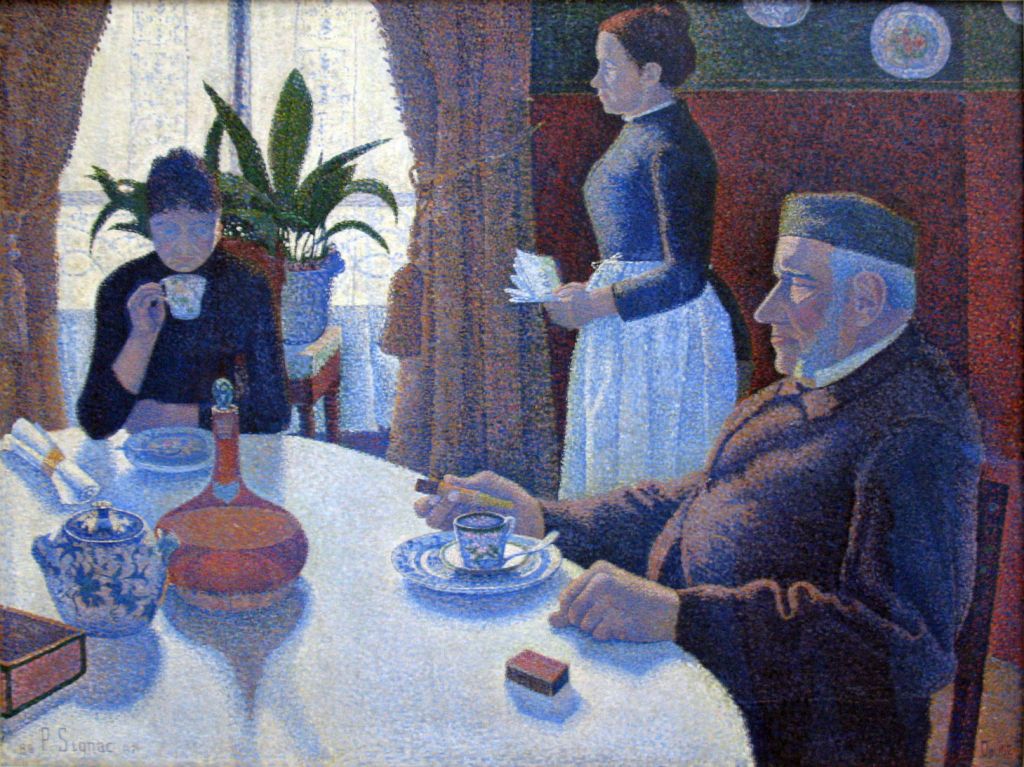
Following his earlier painting of two milliners in Les Modistes (1885-86), Paul Signac found inspiration in Caillebotte’s painting of Luncheon (1876) for another interior, this time showing the bourgeoisie at table. La salle à manger, variously known as Breakfast or The Dining Room (1886-87) is perhaps his first major Neo-Impressionist painting.
The man seen in profile with his cigar is Signac’s grandfather Jules, and the woman drinking coffee may be Signac’s mother, although she appears more anonymously as a type rather than a character. Critical reception was very encouraging, and this painting was exhibited in Brussels the following year at the Salon des XX.

Sunday, which Signac started in October 1888 and completed in March 1890, is perhaps the best-known of his interiors, and continues their theme of the humdrum life of the bourgeoisie. It’s composition is a modification of Caillebotte’s Interior: Woman at the Window (1880), which Signac developed from a lithograph and a series of studies. Berthe Roblès modelled for the woman, but the man remains unidentified. Its static, stultified composition and atmosphere are anarchist in intent, and pervade its every detail. Perhaps it’s those that made this disappointingly unpopular from its first showing in the Spring of 1890.

Signac’s Against the Enamel of a Background Rhythmic with Beats and Angles, Tones, and Tints, Portrait of M. Félix Fénéon in 1890 (1890-91) is a unique combination of colour theory, Japonisme, decorative art, and portrait. Its background consists of colour wheels expressed according to a Japanese kimono pattern.
Fénéon is shown as the dandy he appeared to be, but has the air of a circus ringmaster, perhaps reflecting his ability to spot and encourage artistic talent. He was an odd contradiction, by day a clerk in the War Ministry, a well-known anarchist later suspected of bombing a restaurant in 1894, and one of the most astute art critics of the time. Somehow Signac captures all of those, together with their long friendship. Signac gave Fénéon this portrait, and Fénéon cherished it for the rest of his life.

