
With the first three of what he thought were to be his ten tasks for King Eurytheus completed, Heracles went on to attempt to capture the Erymanthian Boar and bring it back alive to the king.
Capture the Erymanthian Boar
This boar had raged around Mount Erymanthos, and defied all attempts at its capture. Heracles initially chased it by shouting until it was deep in a thicket and exhausted. He then bound it with chains, slung it over his shoulder, and returned to the king.
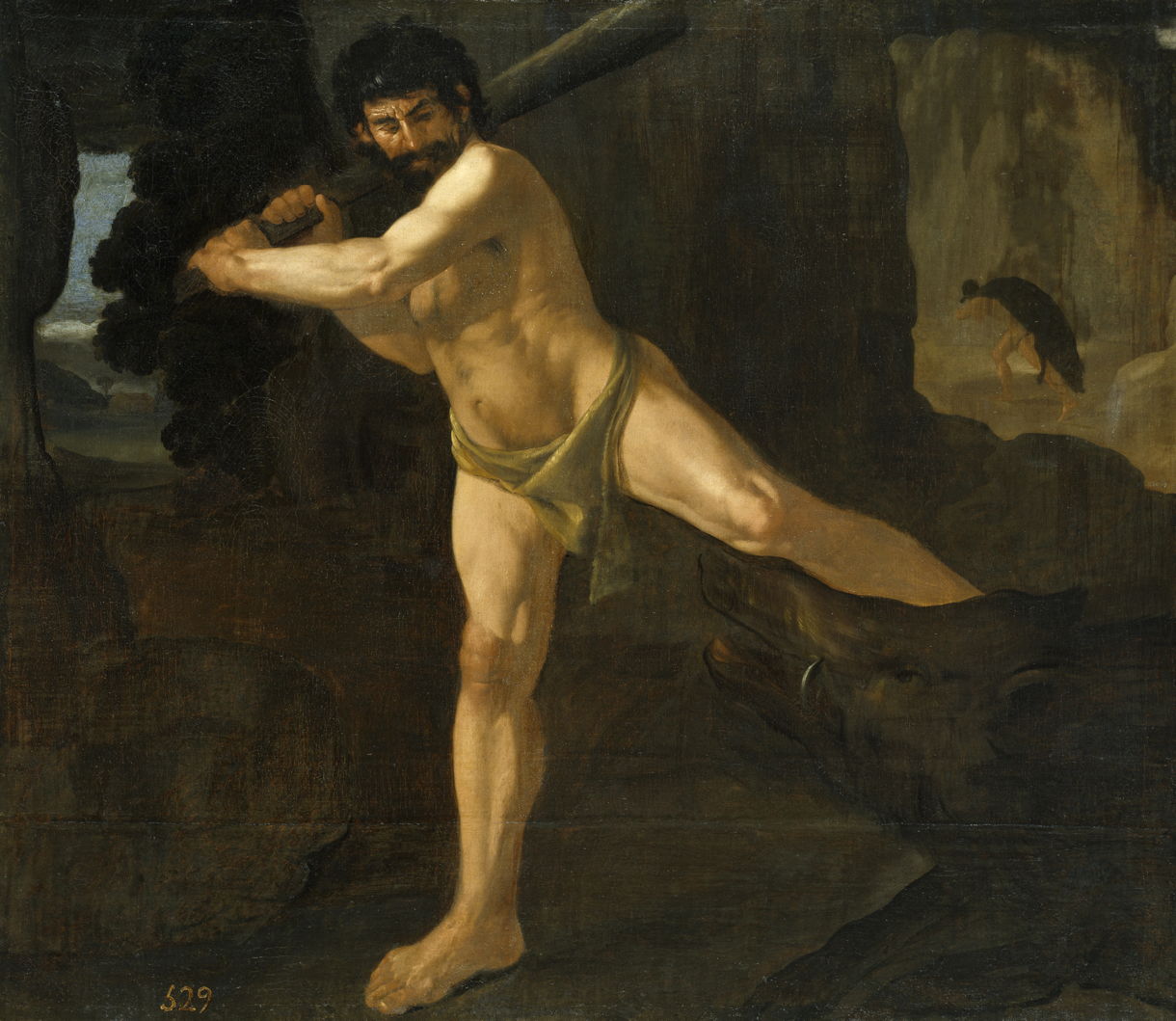
Francisco de Zurbarán’s Hercules and the Erymanthian Boar (1634) continues his series of the twelve labours with the sight of Heracles swinging his heavy club at the boar. In the right background, he is shown again in multiplex narrative, carrying the chained boar away on his shoulders.
King Eurytheus had already banned Heracles from entering the city. The sight of the fearsome boar still alive on Heracles’ shoulder was too much for him, and he promptly hid inside a large bronze jar, refusing to come out.
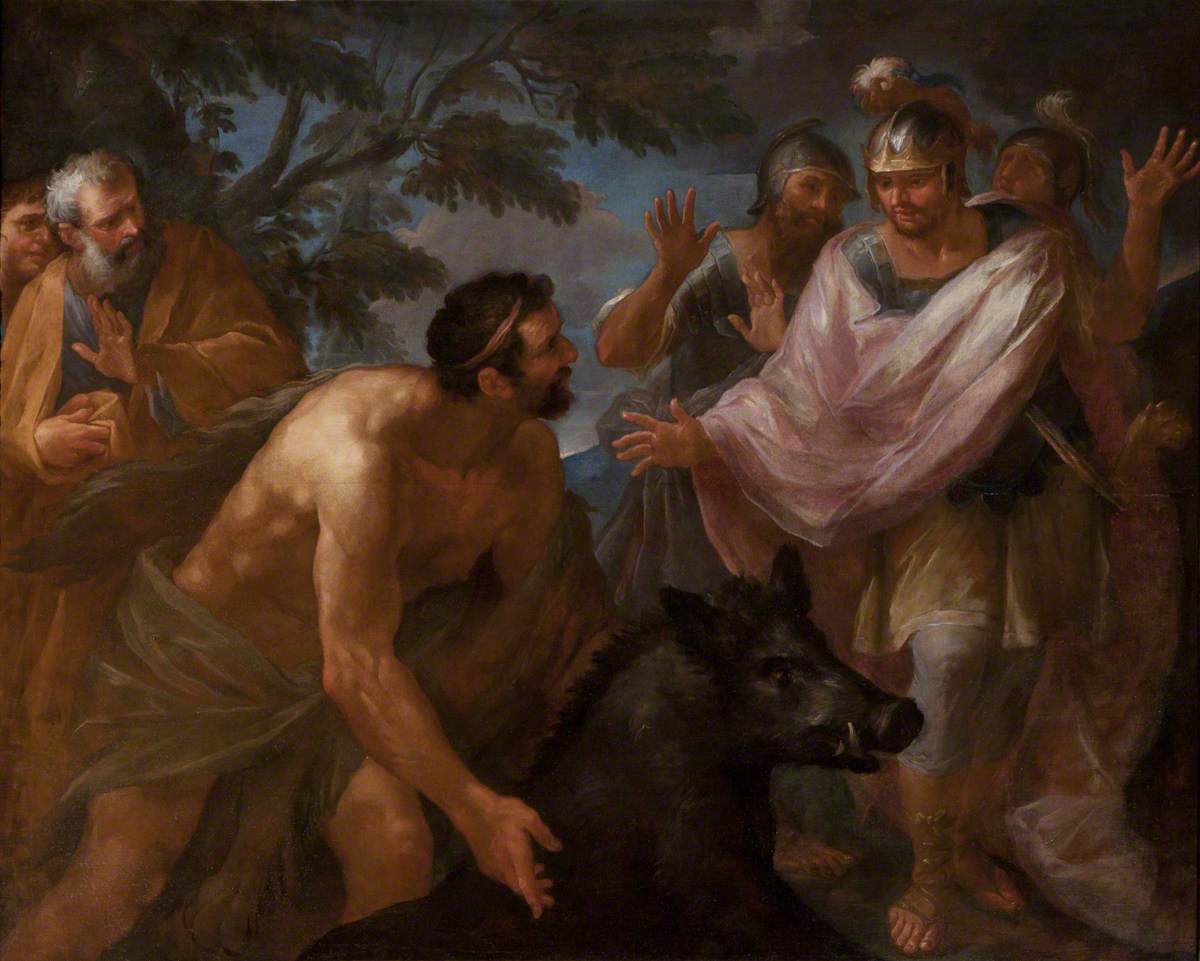
Hercules terrifying King Eurytheus with the Erymanthian Boar was painted by an unidentified artist between 1670-99, and shows the boar being presented to the king, who doesn’t appear exactly grateful, although there’s no sign of any bronze jar.
Cleanse the Augean Stables
The next task and half-way point was to clean the stables of Augeas unaided. This was intended from the outset as an impossible task, and one that would be humiliating to Heracles, as the stables contained three thousand divine cattle that were immortal so produced huge quantities of dung (I don’t see the connection, but apparently this was accepted in classical times). As this hadn’t been attempted in thirty years, the amount of dung would have been prodigious.
Augeas promised Heracles a tenth of the cattle as his reward if he completed this within one day. To accomplish that, he dug deep ditches beside the stables and rerouted the rivers Alpheus and Peneus to wash those clean. Although he had succeeded, Augeas refused to honour their agreement, so Heracles killed him and handed his kingdom to his son, who had been exiled.
Unsurprisingly, paintings of this labour seem rare, and none are suitable for this account.
Kill the Stymphalian Birds
According to myth, the Stymphalian birds had beaks of bronze and metallic feathers that functioned as arrows. They were the pet creatures of Artemis, and had migrated to Lake Stymphalia, where they took over the countryside, destroying the inhabitants, their fruit and crops, and leaving their toxic droppings to poison the land.
The lake had become a swamp that couldn’t bear Heracles’ weight, so Athena provided him with a rattle made by Hephaestus to scare the birds into the air. Once in flight, he was able to shoot them down with his arrows poisoned with the blood of the Hydra, and the few survivors then fled. Heracles returned with some of the corpses as proof of his accomplishment, and the completion of this labour.
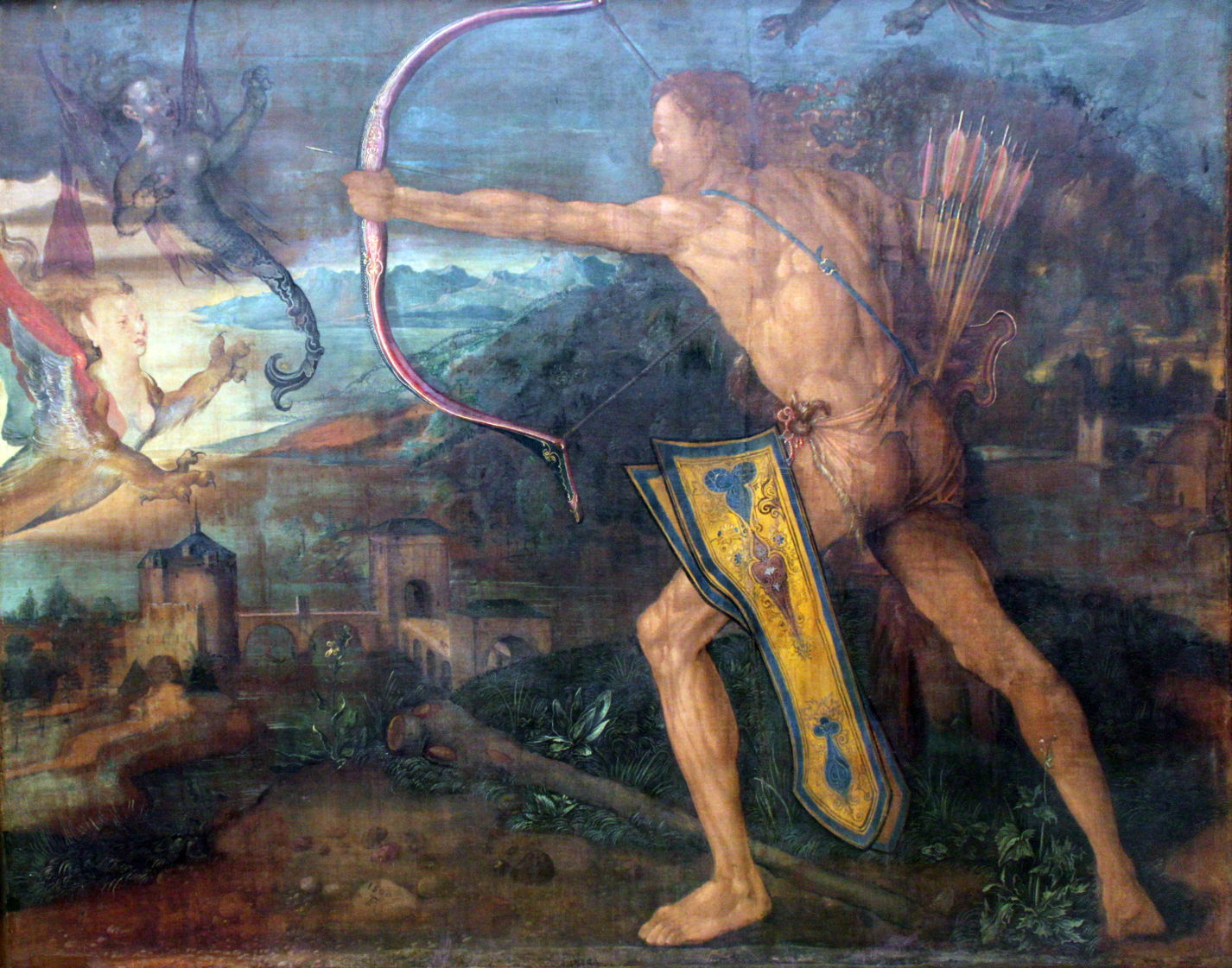
Albrecht Dürer’s Hercules Killing the Stymphalian Birds from 1500 shows the birds as half-women, like winged mermaids, as Heracles shoots them with his bow. His club rests on the ground by his left foot, but there’s no sign of Athena’s rattle.

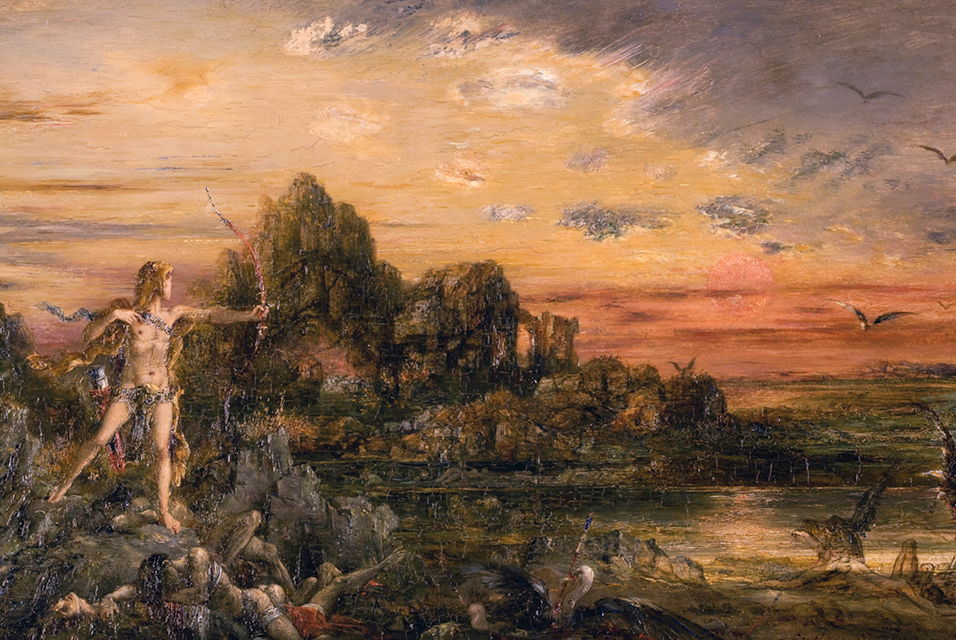
During the early 1870s, Gustave Moreau was working on the depiction of this sixth labour, starting with his Hercules and the Stymphalian Birds from about 1872. This shows Heracles shooting his arrows at the birds, with some dead birds and several human corpses in the lake.
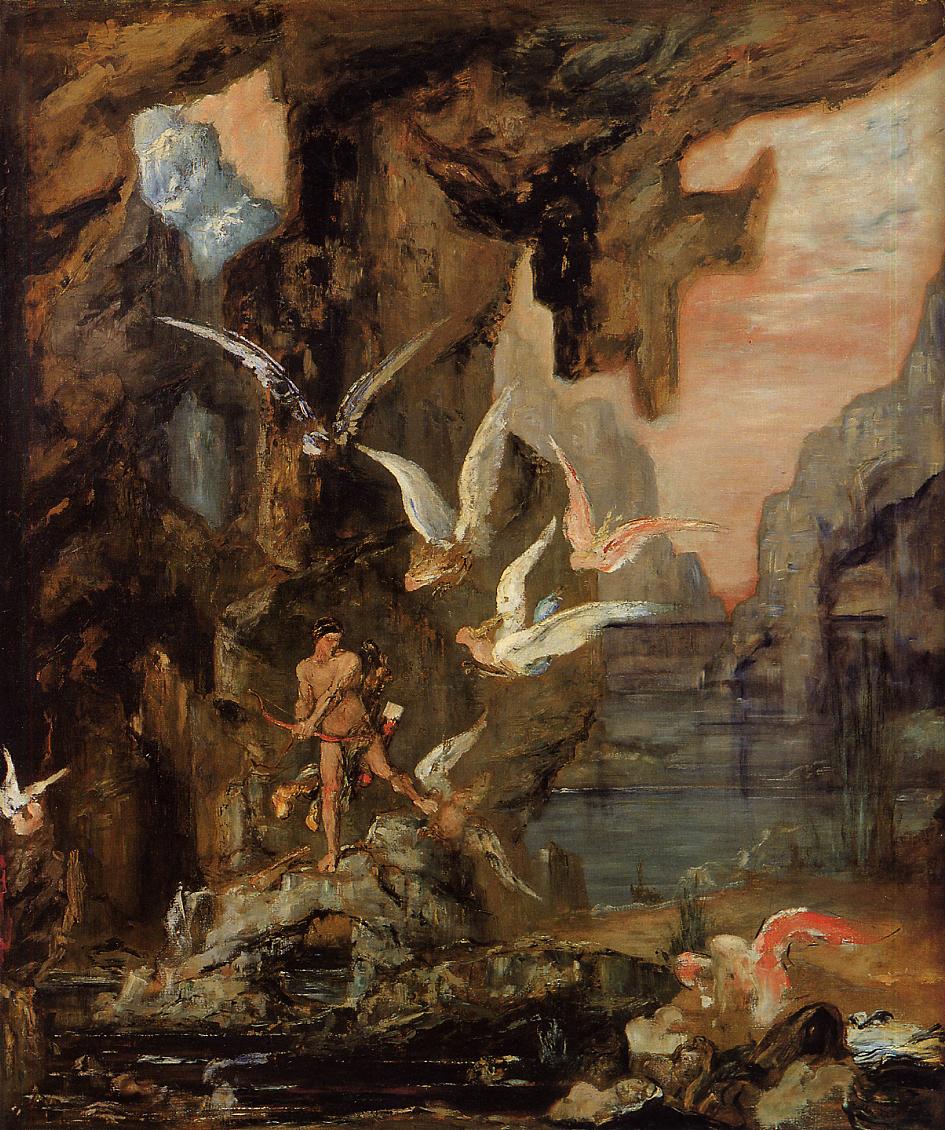
This later study or incomplete painting, Hercules at Lake Stymphalos (c 1875-80) places the scene in a gorge, and the birds here have human heads and chests.
Surviving birds made their way to the island of Aretias, where they were later found by the Argonauts, among them Heracles.
Capture the Cretan Bull
Heracles’ next had to capture a bull that had been laying waste to the lands near Knossos on the island of Crete. He succeeded in that, then shipped the live bull to King Eurystheus, who must have returned to hiding in his bronze jar. It later escaped and brought havoc to Marathon, where it became known as the Marathonian Bull. It was also the same bull that inseminated Pasiphaë, resulting in the Minotaur. Although the latter, and its slaughter by Theseus, were popular themes for paintings, precious few have been made of Heracles capturing the Cretan Bull.
Steal the Mares of Diomedes
Diomedes King of Thrace, not to be confused with the king of Argos and Greek hero of Homer’s Iliad, was at the centre of the eighth of Heracles’ labours. The king had the reputation of being a savage, and took pleasure in feeding prisoners and strangers to his mares, who apparently preferred them to more conventional fodder. These mares were as savage as their owner, and had to be tethered to a bronze manger using chains to prevent their escape.
Heracles first had to wrestle with Diomedes to overcome him, then took him to the stables. Diomedes was put in with the mares, where they started to devour him; in doing so, they were cured of their unnatural hunger for human flesh, and Heracles was able to take the horses back to King Eurystheus, so completing this task.

Gustave Moreau’s watercolour study of Diomedes Devoured by his Horses from 1866 was made in preparation for the finished painting below. This shows the gruesome sight of the mares starting to devour Diomedes in their frenzy, while Heracles watches from safety in the background.

Moreau’s finished painting of Diomedes Devoured by his Horses (1866) drew back slightly from his sketch, in showing the scene a little earlier. But it maintains all the elements of theatrical narrative, with Heracles sat at his safe vantage point watching the king die horribly. Diomedes’ fallen crown, at the lower right corner, is its only moment of subtlety.
Heracles was now reaching the end of his labours, with just two more to complete. The next was a complete contrast, as he had to obtain the belt of Hippolyta, Queen of the Amazons.

