
Before the early nineteenth century, caves had been sacred places where hermits lived, legendary and mythical hidey-holes for sibyls and dragons, and had recently been added to the itinerary of the Grand Tour undertaken to complete a gentleman’s education. Over the next hundred years they became better appreciated for their beauty, grandeur and reality.

Heinrich Jakob Fried’s painting of The Blue Grotto, Capri (1835) shows one of the most famous sights of the island of Capri, the motif for many paintings since. This has to be visited by boat, and is at the north-western tip of the island. It features in August Kopisch’s book, published in German in 1838, describing his re-discovery of the cave in 1826, which popularised the island for northern European tourists. Fried visited the cave in 1835, and probably painted this in a studio in Naples shortly afterwards, just in time for the book’s publication.

Legend has it that witches also occupy caves. In 1816-17, following his ostracisation over alleged incest with his half-sister, Lord Byron wrote Manfred: A Dramatic Poem. Its eponymous hero is tortured by guilt in relation to the death of his beloved Astarte. Living in the Bernese Alps, he casts spells to summon seven spirits to help him forget and sublimate his guilt. As the spirits cannot control past events, he doesn’t achieve his aim, and cannot even escape by suicide. In the end, he dies.
John Martin’s watercolour Manfred and the Alpine Witch (1837) shows Manfred conjuring a witch from a flooded cave in the mountains. Unusually light and sublime but (exceptionally for this artist) not apocalyptic, it is perhaps one of Martin’s most beautiful works, and reminiscent of Turner’s alpine paintings.
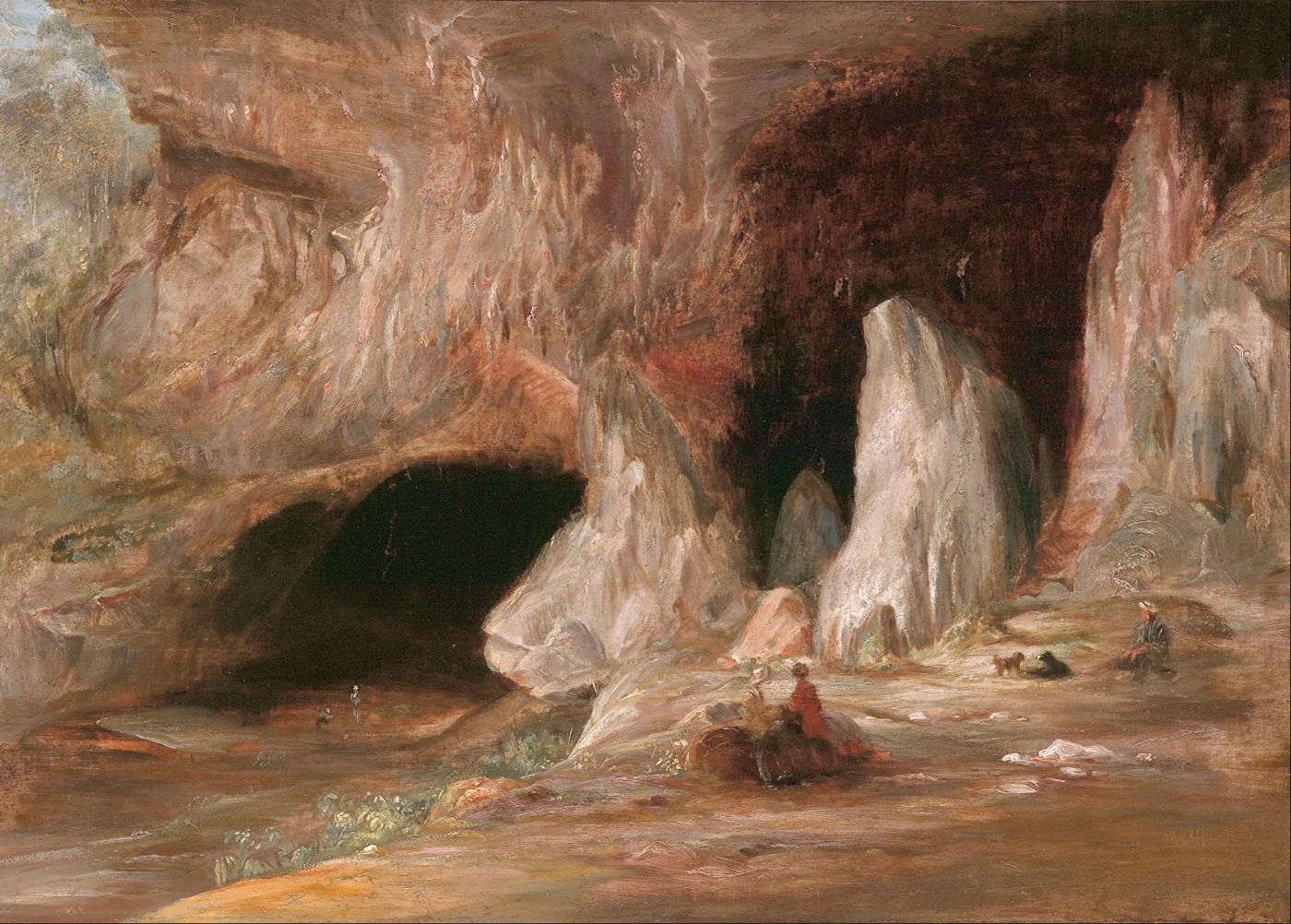
Meanwhile in Australia, the immigrant artist Conrad Martens made this painterly view of Stalagmite Columns at the Southern Entrance of the Burrangalong Cavern in 1843.
During the 1860s, Gustave Courbet took to painting a series of views of the underground sources of rivers near his home town of Ornans in north-eastern France. These have inevitably been interpreted in Freudian terms.

The cave shown in Courbet’s Grotto of Sarrazine near Nans-sous-Sainte-Anne, from about 1864, is the source of stygian waters, and already a noted place for tourists to visit.

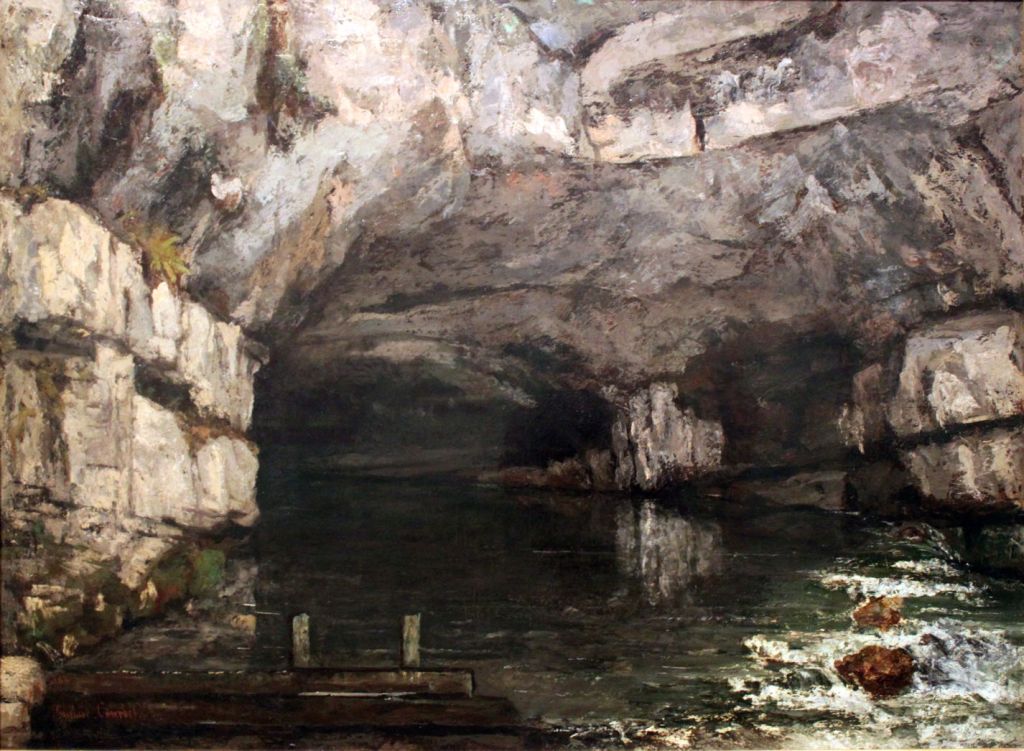
The Grotto of the Loue (1864) had a personal meaning for Courbet, as it is from here that the river runs down through his native town of Ornans. It’s tempting to suggest that in painting these the artist was seeking to symbolically return to his mother’s womb.
Apocryphal stories of apostles, saints, and other key people in the early Christian church were often extremely unconventional, and sometimes downright weird.
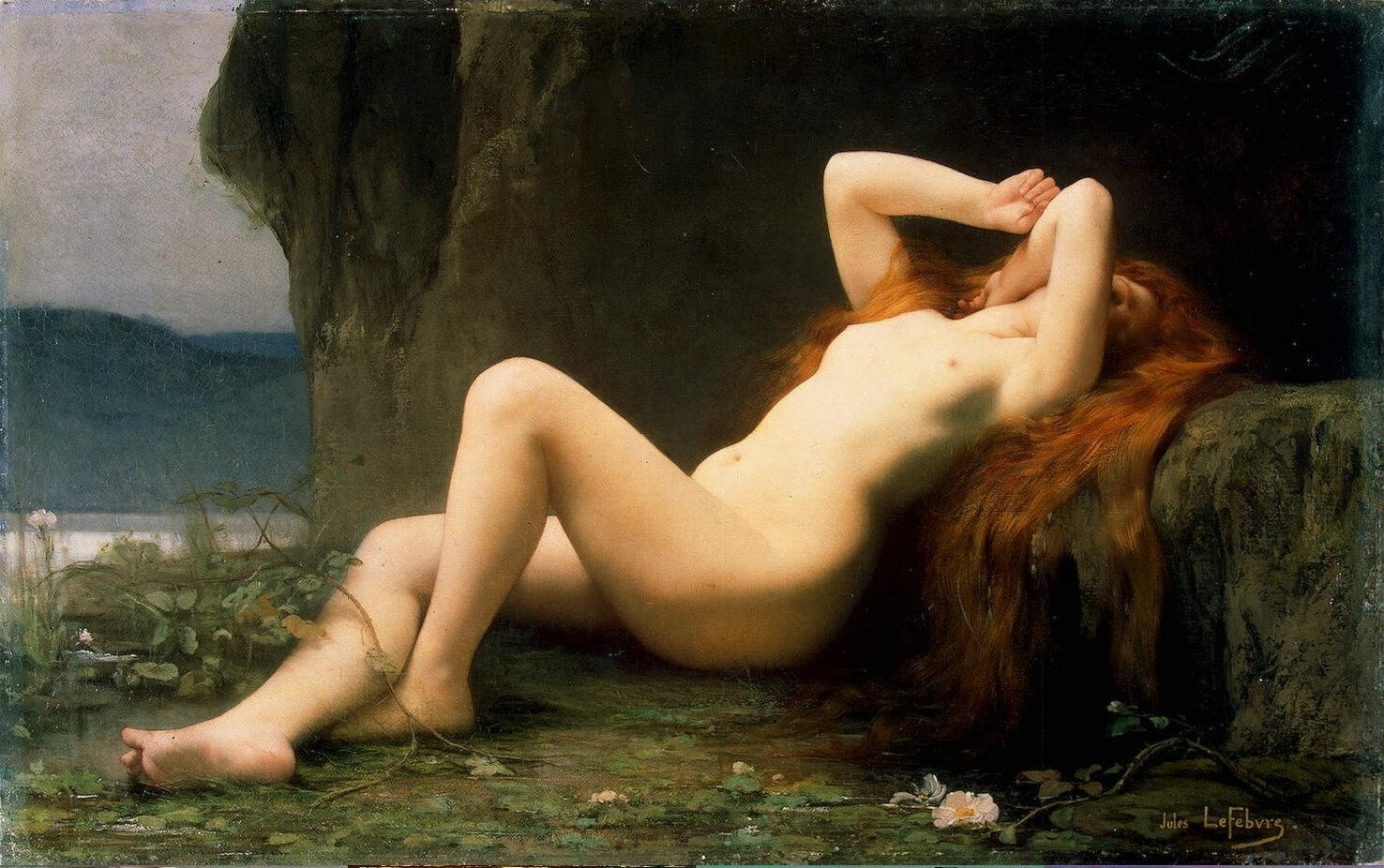
Jules LeFebvre made his career from painting nude women for all sorts of socially acceptable reasons. He even found a religious motif which could feature a nude: Mary Magdalene In The Cave, which he painted in 1876. This refers to a French legend which held that Mary Magdalene, her brother Lazarus and some companions fled across the Mediterranean to land at Saintes-Maries-de-la-Mer near Arles. From there, Mary went to live in isolation in a cave on a hill near Marseille, now known as La Saint-Baume, and the setting for this painting.

John Melhuish Strudwick managed to work a small hut-like cave into his account of Circë and Scylla from 1886. The jealous Circe, dressed in brown rather than blue, is sprinkling a potion into the water from inside this small cave, as Scylla at the left walks down to bathe. Little does the latter know, but that potion is about to turn her into a sea monster.
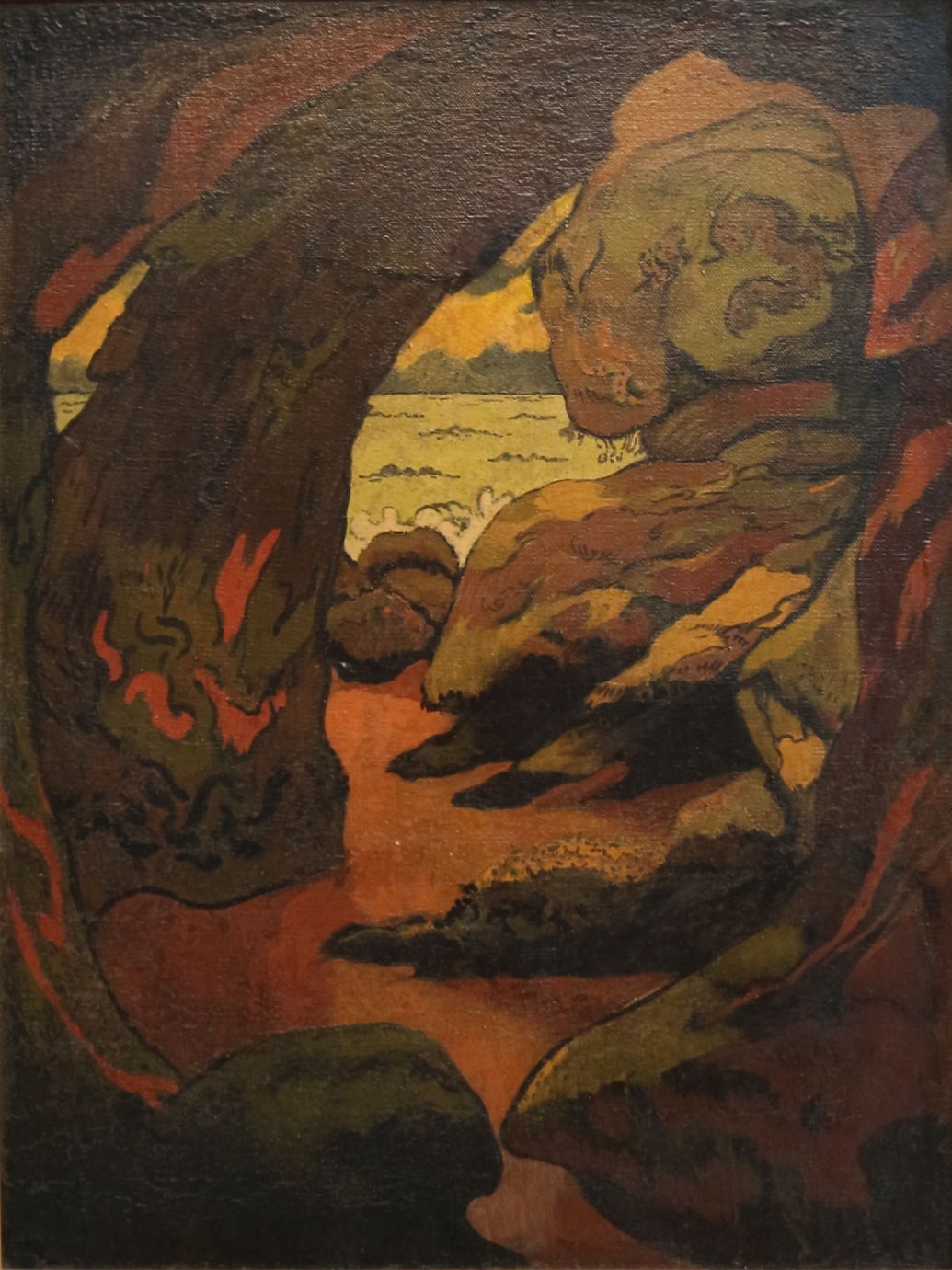
Georges Lacombe’s Cave in Camaret (1890-97), a sea cave at the end of the Crozon peninsula in the far west of Brittany, not far from Cape Finistère, was no holiday haunt. In this case, the cave seems as laden with mystery as the deep woods further inland.
One of the last works to be painted in Jean-Léon Gérôme’s studio during his lifetime may have had its origins in his inner vision, and tells a part of the legend of Androcles set in a cave.
The story of Androcles (or Androclus) and the Lion was first recorded by Aulus Gellius and attributed to Apion, claimed to be a true account, but has become widespread in European folk tales. It was turned into the successful and still popular play Androcles and the Lion by George Bernard Shaw, but that wasn’t published for a decade after this painting.
Androcles was a slave in Rome, with a mean master, so he decided to run away. Hiding in the woods, he became short of food, and weak. One night a lion came into the cave where Androcles was sheltering. The lion was roaring, and scared Androcles, who thought that he was about to be eaten by the beast.
But it was clear that the lion had a painful foot; eventually Androcles plucked up the courage to look at the animal’s foot, from which he extracted a large thorn (or splinter of wood). The lion was overjoyed and thoroughly amiable towards Androcles. They became firm friends, and the lion brought Androcles food, to build up his strength.
One day soldiers were passing, and found Androcles. They returned him to Rome, where the law prescribed that such runaway slaves were to be put in the arena with a hungry lion, as in Gérôme’s earlier paintings of such scenes. The day came that Androcles was put in the arena, but when his lion was released, he turned out to be the same who Androcles had been so friendly with. Instead of the lion killing Androcles, they showed their friendship. When he explained how this came about, Androcles was made a free man, and took the lion as his pet.
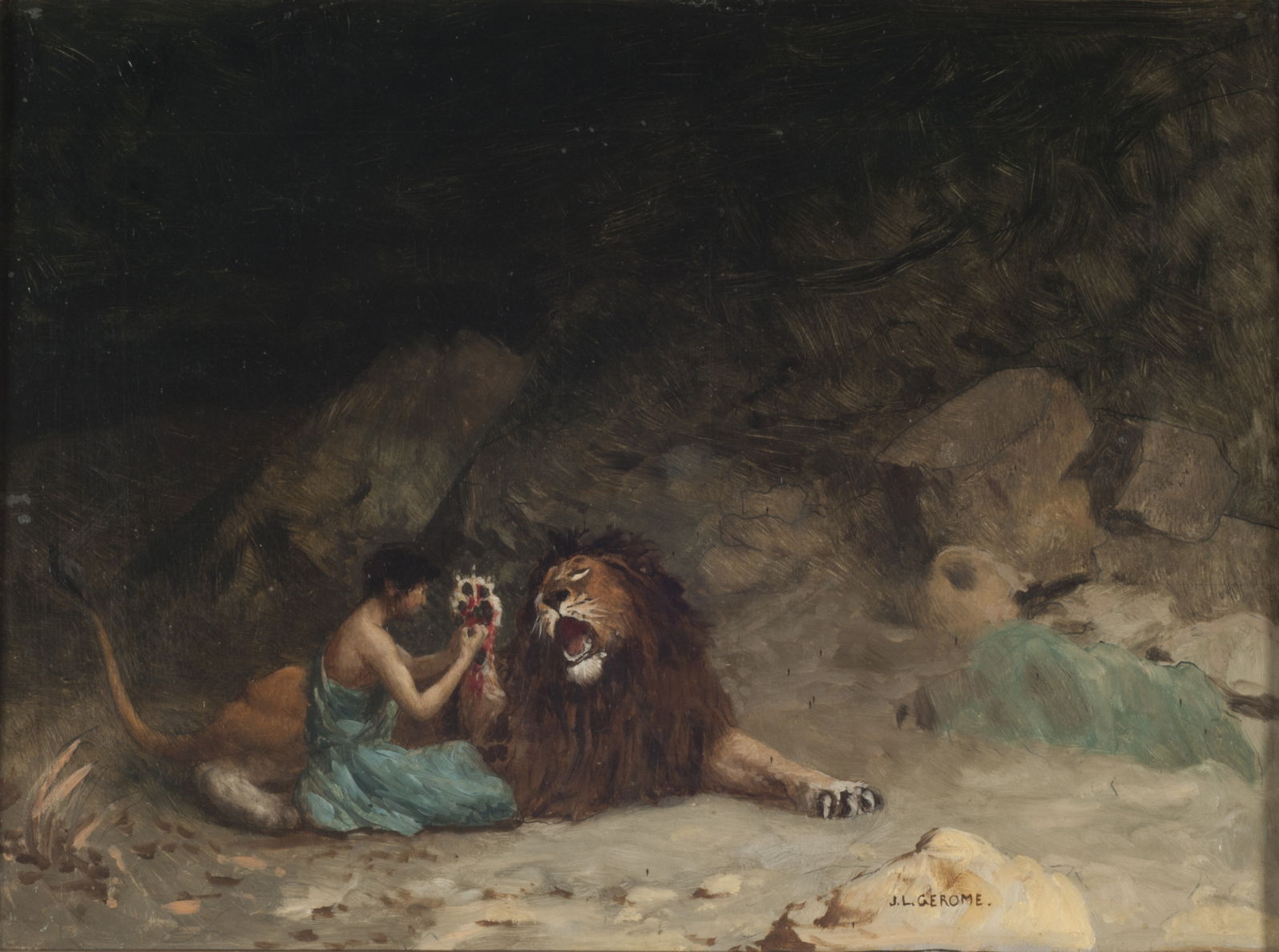
Gérôme shows the salient event in the first part of the story, with Androcles extracting the thorn or splinter from the lion’s paw.

Edward Poynter’s Cave of the Storm Nymphs from 1903 has its literary reference most probably to the Naiads of Homer’s Odyssey, book 13, who live in a sea cave. This is updated to encompass more contemporary references to Wreckers, who lured ships onto the rocks in order to steal their precious cargos, sirens without the socially unacceptable habit of cannibalism.
As with so much, the First World War brought new and even more chilling associations.
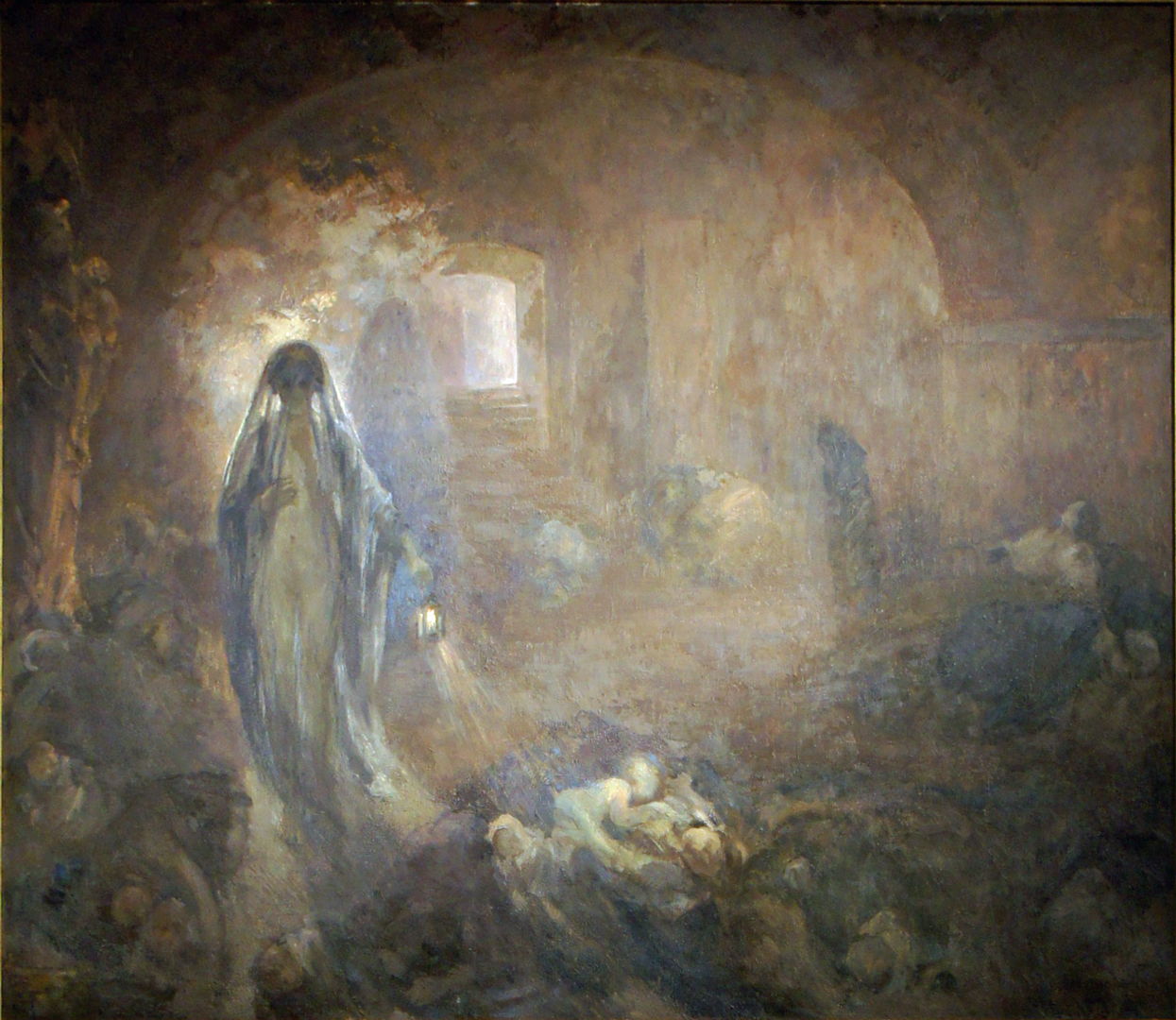
Alfred Roll, then in his late sixties, seems to have spent some of the war in the city of Reims, where in 1915 he painted Reims Under Bombardment, 1915, Vision of a Cavern. The city had first come under shelling on 4 September 1914, and the German army continued to bombard it at irregular intervals through the remainder of 1914, 1915, and into 1916, reducing its ancient cathedral to ruins. Roll shows locals taking shelter in a capacious cave or cellar under the city, as a veiled and ethereal woman bearing a lantern walks through.
Roll refers back to the earlier tradition of the cave being sacred: at the left is a statue of the Virgin and Child, and lit by the lantern is a mother and baby. Oddly, though, the lantern bearer appears naked under her diaphanous robes.
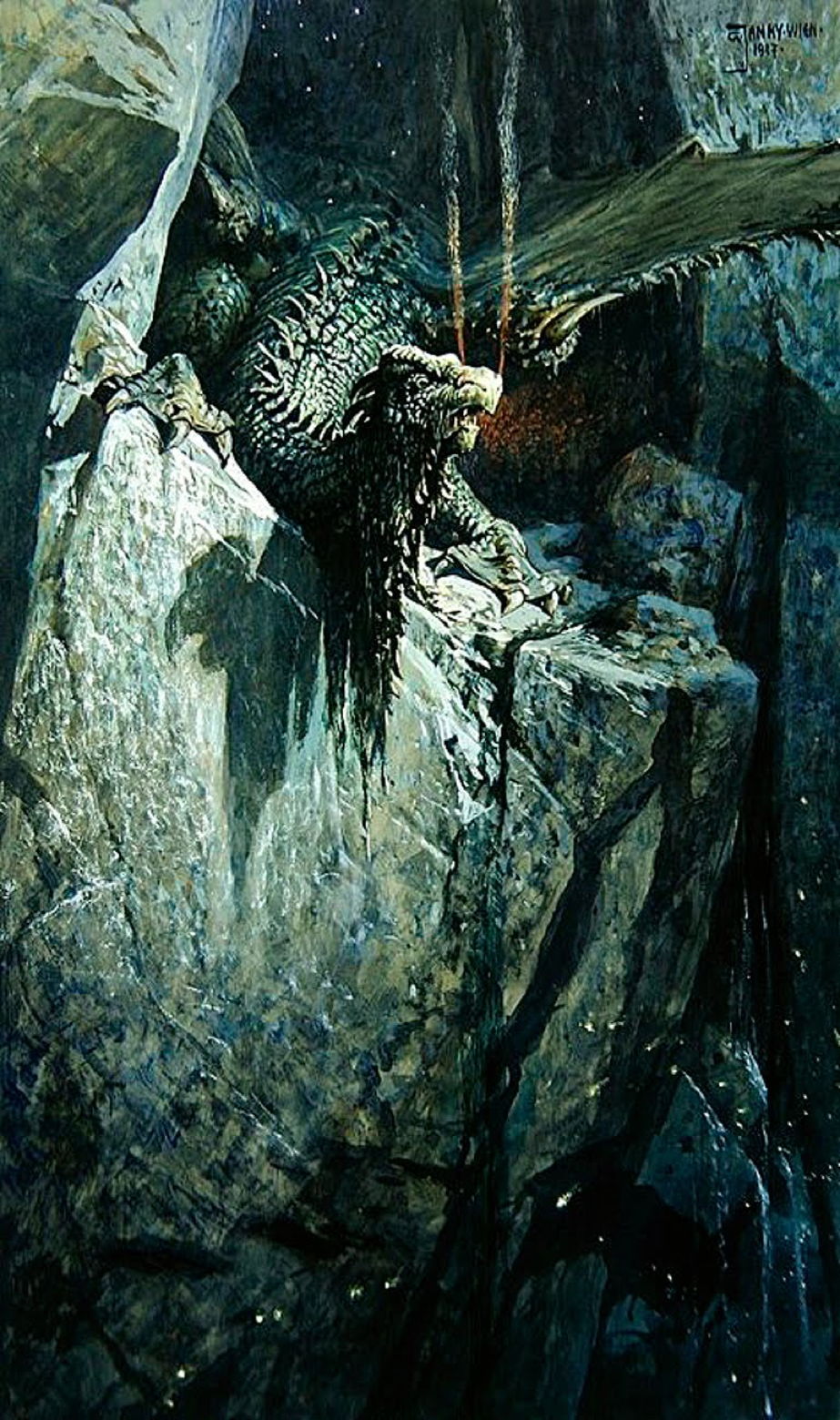
My final painting of a cave is one of Georg Janny’s wonderful flights of the imagination, taking him to The Dragon’s Cave in 1917. Although this doesn’t have any direct references to a classical story, we’re back in the realms of myth and legend.

