
Given that our earliest recorded paintings were made in caves, it’s only appropriate this weekend to look at more modern paintings of the caves that our art, and our ancestors themselves, started in. Today I show a selection of examples from 1500 to 1830, by which time they were in transition from religion, myth and superstition to reality.
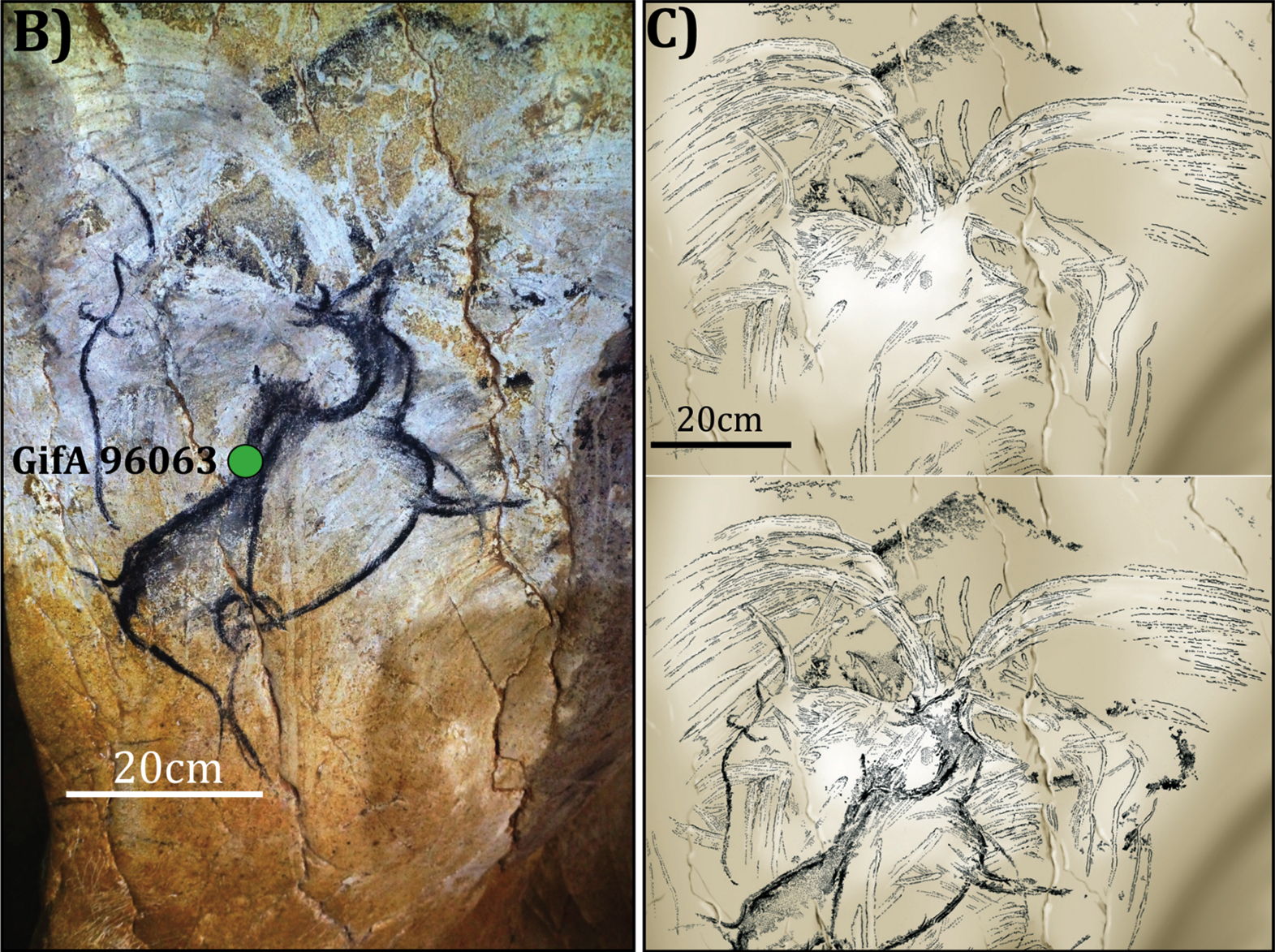
Although these are now by no means the oldest examples of human art, these sophisticated images of animals and a volcano erupting in the Ardèche, France, are thought to date back about thirty-six thousand years. Simpler paintings date back even further, to more than 67,800 years in the past.

The right panel of Hieronymus Bosch’s triptych showing The Hermit Saints Anthony, Jerome and Giles from around 1500 places Saint Giles standing to pray inside a small cave. He’s surrounded by a collection of strange objects, such as the bleached skull of a bird, and a tiny wizened tree.

For Giorgione, in his The Adoration of the Shepherds or the Allendale Nativity from 1505-10, a cave was sacred enough to house the Holy Family itself for the birth of Christ, rather than the more literal and conventional stable.

Caves were most strongly associated with hermits, who were so devout as to give up all worldly possessions, including the shelter of buildings, and live in what nature provided. In about 1635-38, Diego Velázquez painted Saint Anthony Abbot and Saint Paul the Hermit as the altarpiece for one of the small chapels in the grounds of the Buen Retiro in Madrid. Saint Paul’s hermit life has him dwelling in the cave shown just to the right of his head.
Caves also feature in several classical myths, where they’re associated with some of the most ‘sacred’ figures.

When the hero Aeneas consults the Cumaean Sibyl, François Perrier shows her emerging from her cave at the right, in his painting Aeneas and the Cumaean Sibyl from about 1646.

The one-eyed Cyclops Polyphemus was another mythical cave-dweller, this time in Homer’s epic Odyssey. Jacob Jordaens pictures Odysseus’ crew fastening themselves to the underside of sheep as they prepare to escape from the blinded giant, in his Odysseus in the Cave of Polyphemus, probably painted in about 1650.
In more modern literature, caves started to take on other associations, possibly derived from the habit of some mythical monsters such as dragons living in caves.
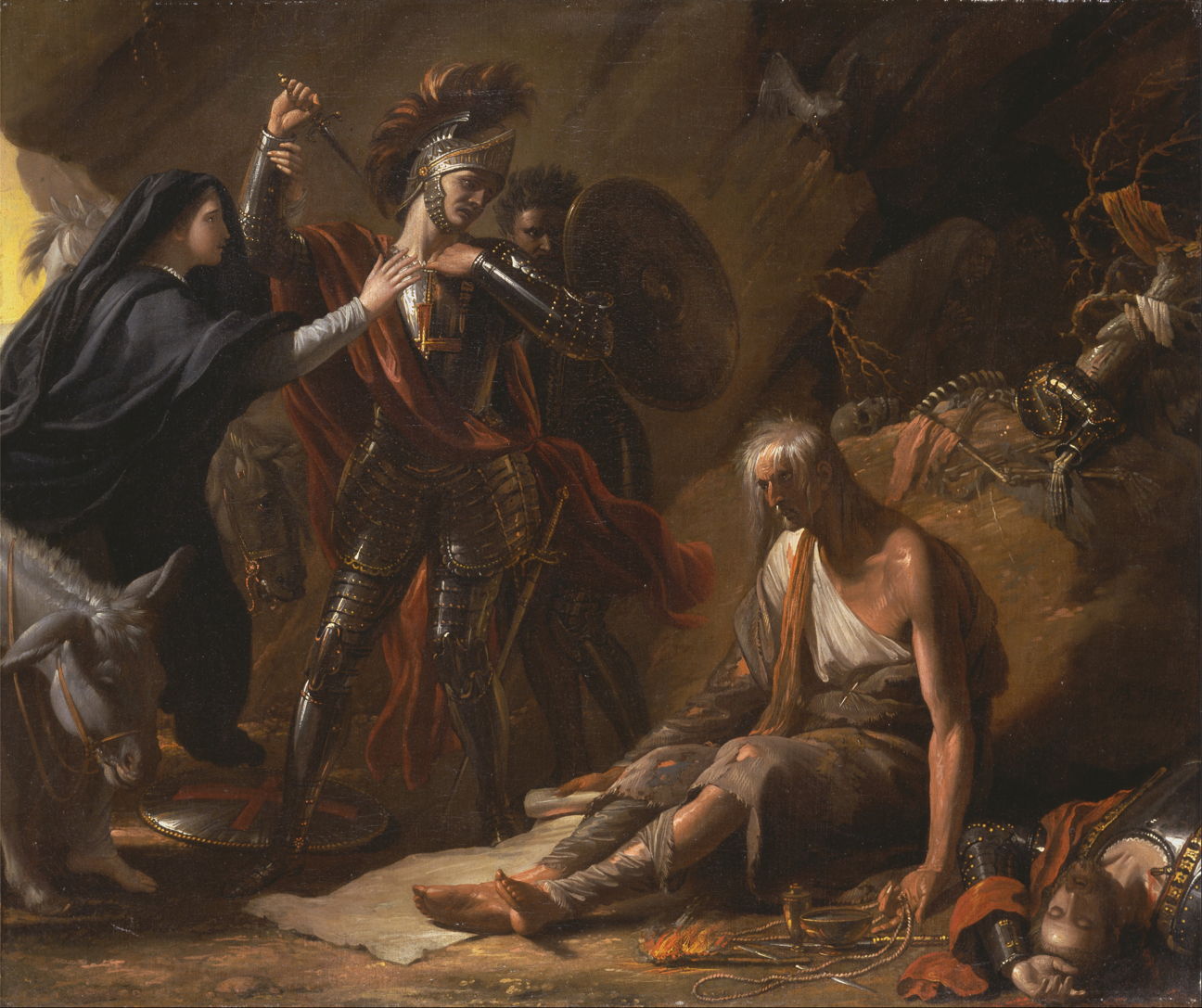
In Edmund Spenser’s epic poem The Faerie Queene, far from being a sacred place, it has become The Cave of Despair, as shown by Benjamin West in his painting of 1772, referring to Book 1, Canto 9. The Knight of Holiness, bearing a red cross, vows to battle the creature Despair. When he finds the creature’s cave, it is littered with corpses, and Despair has only just finished killing the latest. Despair then tries to convince the knight that he should kill himself, an action Una prevents him from doing.

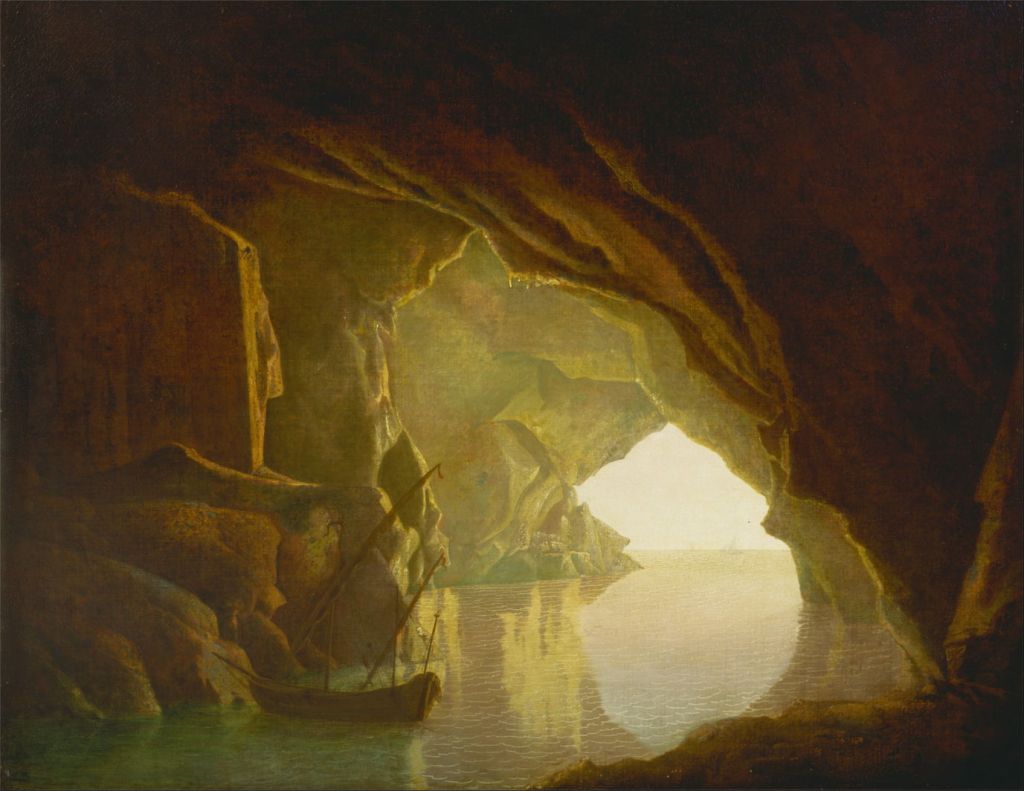
With the Age of Enlightenment came more adventurous travel, and the tendency for artists to depict unusual locations they visit. In 1774, Joseph Wright of Derby visited Italy, where he entered a sea cave at the northern end of the Bay of Naples, and made a series of paintings of the view from inside the cave. This version of A Grotto in the Gulf of Salerno, Sunset was painted in 1780-81, long after his return to Britain.
One less than sacred location traditionally placed underground is the Underworld.

Martin Johann Schmidt’s Labour of the Danaides from 1785 shows the Danaïds paying their penance in the Underworld by trying to fill this leaky barrel with water. This is known as a Sisyphean task after Sisyphus who was similarly condemned to roll a huge boulder uphill only for it to keep rolling back down.

Living in caves was also becoming associated with poverty and destitution for reasons other than being a hermit. When the great Greek statesman Aristides was banished, he sheltered in a cave with his two daughters, as shown here by Charles Brocas in this painting exhibited at the Salon in Paris in 1806. His left arm clutches their few possessions: a thin cloak, and small statues of the goddess Athena, and of Zeus himself. Thankfully, this banishment was rescinded after only three years, and Aristides returned to prove a successful general.

It wasn’t only dragons that lived in caves. According to JAD Ingres’ brilliant painting of Oedipus and the Sphinx, shown in its original form in 1808 but extensively reworked in 1825-27, it was at the entrance to the sphinx’s cave that the famous encounter with Oedipus took place. He used the deep shadow of the cave interior to great effect too.

Christoffer Wilhelm Eckersberg revisited the story of Ulysses Fleeing the Cave of Polyphemus in 1812, showing Ulysses about to make his way out of the Cyclops’ cave, as his captor strokes one of his sheep. In contrast to Ingres, he lights the interior of the cave well enough to make his narrative clear.

During the Greek War of Independence, Ary Scheffer called on multiple associations of caves in his moving painting of Greek Women Plead for the Virgin’s Help (1826). This cave is both a sacred place with its icon of the Virgin Mary, and sanctuary for these women in their distress. Outside the mouth of the cave are Ottoman troops, ready to rape and murder the young Greek women kneeling in front of the icon.

