
Two centuries ago Europeans saw Turkey and the countries of the east Mediterranean seaboard as the Orient, about as far east as even the most adventurous should go, and much of Asia and the Indian subcontinent may as well have been another planet. Among those who brought the Orient to life in Europe was an Italian painter who was born almost two hundred years ago, on 3 September 1826, Alberto Pasini. This is the first of two articles to celebrate his bicentenary.
Pasini’s father died when he was an infant, and he moved with his mother to the city of Parma, in central north Italy, famous now for its prosciutto or Parma ham. He trained at the Academy of Fine Art in the city, where he specialised in landscapes. He was also taught by an uncle, who was a painter and illuminator of manuscripts. His potential was recognised, and he travelled to Paris, where he started working as a studio assistant.
In 1853, one of his lithographs was exhibited at the Salon, and he moved to work in the workshop of the brilliant but short-lived Théodore Chassériau, who had been a pupil of JAD Ingres, had visited Algeria, and was a recognised Orientalist. Pasini was producing impressive work, and as Chassériau’s health failed, the teacher nominated his pupil as the official painter to support a French ministerial tour to Persia.
During the late 1850s into the 1860s, Pasini travelled extensively in Persia, Armenia, Turkey, Egypt, and the Arabian Peninsula, usually as part of that official diplomatic mission.
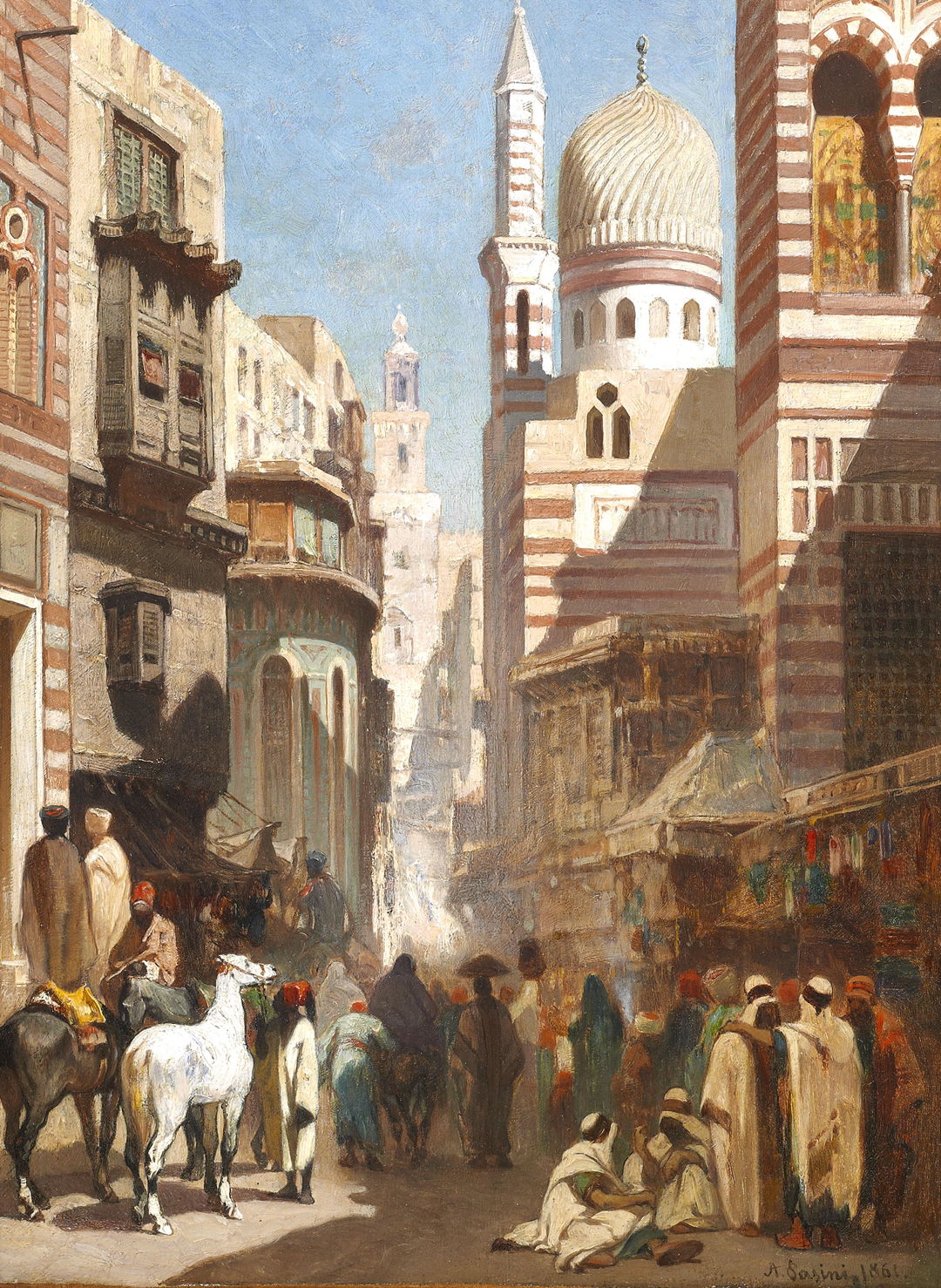
The earliest of Pasini’s paintings I have found is this marvellous depiction of Al-Khudayri Street, Cairo from 1861, eight years after he had first exhibited at the Salon. It’s typical for those of his works now accessible, in being thoroughly realist and highly detailed. Although it has been claimed to show the ancient Ibn Tulun mosque, its famous spiral minaret, and the Saladin fortress in the city, it looks more of a composite inspired by those buildings, rather than a faithful depiction. The street below is bustling with those passing through, and the market stalls to the right, although he has been careful not to show the face of any of the figures.

During his travels in the Middle East, Pasini must have become familiar with the sight of An Arab Camp (1866), shown here at a small watering place. From the dress and preponderance of horses, this was probably further north into Syria or even Turkey.
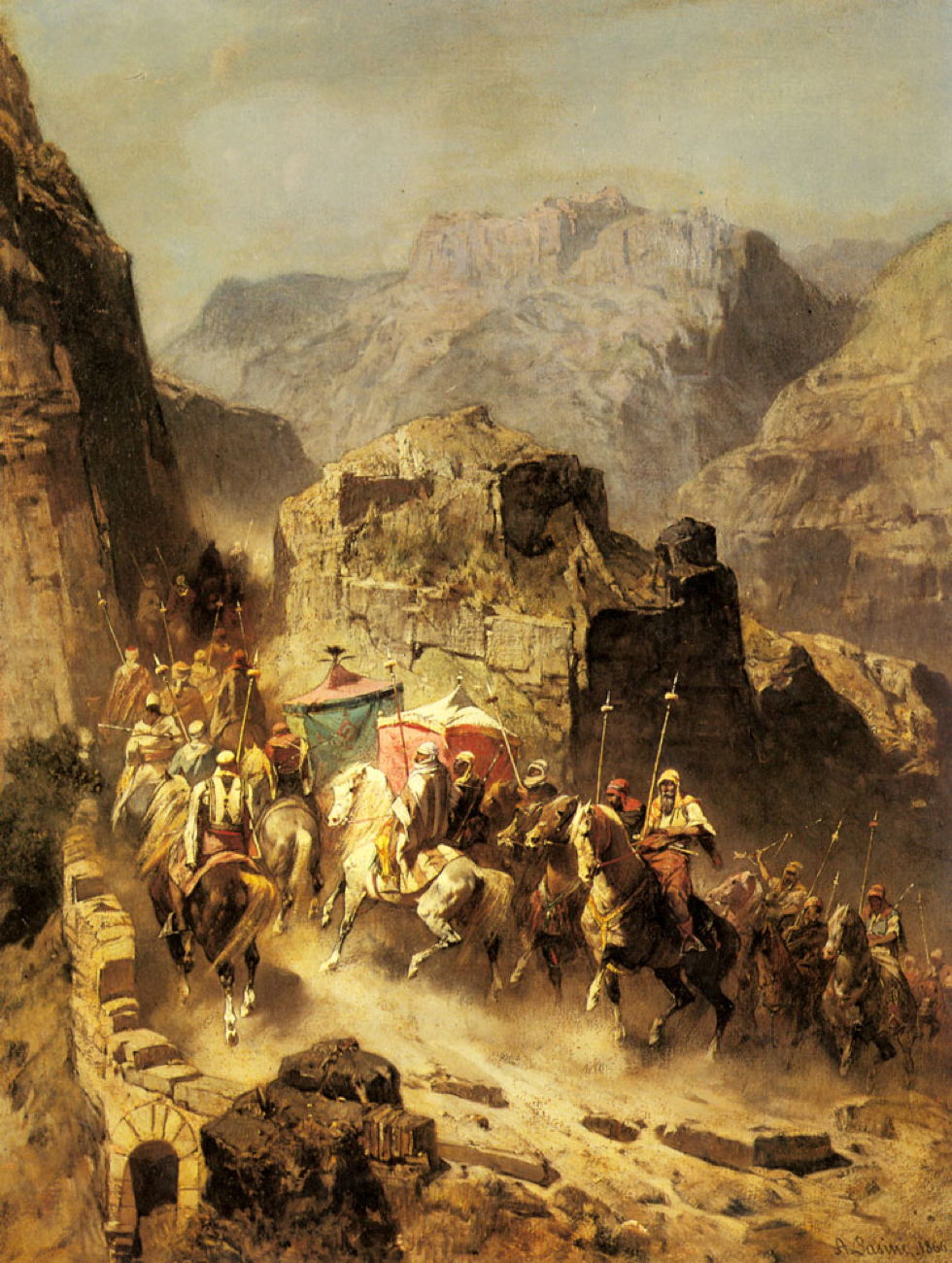
Pasini’s work includes many ‘action’ scenes, including battles, although few are now accessible. His painting of an Arab Caravan from 1866 shows a large caravan negotiating difficult terrain, including ancient ruins.
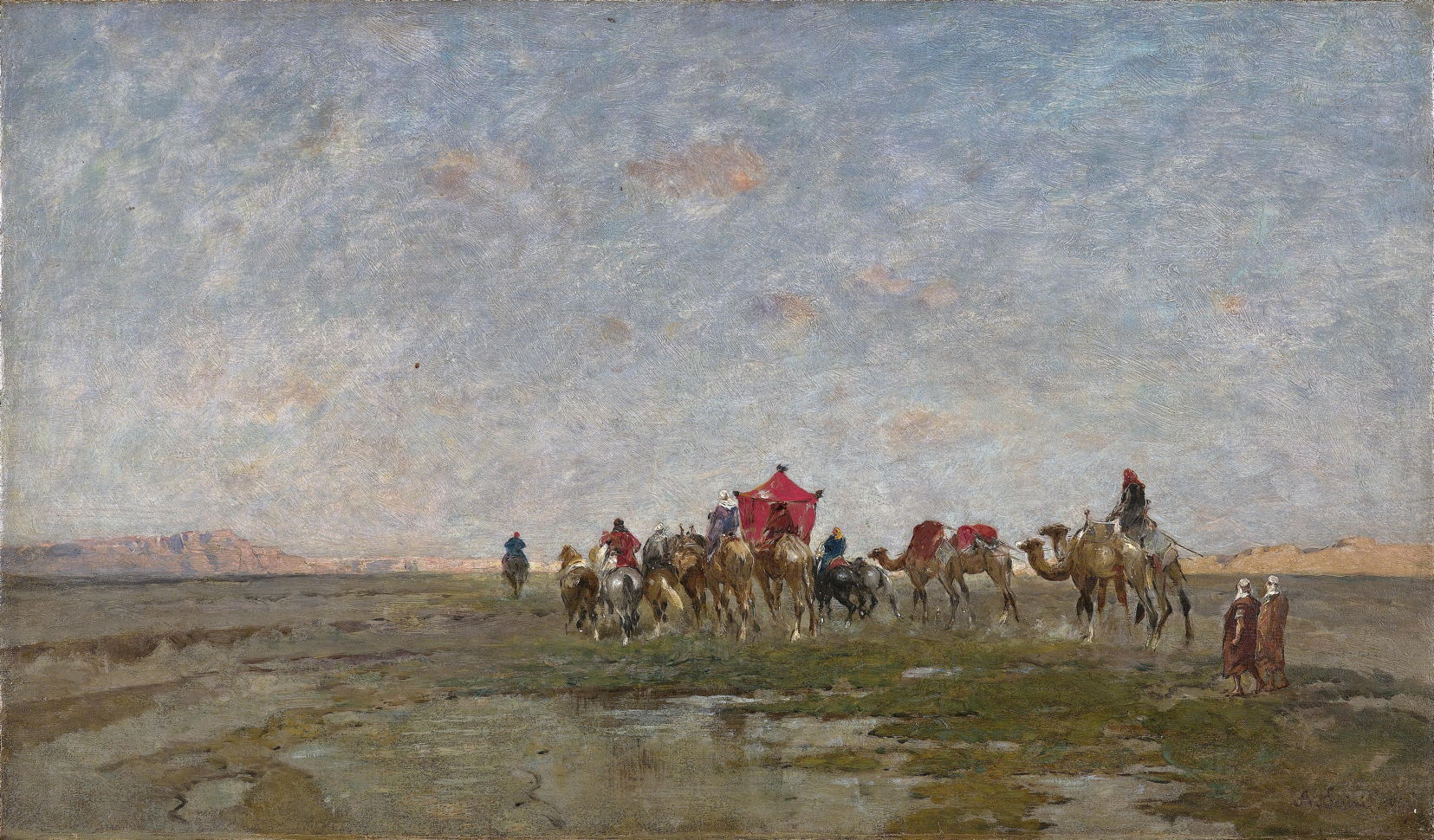
Camels feature in this more sketchy painting of Caravan in the Desert from 1867. His sky is remarkably painterly, and I feel sure Eugène Boudin would have been proud of it at that time.

The Caravan of the Shah of Persia from 1867 is more finished, with its very wide view of an extensive royal caravan crossing a desert plain, with rugged mountains in the distance. There are even a couple of elephants at the right.

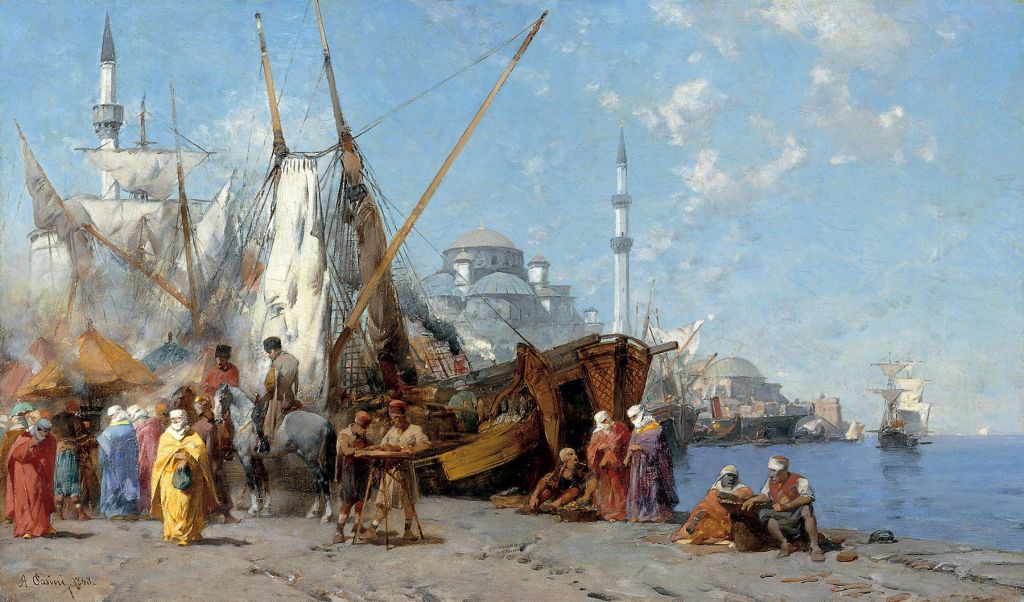
Pasini’s great forte, if these surviving paintings are anything to go by, was the marketplace. He lived in Constantinople (Istanbul, its only name since 1928) for periods of up to nine months, and became very familiar with the often ad hoc markets set up wherever trading vessels came alongside. Market in Istanbul (Constantinople) from 1868 captures their cosmopolitan nature, and that of the whole city, mixing cultures, beliefs, eras, and technologies so gloriously.

Despite their apparent detail, Pasini’s paintings are relatively small, none here exceeding 90 cm (36 inches) in either dimension. The Met’s painting of A Mosque from 1872 is one of his larger works, and appears a more formal composition. A high-ranking figure has just arrived in their decorated carriage to attend this mosque (detail below), where they’re greeted by a casually turned-out guard, at the left. In the right foreground is one of Pasini’s trademark melon sellers, who appear in so many of his paintings.

Reference
In the summer of 2018 there was an exhibition of his paintings at Fondazione Magnani Rocca in Parma, Italy, the artist’s home town. The illustrated account of that remains accessible here.

