
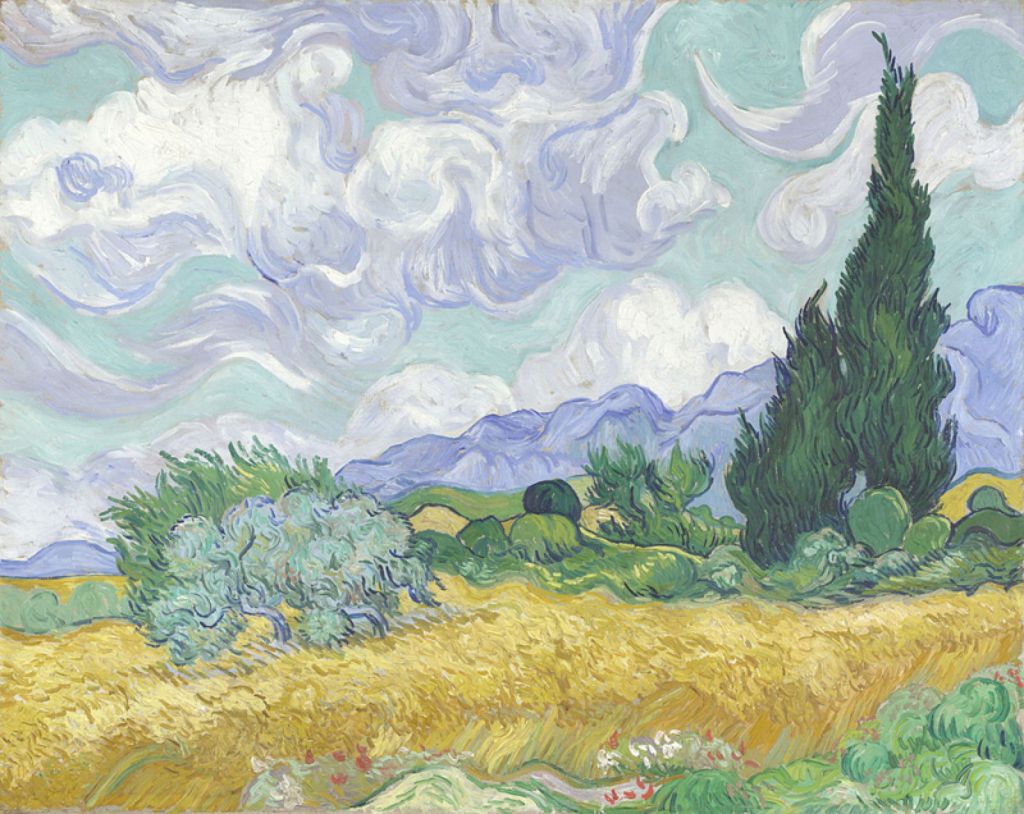
In the last three years of his life, Vincent van Gogh created some of the most distinctive paintings in the European canon, dominated by swirling strokes of vivid colour. This article looks at how they evolved, and how their paint layers are formed.

Prior to 1887, van Gogh had shown few signs of this marked change in style. The first appear to have come in two paintings in 1887, Blossoming Chestnut Tree above, and his unusual still life of Grapes, Lemons, Pears, and Apples, below.
Van Gogh’s chestnut tree, in full leaf and flower, has a solid canopy built from visible and organised brushstrokes. These marks are starting to forms whorls and swirls in places, including the background vegetation. The tree is only demarcated from that background by discontinuity in the structure and orientation of the marks. The still life is also composed entirely of brushstrokes arranged systematically.

Two years later, in the summer of 1889, when he was in the Saint-Paul-de-Mausole mental asylum at Saint-Rémy near Arles, he returned to develop those swirls further. He could see through a window a view of wheatfields and dark Provençal cypress trees, with the Alpilles Mountains in the distance. During a period of intense creativity in June and July of 1889, he first drew parts of this view, then turned those drawings into paintings.

This pen-and-ink drawing gives good insight into how his brushstrokes became organised into swirls and whorls throughout, not only in the foliage of the trees, but in the ground around them, and the sky above.

Cypresses (1889) shows that drawing realised in paint, using an impasto of rich yellows and greens.
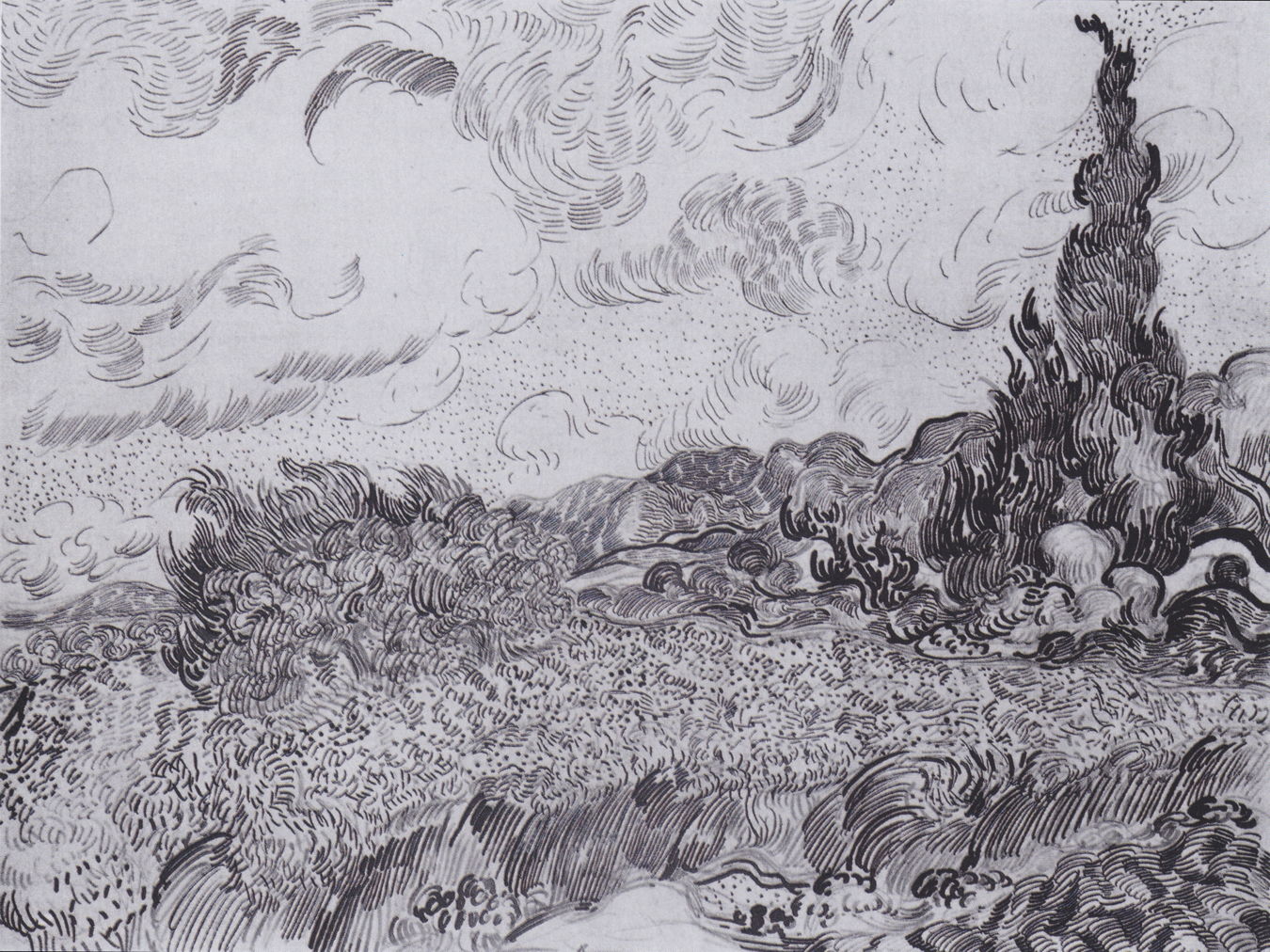
He then broadened the view to extend to a Wheatfield with Cypresses (1889), which he drew using black chalk and his reed pen (above), probably in late June. To achieve this view, he may well have left the immediate surrounds of the asylum and worked en plein air, out in the heat.
Satisfied this would make a good painting, he took a prepared canvas of about 73 by 93 cm (29 x 37 inches) and started to paint, again in front of the motif. He may have made a preparatory drawing in charcoal on the canvas, then laid down thin layers of paint, probably including lead white.

It’s possible he completed the painting in a single sitting, as this initial version seems to have been intended as an oil sketch for a more finished version to be painted later that summer.

The detail above shows the tops of the wheat towards the lower left of the field, in the foreground. Over his initial thin layers of paint, van Gogh laid thick gestural strokes of highly chromatic paint, orientating those strokes according to the object they show. In the golden yellow of the wheat there are blues and greens, mostly showing through from his underpainting, with superimposed impasto of pale straw, ochre, and pale greens.

This detail, taken from the edge of the wheatfield at the lower right corner of the painting, shows three distinct areas of brushwork: the diagonal strokes forming the standing wheat, swirling loops to form the grasses and weeds below, and shorter marks forming a more random pattern for the heads of the wheat in the upper section.

At the centre of the canvas, from where this detail is taken, impasto blue and white have mixed with the green and yellow of the fields below. This shows that much of the painting, at least, was painted wet on wet, either in the same session or on consecutive days. Some of the darker green at the right may have been painted later, onto paint which had by then become touch dry.

An X-ray image of the whole painting shows in white those passages likely to contain the most lead white, and some other pigments that are most radio-opaque. This also reveals the pattern of his brushstrokes well.
Van Gogh’s choice of pigments is also unusual. At this time, he was using both lead white, which he tended to apply in underpainting, and Chinese white (zinc oxide), which was more likely applied in upper layers. Some of the greens are here made by mixing synthetic ultramarine blue with yellow, as well as with viridian and other pigments. In addition to ultramarine, van Gogh used cobalt blue, most commonly in the sky.
This first oil sketch was finished by early July, when van Gogh wrote to his brother Theo, his art dealer, “I have a canvas of cypresses with some ears of wheat, some poppies, a blue sky like a piece of Scotch plaid; the former painted with a thick impasto like the Monticelli’s, and the wheat field in the sun, which represents the extreme heat, very thick too.” This masterpiece is now in the Metropolitan Museum of Art in New York, purchased in 1993 for $57 million thanks to donations.
In late July and early August, van Gogh had something of a psychiatric crisis, and apparently didn’t return to paint his more finished version until late August.

He then made this second version in the studio, and now in London’s National Gallery. He finally painted a third and smaller version in the studio, that he sent to his mother and sister as a gift, now in a private collection.

In July of that year van Gogh also painted Olive Grove, with its similar use of swirling brushstrokes.
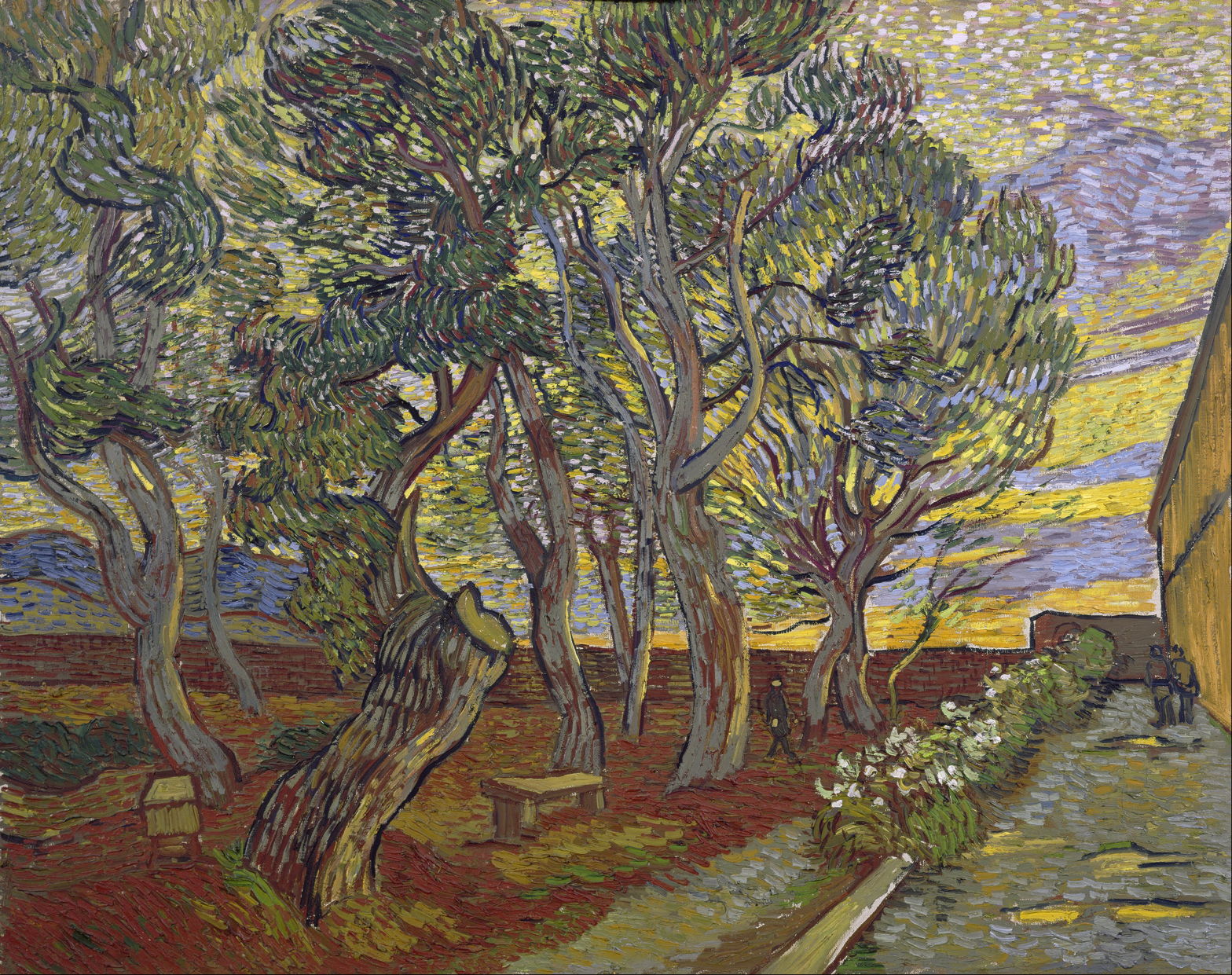
In The Garden of Saint Paul’s Hospital from the same summer his ordered assembly of brushstrokes extends to other species of tree, to branches, trunks, flowerbeds, ground, and sky. Although often claimed to be abstraction, the arrangement of the strokes, and van Gogh’s use of colour, is driven by form.
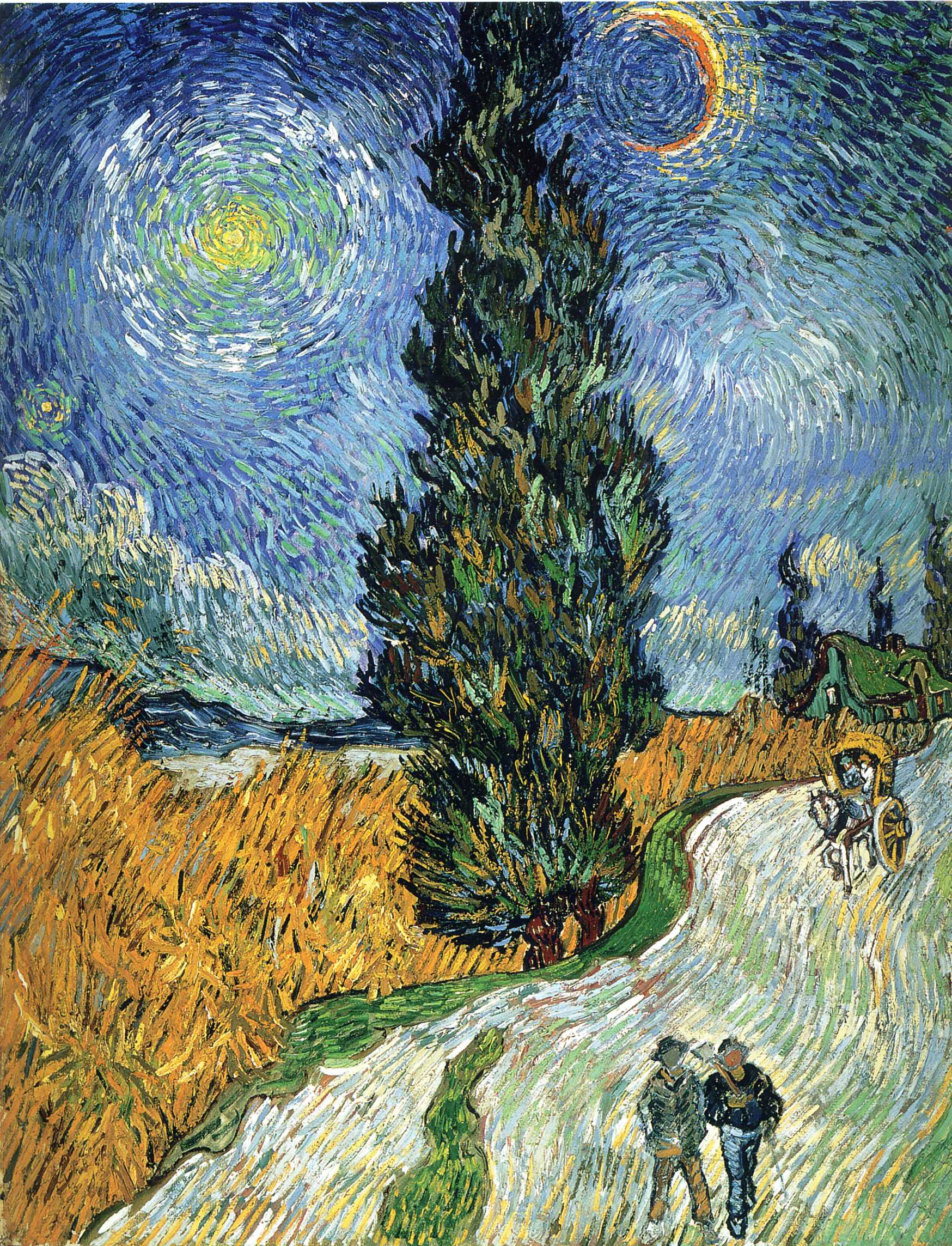
Road with Cypress and Star (1890), painted just two months before his death, is perhaps van Gogh’s ultimate expression of the form, texture, and colours of cypress trees in Provence, its swirling brushstrokes rising to form halos around the crescent moon and solitary star.

