

Georges Seurat’s Divisionism was founded on the concept of optical mixing of colours, and his exemplary masterpiece La Grande Jatte (1884-86) was painted with a second phase applying tiny dots of contrasting high colour pigments. Although others adopted similar techniques, each was slightly different from Seurat’s. Here I show examples of the Pointillist paintings of Paul Signac, and how they diverge after Seurat’s untimely death in 1891.

In his earliest pointillist paintings, here Les Andelys. Côte d’aval from 1886, Signac appears to have applied larger areas of even colour, allowed them to dry, then applied small patches of what are usually contrasting colours, an approach not dissimilar to Seurat’s, but with coarser dots. These are most clearly visible in the foreground, on the tiller and the decking of the barge. These small patches aren’t generally organised, but are applied fairly evenly over much of the painting. Neither do they change size according to how deep they are into the view.
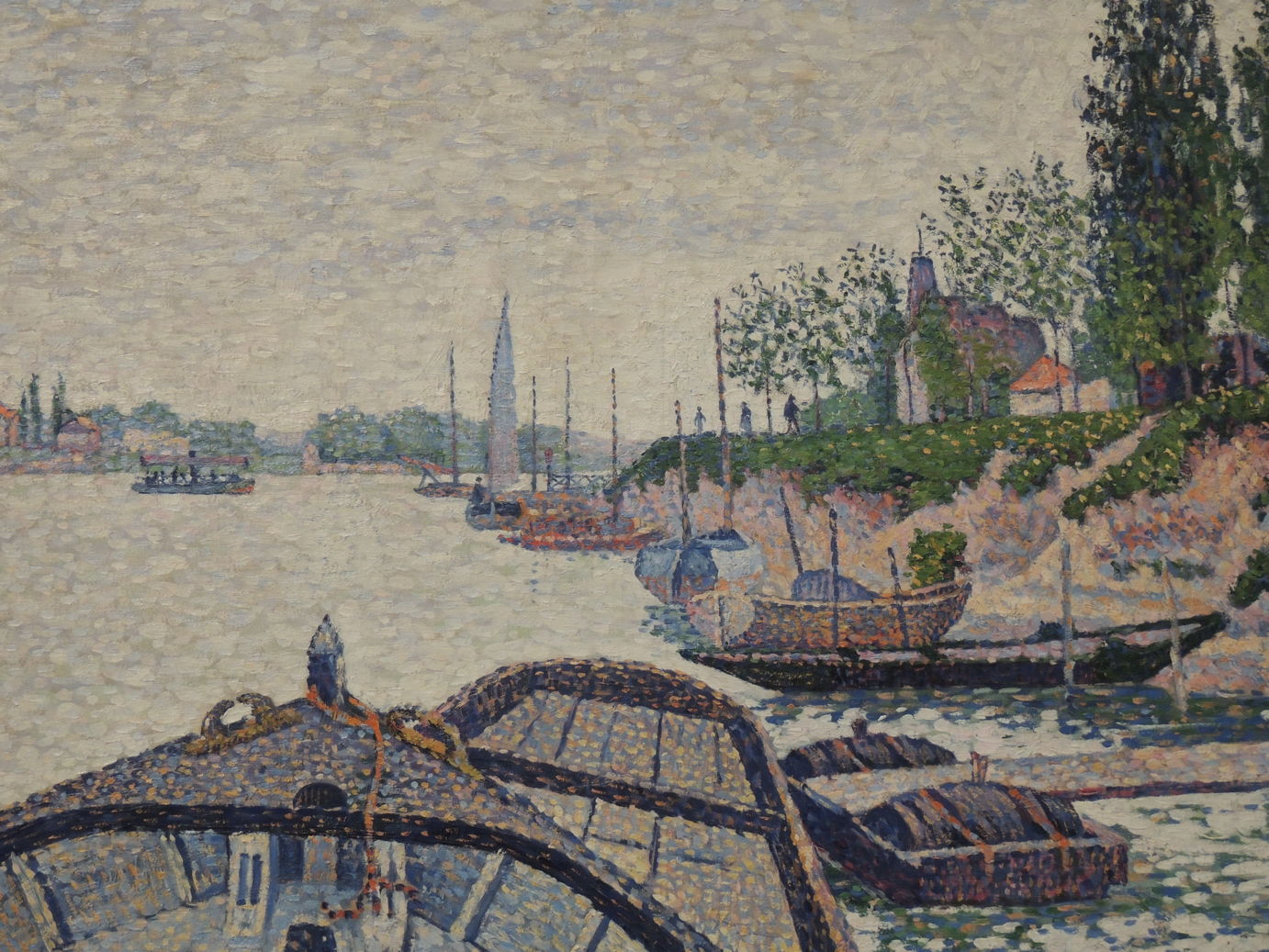
A couple of years later, in Avant du Tub from 1888, his technique has changed little, although the patches applied on more even surfaces, such as the water, are noticeably larger than those on the boats in the foreground.
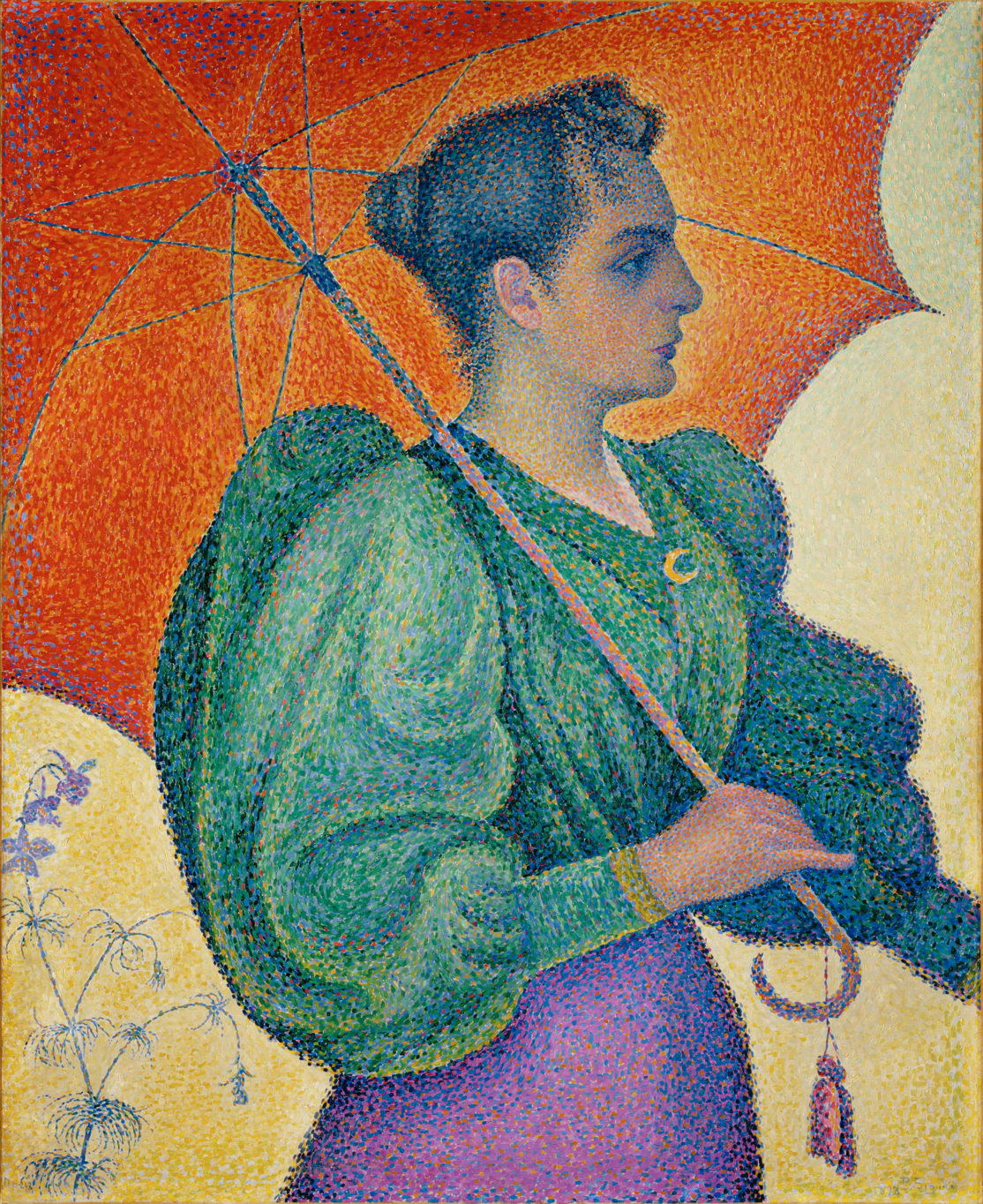
Woman with a Parasol is a portrait of the artist’s wife from 1893, and a Neo-Impressionist reworking of a popular Impressionist theme. It’s an exemplary demonstration of the principles of simultaneous contrast in action. For example, the dominant colours used in the handle of the parasol change from orange to green and back again according to the surrounding colour. The detail below shows the colour transition in the parasol handle, and his technique at this time, resulting in swirls of coloured patches of paint, rather than Seurat’s dots.


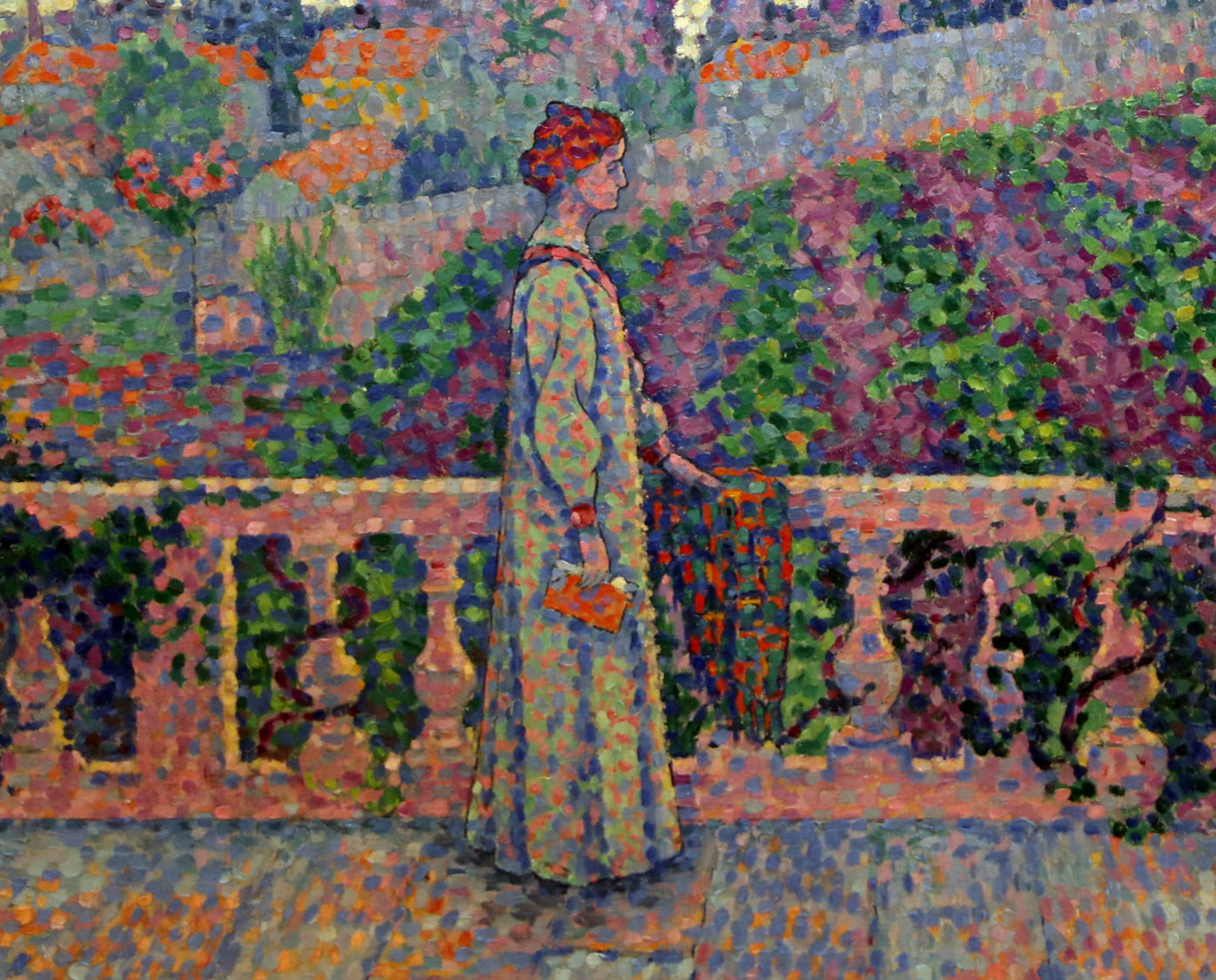
Signac started painting Saint-Tropez. The Terrace on 16 August 1898, aiming to complete it about ten days later. Although slightly larger than Woman with a Parasol above, its patches of paint have grown noticeably larger. As the detail below confirms, he has retained some areas with contrasting coloured patches, while others contain different shades of the same colour. He has also added a fine black outline to distinguish the figure from the ground.
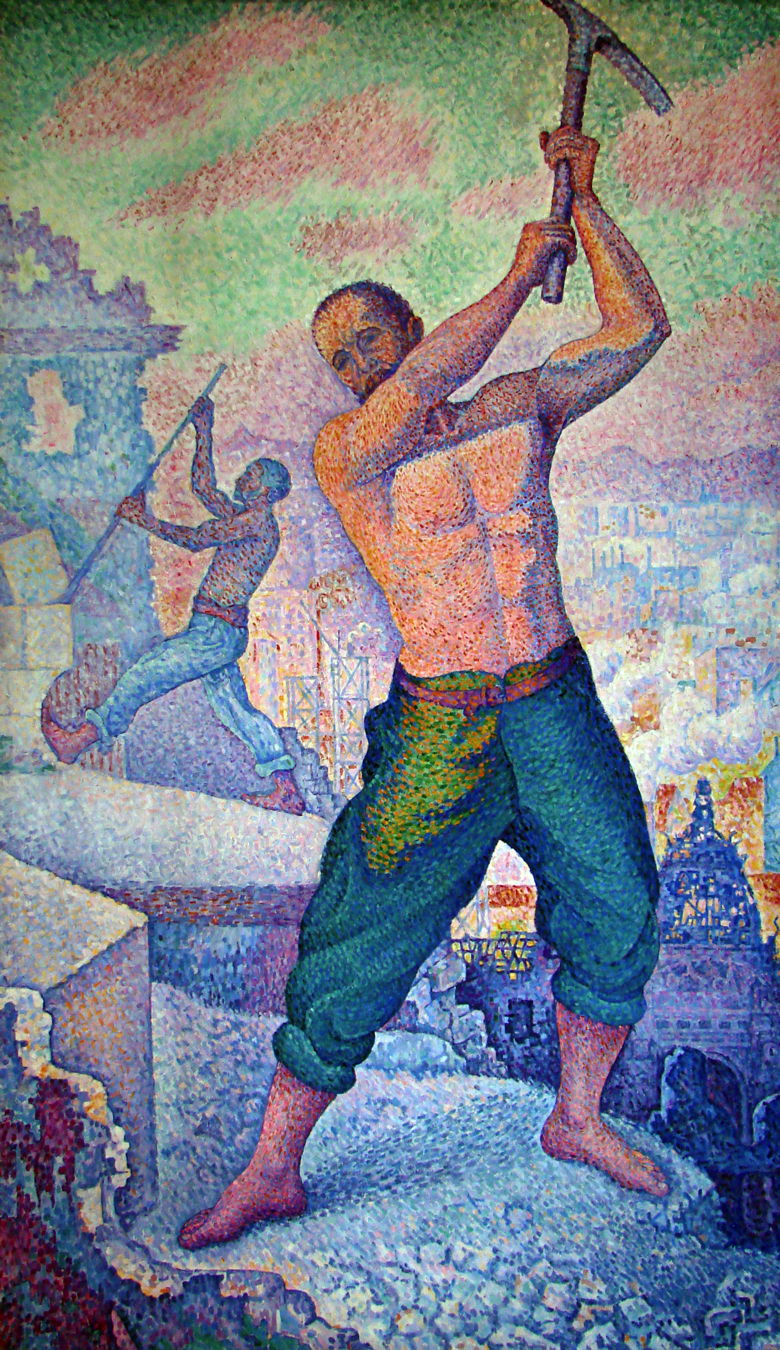
Signac’s major work over the period immediately before the new century was The Demolisher or The Wrecker, first conceived in 1896, when he made a lithograph of his initial composition. He began work on this painting by the start of 1897, with the intention of making a series with the overall theme of labour. By the time he had completed it two years later, his enthusiasm had waned, and he never started work on any of its projected companions. This painting wasn’t exhibited until 1901, and it remained in his studio until after Signac’s death more than thirty years later.

This detail of The Demolisher has greater contrast in the colour of its patches, and more obvious organisation of their placement according to the topography of each surface.
In the early twentieth century, Signac’s patches changed form and size.
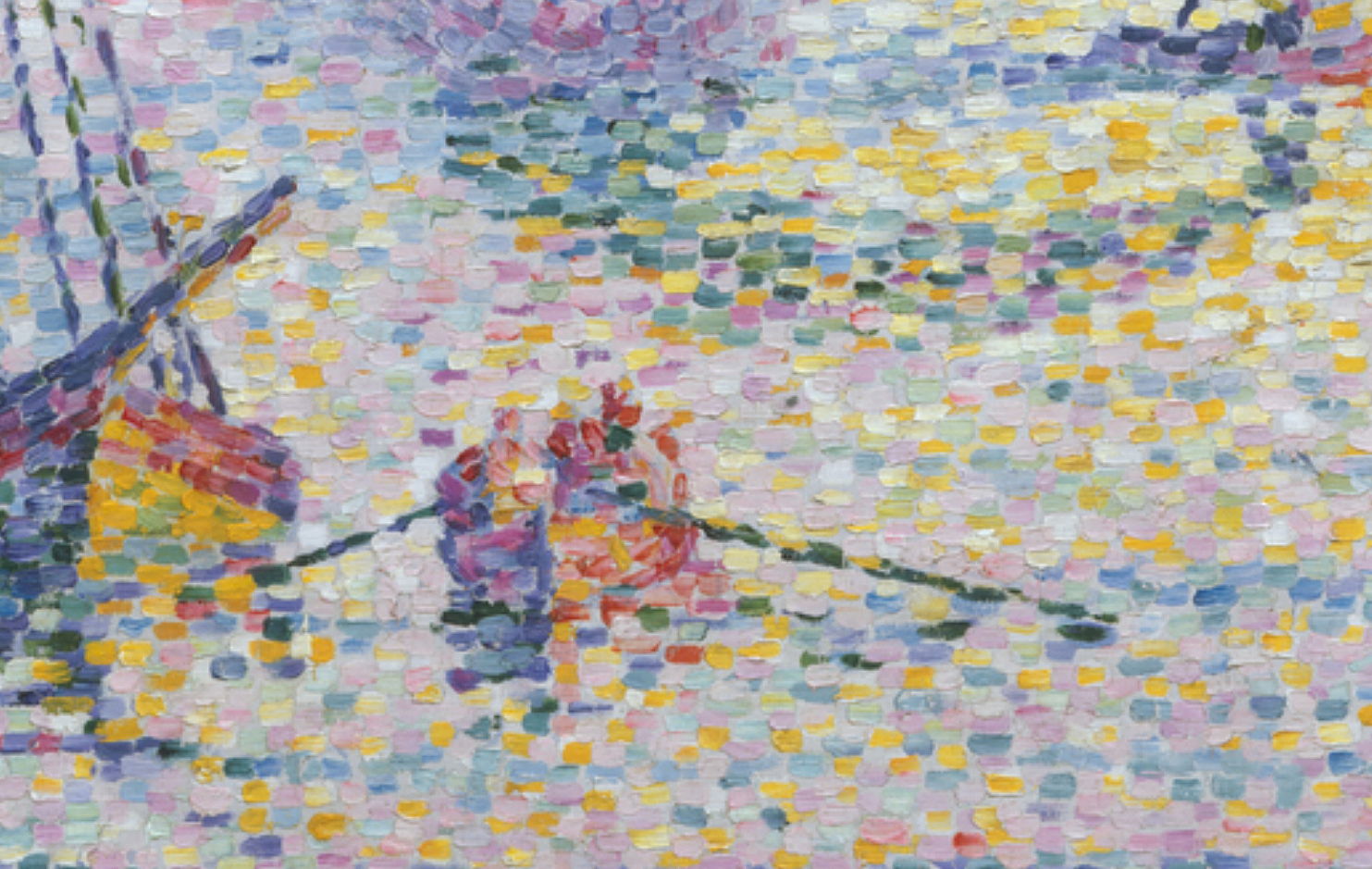
Shown in this detail of Notre-Dame-de-la-Garde, Marseilles from 1905-06 is the elongation of his patches into rectangular tiles or tesserae of paint. These are visibly coarser-grained in the foreground, finer and almost merging in the distance and sky.

By 1907, these tesserae were an established feature, replacing his more variable blobs. Each is arranged according to the form of the object, and some are relatively thick if not impasto.

Carefully oriented tesserae continued for the rest of his career, here in The Port of La Rochelle, from 1915.

A decade later there is little change in his construction or technique in his Lighthouse at Groix, shown in detail above, where many of the tesserae are formed using impasto. This is a far cry from his early paintings of the late 1880s, and from Seurat’s original concept of optical mixing of colours.
 The Eclectic Light Company